
A Certificate of Analysis is not a guarantee of purity. It is merely a claim until verified by independent, third-party instrumentation. You recognize that inconsistent batch quality and opaque manufacturing origins are more than logistical hurdles. They represent direct threats to the integrity of your research data and the viability of your findings. Gaining confidence in your peptide supplier requires moving beyond marketing promises and into a disciplined framework of empirical validation.
You will master the specific analytical benchmarks and logistical standards necessary to verify supplier integrity. This ensures every experiment remains reproducible and scientifically sound. This guide provides a repeatable protocol for vetting US-based supply chains, managing the impact of 2026 FDA reclassifications, and accessing verifiable, transparent documentation. We outline the technical requirements for a laboratory-grade supply chain that prioritizes objective data over marketing hype.
Key Takeaways
- Understand why raw purity percentages require specific context regarding residual impurities to maintain experimental reproducibility.
- Establish a rigorous 5-point framework for gaining confidence in your peptide supplier by prioritizing independent third-party validation over internal claims.
- Implement a standardized procurement workflow that utilizes a COA verification portal to cross-reference batch numbers and ensure documentation authenticity.
- Secure your laboratory’s operational continuity by transitioning to a US-based supply chain that mitigates global regulatory volatility and logistical delays.
The Criticality of Analytical Verification in Peptide Procurement
Experimental reproducibility depends entirely on chemical consistency. In a laboratory setting, minor deviations in molecular structure can skew data. Gaining confidence in your peptide supplier starts with scrutinizing standard “99% Purity” claims. This figure is scientifically incomplete without an analysis of the remaining 1%. These residual impurities, often byproducts of specific peptide synthesis methods, can interact unpredictably with research models. Precise identification of these contaminants is mandatory for rigorous data collection.
US-based manufacturing and finishing act as a critical stabilizer for domestic research facilities. Domestic facilities operate under stringent quality control protocols that overseas wholesalers often bypass. This geographical accountability ensures that reagents match their analytical data. When a supplier like Biomod Peptides maintains a US-based supply chain, they provide a transparent chain of custody essential for long-term project stability. This level of oversight prevents common pitfalls associated with opaque international logistics and unverified third-party handlers.
Identifying Red Flags in Unverified Peptide Supply Chains
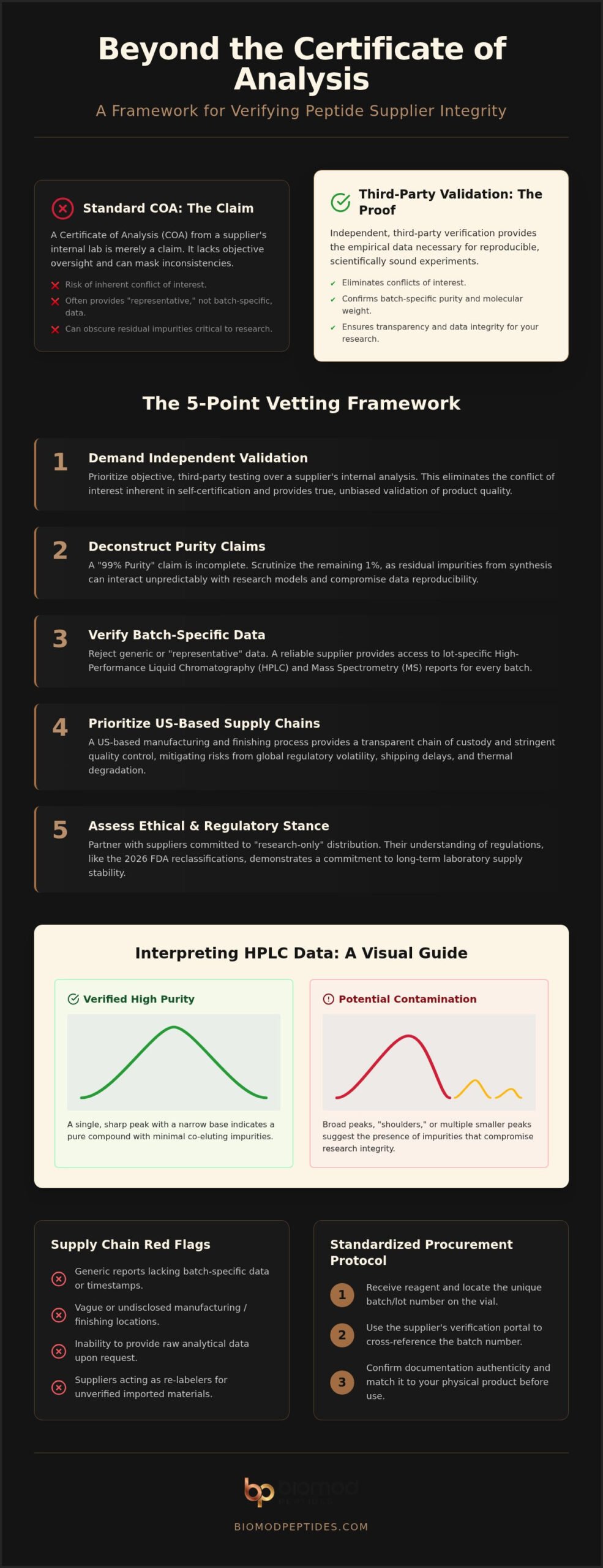
Researchers don’t just need a product; they need data. Distinguishing between genuine domestic manufacturers and re-labelers of imported materials is vital. Generic HPLC or MS reports lacking batch-specific timestamps are primary red flags. Many suppliers provide “representative” data rather than actual lot testing. A reliable provider maintains total transparency regarding finishing locations and batch history. Without this, the risk of receiving degraded material increases, complicating the process of gaining confidence in your peptide supplier.
The 5-Point Framework for Gaining Confidence in Your Peptide Supplier
Gaining confidence in your peptide supplier requires a systematic audit of both documentation and distribution ethics. A rigorous procurement framework must prioritize independent third-party testing over internal in-house analysis. While internal labs serve a purpose in early-stage synthesis, only an external facility provides the objective distance required for true validation. This independence eliminates the conflict of interest inherent in self-certification.
Ethical alignment is equally vital. A supplier committed to research-only distribution demonstrates an understanding of the regulatory landscape, specifically the 2026 FDA reclassifications of Category 2 substances like BPC-157 and TB-500. Sophisticated laboratory reagents are also identified by their finishing formats. The availability of specialized delivery systems, such as peptide softgels or peptide spray products, indicates a higher tier of manufacturing capability and logistical investment.
Interpreting Third-Party HPLC and Mass Spectrometry Reports
Verification relies on the technical depth of the provided analytical data. In a High-Performance Liquid Chromatography (HPLC) chromatogram, look for a single, sharp peak with a narrow base. Broad peaks or “shoulders” suggest co-eluting impurities that compromise research integrity. Mass Spectrometry (MS) then confirms the exact molecular weight, ensuring the synthesized sequence matches the theoretical design. Distinguish between a standard, static COA and an independently verified batch report that includes raw data. For researchers seeking this level of empirical proof, verifying analytical reports through a dedicated portal is the final step in establishing supplier integrity.
Implementing a Standardized Procurement Protocol
A robust procurement protocol eliminates the variables that compromise longitudinal data. Establishing a workflow for cross-referencing batch numbers with analytical databases is the final step in gaining confidence in your peptide supplier. This process ensures that the specific lot used in month one matches the chemical profile of the lot used in month twelve. For Las Vegas laboratories and high-output research facilities, local supply stability is a logistical necessity. Relying on international wholesalers introduces risks of thermal degradation during transit and unpredictable customs interference. US-finished reagents provide the environmental control required to maintain molecular integrity from the lab to the bench. A standardized protocol is the most effective tool for gaining confidence in your peptide supplier while managing complex study timelines.
This geographic proximity also mitigates risks associated with the 2026 FDA reclassifications. It ensures your laboratory maintains a consistent, compliant source of materials despite shifting global regulations. Integrating verified reagents into long-term projects requires a commitment to this level of logistical transparency. It’s a protective measure for your data and your facility’s operational continuity.
Utilizing the COA Verification Portal for Real-Time Quality Assurance
Manual verification is prone to error and document manipulation. You can use the Biomod Peptides verification portal to authenticate research data in real-time. This system allows you to cross-reference batch numbers against digital, tamper-proof records. These records are essential for laboratory compliance audits and internal quality reviews. Securing your supply chain through US-finished research peptides ensures that the documentation you review reflects the actual product in the vial. This level of digital transparency transforms quality assurance from a periodic check into a continuous, data-driven standard. By integrating these verified reagents into your protocol, you protect the viability of your research against the volatility of unverified markets. It’s a method that prioritizes empirical proof over supplier claims.
Standardizing Analytical Integrity in Laboratory Research
Scientific progress relies on the elimination of variables. Moving from speculative procurement to a data-driven protocol is the only way to ensure experimental reproducibility. By prioritizing independent third-party testing and US-based finishing, you mitigate the risks of chemical degradation and regulatory volatility. Gaining confidence in your peptide supplier is an ongoing process of verification rather than a one-time decision. This commitment to transparency protects the viability of your research data and the integrity of your laboratory standards.
Biomod Peptides supports this objective through a US-manufactured supply chain and rigorous analytical oversight. Every batch undergoes independent validation to confirm purity and sequence accuracy. Access the Verification Portal and View Our Certified Research Peptides to implement these standards in your facility today. Secure your research with reagents that meet the highest benchmarks of empirical proof.
Frequently Asked Questions
How can I verify the purity of a peptide batch independently?
You can verify purity by cross-referencing batch numbers through an independent analytical portal. This step is critical for gaining confidence in your peptide supplier because it bypasses potentially biased internal data. Independent validation uses High-Performance Liquid Chromatography to isolate compounds and Mass Spectrometry to confirm molecular weight. For Las Vegas research teams, using these external benchmarks ensures that every reagent arrives with verifiable empirical proof.
What is the difference between US-manufactured and US-distributed peptides?
US-manufactured reagents are synthesized and finished under domestic oversight; US-distributed products are often imported and simply repackaged. Relying on domestic manufacturing minimizes risks associated with international thermal exposure and customs interference. For Las Vegas laboratories, this distinction is vital for maintaining a stable supply chain. It ensures that the chemical integrity of the peptide hasn’t been compromised by the logistics of long-distance transport.
Why is third-party testing superior to in-house laboratory analysis?
Third-party testing eliminates the conflict of interest inherent in self-certification. An external laboratory provides an unbiased audit of the synthesis process, ensuring that purity claims are accurate and reproducible. This objective distance is a prerequisite for gaining confidence in your peptide supplier in a highly technical market. It provides researchers with a layer of accountability that internal reports cannot match, particularly when navigating strict 2026 regulatory changes.
What should I look for in a Certificate of Analysis (COA)?
A comprehensive COA should feature batch-specific HPLC chromatograms and Mass Spectrometry data. You must look for a sharp, isolated peak on the HPLC report to confirm high purity. The Mass Spectrometry results must align with the peptide’s theoretical molecular weight to verify the sequence. Digital verification through a secure portal is also necessary to confirm that the documentation is authentic and specific to your current lot.
Disclaimer
BIOMOD products are sold strictly for laboratory, analytical, and scientific research use only. They are not intended for human or animal consumption, administration, application, ingestion, injection, or any therapeutic, diagnostic, or cosmetic use.
The statements made on this website have not been evaluated by the United States Food and Drug Administration. BIOMOD products are not intended to diagnose, treat, cure, mitigate, or prevent any disease or medical condition.
BIOMOD is a research chemical supplier. BIOMOD is not a compounding pharmacy or chemical compounding facility as defined under Section 503A of the Federal Food, Drug, and Cosmetic Act. BIOMOD is not an outsourcing facility as defined under Section 503B of the Federal Food, Drug, and Cosmetic Act.
By accessing this site, you confirm you are at least 21 years of age and that you have read and accepted the BIOMOD Terms of Sale, Privacy Policy, and Research Use Only Policy. BIOMOD does not provide dosing, medical, therapeutic, diagnostic, veterinary, or use guidance under any channel.