
Nevada remains one of only 10 states in the U.S. that enforces strict laboratory personnel licensure laws. This regulatory environment demands more than just a standard operational plan. Executing a comprehensive new lab startup checklist Nevada requires exact alignment with NAC Chapter 652 and specific Clark County biosafety protocols. Precision is mandatory. Oversight is constant.
Scaling a biotech facility involves significant logistical friction. You likely recognize the difficulty of balancing rigorous state compliance with the need for high-purity research materials. This guide provides a clinical roadmap to launch your facility with technical confidence. It eliminates the ambiguity of local environmental permits and reagent procurement.
We’ll detail the specific 2026 licensing fees, CLIA certification requirements, and strategies for establishing a verified local supply chain. You’ll gain the procedural evidence necessary to maintain day-one structural integrity and experimental output.
Key Takeaways
- Navigate mandatory registration with the Nevada Secretary of State and align operations with NVOSHA safety standards that differ from federal guidelines.
- Implement a rigorous new lab startup checklist Nevada to manage facility design and Clark County biosafety permit lead times effectively.
- Design high-efficiency workflows that separate analytical stations from synthesis areas to ensure maximum output and data integrity.
- Establish a secure reagent supply chain by prioritizing US-manufactured materials and utilizing third-party COA verification portals for all biochemical inputs.
Navigating Nevada Regulatory Compliance and Facility Infrastructure
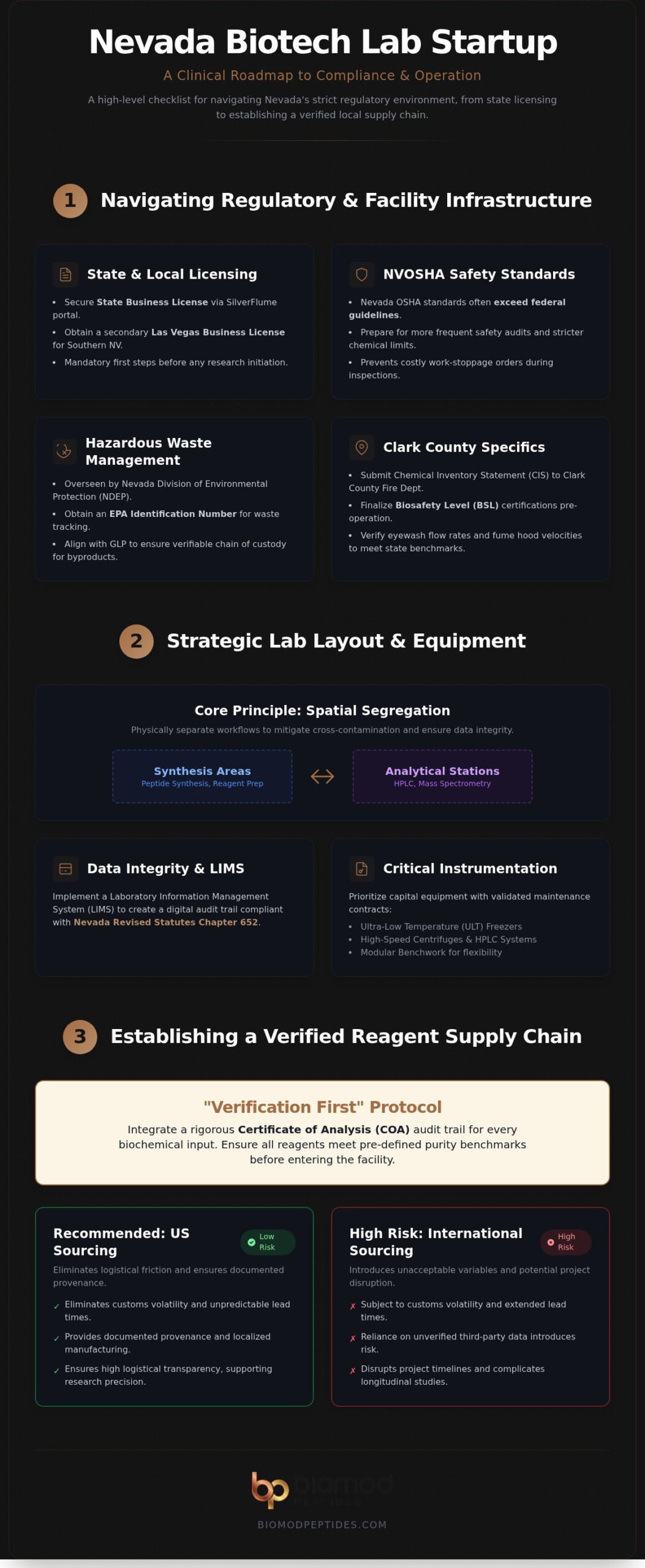
Operational legality begins with the Nevada Secretary of State. Every facility must secure a State Business License through the SilverFlume portal before initiating research. For those located in Southern Nevada, a specific Las Vegas business license is a mandatory secondary step. Compliance extends beyond federal oversight. Nevada OSHA (NVOSHA) operates a state-specific plan. It often demands more frequent safety audits and stricter chemical exposure limits than federal standards. Incorporating these nuances into your new lab startup checklist Nevada prevents costly work-stoppage orders during initial inspections.
Environmental accountability is equally rigorous. The Nevada Division of Environmental Protection (NDEP) oversees hazardous waste through the Bureau of Sustainable Materials Management. Labs must obtain an EPA Identification number to track the generation and disposal of biochemical byproducts. Aligning these waste streams with Good Laboratory Practice (GLP) principles ensures your facility maintains a verifiable chain of custody. This structural discipline is vital for founders seeking institutional-grade accountability. It’s about establishing a documented audit trail for every chemical lifecycle.
Local Permitting and Biosafety Standards in Clark County
The Clark County Fire Department (CCFD) enforces unique codes for chemical storage and high-purity gas manifolds. You’ll need to provide a comprehensive Chemical Inventory Statement (CIS) to determine maximum allowable quantities for hazardous materials. Biosafety Level (BSL) certifications are then tailored to specific Nevada research mandates. These protocols must be finalized before day-one operations. Establishing localized safety measures for Las Vegas facilities includes verifying eyewash station flow rates and fume hood face velocities. Every component must meet the state’s uncompromising benchmarks. Precision isn’t optional.
Strategic Equipment Procurement and Laboratory Layout
Efficiency in a research environment depends on spatial segregation. Your floor plan must physically separate analytical stations from synthesis areas to mitigate cross-contamination risks. This structural logic is a fundamental requirement of a new lab startup checklist Nevada. Precision isn’t optional. Beyond physical layout, data integrity is paramount. Implementing a Laboratory Information Management System (LIMS) ensures that every experiment follows the rigorous documentation standards mandated by Nevada Revised Statutes Chapter 652. It’s about building a digital audit trail that matches your physical precision.
Prioritizing capital equipment requires a focus on long-term verification. Ultra-low temperature (ULT) freezers, high-speed centrifuges, and High-Performance Liquid Chromatography (HPLC) systems represent significant investment. Validated maintenance contracts are essential. They ensure that instrumentation remains within calibrated tolerances, protecting the validity of your research data.
Critical Instrumentation for Biotech Startups
Modular benchwork is the standard for facilities in expanding Las Vegas tech corridors. It allows for rapid reconfiguration as research objectives evolve. Specific attention must be paid to specialized storage for lyophilized peptides and temperature-sensitive reagents. For labs focused on high-throughput peptide research or sequence verification, instrumentation must support diverse delivery formats. This includes evaluating advanced research delivery systems like specialized sprays and softgels. Validating these complex matrices requires high-resolution mass spectrometry and precise environmental controls. Every instrument must be selected based on its ability to provide objective, reproducible evidence of sequence purity and structural stability.
Establishing a Verified Reagent Supply Chain in Las Vegas
Experimental reproducibility depends on the integrity of your biochemical inputs. A “Verification First” protocol must be integrated into every new lab startup checklist Nevada. This ensures that every reagent entering the facility meets pre-defined purity benchmarks. Relying on unverified third-party data introduces unacceptable variables into longitudinal studies. Establishing a rigorous Certificate of Analysis (COA) audit trail creates the structural accountability required for high-output research. It’s about data-driven confidence.
Sourcing strategy is a logistical priority. International procurement often introduces customs volatility and extended lead times that disrupt project timelines. Transitioning to US manufactured research peptides eliminates these friction points. Localized finishing and manufacturing ensure that reagents arrive with documented provenance. This level of logistical transparency supports the precision required in modern biotechnology. It minimizes the risk of reagent degradation during transit while maintaining a secure chain of custody.
Procurement Protocols for High-Purity Research Peptides
Verification must be objective. Utilizing the Biomod Peptides COA Verification Portal allows lab managers to validate reagent purity via independent third-party testing results before initiating protocols. This step is critical for maintaining experimental standards. For specialized studies, integrating advanced delivery formats provides nuanced data points. Consider incorporating peptide softgels or intranasal research sprays into pilot studies to evaluate delivery-specific responses. Each format must be backed by a verifiable COA to ensure sequence integrity and technical merit. Quality control is the final barrier against experimental failure.
Optimizing Nevada Laboratory Readiness and Operational Integrity
Launching a facility in the Silver State requires a synthesis of regulatory precision and logistical foresight. Completing a new lab startup checklist Nevada isn’t just a compliance hurdle; it’s a foundational step toward technical accountability. You’ve established your legal framework under NRS 652 and optimized your facility layout for maximum workflow efficiency. Now, the final phase focuses on the structural integrity of your biochemical inputs.
High-output research demands a supply chain that mirrors your internal benchmarks for precision. You can secure high-purity research reagents from Biomod Peptides to ensure your protocols start with strictly verified materials. We provide US-based finishing and manufacturing combined with independent third-party HPLC testing for every batch. Our local Las Vegas distribution eliminates the volatility of international logistics. Your facility is now positioned for rigorous scientific advancement.
Frequently Asked Questions
What are the specific Nevada OSHA requirements for startup labs?
Nevada OSHA (NVOSHA) mandates a written Chemical Hygiene Plan (CHP) and specific Hazard Communication standards that exceed federal baselines. Your new lab startup checklist Nevada must include documented training logs for all personnel regarding hazardous secondary containers. Site-specific safety protocols must be reviewed annually. These records serve as primary evidence during state inspections to ensure workplace accountability and operational safety.
How do I obtain a hazardous materials permit in Clark County?
Obtaining a hazardous materials permit requires filing a Chemical Inventory Statement (CIS) with the Clark County Fire Department. This document categorizes all stored substances by hazard class and volume. CCFD uses this data to verify compliance with local fire codes and high-purity gas manifold safety. In 2026, permit lead times require early integration into your facility timeline to prevent operational bottlenecks.
Why is third-party testing critical for new lab reagent procurement?
Third-party testing establishes an empirical baseline for reagent purity, removing reliance on potentially biased internal manufacturer data. It’s a critical component of laboratory quality control. Utilizing an independent COA verification portal ensures that every peptide sequence matches its documented profile. This verification step prevents experimental failure caused by reagent degradation or synthesis errors. It guarantees that your research data remains reproducible.
Are there Nevada-specific grants for biotech lab startups in 2026?
The Nevada Governor’s Office of Economic Development (GOED) manages the Knowledge Fund to catalyze biotech innovation and commercialization. Startups can also explore the Battle Born Venture fund for equity-based financing within the state’s tech hubs. Eligibility for these 2026 incentives often requires proof of Nevada-based operations. Founders should consult the GOED website for specific application windows and technical requirements for research-driven grants.
Disclaimer
BIOMOD products are sold strictly for laboratory, analytical, and scientific research use only. They are not intended for human or animal consumption, administration, application, ingestion, injection, or any therapeutic, diagnostic, or cosmetic use.
The statements made on this website have not been evaluated by the United States Food and Drug Administration. BIOMOD products are not intended to diagnose, treat, cure, mitigate, or prevent any disease or medical condition.
BIOMOD is a research chemical supplier. BIOMOD is not a compounding pharmacy or chemical compounding facility as defined under Section 503A of the Federal Food, Drug, and Cosmetic Act. BIOMOD is not an outsourcing facility as defined under Section 503B of the Federal Food, Drug, and Cosmetic Act.
By accessing this site, you confirm you are at least 21 years of age and that you have read and accepted the BIOMOD Terms of Sale, Privacy Policy, and Research Use Only Policy. BIOMOD does not provide dosing, medical, therapeutic, diagnostic, veterinary, or use guidance under any channel.