
The validity of BPC-157 experimental data often hinges on a single, frequently overlooked variable: the absolute structural integrity of the pentadecapeptide sequence. While preclinical findings suggest significant therapeutic potential, many laboratories encounter hurdles when trying to replicate results due to reagent impurity or non-homologous sequences. It’s a common frustration in the field. You need reliable, empirical proof to move your protocols forward. This analysis provides a rigorous clinical examination of the biochemical pathways and growth factor modulation central to bpc-157 mechanism of action research. We’ve compiled the latest 2026 data to clarify how this compound interacts with cellular receptors. We’ll explore the specifics of angiogenesis and GHR pathways while establishing clear criteria for identifying high-purity research reagents. This technical foundation ensures your research remains grounded in objective, verifiable science.
Key Takeaways
- Understand the precise 15-amino acid sequence and molecular targets required to ensure structural integrity in experimental models.
- Examine the specific pathways involved in bpc-157 mechanism of action research, focusing on the upregulation of VEGF and modulation of the nitric oxide system.
- Identify the analytical benchmarks for high-purity reagents, including the role of third-party HPLC and Mass Spectrometry in verifying sequence accuracy.
- Gain a comprehensive framework for designing research protocols using verified peptide formats, including softgels and sprays for varied applications.
Biochemical Structure and Molecular Targets of BPC-157
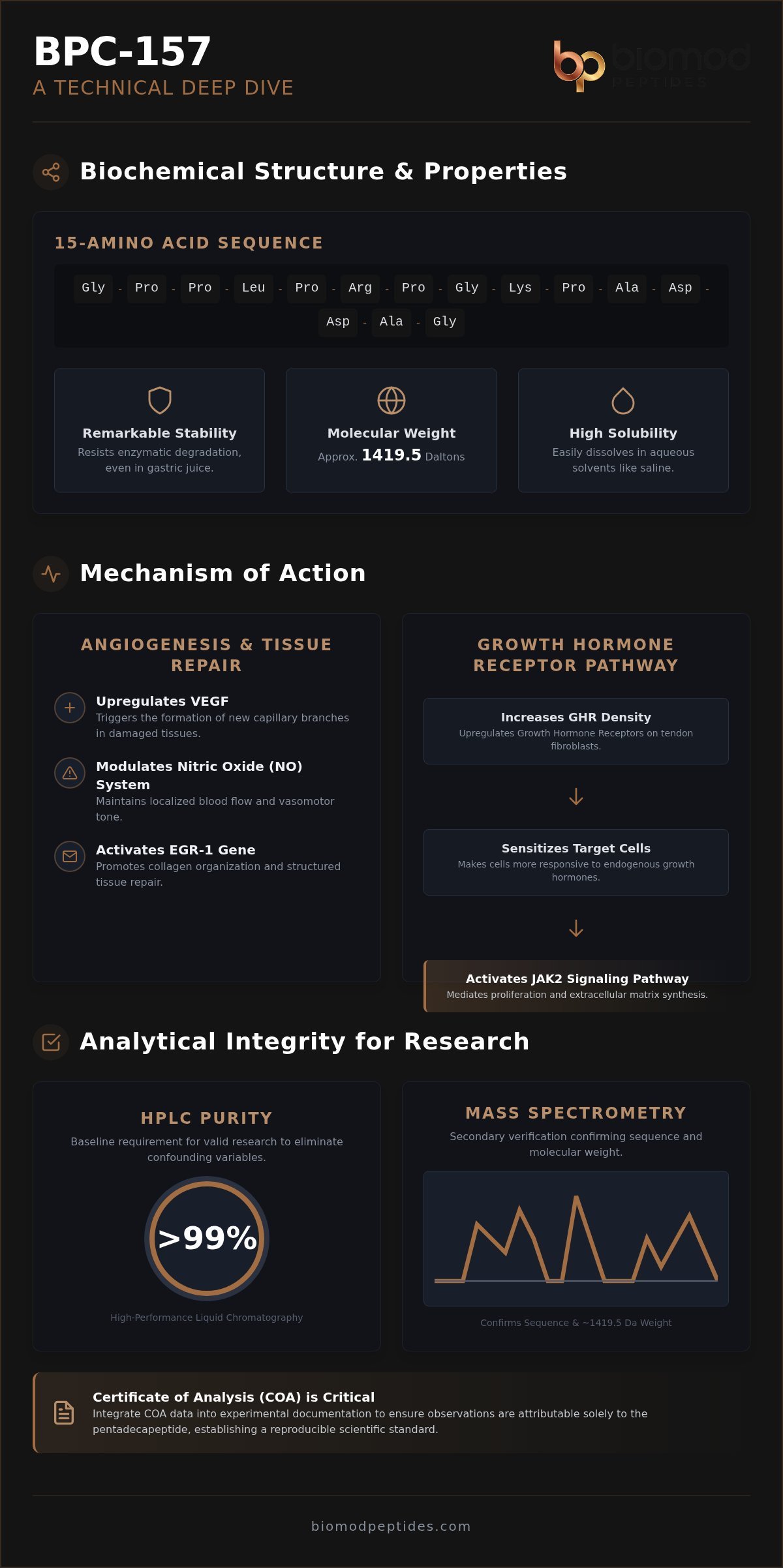
BPC-157 is a synthetic pentadecapeptide derived from a partial sequence of human gastric juice protein. It consists of a precise 15-amino acid sequence: Gly-Pro-Pro-Leu-Pro-Arg-Pro-Gly-Lys-Pro-Ala-Asp-Asp-Ala-Gly. This specific arrangement is the cornerstone of bpc-157 mechanism of action research. Unlike many linear peptides, it exhibits remarkable stability. It resists enzymatic degradation and remains bioactive even in the presence of concentrated gastric juice. This resilience allows for consistent experimental modeling across varied delivery systems.
Researchers prioritize this compound because it doesn’t degrade rapidly in biological environments. This structural integrity is essential for observing downstream effects on tissue repair. In laboratory settings, the peptide maintains its configuration without the immediate cleavage typical of other signaling proteins. Researchers often utilize specialized formats like peptide softgels or spray products to maintain stability across different experimental models.
Physicochemical Properties and Sequence Stability
Technical analysis identifies the molecular weight of BPC-157 at approximately 1419.5 Daltons. It demonstrates high solubility in aqueous solvents, including saline and distilled water. Maintaining this profile requires meticulous storage protocols. Lyophilization is the industry standard for preserving sequence integrity, as it prevents hydrolysis during long-term laboratory storage. The pentadecapeptide structure is characterized by its non-homologous nature, ensuring it remains a distinct entity in protein BLAST searches compared to other known gastric peptides. Proper bpc-157 mechanism of action research necessitates reagents that meet these exact physicochemical benchmarks to ensure data reproducibility.
Modulation of Angiogenesis and Growth Factor Signaling
Angiogenesis is a primary focus of bpc-157 mechanism of action research. The peptide upregulates Vascular Endothelial Growth Factor (VEGF). This process triggers the formation of new capillary branches in damaged tissues. It also interacts directly with the nitric oxide (NO) system. This interaction modulates vasomotor tone. It maintains localized blood flow in experimental subjects. These dual pathways are essential for modeling systemic recovery after ischemic injury or chronic tissue damage. The precision of these interactions depends heavily on the chemical purity of the reagent used in the trial.
Beyond vascular effects, the peptide influences early growth response 1 (EGR-1) gene expression. This activation is critical for downstream collagen organization. It facilitates the transition from disorganized granulation tissue to structured fiber alignment. It ensures structural integrity during the repair phase of experimental protocols. Researchers utilize high-purity research peptides to observe these genetic shifts without interference from synthetic byproducts or sequence errors. This focus on genetic modulation distinguishes the compound from traditional growth factors that only target surface receptors.
Growth Hormone Receptor (GHR) Expression and JAK2 Activation
Technical analysis shows BPC-157 increases GHR density on the surface of tendon fibroblasts. This upregulation sensitizes the target cells to endogenous growth hormones. It specifically activates the Janus Kinase 2 (JAK2) signaling pathway. This pathway mediates growth-hormone-induced proliferation and extracellular matrix synthesis. These findings have significant implications for research targeting ligament repair and musculoskeletal regenerative medicine. Precise verification of the peptide’s molecular weight and sequence is required to ensure these specific receptor interactions occur as intended in complex biological models.
Analytical Integrity in BPC-157 Research Protocols
High-performance liquid chromatography (HPLC) is the baseline requirement for valid bpc-157 mechanism of action research. Reagents must demonstrate >99% purity to eliminate confounding variables from synthesis byproducts. Mass Spectrometry provides the secondary layer of verification. It confirms the exact 15-amino acid sequence and the predicted molecular weight of approximately 1419.5 Daltons. Relying on unverified reagents introduces structural ambiguity that can invalidate cellular signaling data.
Peer-reviewed publications increasingly demand this level of empirical evidence. Researchers must integrate Certificate of Analysis (COA) data directly into their experimental documentation. This practice ensures that observations regarding VEGF upregulation or JAK2 activation are attributable solely to the pentadecapeptide. Precise documentation of the reagent’s biochemical profile is as critical as the experimental results themselves. It establishes a reproducible standard for the scientific community.
Procurement Standards for Las Vegas Laboratories
Logistical transparency is paramount for domestic laboratories. Utilizing US-manufactured research peptides minimizes the risk of sequence degradation during transit and ensures strict adherence to quality control benchmarks. The Biomod Peptides’ COA verification portal allows investigators to cross-reference batch numbers with independent lab results instantly. This tool is essential for maintaining batch-to-batch consistency across multi-phase longitudinal studies.
Protocol design must also account for diverse delivery systems. Handling peptide softgels for research or intranasal research sprays requires specific stability assessments. These specialized formats offer unique pathways for experimental administration while maintaining the analytical rigor required for high-tier scientific inquiry. Verifying the structural integrity of these formats ensures that the peptide remains bioactive throughout the duration of the study.
Advancing Empirical Standards in Peptide Science
The success of bpc-157 mechanism of action research depends on a transition from anecdotal observation to rigorous, multi-pathway analysis. Valid results require a technical understanding of VEGF upregulation and JAK2 signaling density. They also demand reagents that meet uncompromising purity benchmarks. Verified sequence integrity is the only path toward reproducible data and peer-reviewed credibility. Biomod Peptides supports these objectives through US-based laboratory manufacturing and independent third-party HPLC and Mass Spec testing. Our instant COA verification portal ensures your facility operates with absolute logistical transparency. When you prioritize analytical grade materials, you eliminate the variables that stall progress. Secure Analytical Grade BPC-157 for Your Research Facility and elevate the precision of your experimental protocols. We’re committed to providing the structural foundation your research requires.
Frequently Asked Questions
What is the primary mechanism of action for BPC-157 in musculoskeletal research?
The primary mechanism involves the upregulation of growth hormone receptors (GHR) on the surface of fibroblasts. This interaction triggers the Janus Kinase 2 (JAK2) signaling pathway. It’s a key focus of bpc-157 mechanism of action research in musculoskeletal models. These molecular shifts facilitate increased cellular proliferation and collagen organization. Las Vegas laboratories often prioritize these specific pathways when modeling ligament and tendon recovery.
How does BPC-157 interact with the VEGF pathway in angiogenesis models?
It stimulates the expression of Vascular Endothelial Growth Factor (VEGF) to promote the formation of new capillary branches. This process occurs in conjunction with the nitric oxide (NO) system. It modulates vasomotor tone and localized blood flow. Scientific facilities in Las Vegas use these parameters to study tissue revascularization. This dual-pathway interaction is critical for maintaining structural integrity in ischemic or damaged tissue models.
Is BPC-157 research restricted to gastrointestinal applications?
No, research isn’t limited to gastrointestinal studies. While derived from gastric protein, current protocols explore orthopedic, vascular, and neurological models. Scientists in Las Vegas apply the peptide to research involving tendon-to-bone healing and peripheral nerve regeneration. The compound’s stability allows for diverse delivery formats. These include peptide softgels and nasal sprays, which expand the scope of experimental administration beyond simple aqueous solutions.
What purity standards are required for BPC-157 in analytical laboratory use?
Analytical standards require a minimum of 99% purity as verified by High-Performance Liquid Chromatography (HPLC). Mass Spectrometry must also confirm the exact 15-amino acid sequence. Las Vegas research institutions rely on US-manufactured reagents to ensure sequence integrity. Utilizing an online COA verification portal is essential for batch-to-batch consistency. These rigorous benchmarks prevent reagent impurities from contaminating bpc-157 mechanism of action research data.
Disclaimer
BIOMOD products are sold strictly for laboratory, analytical, and scientific research use only. They are not intended for human or animal consumption, administration, application, ingestion, injection, or any therapeutic, diagnostic, or cosmetic use.
The statements made on this website have not been evaluated by the United States Food and Drug Administration. BIOMOD products are not intended to diagnose, treat, cure, mitigate, or prevent any disease or medical condition.
BIOMOD is a research chemical supplier. BIOMOD is not a compounding pharmacy or chemical compounding facility as defined under Section 503A of the Federal Food, Drug, and Cosmetic Act. BIOMOD is not an outsourcing facility as defined under Section 503B of the Federal Food, Drug, and Cosmetic Act.
By accessing this site, you confirm you are at least 21 years of age and that you have read and accepted the BIOMOD Terms of Sale, Privacy Policy, and Research Use Only Policy. BIOMOD does not provide dosing, medical, therapeutic, diagnostic, veterinary, or use guidance under any channel.