
Between 50% and 60% of endogenous mammalian peptide hormones require C-terminal amidation for native receptor binding and biological activity. Yet, selecting solid-phase capping remains an overlooked variable during sequence design. Knowing when to use amidated vs carboxylated peptides directly dictates experimental reproducibility. A single terminal modification shifts the isoelectric point, alters local charge distribution, and alters binding kinetics.
It’s frustrating when an in vitro assay fails because carboxypeptidases degraded an unprotected sequence, or because an unreactive amide blocked critical carbodiimide bioconjugation. This technical guide delivers the analytical framework needed to align C-terminal chemistry with your assay objectives. We’ll examine exopeptidase susceptibility, native sequence mimicry, and the high-resolution mass spectrometry parameters required to resolve the critical 0.9840 Da mass shift.
Key Takeaways
- Identify how C-terminal charge states alter physiological net neutrality, shift isoelectric points, and stabilize secondary structures.
- Establish clear experimental criteria for when to use amidated vs carboxylated peptides across receptor-ligand kinetics, enzymatic screens, and bioconjugation workflows.
- Evaluate exopeptidase susceptibility to protect synthetic sequences from rapid carboxypeptidase cleavage in serum and cell culture assays.
- Implement high-resolution mass spectrometry standards to reliably resolve the critical 0.9840 Da mass shift and eliminate deamidation artifacts.
Structural and Chemical Differences: C-Terminal Amidation vs. Carboxylation
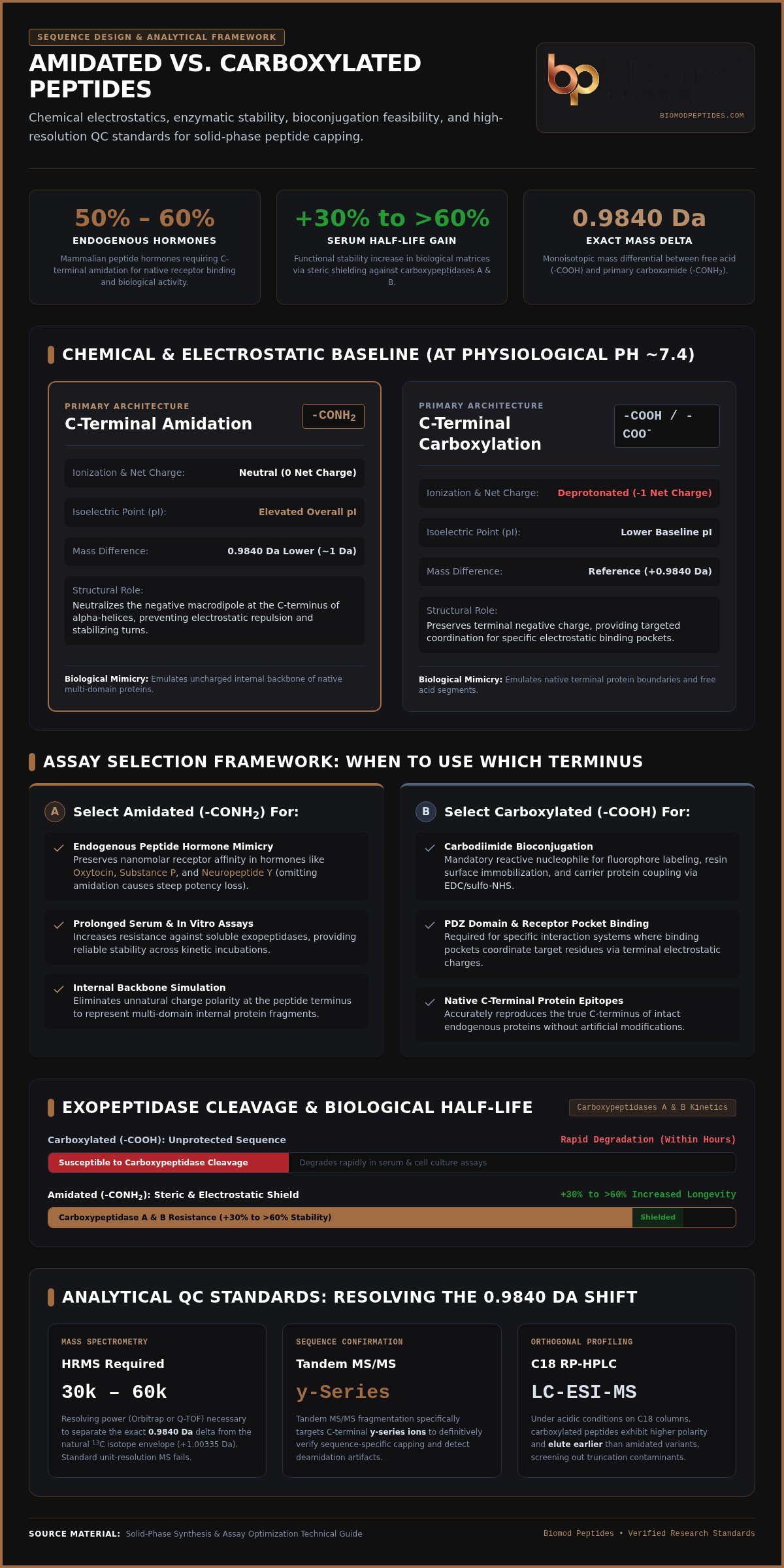
Solid-phase peptide synthesis yields two primary C-terminal architectures: uncharged primary carboxamides (-CONH2) or ionizable carboxylic acids (-COOH). Determining when to use amidated vs carboxylated peptides begins with baseline solution electrostatics. At physiological pH (~7.4), a free carboxyl terminus fully deprotonates into a negatively charged carboxylate (-COO–), contributing a net -1 charge. Conversely, C-terminal amidation caps the terminus with a neutral amine group. This modification removes the ionizable functional group, eliminates the negative charge, and elevates the peptide’s overall isoelectric point (pI).
Charge Neutrality and Secondary Structure Stabilization
Terminal amidation mimics the uncharged internal peptide backbone found within native multi-domain proteins. By replacing the terminal carboxylate with a neutral amide, the synthetic sequence eliminates unnatural terminal polarity. An amidated peptide exhibits a monoisotopic mass that is 0.9840 Da lower than its carboxylated counterpart, representing an exact mass differential of approximately 1 Da.
This charge neutralization prevents electrostatic disruption along the peptide backbone. Alpha-helices exhibit an intrinsic macrodipole: a partial positive charge aligns at the N-terminus, while a partial negative charge concentrates at the C-terminus. When deciding when to use amidated vs carboxylated peptides for structural biology, amidation neutralizes this localized negative dipole. Removing that charge prevents electrostatic repulsion, stabilizes helical turns, and preserves structural fidelity during in vitro characterization.
When to Use Amidated vs Carboxylated Peptides: An Assay Selection Framework
Establishing when to use amidated vs carboxylated peptides depends on target receptor architecture and required assay lifespan. Sequences mimicking endogenous hormones like oxytocin, substance P, or neuropeptide Y frequently demand amidation to retain nanomolar receptor affinity; omitting it causes steep drops in biological potency. Conversely, assays probing PDZ domain interactions or intact C-terminal protein epitopes mandate a free carboxylate group. In these systems, specific binding pockets rely on terminal electrostatic interactions to coordinate target residues.
Enzymatic Resistance and Downstream Bioconjugation Trade-Offs
In biological matrices, exopeptidases dictate peptide survival. Soluble carboxypeptidases rapidly recognize and hydrolyze free carboxylated sequences from the C-terminus, degrading unshielded variants within hours during in vitro incubations. C-terminal amidation confers direct steric and electrostatic protection against carboxypeptidases A and B. This modification increases functional half-life in serum and cell culture assays by 30% to over 60%, providing reliable stability across prolonged kinetic measurements.
Chemical functionalization, however, reverses this operational advantage. When experimental protocols demand fluorophore labeling, resin surface immobilization, or carrier protein conjugation via standard carbodiimide crosslinking (such as EDC/sulfo-NHS chemistry), an unmodified terminal carboxyl is mandatory. Amidation eliminates this reactive nucleophile, completely preventing targeted C-terminal attachment. Sourcing analytical-grade research peptides ensures verified terminal purity, enabling researchers to avoid false-negative results during downstream coupling workflows.
Analytical Verification: QC Standards for Terminal Modifications
Evaluating when to use amidated vs carboxylated peptides requires rigorous analytical validation. The monoisotopic mass difference between a free acid (-COOH) and a primary carboxamide (-CONH2) is exactly 0.9840 Da. Standard unit-resolution mass spectrometers cannot separate this subtle delta from the peptide’s naturally occurring 13C isotopic envelope (+1.00335 Da). High-resolution mass spectrometry (HRMS) platforms, such as Orbitrap or Q-TOF systems operating at resolving powers of 30,000 to 60,000, are necessary to differentiate target amidated peptides from deamidated species. Tandem MS/MS fragmentation focusing on C-terminal y-series ions confirms sequence-specific capping.
High-Resolution Mass Spectrometry and Quality Control Protocols
Chromatographic profiles offer critical orthogonal confirmation. On analytical C18 reversed-phase columns under acidic mobile-phase conditions, carboxylated peptides display increased polarity, eluting slightly earlier than their amidated counterparts. Incomplete synthesis or unoptimized cleavage generates deamidation artifacts and deletion truncations that co-elute with the target product. Applying liquid chromatography coupled with electrospray ionization (LC-ESI-MS) detects these trace contaminants before they compromise sensitive in vitro receptor-binding screens.
Empirical verification must precede bench work. Laboratory teams should cross-reference batch-specific analytical metrics through an accessible COA verification portal prior to reconstitution. Procuring US-manufactured, analytical-grade research peptides backed by third-party HPLC traces and high-resolution mass spectra eliminates structural ambiguity, ensuring your experimental results reflect intended biological mechanisms rather than terminal synthesis defects.
Standardizing Sequence Design for Reproducible Assay Outcomes
Terminal capping isn’t a cosmetic design choice; it dictates experimental viability. Mastering when to use amidated vs carboxylated peptides ensures you balance exopeptidase resistance against essential downstream conjugation requirements. Determining whether your assay demands native carboxamide receptor affinity or free-acid reactivity eliminates baseline variability before reconstitution. High-resolution mass spectrometry and orthogonal chromatography safeguard your workflows against silent deamidation artifacts.
Empirical precision begins with fully characterized reagents. Source verified research peptides for your laboratory manufactured and finished in the United States under rigorous quality standards. Every batch undergoes independent third-party HPLC and mass spectrometry testing, accessible directly through our batch COA verification portal. Equip your bench with validated sequences designed for definitive, reproducible in vitro data.
Frequently Asked Questions
What is the primary chemical difference between amidated and carboxylated peptides?
Carboxylated peptides terminate in an ionizable carboxylic acid (-COOH) carrying a negative charge at physiological pH, whereas amidated peptides terminate in an uncharged primary carboxamide (-CONH2). This structural alteration changes the overall electrostatic profile, elevates the isoelectric point, and shifts monoisotopic mass by 0.9840 Da. Recognizing this core distinction guides Las Vegas investigators on when to use amidated vs carboxylated peptides during experimental design.
Why do many biological assays require C-terminally amidated peptides?
Endogenous neuroendocrine hormones require C-terminal amidation to achieve proper receptor binding conformation and prevent rapid enzymatic proteolysis. Uncapped carboxylates attract soluble carboxypeptidases in biological matrices, shortening in vitro assay stability. Amidation eliminates the negative terminal charge, protecting sequences from exopeptidase cleavage and stabilizing alpha-helical structures. For Las Vegas researchers modeling native endocrine pathways, amidation preserves essential ligand kinetics and prevents premature assay degradation.
How can mass spectrometry distinguish between amidated and carboxylated forms?
Distinguishing between both forms requires high-resolution mass spectrometry (HRMS) systems, such as Orbitrap or Q-TOF platforms running at resolving powers between 30,000 and 60,000. Because the mass differential is precisely 0.9840 Da, unit-resolution instruments confuse target amidated peptides with natural 13C isotopic envelopes (+1.00335 Da). Tandem MS/MS fragmentation targeting C-terminal y-series ions confirms modification status, enabling Las Vegas laboratory teams to audit batch certificates effectively.
Can a carboxylated peptide be converted to an amidated peptide post-synthesis?
Post-synthesis chemical conversion is inefficient and impractical for routine laboratory workflows. Converting a free carboxylic acid to an amide in solution requires multi-step activating reagents and anhydrous ammonia, introducing risks of epimerization, side-chain cross-reactivity, and severe yield loss. Instead, Las Vegas researchers determining when to use amidated vs carboxylated peptides should specify solid-phase synthesis using Rink amide solid supports to guarantee authentic C-terminal amidation.
Disclaimer
BIOMOD products are sold strictly for laboratory, analytical, and scientific research use only. They are not intended for human or animal consumption, administration, application, ingestion, injection, or any therapeutic, diagnostic, or cosmetic use.
The statements made on this website have not been evaluated by the United States Food and Drug Administration. BIOMOD products are not intended to diagnose, treat, cure, mitigate, or prevent any disease or medical condition.
BIOMOD is a research chemical supplier. BIOMOD is not a compounding pharmacy or chemical compounding facility as defined under Section 503A of the Federal Food, Drug, and Cosmetic Act. BIOMOD is not an outsourcing facility as defined under Section 503B of the Federal Food, Drug, and Cosmetic Act.
By accessing this site, you confirm you are at least 21 years of age and that you have read and accepted the BIOMOD Terms of Sale, Privacy Policy, and Research Use Only Policy. BIOMOD does not provide dosing, medical, therapeutic, diagnostic, veterinary, or use guidance under any channel.