
Between 12% and 15% of imported research chemical consignments now face targeted customs holds at U.S. ports of entry, stranding fragile compounds in non-climate-controlled logistics bays for weeks. If your lab relies on foreign freight, you already know the operational cost: thawed cold packs, structural degradation, and stalled experimental schedules. Securing reliable peptide sourcing without customs delays isn’t merely an administrative convenience; it’s a structural necessity for protecting reagent viability.
You shouldn’t have to risk grant capital or biological integrity on unpredictable border clearance. You’ll discover how domestic synthesis and stateside inventory remove customs exposure entirely while safeguarding lyophilized structures from catastrophic thermal stress. This guide details the regulatory shifts driving recent port seizures and provides the analytical criteria needed to build an uninterrupted, laboratory-grade supply line.
Key Takeaways
- Extended international border holds expose lyophilized reagents to uncontrolled thermal spikes, accelerating deamidation, oxidation, and structural hydrolysis.
- Establishing dependable domestic peptide sourcing without customs delays eliminates port-of-entry seizures and preserves experimental continuity.
- Objective procurement frameworks require lot-specific HPLC and mass spectrometry verification accessible through independent testing portals.
- Stateside finishing streamlines laboratory workflows with rapid delivery and specialized research formats, including peptide softgels and precision sprays.
Why International Customs Delays Compromise Research Peptide Integrity
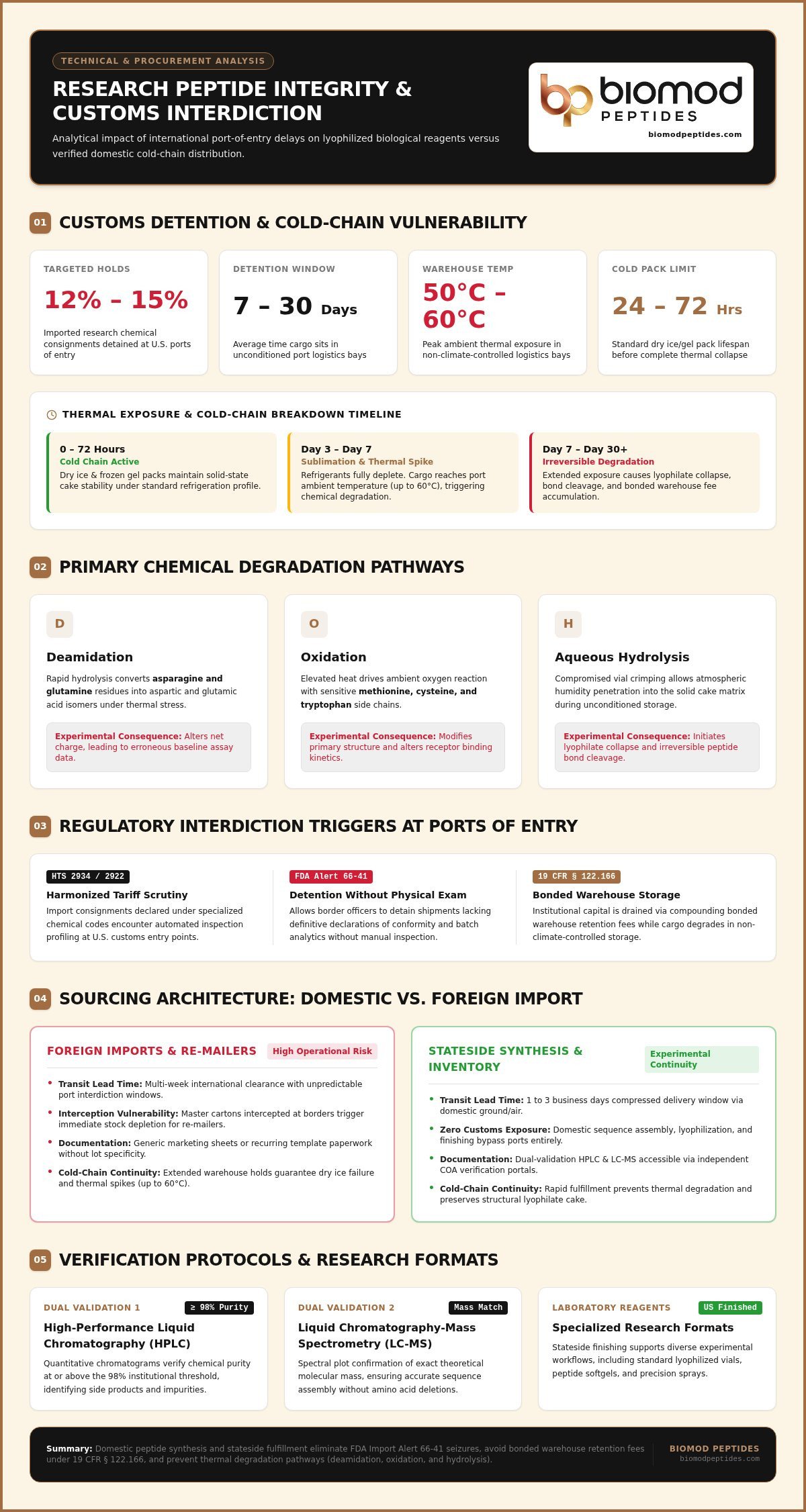
Lyophilized peptides are inherently temperature-sensitive biomolecules. While solid-state cakes remain stable under refrigeration, international transit introduces severe biological vulnerabilities. Customs clearance holds regularly detain overseas consignments for 7 to 30 days. During this window, cargo sits in unconditioned port warehouses where ambient temperatures can reach 50°C to 60°C. Standard dry ice or gel packs fail within 24 to 72 hours, completely breaking the cold chain logistics necessary to protect delicate peptide sequences.
Extended thermal exposure accelerates primary chemical degradation pathways before reagents ever reach the bench:
- Deamidation: Rapid hydrolysis converts asparagine and glutamine residues into aspartic and glutamic acid isomers, altering net charge.
- Oxidation: Elevated heat drives ambient oxygen reaction with sensitive methionine, cysteine, and tryptophan side chains.
- Aqueous Hydrolysis: Compromised vial crimping allows humidity penetration, initiating lyophilate collapse and peptide bond cleavage.
These degradation products compromise primary structure, generating erroneous baseline assay data and invalidated cell cultures. Establishing dependable peptide sourcing without customs delays is essential to ensure biological integrity remains intact from synthesis to experimentation.
Regulatory and Physical Hazards at Ports of Entry
Import holds rarely happen at random. Consignments under Harmonized Tariff Schedule codes 2934 and 2922 encounter targeted scrutiny. Incomplete Declarations of Conformity or missing analytical paperwork trigger immediate administrative holds. Under FDA Import Alert 66-41, border officers can detain shipments lacking definitive documentation without physical inspection. Dry ice sublimes entirely within days of entry detention. Bonded warehouse fees accumulate under 19 CFR § 122.166 while reagents degrade irreversibly. Procuring domestically from Biomod Peptides protects research timelines, eliminating regulatory interdiction and safeguarding institutional capital through fully domestic, stateside fulfillment.
Evaluation Criteria for Sourcing Domestic Peptides Without Border Interruption
Many online vendors claim domestic operations while functioning merely as re-mailers for bulk overseas imports. When foreign consolidated master cartons are intercepted under strict FDA biological product import requirements, these entities face immediate stock depletion. Genuine peptide sourcing without customs delays requires working exclusively with suppliers whose manufacturing and finishing processes take place entirely on domestic soil. You can evaluate domestic provenance through three core parameters:
- Domestic Synthesis and Finishing: Confirm raw sequence assembly, lyophilization, and final vial packaging occur within U.S. facilities rather than offshore clearinghouses.
- Direct Inventory Holdings: Genuine suppliers maintain on-hand inventory stateside, enabling immediate transit rather than quoting standard multi-week international clearance lead times.
- Batch-Specific Testing: Every individual production lot must carry distinct analytical confirmation rather than recurring template documents.
Auditing Vendor Authenticity and Analytical Verification
Analytical integrity separates reliable suppliers from speculative resellers. Institutional protocols mandate dual validation: High-Performance Liquid Chromatography (HPLC) showing purity at or above 98%, paired with Liquid Chromatography-Mass Spectrometry (LC-MS) confirming precise theoretical molecular mass. Generic marketing sheets won’t suffice. Reputable suppliers provide access to an independent COA verification portal, allowing researchers to inspect raw chromatograms and spectral plots for their exact vial lot.
Confirming chain-of-custody documentation ensures your materials bypass border infrastructure entirely. When sourcing biological reagents, review verified research peptides backed by lot-specific analytical data to guarantee experimental repeatability and eliminate border interdiction risks.
Streamlining Laboratory Procurement with US-Finished Research Formats
Procurement velocity directly governs experimental continuity. Relying on unpredictable cross-border freight doesn’t just introduce friction; it leaves critical project milestones vulnerable to sudden customs holds, documentation rejections, and inventory loss. Transitioning to domestic fulfillment compresses transit windows to one to three business days, eliminating border interdiction entirely. Establishing dependable peptide sourcing without customs delays enables laboratories to maintain predictable replenishment schedules without bureaucratic interference.
Standardizing laboratory acquisition through Biomod Peptides provides direct access to fully domestic inventory backed by independent verification. This operational structure insulates research facilities from foreign transit failures. Reagents won’t sit on sweltering airport tarmac docks; they move directly from stateside controlled storage into your research workflow under verified handling conditions.
Implementing Institutional Supply Protocols and Order Redundancy
Institutional workflows require scheduled ordering cadences rather than reactive purchasing. Setting automated replenishment buffers prevents sudden reagent gaps during multi-stage experimental timelines. Expanding procurement beyond standard lyophilized vials also enhances procedural efficiency. Finished research preparations, including peptide softgels and precision peptide spray products, offer standardized unit concentrations for specialized in vitro investigations, significantly minimizing benchtop reconstitution variability and measurement error.
Securing high-integrity peptide sourcing without customs delays requires total supply chain visibility and rigorous domestic controls. Learn more about Biomod and our domestic manufacturing standards engineered to safeguard research integrity.
Standardizing Experimental Reproducibility Through Domestic Supply
Experimental reliability depends entirely on reagent stability. Border holds, thermal degradation, and administrative impoundment directly threaten analytical validity. Sourcing reagents within the United States removes these vulnerabilities entirely, safeguarding primary peptide structures from initial synthesis through final benchtop reconstitution. Establishing dependable peptide sourcing without customs delays provides the operational predictability necessary to maintain rigorous research benchmarks.
Insulate your laboratory workflows with 100% US manufactured and finished laboratory reagents. Every production lot undergoes rigorous independent third-party analytical HPLC and MS testing, supported by direct, transparent batch COA verification portal access for complete data integrity. You can easily protect your experimental schedules and advance institutional milestones. Procure US-Manufactured Research Peptides to establish a resilient, border-free procurement pipeline today.
Frequently Asked Questions
Why do international research peptide shipments get delayed at customs?
International shipments get delayed because regulatory agencies systematically target imported chemical consignments under strict import alerts and tariff classifications. Border agents frequently detain parcels when commercial invoices lack explicit in vitro declarations or compliant research documentation. Missing clearance filings trigger multi-week holds in non-climate-controlled facilities, stranding parcels until protective dry ice sublimates and causes complete reagent degradation.
How does domestic peptide sourcing protect reagent stability?
Domestic fulfillment eliminates border checkpoints entirely, compressing freight transit into rapid one-to-three-day windows. Reliable peptide sourcing without customs delays prevents prolonged thermal exposure on cargo tarmac docks, shielding peptide sequences from heat-induced deamidation, oxidation, and hydrolysis. Facilities in regional biotech hubs like Las Vegas maintain reliable cold-chain continuity, ensuring lyophilized cakes and finished research formats arrive structurally intact.
How can laboratories verify that peptides are truly manufactured in the US?
Laboratories should request verifiable chain-of-custody documentation tracing peptide synthesis, filtration, and finishing directly to domestic facilities. Authentic U.S. providers, including Biomod Peptides in Las Vegas, maintain physical domestic inventory rather than drop-shipping from overseas brokers. Research teams can’t rely on self-reported vendor claims alone; they must demand accessible verification portals demonstrating transparent, lot-specific domestic batch records.
What documentation should accompany domestic analytical-grade research peptides?
Every compliant shipment must include a lot-specific Certificate of Analysis featuring concurrent HPLC and mass spectrometry data. HPLC chromatograms establish purity thresholds at or above 98%, while mass spectrometry verifies theoretical molecular weight. Laboratories establishing peptide sourcing without customs delays should confirm these analytical records link directly to independent testing facilities through an accessible portal rather than generic marketing documentation.
Disclaimer
BIOMOD products are sold strictly for laboratory, analytical, and scientific research use only. They are not intended for human or animal consumption, administration, application, ingestion, injection, or any therapeutic, diagnostic, or cosmetic use.
The statements made on this website have not been evaluated by the United States Food and Drug Administration. BIOMOD products are not intended to diagnose, treat, cure, mitigate, or prevent any disease or medical condition.
BIOMOD is a research chemical supplier. BIOMOD is not a compounding pharmacy or chemical compounding facility as defined under Section 503A of the Federal Food, Drug, and Cosmetic Act. BIOMOD is not an outsourcing facility as defined under Section 503B of the Federal Food, Drug, and Cosmetic Act.
By accessing this site, you confirm you are at least 21 years of age and that you have read and accepted the BIOMOD Terms of Sale, Privacy Policy, and Research Use Only Policy. BIOMOD does not provide dosing, medical, therapeutic, diagnostic, veterinary, or use guidance under any channel.