
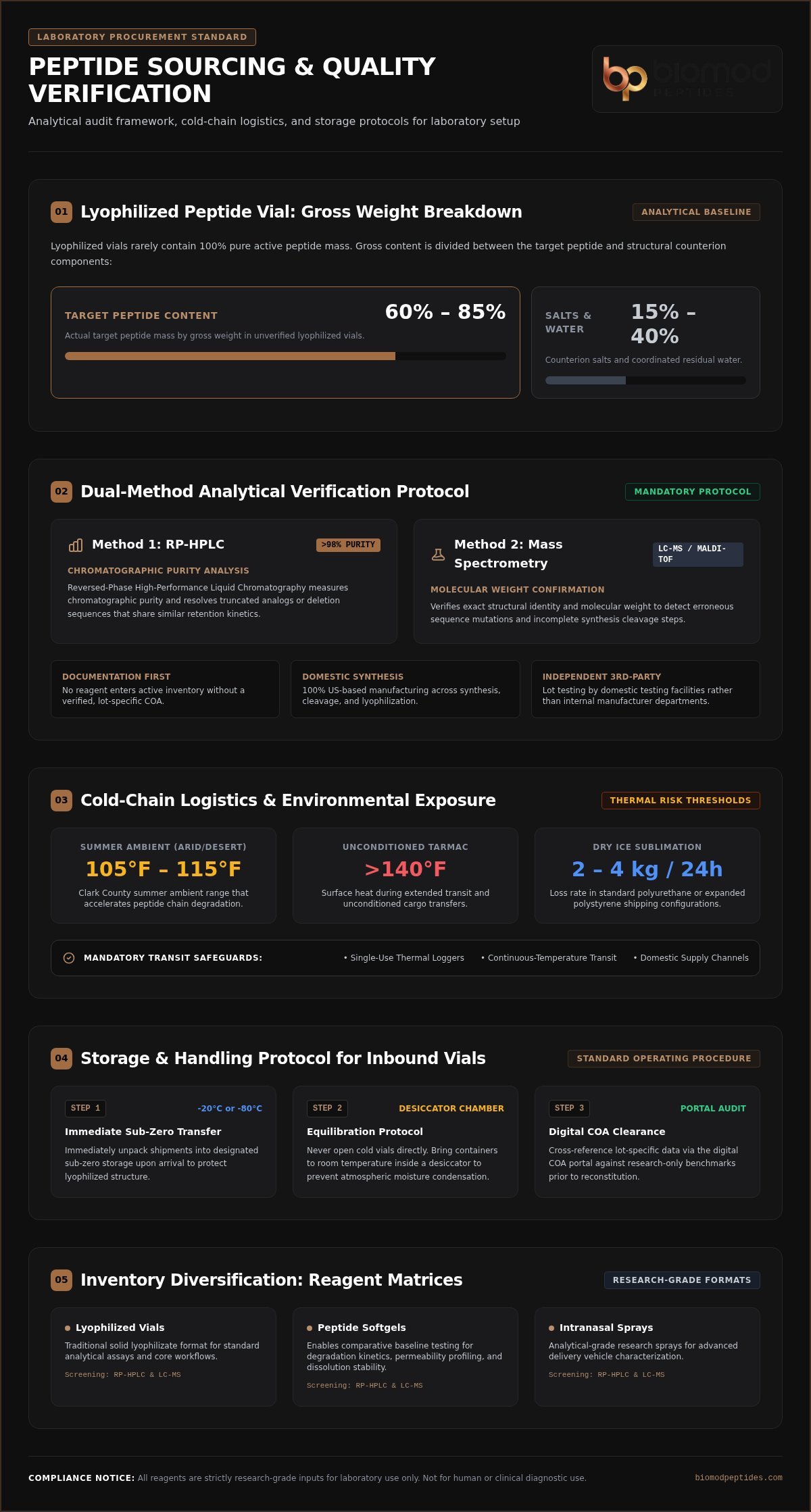
Lyophilized peptide vials often contain only 60% to 85% actual target peptide by gross weight, with the remainder consisting of counterion salts and coordinated water. When sourcing peptides for a new laboratory setup, unverified vendor claims and opaque international supply chains introduce immediate risk to experimental reproducibility. You already know that early project timelines don’t survive analytical surprises, delayed transit, or phantom purity metrics.
This checklist provides procurement officers and researchers with a rigorous framework to secure high-purity, research-only reagents backed by transparent documentation. We’ll examine orthogonal analytical testing using RP-HPLC and mass spectrometry, proper counterion selection, and the critical verification steps needed to establish a stable US-based supply chain from day one.
Key Takeaways
- Mandate dual-method analytical confirmation, requiring both RP-HPLC and mass spectrometry, to verify chromatographic purity alongside structural identity for every lot.
- Streamline sourcing peptides for a new laboratory setup by establishing a domestic supply chain that mitigates transit delays and desert climate exposure.
- Accelerate compliance audits by utilizing digital COA verification portals to cross-reference lot-specific testing data against research-only benchmarks.
- Diversify initial reagent libraries with specialized formats, such as research peptide softgels and sprays, to expand comparative analytical capabilities.
Vetting Peptide Purity: The Analytical Verification Protocol
Hardware investments often dominate lab buildouts, yet reagent integrity dictates experimental validity. When sourcing peptides for a new laboratory setup, establishing an uncompromising vetting protocol prevents downstream assay failures before benchwork begins. Instrumentation alone won’t compensate for degraded or misidentified chemical inputs.
Every inbound lot demands dual-method analytical confirmation. Reversed-Phase High-Performance Liquid Chromatography (RP-HPLC) measures chromatographic purity, while Mass Spectrometry (LC-MS or MALDI-TOF) verifies exact molecular weight. Neither method suffices alone. Complex side reactions during chemical peptide synthesis generate deletion sequences and truncated analogs that closely mirror target retention times. Enforcing 100% US-based manufacturing ensures transparent oversight across synthesis, cleavage, and lyophilization stages. Implement a strict “Documentation First” rule: no reagent enters active inventory without a confirmed Certificate of Analysis (COA). Researchers should leverage a verified peptide certificates of analysis portal to audit supplier claims against raw analytical runs in real time.
Criteria for Third-Party Testing and Accountability
Internal vendor reports don’t provide sufficient operational accountability. Require lot-specific verification from independent domestic testing facilities rather than manufacturer departments. Research-grade peptides require documented purity exceeding 98% by RP-HPLC, alongside complete sequence verification. This disciplined baseline eliminates lot-to-lot variance and protects reproducibility when sourcing peptides for a new laboratory setup.
Logistics Checklist: Sourcing for Las Vegas Lab Relocations
Facility transitions introduce extreme physical vulnerabilities to sensitive biological inputs. In arid environments like Clark County, ambient summer temperatures routinely reach 105°F to 115°F, with unconditioned tarmac surfaces exceeding 140°F. When sourcing peptides for a new laboratory setup, standard nationwide shipping routes create thermal stress that degrades fragile peptide chains before arrival. Securing an established Las Vegas lab relocation chemical supplier drastically cuts transit exposure, shielding consignments from prolonged desert cargo handling.
Audit incoming cold chain procedures against strict environmental controls. Standard polyurethane or expanded polystyrene shipping configurations lose dry ice at rates of 2 to 4 kg every 24 hours. Maintaining verified peptide stability for research requires documented continuous-temperature transit and single-use thermal loggers. Sourcing initial batch inventory in bulk quantities from local distribution channels preserves batch-to-batch consistency across longitudinal protocols, aligning your operational controls with standard FDA guidance on peptide impurities and quality standards.
Storage and Handling Standards for New Facilities
Inbound consignments demand precise handling upon arrival. Unpack lyophilized research peptides immediately into designated sub-zero storage at -20°C or -80°C. Never open vials straight from cold storage; bring containers to room temperature inside a desiccator to prevent atmospheric moisture condensation. Establishing just-in-time delivery with domestic providers protects reagent batches, ensuring streamlined execution when sourcing peptides for a new laboratory setup.
Inventory Diversification: Specialized Reagent Formats
Modern bioanalytical workflows increasingly evaluate non-lyophilized matrices. When sourcing peptides for a new laboratory setup, limiting procurement strictly to traditional lyophilized vials restricts experimental scope. Integrating specialized peptide softgels for research allows labs to establish comparative baseline data for degradation kinetics, permeability profiling, and dissolution stability. Similarly, configuring inventory with analytical-grade intranasal peptide research sprays expands delivery vehicle characterization.
Alternative matrices demand identical analytical rigor. Every softgel lot or spray solution must undergo the same RP-HPLC and mass spectrometry screening as solid lyophilizates. Confirm that all procured materials carry clear research-use documentation. They aren’t intended for human administration or clinical diagnostic use, ensuring full compliance with domestic research mandates.
Final Vendor Selection and Compliance Audit
Vendor audits require absolute verification of research-only boundaries. Review supply terms to verify adherence to standardized laboratory peptide supply protocols, ensuring complete operational segregation from clinical channels. Execute master agreements only with providers that offer direct access to an analytical verification portal. Instant portal access allows procurement teams to inspect lot-specific chromatograms, purity thresholds, and third-party laboratory reports before releasing shipments into active bench inventory when sourcing peptides for a new laboratory setup.
Standardize Your Analytical Pipeline for Long-Term Integrity
Flawless experimental design counts for little when incoming consumables lack empirical validation. Successfully sourcing peptides for a new laboratory setup requires strict adherence to orthogonal analytical standards, desert-resilient cold chains, and verifiable research-only documentation. Eliminating supply volatility early protects both your project timelines and your operational budget.
Biomod Peptides delivers US-manufactured and finished research reagents supported by rigorous, independent third-party verification for every lot. With dedicated Las Vegas local distribution, ambient transit exposure won’t compromise your storage baselines. Secure your laboratory’s reagent supply chain with Biomod Peptides and establish your benchwork on verifiable chemical integrity from day one.
Frequently Asked Questions
What are the essential documents required for sourcing peptides in a new lab?
Essential compliance documentation includes lot-specific Certificates of Analysis (COAs) featuring both RP-HPLC chromatograms and mass spectrometry spectra. Facilities also require detailed safety data sheets (SDS) and documented terms confirming research-only parameters. When sourcing peptides for a new laboratory setup, establishing an unbroken paper trail prevents analytical discrepancies and satisfies institutional audit standards before experimental workflows begin.
Why is US-based peptide manufacturing critical for laboratory relocation in Las Vegas?
Domestic synthesis guarantees direct regulatory oversight and eliminates customs holds that imperil cold chain integrity. Las Vegas relocations face extreme ambient heat that rapidly destabilizes sensitive reagents during extended transit. Sourcing US-manufactured peptides with local distribution hubs significantly shortens the shipping window, minimizing environmental thermal exposure and preserving structural stability during sensitive transition phases.
How do I verify the purity of research peptides using a COA portal?
Access the vendor’s digital portal and input the specific batch or lot number printed on the reagent vial. A legitimate portal displays raw analytical test records, including third-party RP-HPLC peak area data and LC-MS molecular weight confirmations. Cross-reference the identified molecular mass against theoretical sequence values to ensure the documentation matches the physical product delivered to your bench.
What are the advantages of sourcing peptide softgels and sprays for a new setup?
Specialized reagent formats allow researchers to diversify their analytical scope beyond standard lyophilized powders. Sourcing peptide softgels and spray products facilitates comparative studies into alternative vehicle delivery, matrix permeability, and solution stability. Sourcing peptides for a new laboratory setup across diverse physical formats establishes broader analytical capabilities right from initial facility validation, provided all lots meet rigorous testing standards.
Disclaimer
BIOMOD products are sold strictly for laboratory, analytical, and scientific research use only. They are not intended for human or animal consumption, administration, application, ingestion, injection, or any therapeutic, diagnostic, or cosmetic use.
The statements made on this website have not been evaluated by the United States Food and Drug Administration. BIOMOD products are not intended to diagnose, treat, cure, mitigate, or prevent any disease or medical condition.
BIOMOD is a research chemical supplier. BIOMOD is not a compounding pharmacy or chemical compounding facility as defined under Section 503A of the Federal Food, Drug, and Cosmetic Act. BIOMOD is not an outsourcing facility as defined under Section 503B of the Federal Food, Drug, and Cosmetic Act.
By accessing this site, you confirm you are at least 21 years of age and that you have read and accepted the BIOMOD Terms of Sale, Privacy Policy, and Research Use Only Policy. BIOMOD does not provide dosing, medical, therapeutic, diagnostic, veterinary, or use guidance under any channel.