
A standard IT backup cannot restore a degraded peptide chain. When the power grid fails, the clock starts on your most sensitive assets. You understand that years of meticulous research and experimental integrity hinge on precise environmental controls. A single cooling failure or supply chain disruption doesn’t just stall progress. It can invalidate entire datasets. Implementing a robust disaster recovery plan for a research lab is not an IT luxury. It’s a scientific necessity.
This article establishes a rigorous, science-forward framework to protect critical research assets and maintain operational continuity during unforeseen disruptions. We’ll examine actionable checklists for specimen preservation, rapid reagent procurement strategies, and verification protocols to ensure experimental integrity remains intact. By prioritizing biochemical uptime over simple data redundancy, you secure the structural integrity of your laboratory’s long-term output and professional standing.
Key Takeaways
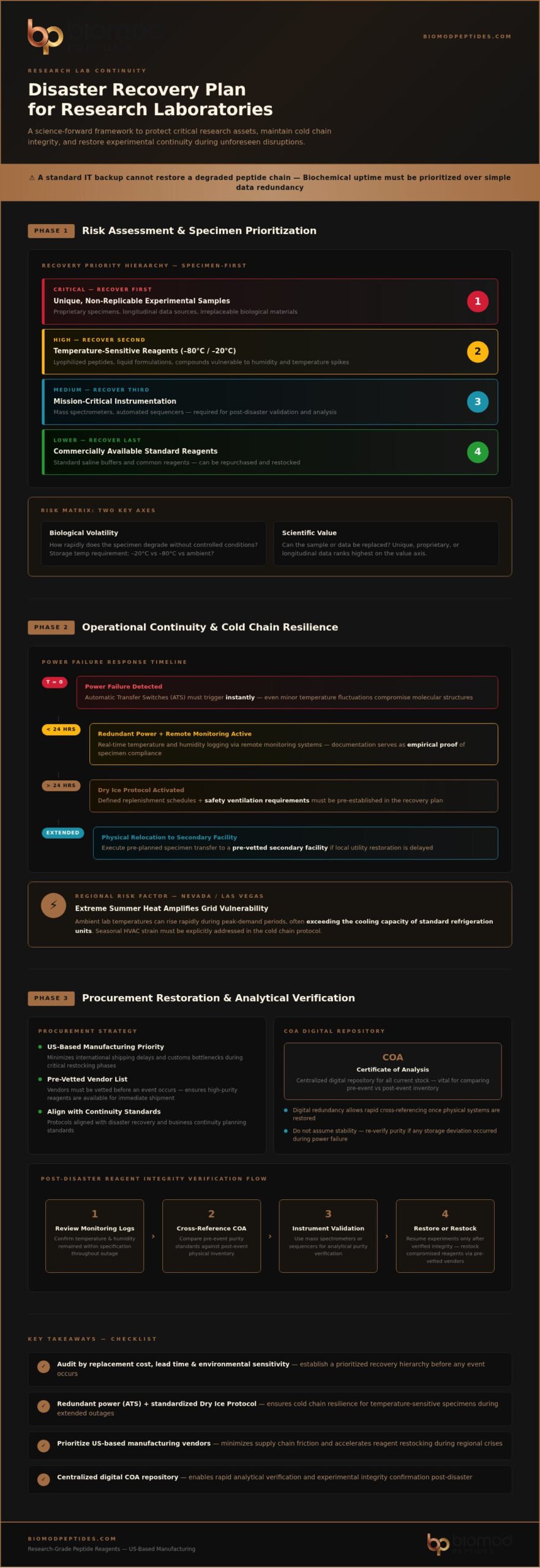
- Audit high-value reagents and experimental samples by replacement cost and environmental sensitivity to establish a prioritized recovery hierarchy.
- Implement redundant power systems and standardized “Dry Ice Protocols” to ensure cold chain resilience for temperature-sensitive specimens during extended outages.
- Develop a disaster recovery plan for a research lab that prioritizes US-based manufacturing to minimize supply chain friction and accelerate reagent restocking.
- Maintain a centralized digital repository of Certificates of Analysis (COA) to facilitate rapid analytical verification and ensure experimental integrity post-event.
Risk Assessment and Critical Specimen Prioritization
A functional disaster recovery plan for a research lab begins with a precise, comprehensive audit of all high-value laboratory reagents and experimental samples. Don’t treat all assets as equal. Categorize items by replacement cost, lead time, and sensitivity to environmental shifts. While digital data is essential, biological specimens require much tighter Recovery Time Objectives (RTO). Digital files reside in redundant clouds, but physical specimens exist in a fragile state. Applying standard disaster recovery planning principles to a laboratory requires a specimen-first hierarchy. You must identify the mission-critical equipment, such as mass spectrometers or automated sequencers, required for immediate post-disaster validation and analysis.
Specimen-Specific Risk Matrices for Research Labs
Evaluate the stability profiles of your existing stocks to determine survival windows during a total power failure. This involves documenting specific storage requirements, such as -20°C versus -80°C, for every reagent class. For instance, lyophilized research peptides generally offer greater structural stability than liquid formulations, yet they remain vulnerable to humidity and temperature spikes. Prioritize unique, non-replicable experimental outcomes over commercially available reagents. You can repurchase a standard saline buffer, but you cannot replace years of longitudinal data derived from a lost, proprietary sample. Use a risk matrix to rank assets by their biological volatility and scientific value. This ensures that limited backup power and emergency response efforts focus on the most vulnerable, high-impact materials first. Structural integrity is the primary metric of success.
Operational Continuity and Cold Chain Resilience
Maintaining biochemical integrity requires more than just backup power. It demands a specialized disaster recovery plan for a research lab that prioritizes thermal stability over simple data redundancy. Implement redundant power systems equipped with automatic transfer switches (ATS) for all critical refrigeration units. These systems must trigger instantly to prevent even minor temperature fluctuations that could compromise molecular structures. For outages exceeding 24 hours, establish a “Dry Ice Protocol” that defines specific replenishment schedules and safety ventilation requirements. Utilize remote monitoring systems for real-time temperature and humidity logging. This documentation serves as empirical proof that specimens remained within specification during the disruption. Align these efforts with federal business continuity planning guidance to ensure a comprehensive organizational response.
Mitigating Las Vegas Regional Climate Risks
Regional environmental factors introduce unique variables into the continuity equation. In Nevada, extreme summer heat places immense strain on both laboratory HVAC systems and the local power grid. Ambient laboratory temperatures can rise rapidly, often exceeding the cooling capacity of standard refrigeration units during peak-demand periods. Your plan must account for these seasonal vulnerabilities. Ensure your cold chain protocols are robust enough for local logistics, even if primary cooling fails. Develop a physical relocation plan for specimens to a pre-vetted secondary facility if local utility restoration is delayed. For labs requiring high-tier reliability, sourcing from a US-based research reagent provider ensures that replenishment logistics remain manageable during regional crises. Structural resilience is achieved through meticulous planning and redundant technical layers.
Procurement Restoration and Analytical Verification
Restoring laboratory operations requires a structured approach to procurement that mitigates future supply chain friction. A comprehensive disaster recovery plan for a research lab should prioritize pre-vetted vendors with US-based manufacturing. This strategy minimizes the risk of international shipping delays and customs bottlenecks during critical restocking phases. Aligning your procurement protocols with disaster recovery and business continuity planning standards ensures that high-purity peptide reagents are available for immediate shipment. Maintain a centralized digital repository of all current Certificates of Analysis (COA) for existing stock. This documentation is vital when comparing pre-event standards against post-event inventory. Digital redundancy allows for rapid cross-referencing once physical systems are restored.
Validating Post-Disaster Reagent Integrity
Experimental integrity depends on the physical state of your reagents. If storage deviations occurred during a power failure, you must establish a protocol for re-verifying purity. Don’t assume stability. Use the COA Verification Portal to confirm that new reagent batches meet established benchmarks. Reference the protocol for peptide purity verification to ensure your experimental data remains scientifically valid. Conduct High-Performance Liquid Chromatography (HPLC) and mass spectrometry on any samples suspected of thermal degradation. These analytical steps provide empirical proof of sample viability. Verification is the only defense against skewed data. By integrating rapid-restock lists and rigorous analytical checks, you ensure that your disaster recovery plan for a research lab facilitates a return to full operational capacity without compromising laboratory-grade quality control.
Securing Long-Term Experimental Integrity
A robust disaster recovery plan for a research lab prioritizes physical specimen stability and biochemical uptime. You’ve identified that redundant power and climate-specific protocols are essential for maintaining experimental continuity. Verification remains the final defense against degraded results. By integrating US-based manufacturing and rigorous analytical standards, you eliminate logistical friction and ensure rapid restoration of research capacity. Structural resilience is the benchmark of a professional laboratory environment.
Biomod Peptides supports this resilience through independent third-party testing and a dedicated COA Verification Portal. Our US-based manufacturing and finishing processes provide the transparency required for high-stakes research. Don’t wait for a disruption to audit your supply chain. Secure your laboratory supply chain with US-manufactured Biomod Peptides. Your research outcomes depend on the structural integrity of your reagents. Build a more resilient future for your data today.
Frequently Asked Questions
What is the most critical component of a research lab disaster recovery plan?
The most critical component is a specimen-first prioritization hierarchy based on biochemical volatility. In Las Vegas, a disaster recovery plan for a research lab must account for extreme ambient heat and regional grid strain during summer. Your strategy must define clear Recovery Time Objectives for biological assets. It ensures that finite backup power protects non-replicable experimental outcomes rather than generic reagents.
How long can lyophilized peptides remain stable during a power outage?
Lyophilized peptides generally remain stable for several days at room temperature, but Las Vegas environmental conditions can accelerate degradation. High ambient temperatures in the Southwest increase the risk of moisture absorption and secondary structure shifts. While lyophilization provides a stability buffer during outages, you must perform analytical verification once cooling is restored to confirm that no thermal degradation occurred during the excursion.
Should I prioritize data backup or specimen preservation first?
Specimen preservation is the priority. Digital data is usually protected by off-site redundancy, but physical samples are vulnerable to immediate local disruptions, especially during Las Vegas power grid failures. A robust disaster recovery plan for a research lab focuses on maintaining the cold chain. Losing unique biological samples can invalidate years of work, whereas data is easily restored from cloud backups.
How do I verify if my reagents are still usable after a temperature excursion?
Utilize HPLC and mass spectrometry to confirm the purity and structural integrity of the reagents. Biomod Peptides offers a COA Verification Portal to help Las Vegas researchers compare post-event analytical data against original manufacturing standards. This process provides empirical proof of viability. If a temperature excursion exceeds established stability windows, validation is the only way to safeguard your laboratory’s experimental integrity.
Disclaimer
BIOMOD products are sold strictly for laboratory, analytical, and scientific research use only. They are not intended for human or animal consumption, administration, application, ingestion, injection, or any therapeutic, diagnostic, or cosmetic use.
The statements made on this website have not been evaluated by the United States Food and Drug Administration. BIOMOD products are not intended to diagnose, treat, cure, mitigate, or prevent any disease or medical condition.
BIOMOD is a research chemical supplier. BIOMOD is not a compounding pharmacy or chemical compounding facility as defined under Section 503A of the Federal Food, Drug, and Cosmetic Act. BIOMOD is not an outsourcing facility as defined under Section 503B of the Federal Food, Drug, and Cosmetic Act.
By accessing this site, you confirm you are at least 21 years of age and that you have read and accepted the BIOMOD Terms of Sale, Privacy Policy, and Research Use Only Policy. BIOMOD does not provide dosing, medical, therapeutic, diagnostic, veterinary, or use guidance under any channel.