
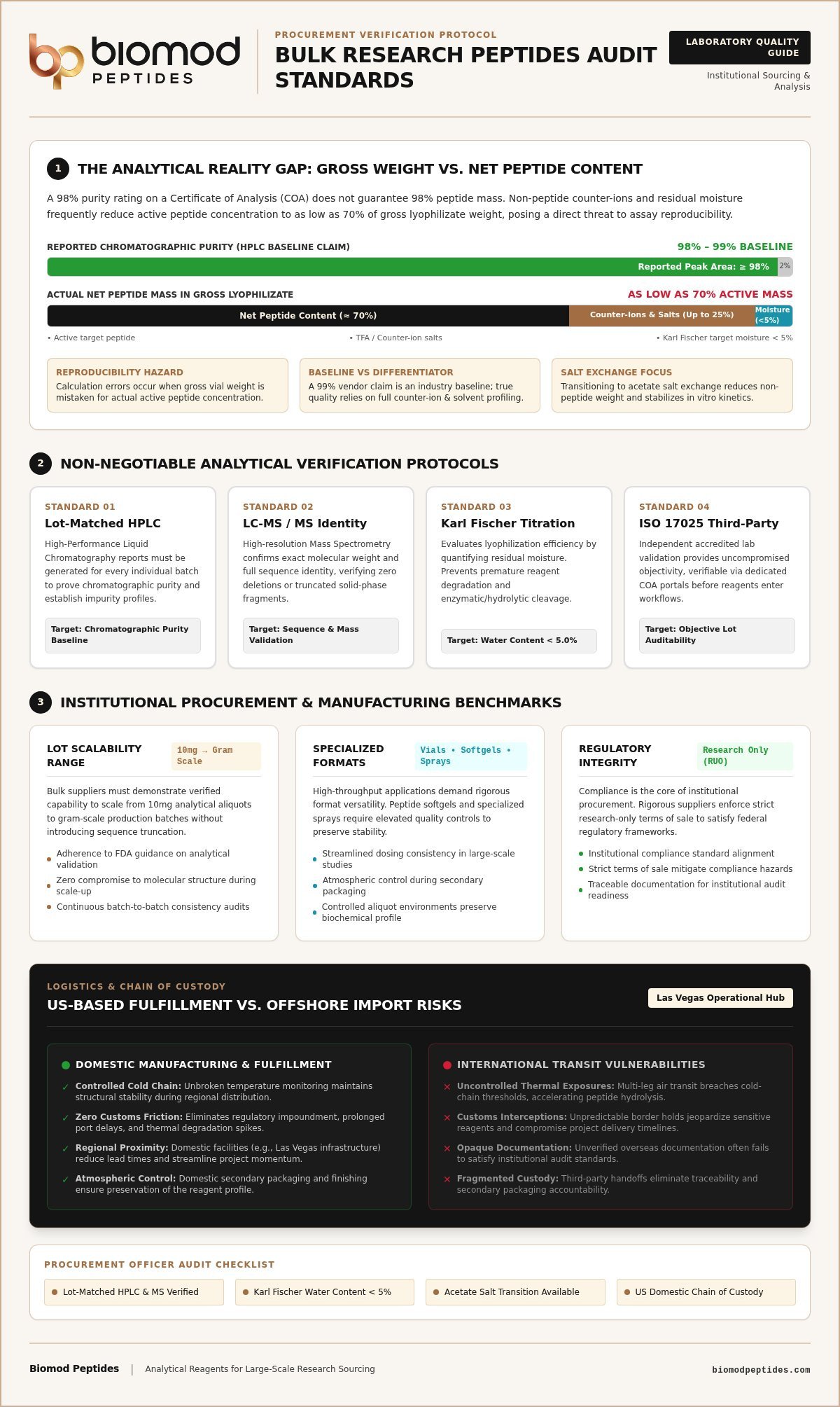
A 98% purity rating on a certificate of analysis does not mean your vial contains 98% peptide mass. In reality, counter-ions and residual moisture often reduce net peptide content to as little as 70% of the gross lyophilizate weight. For laboratory procurement teams, this discrepancy is more than a technicality; it’s a direct threat to experimental reproducibility. You need a bulk research peptides supplier that prioritizes rigorous analytical depth over surface-level marketing claims. Opaque verification protocols and batch-to-batch inconsistency are unacceptable variables that stall critical research timelines.
This guide provides the professional protocol necessary to secure high-purity reagents for large-scale applications. You’ll learn to audit supplier standards, from HPLC benchmarks to the logistical security of US-based manufacturing. We will examine the transition to acetate salt exchange, the requirement for ISO 17025 accredited testing, and the verification methods that ensure your reagents meet the highest structural benchmarks.
Key Takeaways
- Verify purity through lot-matched HPLC reports and Mass Spectrometry to ensure molecular weight accuracy and sequence identity for every batch.
- Implement a rigorous cold chain protocol and evaluate lyophilization quality to maintain peptide stability during regional distribution.
- Selecting a reliable bulk research peptides supplier requires auditing their US-based manufacturing and finishing processes to ensure domestic supply chain integrity.
- Adhere to strict research-only terms of sale and institutional compliance standards to mitigate regulatory risks in large-scale procurement.
Evaluating Analytical Standards in Bulk Peptide Sourcing
Procurement for large-scale research demands rigorous analytical accountability. A reputable bulk research peptides supplier must provide lot-matched High-Performance Liquid Chromatography (HPLC) reports for every shipment. This is not a suggestion; it’s a requirement for data integrity. While many vendors claim 99% purity, this figure serves as a baseline rather than a differentiator in analytical research. High chromatographic purity alone doesn’t guarantee the correct sequence. Mass Spectrometry (MS) must accompany HPLC to confirm molecular weight accuracy and sequence identity, ideally through high-resolution LC-MS/MS. These methods ensure that the solid-phase peptide synthesis process was executed without truncated sequences or significant deletions. Identifying specific impurity profiles is critical to prevent off-target effects in complex assays.
The Role of Third-Party Verification in Procurement
Internal laboratory testing, while valuable, lacks the objective distance required for high-stakes procurement. Independent third-party validation is the only way to prevent batch-to-batch inconsistency. When vetting a bulk research peptides supplier, you should utilize a COA verification portal to audit lots before they enter your research workflow. This level of transparency allows for the quantification of residual solvents and moisture that can alter concentration calculations. It’s about establishing a repeatable protocol for vetting reagents. For a deeper analysis of these benchmarks, review The Protocol for Peptide Purity Verification to understand the non-negotiable standards of modern laboratory operations.
Streamlining the Procurement Process for Large-Scale Research
Efficient procurement requires more than just high purity; it demands logistical precision. Maintaining a strict cold chain protocol is vital for peptide stability during regional distribution. Bulk reagents are sensitive. Superior lyophilization quality ensures long-term storage viability by targeting water content below 5% via Karl Fischer titration to prevent hydrolysis. When assessing a bulk research peptides supplier, verify their ability to scale from 10mg to gram-scale lots without compromising structural integrity. Improper scaling often introduces truncated sequences that interfere with sensitive assays. This scalability requires adherence to rigorous FDA guidance on analytical procedures and methods validation to ensure every batch meets defined benchmarks.
US-based fulfillment serves as a critical safeguard against degradation. International transit often involves unpredictable delays and uncontrolled environments. Domestic finishing and shipping reduce these risks significantly. It’s about accountability. Partnering with a bulk research peptides supplier that maintains US-based facilities ensures a transparent chain of custody. For laboratories managing tight project timelines, sourcing from a US-manufactured peptide provider allows for precise control over secondary packaging and atmospheric conditions during the final aliquot process. This preserves the reagent’s biochemical profile from synthesis to delivery.
Logistical Considerations for Las Vegas Laboratories
Local Las Vegas sourcing offers distinct advantages for high-throughput research facilities. Proximity reduces lead times. It simplifies the chain of custody. By leveraging regional distribution networks, labs can maintain project momentum without the friction of cross-border logistics. You can learn more about Biomod’s Las Vegas operations and how local infrastructure supports domestic research initiatives through rapid fulfillment and expert support.
Ensuring Regulatory and Logistical Integrity in Bulk Supply
Compliance is the cornerstone of institutional procurement. A professional bulk research peptides supplier must enforce strict research-only terms of sale to align with federal regulatory frameworks. It’s not just about labeling; it’s about the integrity of the entire supply chain. Choosing US-manufactured and finished reagents eliminates the volatility of international customs and ensures that documentation meets domestic audit standards. Transparency in manufacturing and finishing protocols provides the accountability necessary for high-volume orders. This domestic focus ensures that every reagent is finished in a controlled environment, preserving the biochemical profile of the batch from synthesis to storage.
Specific analytical applications may require specialized delivery formats. Evaluating peptide softgels or spray products for research can streamline dosing consistency in large-scale studies. These formats demand rigorous quality control to maintain structural integrity. To prevent degradation during these processes, laboratories must follow established peptide storage and handling protocols. Consistency in aliquot management and cold-chain maintenance is essential for long-term project viability. Reliable documentation must accompany these specialized formats to confirm that finishing meets the required purity benchmarks.
Risk Mitigation in High-Volume Peptide Procurement
Standardizing procurement checklists is a necessary step for any high-throughput facility. These lists should mandate COA verification, sequence validation, and impurity profiling for every batch. Dedicated technical support is equally vital. When managing complex reagents, having a direct line to experts who understand the nuances of peptide chemistry can resolve technical inquiries before they impact research timelines. Proactive communication with your bulk research peptides supplier ensures that batch-specific data is always available for review. For a comprehensive overview of these standards, consult the Laboratory Peptide Supply Resource Guide to optimize your procurement strategy and maintain experimental reproducibility.
Advancing Research Through Analytical Accountability
Selecting a bulk research peptides supplier is a strategic decision that dictates the integrity of your longitudinal data. Success depends on more than surface-level purity claims. It requires lot-matched HPLC and MS validation to confirm sequence identity and structural accuracy. Logistical proximity and US-based finishing are essential safeguards against degradation and supply chain volatility. By standardizing your procurement around these rigorous benchmarks, you eliminate the variables that compromise experimental reproducibility.
Biomod Peptides provides the technical transparency required for high-throughput laboratory applications. All reagents are US-manufactured and finished, featuring independent third-party HPLC/MS verification for every lot. Based in Las Vegas, we offer regional supply support designed for domestic research momentum. Procure High-Purity Bulk Research Peptides from Biomod to secure the reagents your methodology demands. Elevate your research with reagents built on empirical proof and logistical precision.
Frequently Asked Questions
How do I verify the purity of a bulk peptide lot?
Purity is verified through lot-matched High-Performance Liquid Chromatography (HPLC) and Mass Spectrometry (MS). HPLC measures relative chromatographic purity; MS confirms sequence identity and molecular weight. You should cross-reference these reports against independent third-party findings. A reliable bulk research peptides supplier provides QR-code-traceable analytical reports to prevent data tampering and ensure experimental reproducibility.
What are the advantages of sourcing peptides from a US-based supplier?
US-based sourcing eliminates the volatility of international customs and reduces transit-related degradation. For laboratories in Las Vegas, regional distribution ensures faster lead times and a transparent chain of custody. Domestic manufacturing and finishing allow for stricter adherence to US analytical standards. This logistical proximity is crucial for maintaining project momentum and ensuring bulk reagents remain stable during domestic transport.
How should bulk research peptides be stored to ensure long-term stability?
Lyophilized bulk peptides should be stored at -20°C or -80°C to minimize degradation and oxidation. Vials must be kept in a desiccated environment to prevent moisture absorption; moisture can lead to hydrolysis. It’s vital to follow established peptide storage and handling protocols, such as minimizing freeze-thaw cycles and using inert gas purging for long-term containment. These steps preserve the reagent’s biochemical profile.
Can I access Certificates of Analysis for bulk orders before purchasing?
Yes, professional suppliers provide instant access to Certificates of Analysis (COA) through dedicated verification portals. You should audit these reports to confirm purity benchmarks and identify impurity profiles before integrating reagents into research protocols. A transparent bulk research peptides supplier ensures every lot is independently tested. This allows procurement teams to validate structural integrity before finalizing a high-volume order.
Disclaimer
BIOMOD products are sold strictly for laboratory, analytical, and scientific research use only. They are not intended for human or animal consumption, administration, application, ingestion, injection, or any therapeutic, diagnostic, or cosmetic use.
The statements made on this website have not been evaluated by the United States Food and Drug Administration. BIOMOD products are not intended to diagnose, treat, cure, mitigate, or prevent any disease or medical condition.
BIOMOD is a research chemical supplier. BIOMOD is not a compounding pharmacy or chemical compounding facility as defined under Section 503A of the Federal Food, Drug, and Cosmetic Act. BIOMOD is not an outsourcing facility as defined under Section 503B of the Federal Food, Drug, and Cosmetic Act.
By accessing this site, you confirm you are at least 21 years of age and that you have read and accepted the BIOMOD Terms of Sale, Privacy Policy, and Research Use Only Policy. BIOMOD does not provide dosing, medical, therapeutic, diagnostic, veterinary, or use guidance under any channel.