
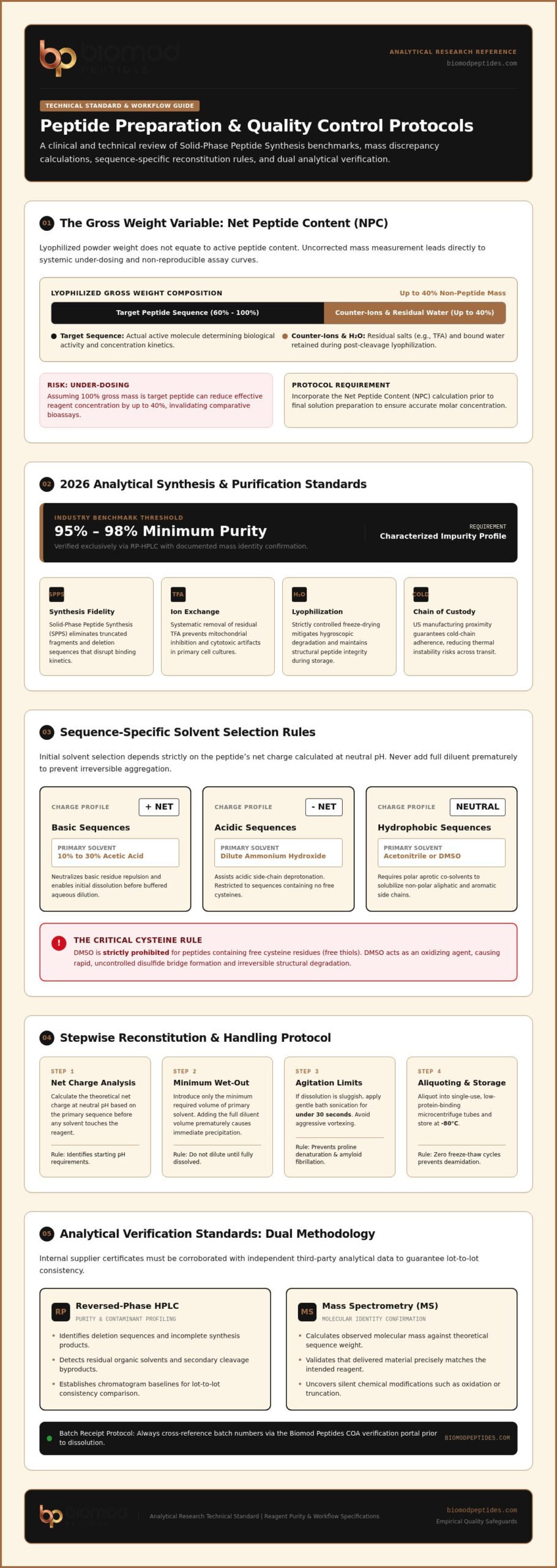
Up to 40% of a lyophilized peptide’s gross weight often consists of counter-ions and residual water rather than the target sequence. This discrepancy frequently leads to systemic under-dosing and failed assays. Adopting rigorous peptide preparation protocols for research labs is the only way to mitigate these hidden variables. Experimental reproducibility depends on chemical integrity. Inconsistent purity levels and degradation during reconstitution shouldn’t compromise your data.
This technical roundup provides a clinical review of modern synthesis standards, verified reconstitution workflows, and 2026 analytical verification protocols. We examine the transition to green solvents, the Net Peptide Content calculation, and the precise solvent selection rules required for high-purity laboratory research. Expect a focus on structural integrity and empirical proof to standardize your laboratory workflow.
Key Takeaways
- Analyze how Solid-Phase Peptide Synthesis (SPPS) establishes the purity foundation required for consistent experimental outcomes.
- Optimize solubility and prevent aggregation by applying standardized peptide preparation protocols for research labs based on sequence-specific hydrophobicity.
- Validate reagent integrity through rigorous interpretation of third-party HPLC and Mass Spectrometry verification data.
- Establish a disciplined workflow for stepwise reconstitution to maintain the structural stability of high-purity laboratory reagents.
Modern Synthesis and Preparation Standards in Peptide Research
Precision in biochemical research begins at the molecular level. solid-phase peptide synthesis (SPPS) remains the primary methodology for generating high-fidelity reagents. Crude purity levels directly dictate the success of subsequent purification cycles. Poor synthesis results in deletion sequences and truncated fragments. These impurities skew concentration curves. They invalidate bioassay results. Rigorous peptide preparation protocols for research labs start with the initial chemical assembly.
Standardizing these workflows requires a focus on structural integrity. Lyophilization must be strictly controlled to prevent hygroscopic degradation. US-based manufacturing at Biomod Peptides ensures logistical transparency. It facilitates strict cold-chain adherence from synthesis to finishing. This domestic proximity reduces the risk of thermal instability during transit. It provides researchers with a verifiable chain of custody for every reagent batch.
Refining Purification Benchmarks for Laboratory Reagents
Achieving analytical grade results requires sophisticated multi-step purification. Residual trifluoroacetic acid (TFA) and organic solvents must be systematically removed via ion exchange. TFA is a known mitochondrial inhibitor. Its presence leads to cytotoxic artifacts in primary cell cultures. High-throughput environments demand absolute lot-to-lot consistency. Every batch undergoes HPLC and Mass Spectrometry verification. This ensures structural identity remains constant across longitudinal studies.
Analytical Grade Purity Standards for 2026 Research
Analytical grade purity in 2026 is defined as a minimum threshold of 95% to 98% verified by RP-HPLC, incorporating documented mass identity confirmation and characterized impurity profiles to ensure experimental reproducibility.
Advanced Handling Protocols: Reconstitution and Solubility Optimization
Transitioning from a lyophilized powder to a stable solution requires more than simple dilution. Successful dissolution depends on a quantitative assessment of the peptide’s primary sequence. Researchers must calculate the net charge at neutral pH to identify the optimal starting solvent. Following established peptide laboratory supply standards ensures reagents remain sterile and free from bacterial endotoxins. Implementing peptide preparation protocols for research labs involves a stepwise approach. Adding the full diluent volume prematurely often causes irreversible precipitation. Use the minimum volume of primary solvent first to ensure complete wet-out.
Precision at this stage mirrors the rigor found in the analytical procedures and methods validation guidance regarding chemical stability. If dissolution is sluggish, apply gentle bath sonication for under 30 seconds. Avoid aggressive vortexing. Physical shearing can denature multi-proline repeats or induce fibrillation in amyloidogenic sequences. Maintaining structural integrity is paramount for reproducible data.
Solvent Selection and pH Management for Difficult Sequences
Net positive peptides typically require 10% to 30% acetic acid for solubility. For net negative sequences, utilize dilute ammonium hydroxide, provided the sequence contains no free cysteines. Highly hydrophobic research compounds may necessitate polar aprotic co-solvents like DMSO or acetonitrile. However, the Critical Cysteine Rule prohibits DMSO use for peptides with free thiols due to rapid oxidation risks. After successful reconstitution, aliquot the solution into single-use, low-protein-binding microcentrifuge tubes. Store these at -80°C to mitigate deamidation and hydrolysis. Avoiding repeated freeze-thaw cycles is essential when handling high-purity research peptides.
Verification and Quality Control: Utilizing Analytical Grade Standards
Empirical proof serves as the final safeguard in high-purity research. Relying solely on internal manufacturer data introduces unacceptable variables into a study. Independent third-party verification via HPLC and Mass Spectrometry is now the industry baseline. HPLC analysis identifies deletion sequences and residual organic contaminants that might skew bioactivity results. Mass Spectrometry confirms the molecular identity by matching the observed mass to the theoretical sequence weight. These peptide preparation protocols for research labs ensure that the reagent used matches the reagent intended.
Accountability requires transparent documentation. Utilize the Biomod Peptides COA verification portal to cross-reference batch numbers with original analytical reports. This real-time validation prevents lot-to-lot inconsistencies from compromising longitudinal data. Every laboratory receipt should trigger a formal verification protocol. Cross-referencing the HPLC chromatogram for baseline noise and peak symmetry provides an immediate assessment of chemical integrity before any assay begins.
Implementing Third-Party Accountability in Las Vegas Labs
Regional facilities in Nevada benefit from sourcing US-manufactured reagents. Domestic production minimizes the thermal stress associated with international transit. Integrating peptide purity verification into standard operating procedures (SOPs) is essential for institutional compliance. Modern labs are transitioning toward digital documentation and blockchain-verified certificates of analysis. These immutable records provide a permanent audit trail for every reagent. This level of logistical transparency supports the rigorous demands of 2026 analytical standards.
Standardizing Analytical Excellence for Future Research
Experimental success in 2026 requires a disciplined approach to reagent management. High-purity synthesis and precise solvent selection form the core of reliable data. Adopting standardized peptide preparation protocols for research labs eliminates the chemical variables that frequently cause study failure. Verification isn’t merely an option; it’s a fundamental requirement for institutional accountability. Maintaining structural integrity from the moment of receipt to the final bioassay ensures longitudinal consistency across complex studies. Precision at the bench translates directly to the validity of your findings.
Biomod Peptides supports these rigorous standards through US-based manufacturing and independent third-party testing on every lot. Our clinical-grade reagents are finished domestically to ensure maximum stability and logistical transparency. Access our COA Verification Portal for analytical grade research peptides to validate your reagents with empirical data in real-time. Elevate your methodology and secure your research outcomes with uncompromising quality.
Frequently Asked Questions
What is the standard protocol for reconstituting lyophilized research peptides?
Reconstitution begins with a stepwise addition of diluent based on the peptide’s calculated net charge. Researchers in Las Vegas labs should prioritize sterile, degassed solvents to prevent oxidation. Standard peptide preparation protocols for research labs dictate adding the minimum volume required for initial dissolution before further dilution. This method prevents the irreversible precipitation often seen in high-concentration stock solutions.
How do researchers determine the solubility of a specific peptide sequence?
Solubility is determined by evaluating the ratio of hydrophobic residues to charged amino acids within the sequence. A net positive charge suggests a requirement for 10% acetic acid; a net negative charge indicates 0.1% ammonium hydroxide. Sequences with over 25% hydrophobic residues usually require organic co-solvents like DMSO or acetonitrile to achieve full dissolution without inducing fibrillation.
Why is third-party HPLC verification necessary for laboratory reagents?
Independent HPLC verification provides objective proof of reagent purity and structural identity. It identifies insertion fragments or truncated sequences that could skew experimental results. Biomod Peptides facilitates this through a dedicated COA verification portal. This system allows Las Vegas researchers to validate lot-specific data against third-party analytical standards before beginning sensitive analytical or experimental assays.
How should research peptides be stored to ensure long-term stability?
Long-term stability requires storage at -20°C or -80°C in a manual-defrost freezer to prevent thermal fluctuations. Reconstituted peptides must be aliquoted into single-use, low-protein-binding tubes. This practice minimizes the risk of deamidation and hydrolysis caused by repeated freeze-thaw cycles. Protecting vials from light and moisture maintains the chemical integrity of US-manufactured reagents throughout the study duration.
Disclaimer
BIOMOD products are sold strictly for laboratory, analytical, and scientific research use only. They are not intended for human or animal consumption, administration, application, ingestion, injection, or any therapeutic, diagnostic, or cosmetic use.
The statements made on this website have not been evaluated by the United States Food and Drug Administration. BIOMOD products are not intended to diagnose, treat, cure, mitigate, or prevent any disease or medical condition.
BIOMOD is a research chemical supplier. BIOMOD is not a compounding pharmacy or chemical compounding facility as defined under Section 503A of the Federal Food, Drug, and Cosmetic Act. BIOMOD is not an outsourcing facility as defined under Section 503B of the Federal Food, Drug, and Cosmetic Act.
By accessing this site, you confirm you are at least 21 years of age and that you have read and accepted the BIOMOD Terms of Sale, Privacy Policy, and Research Use Only Policy. BIOMOD does not provide dosing, medical, therapeutic, diagnostic, veterinary, or use guidance under any channel.