
A peptide sequence is only as reliable as the analytical verification behind it. Many researchers encounter inconsistent results driven by batch-to-batch variability and hidden synthesis byproducts. You recognize that minor impurities compromise the integrity of complex cellular environments. This guide establishes the technical criteria for selecting high-purity peptide reagents for in vitro cellular assays to ensure your data remains reproducible and scientifically sound.
We’ll focus on achieving verified purity levels exceeding 98% and the critical elimination of TFA contaminants that threaten cell viability. You’ll learn to navigate COA documentation with precision and leverage US-based manufacturing for logistical reliability in Las Vegas facilities. We examine the transition from standard reagents to laboratory-grade materials supported by rigorous third-party testing and objective verification protocols. Precision in selection is the first step toward experimental success.
Key Takeaways
- Establish a 98% purity benchmark to mitigate the risk of residual TFA and synthesis byproducts that compromise cellular viability and phenotype.
- Select specialized peptide reagents for in vitro cellular assays that minimize background fluorescence to ensure high-resolution signal clarity in confocal microscopy.
- Prioritize US-manufactured supply chains to secure logistical transparency and rigorous quality control for Las Vegas research facilities.
- Audit reagent integrity using independent third-party testing and digital COA verification portals to maintain data reproducibility across complex experimental lots.
Technical Requirements for Peptide Reagents in In Vitro Cellular Assays
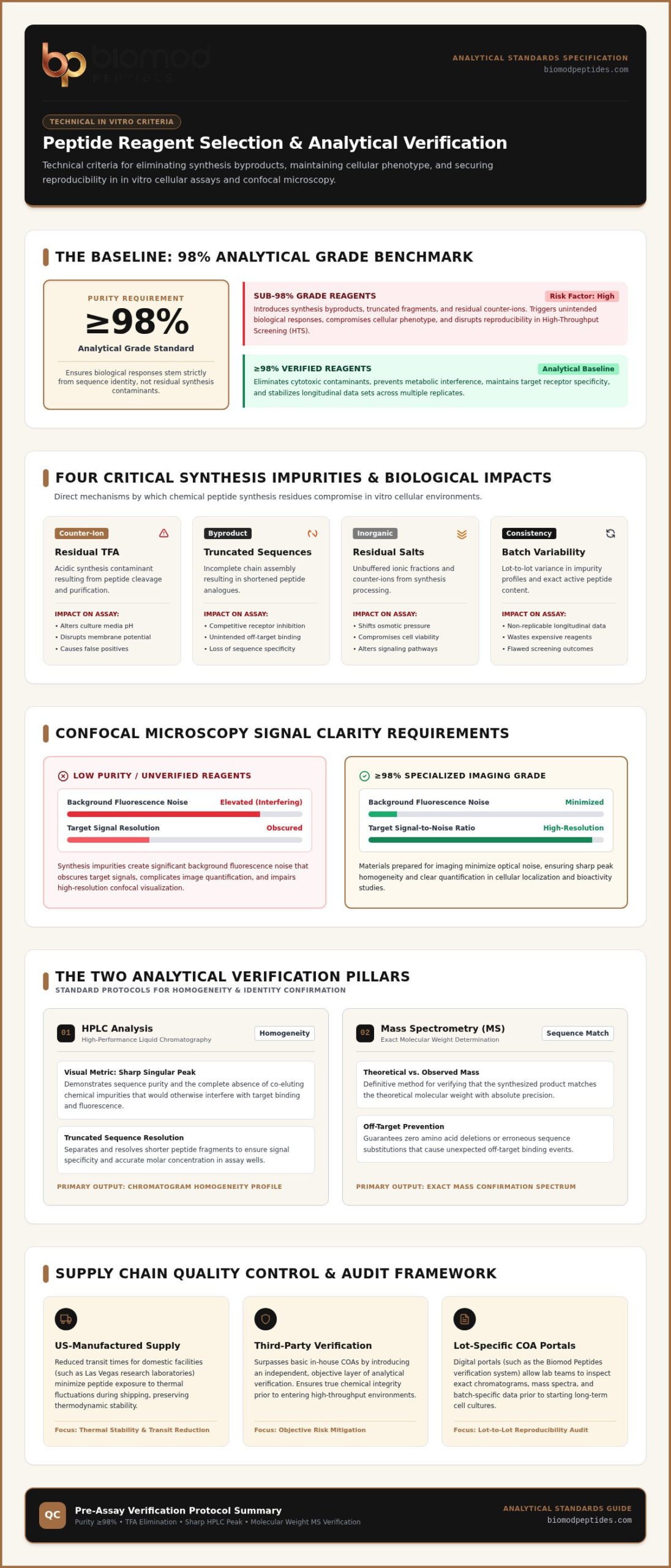
High-purity peptide reagents for in vitro cellular assays are fundamental for maintaining cellular phenotype. Using reagents with less than 98% purity introduces synthesis byproducts that can trigger unintended biological responses. These impurities often include truncated sequences, residual solvents, and counter-ions resulting from the chemical peptide synthesis process. In high-throughput screening (HTS), even minor batch-to-batch variability disrupts reproducibility and wastes expensive laboratory resources. Meticulous removal of these contaminants is mandatory to prevent cytotoxicity and ensure that observed effects stem from the peptide sequence itself rather than its impurities.
Understanding the Impact of Impurities on Assay Reproducibility
Acidic contaminants like Trifluoroacetic Acid (TFA) represent a primary concern. TFA can significantly alter the pH of cell culture media, interfering with sensitive signaling pathways and metabolic activity. This acidification often leads to false positives in bioactivity assays, masking the true experimental outcome. Establishing a baseline of ‘analytical grade’ (98% or higher) is essential for modern cellular research. It’s vital to verify lot-specific data through a digital COA portal before initiating long-term cultures. Precise documentation ensures that experimental results remain consistent across multiple replicates.
- TFA: Disrupts intracellular pH and membrane potential.
- Truncated Sequences: Can competitively inhibit target receptors or cause off-target binding.
- Residual Salts: Affect osmotic pressure and overall cell viability.
- Batch Variability: Leads to non-replicable data in longitudinal studies.
Reagents for Confocal Microscopy Peptide Studies and Verification
High-resolution confocal microscopy requires reagents with exceptional optical clarity. When utilizing peptide reagents for in vitro cellular assays in imaging studies, impurities can cause significant background fluorescence. This noise obscures target signals and complicates data quantification. Researchers must select materials that adhere to established guidelines for peptide procurement and handling to ensure high signal-to-noise ratios. Verification of these standards is possible through the Biomod Peptides COA verification portal. It’s a tool that allows laboratory teams to audit the specific analytical data of each lot before beginning sensitive imaging protocols.
Verification Protocols: HPLC and Mass Spectrometry Standards
Analytical verification relies on two primary pillars: High-Performance Liquid Chromatography (HPLC) and Mass Spectrometry (MS). HPLC chromatograms provide a visual representation of sequence homogeneity. A sharp, singular peak indicates the absence of co-eluting impurities that might interfere with fluorescence. HPLC verification ensures the absence of truncated sequences in imaging reagents by resolving and identifying shorter peptide fragments that would otherwise compromise signal specificity.
Mass Spectrometry supplements this by confirming the exact molecular weight. It’s the definitive method for identifying whether the synthesized product matches the theoretical sequence with absolute precision. This level of verification prevents the use of incorrect sequences that could lead to off-target binding when applying peptide reagents for in vitro cellular assays. You can learn about our peptide purity verification protocols to understand the depth of our internal benchmarks. For labs requiring absolute data integrity, reviewing these documents at Biomod Peptides remains a critical step in the procurement process.
Procurement Strategies for Laboratory Peptide Supply in Las Vegas
Selecting peptide reagents for in vitro cellular assays requires a rigorous evaluation of the supply chain. Vendor accountability often differentiates reproducible research from failed experiments. Relying solely on in-house certificates of analysis (COAs) introduces unnecessary risk. Independent third-party testing provides an objective layer of verification that ensures chemical integrity. For laboratories managing high-throughput environments, strategic procurement must prioritize lot-to-lot consistency and transparent documentation. Establishing a reliable baseline for bulk research peptides involves auditing the provider’s analytical standards and manufacturing origin.
Leveraging US-Manufactured Peptides for Experimental Integrity
Las Vegas research facilities benefit significantly from domestic supply chains. Reduced transit times directly impact peptide stability by minimizing exposure to thermal fluctuations during shipping. Peptides are inherently sensitive to environmental stress. US-manufactured and finished materials offer superior logistical transparency compared to international alternatives. Direct procurement through Biomod Peptides ensures that every lot undergoes standardized validation protocols before reaching the bench.
Quality control remains the final bottleneck in experimental workflows. US-based finishing allows for immediate oversight of purification and lyophilization processes. This proximity facilitates faster response times for technical inquiries and custom synthesis requirements. Researchers should consult this guide on Navigating laboratory peptide supply in the USA to optimize their procurement frameworks. Maintaining high-tier reliability in Las Vegas laboratories depends on this intersection of logistical efficiency and rigorous analytical verification.
Advancing Experimental Precision with Verified Reagents
The integrity of your data depends on the elimination of synthesis byproducts and residual contaminants. Prioritizing a 98% purity benchmark ensures that experimental observations reflect intended biological interactions rather than cytotoxic interference. Sourcing US-manufactured materials provides Las Vegas laboratories with logistical stability and transparent quality control. Integrating these rigorous standards into your procurement workflow mitigates the risk of batch variability. It prevents off-target effects in complex environments.
Utilizing high-purity peptide reagents for in vitro cellular assays is a technical necessity for reproducible research. Every lot must meet strict adherence to research-only laboratory standards. Verification occurs through an independent third-party portal. You can secure high-purity reagents for your next in vitro study at Biomod Peptides, where analytical grade peptides are supported by meticulous documentation. Precision in reagent selection establishes the foundation for definitive scientific advancement. Your commitment to these analytical benchmarks ensures the credibility of your laboratory’s output.
Frequently Asked Questions
What is the recommended purity level for peptide reagents in cellular assays?
For most sensitive experimental designs, a purity level of 98% or higher is the industry standard. Using peptide reagents for in vitro cellular assays with lower purity introduces truncated sequences and synthesis byproducts. These impurities can trigger unintended biological responses or mask the true effects of the target sequence. Maintaining this high benchmark is essential for data reproducibility in rigorous laboratory settings.
How do I verify the certificate of analysis for research peptides?
Researchers should verify analytical data through a dedicated COA verification portal. This process involves entering the specific lot number to access independent HPLC and Mass Spectrometry reports. These documents confirm sequence homogeneity and molecular weight accuracy. Biomod Peptides provides this digital transparency to ensure that every reagent meets documented purity standards before it reaches the bench in Las Vegas facilities.
Are US-manufactured peptides necessary for in vitro research?
US-manufactured peptides provide significant logistical advantages that preserve experimental integrity. For research facilities in Las Vegas, domestic production minimizes the risk of peptide degradation caused by long-distance thermal fluctuations during transit. Local supply chains ensure faster delivery and greater vendor accountability. This proximity allows for stricter oversight of the finishing and quality control processes compared to international providers.
Can residual TFA affect the results of my cellular assay?
Residual Trifluoroacetic Acid (TFA) can significantly impact assay outcomes by altering the pH of the cell culture environment. Even trace amounts of this counter-ion may lead to cytotoxicity or interfere with delicate cell signaling pathways. Choosing peptide reagents for in vitro cellular assays that undergo thorough desaltation or TFA removal is critical to prevent false positives and maintain baseline cellular health.
Disclaimer
BIOMOD products are sold strictly for laboratory, analytical, and scientific research use only. They are not intended for human or animal consumption, administration, application, ingestion, injection, or any therapeutic, diagnostic, or cosmetic use.
The statements made on this website have not been evaluated by the United States Food and Drug Administration. BIOMOD products are not intended to diagnose, treat, cure, mitigate, or prevent any disease or medical condition.
BIOMOD is a research chemical supplier. BIOMOD is not a compounding pharmacy or chemical compounding facility as defined under Section 503A of the Federal Food, Drug, and Cosmetic Act. BIOMOD is not an outsourcing facility as defined under Section 503B of the Federal Food, Drug, and Cosmetic Act.
By accessing this site, you confirm you are at least 21 years of age and that you have read and accepted the BIOMOD Terms of Sale, Privacy Policy, and Research Use Only Policy. BIOMOD does not provide dosing, medical, therapeutic, diagnostic, veterinary, or use guidance under any channel.