
A signed Material Transfer Agreement (MTA) often dictates the future of your intellectual property before the first pipetting step occurs. Many researchers inadvertently sign away downstream rights to the provider in exchange for access to specialized sequences. It’s a high-stakes trade-off that compromises the commercial viability of your findings. You understand that precision in the lab must be matched by precision in the contract. Navigating material transfer agreements for peptides requires a rigorous approach to both legal language and analytical verification. This article delivers a technical framework to master these complexities, ensuring your IP remains protected and your material purity is independently verified. We will examine the structural differences between the Uniform Biological Material Transfer Agreement (UBMTA) and custom contracts. You’ll also learn to implement verification protocols that prevent the use of degraded or unverified sequences in your research.
Key Takeaways
- Understand the critical distinction between incoming and outgoing MTAs. Align every reagent acquisition with your laboratory’s long-term research objectives.
- Establish a rigorous protocol for navigating material transfer agreements for peptides. Evaluate proprietary status and compare provider terms against the UBMTA framework.
- Streamline procurement and reduce legal friction. Utilize US-manufactured vendors that provide transparent analytical documentation and third-party verification.
- Protect downstream intellectual property and ensure sequence integrity. Implement standardized verification protocols to safeguard your experimental results.
Understanding the Role of MTAs in Peptide Research and Procurement
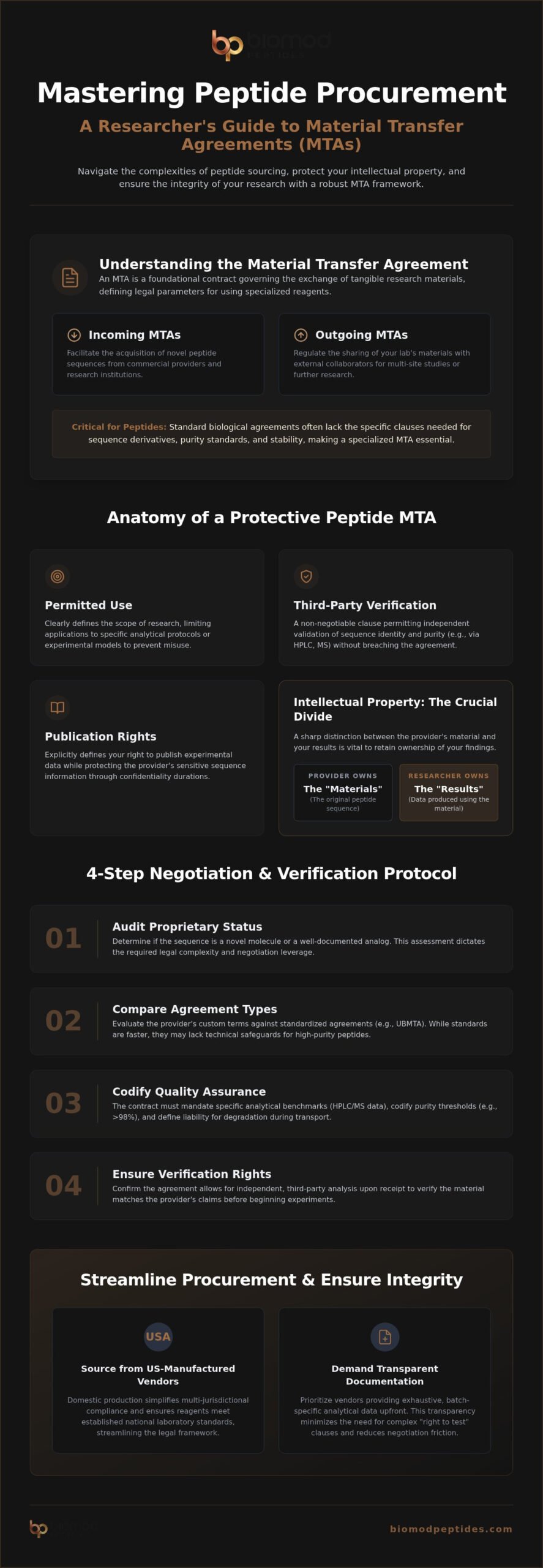
A Material Transfer Agreement (MTA) is a foundational contract governing the exchange of tangible research substances between organizations. In peptide procurement, these documents define the legal parameters for using specialized reagents in a laboratory setting. Incoming MTAs facilitate the acquisition of novel sequences from commercial providers. Outgoing MTAs regulate sharing materials with external collaborators for multi-site studies. Navigating material transfer agreements for peptides requires a granular understanding of how these contracts protect proprietary interests and define researcher obligations.
Peptides demand specialized contractual language that generic biological agreements often lack. Standard contracts may overlook the nuances of sequence derivatives or structural analogs. For industrial and academic laboratories in Las Vegas, these documents are a mandatory legal safeguard. They address specific regional requirements for high-precision research:
- Rigorous chain of custody documentation for high-purity reagents.
- Defined liability parameters for experimental outcomes.
- Prohibitions on unauthorized synthesis of modified analogs.
These clauses ensure sequence integrity and legal compliance before any benchwork commences. It’s a critical step in maintaining the structural integrity of a research project.
Key Provisions: Intellectual Property and Usage Scope
MTAs must define the “permitted use” of a peptide reagent with absolute clarity. This scope limits applications to specific analytical protocols or experimental models. A sharp distinction between “Materials” and “Results” is required. The provider maintains ownership of the sequence; the researcher must retain ownership of the data produced. Contracts should also permit material transfer to third-party labs for verification. This allows for independent validation of purity through documented testing without breaching the core agreement.
A Step-by-Step Protocol for Negotiating Peptide Transfer Terms
Successful negotiation begins with a rigorous audit of the peptide’s proprietary status. You must determine if the sequence is a novel molecule or a well-documented analog. This assessment dictates the complexity of the legal language required. Navigating material transfer agreements for peptides often involves comparing a provider’s custom terms against Standardized Transfer Agreements like the UBMTA. While standardized forms accelerate the process, they may lack the specific technical safeguards needed for high-purity reagents. Contracts should explicitly define publication rights and confidentiality durations. This prevents providers from blocking the release of experimental data while protecting sensitive sequence information.
Independent verification is a non-negotiable clause. Your agreement must permit the use of third-party analytical services to confirm sequence identity. This step ensures that the material received matches the provider’s claims before you invest laboratory resources. For those seeking reagents with pre-validated transparency, sourcing through a provider with a dedicated verification portal streamlines this requirement and reduces contractual friction.
Addressing Technical Specifications and Quality Assurance
Agreement language must incorporate specific analytical benchmarks. High-Performance Liquid Chromatography (HPLC) and Mass Spectrometry (MS) data should be mandatory deliverables. Purity thresholds, typically exceeding 98%, must be codified in the contract. Liability for material degradation is another critical factor. Transport to Las Vegas facilities involves exposure to environmental fluctuations that can compromise peptide stability. The MTA should define clear protocols for reporting discrepancies. If the material purity fails to meet the agreed-upon standards upon arrival, the contract must outline the specific replacement or refund procedure. Precision is mandatory. Contracts must reflect the data.
Streamlining Procurement Through Standardized Verification
Sourcing from US-manufactured vendors provides a streamlined legal and logistical framework for modern laboratories. Domestic production ensures that reagents meet established national laboratory standards; this reduces the complexity of multi-jurisdictional compliance. Navigating material transfer agreements for peptides becomes significantly more efficient when vendors provide exhaustive analytical documentation upfront. When a provider offers batch-specific data, the need for complex “right to test” clauses is minimized. This transparency allows researchers to bypass lengthy negotiations over verification rights. For high-throughput facilities in Las Vegas, managing procurement requires a focus on logistical transparency and rapid validation. It’s about data, not promises.
Third-party testing serves as an objective benchmark in validating MTA compliance. It confirms that the material delivered aligns with contractual purity requirements. By utilizing vendors that prioritize analytical proof, labs protect their experimental timelines. This approach ensures that institutional record-keeping remains robust and verifiable. Standardized verification protocols transform the MTA from a hurdle into a routine procedural step. Precision remains the priority.
Leveraging Third-Party Testing and COA Portals
Effective documentation is the backbone of contractual compliance. Researchers can use the COA Verification Portal to satisfy institutional documentation requirements instantly. Integrating these third-party purity reports into your internal records ensures long-term data integrity. This level of transparency is essential when optimizing the supply chain for high purity research peptides. Accessing batch-specific HPLC and MS data at the point of procurement eliminates the uncertainty of sequence verification. It’s a method that allows your team to focus on results rather than administrative friction.
Advancing Laboratory Standards Through Contractual Precision
Rigorous research depends on the intersection of legal protection and analytical accuracy. Protecting your intellectual property requires a precise definition of usage scope and result ownership. Technical verification isn’t a luxury; it’s a mandatory safeguard for sequence integrity. Navigating material transfer agreements for peptides becomes a streamlined process when you prioritize vendors that provide transparent, batch-specific data. Integrating HPLC and Mass Spectrometry standards directly into your contracts eliminates the risks of material degradation and unverified sequences. This proactive approach ensures your laboratory resources are invested in validated reagents that produce reliable, reproducible results. Biomod Peptides supports these institutional standards through US manufacturing and independent third-party testing. Access our verification portal to simplify your documentation requirements today. Secure your research with high-purity peptides from Biomod Peptides. Your commitment to precision starts with verified material.
Frequently Asked Questions
What is the difference between an MTA and a purchase agreement for peptides?
An MTA governs the transfer of tangible research material and defines legal rights regarding intellectual property and usage scope. A purchase agreement typically transfers ownership of a commercial product without imposing restrictive research conditions. For Las Vegas laboratories, an MTA is essential when dealing with proprietary sequences where the provider retains specific ownership rights over the material.
Can I use a UBMTA for synthetic peptides from a commercial vendor?
The Uniform Biological Material Transfer Agreement (UBMTA) is a standardized framework primarily used among academic and non-profit institutions. While possible, commercial vendors often require custom terms to protect proprietary synthesis methods. Navigating material transfer agreements for peptides involving commercial entities usually requires specific clauses that address sequence modifications and commercialization rights that the standard UBMTA lacks.
Who owns the modifications made to a peptide sequence under a standard MTA?
Ownership of modifications depends on the specific “reach-through” provisions within the agreement. Most standard MTAs stipulate that the provider retains ownership of the original material and any subsequent derivatives or analogs. The researcher typically maintains rights to experimental data and results. Las Vegas research teams must verify these definitions to ensure they don’t inadvertently surrender intellectual property rights.
What happens if the peptide purity does not match the provided COA?
If independent third-party testing reveals a purity discrepancy, the researcher should initiate the “non-conforming material” protocol defined in the MTA. Most agreements provide a specific window to report analytical failures. For Las Vegas facilities, utilizing a provider with a COA verification portal ensures that institutional records are synchronized with the most current laboratory data before any experimental benchwork begins.
Disclaimer
BIOMOD products are sold strictly for laboratory, analytical, and scientific research use only. They are not intended for human or animal consumption, administration, application, ingestion, injection, or any therapeutic, diagnostic, or cosmetic use.
The statements made on this website have not been evaluated by the United States Food and Drug Administration. BIOMOD products are not intended to diagnose, treat, cure, mitigate, or prevent any disease or medical condition.
BIOMOD is a research chemical supplier. BIOMOD is not a compounding pharmacy or chemical compounding facility as defined under Section 503A of the Federal Food, Drug, and Cosmetic Act. BIOMOD is not an outsourcing facility as defined under Section 503B of the Federal Food, Drug, and Cosmetic Act.
By accessing this site, you confirm you are at least 21 years of age and that you have read and accepted the BIOMOD Terms of Sale, Privacy Policy, and Research Use Only Policy. BIOMOD does not provide dosing, medical, therapeutic, diagnostic, veterinary, or use guidance under any channel.