
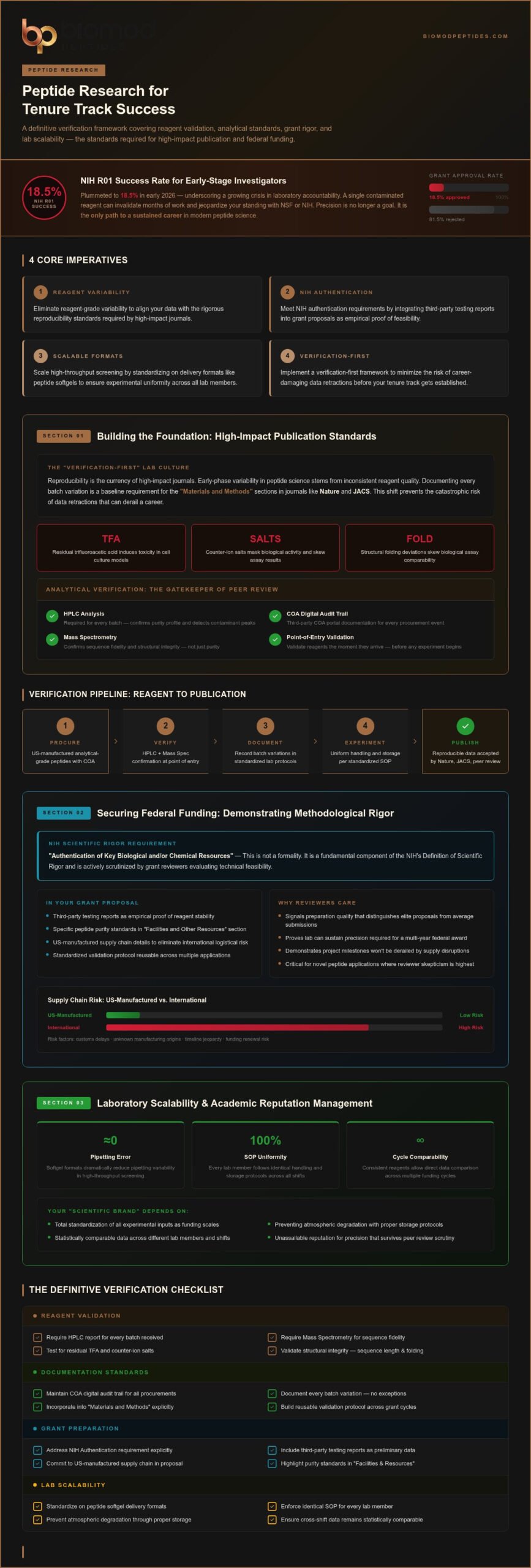
The NIH R01 success rate for early-stage investigators plummeted to 18.5% in early 2026. This statistical reality underscores a growing crisis in laboratory accountability. You understand that a single contaminated reagent can invalidate months of work and jeopardize your standing with the NSF or NIH. Securing peptide research for tenure track success now demands an uncompromising approach to analytical rigor. It’s no longer enough to produce data. You must verify it through every stage of the research lifecycle. This guide provides a definitive checklist for mastering the procedural standards required for high-impact publications in journals like JACS and Nature. We’ll examine reagent validation, third-party COA transparency, and the specific documentation protocols that safeguard your laboratory’s reputation for precision. Precision isn’t just a goal. It’s the only path to a sustained career in modern peptide science.
Key Takeaways
- Eliminate reagent-grade variability to align your data with the rigorous reproducibility standards required by high-impact journals.
- Meet NIH authentication requirements by integrating third-party testing reports into your grant proposals for empirical proof of feasibility.
- Scale high-throughput screening by standardizing on delivery formats like peptide softgels for research to ensure experimental uniformity.
- Implement a verification-first framework in peptide research for tenure track success to minimize the risk of career-damaging data retractions.
Building the Foundation: High-Impact Publication Standards
Reproducibility is the currency of high-impact journals. In peptide science, early-phase variability often stems from inconsistent reagent quality. Eliminating this noise is essential for peptide research for tenure track success. You must establish a “Verification-First” lab culture. This shift prevents the catastrophic risk of data retractions that can derail a career before it begins. Using analytical grade peptides ensures that longitudinal results remain consistent across years of study. This consistency allows for the direct comparison of data sets generated across different funding cycles. Documenting every batch variation is no longer optional. It is a baseline requirement for the “Materials and Methods” sections in journals like Nature or JACS. Even minor deviations in peptide basics like sequence length or structural folding can skew biological assays. Precise documentation transforms a standard experimental record into a strategic career asset.
Analytical Verification: The Gatekeeper of Peer Review
Sequence identity must be confirmed through empirical data. Require HPLC and Mass Spectrometry for every batch received. This isn’t just about purity. It’s about sequence fidelity and structural integrity. The Biomod Peptides COA verification portal provides a digital audit trail to simplify this documentation. Beyond identity, you must validate the absence of contaminants. Residual trifluoroacetic acid (TFA) or specific counter-ion salts can introduce unintended variables into cell culture or in vivo models. These impurities often ruin months of experimental work by inducing toxicity or masking biological activity. Rigorous verification ensures your laboratory’s reputation for precision remains unassailable during the peer review process. Validating reagents at the point of entry is the only way to safeguard your findings against the data reproducibility crisis.
Securing Federal Funding: Demonstrating Methodological Rigor
Grant reviewers increasingly scrutinize the technical feasibility of proposed studies. To secure peptide research for tenure track success, you must explicitly address the NIH “Authentication of Key Biological and/or Chemical Resources” requirement. This isn’t a formality. It’s a fundamental component of the NIH’s Definition of Scientific Rigor. Providing empirical proof of reagent stability through third-party testing reports signals a level of preparation that distinguishes elite proposals. Including specific peptide purity standards in your “Facilities and Other Resources” section demonstrates institutional quality. It proves your lab can sustain the precision required for a multi-year federal award.
International logistical risks can derail project timelines and jeopardize funding renewals. Committing to US-manufactured supply chains minimizes these variables. It ensures that your research milestones aren’t delayed by customs hurdles or unknown manufacturing origins. This reliability is a key metric for reviewers assessing the feasibility of your project plan. Eliminating these uncertainties allows you to focus on the core scientific questions that drive grant success.
Documenting Reagent Integrity in Grant Biosketches
Standardizing your validation protocol creates a reusable asset for multiple applications. Highlighting the use of US manufactured research peptides emphasizes both quality control and supply chain security. Analytical verification acts as a trust-builder. It provides preliminary data that reassures reviewers about the integrity of your chemical resources. This level of detail is particularly effective when proposing novel peptide applications where skepticism is high. By documenting every step of the procurement and verification process, you build a narrative of uncompromising laboratory standards. For those looking to strengthen their next submission, sourcing from a provider that prioritizes verified analytical standards is a strategic first step.
Laboratory Scalability and Academic Reputation Management
Scaling a laboratory requires more than just increased funding. It necessitates the total standardization of experimental inputs. Utilizing formats like peptide softgels for research allows for high-throughput screening with significantly reduced pipetting error. This uniformity is vital for peptide research for tenure track success. It ensures that data generated by different lab members across various shifts remains statistically comparable. Your “Scientific Brand” depends entirely on this level of internal precision. Every graduate student must follow identical handling and storage protocols to prevent atmospheric degradation or contamination. Key components of this protocol include:
- Strict temperature-controlled storage at -20°C or -80°C depending on peptide stability.
- Desiccation protocols to prevent moisture absorption during reagent weighing.
- Single-use aliquotting to avoid repeated freeze-thaw cycles that compromise integrity.
This discipline builds the necessary framework for collaboration with Las Vegas research institutions. Transparent, verified data sets become your laboratory’s primary calling card in the academic community. Maintaining a long-term inventory of analytical-grade reagents is another essential pillar of scalability. It eliminates the variable of batch-to-batch inconsistency over the course of multi-year studies. Consistency is the ultimate foundation of institutional trust and long-term funding viability.
Standardizing Protocols with US-Manufactured Reagents
Batch-to-batch drift can quietly invalidate years of longitudinal data. Sourcing from a single, high-purity US laboratory supply minimizes this risk by ensuring identical manufacturing conditions across all lots. You must integrate peptide science trends into your core methodology to remain globally competitive. This integration includes establishing a robust “Chain of Custody” for all research materials. From initial procurement to final experimental analysis, every step must be documented and verified. US-based manufacturing provides the logistical transparency required to satisfy federal auditors and departmental reviewers. It ensures that your laboratory remains at the absolute cutting edge of analytical rigor and professional accountability.
Securing the Future of Your Academic Record
Analytical rigor is the differentiator in a saturated funding environment. You’ve established that publication standards and federal grant success depend on the integrity of your chemical resources. Transitioning from basic experimentation to scalable, high-impact science requires a commitment to documented verification. By standardizing your protocols and procurement, you eliminate the variables that threaten data reproducibility. This precision is the core of peptide research for tenure track success. Every batch must be validated. Every sequence must be confirmed.
Biomod Peptides provides the structural integrity your laboratory requires through US-manufactured and finished products. Every reagent undergoes independent third-party verification to ensure your research remains unassailable. Secure COA access through our portal allows you to document this transparency for peer review or grant biosketches. Explore Analytical Grade Peptides for Your Tenure-Track Research and ensure your laboratory’s reputation for precision remains intact. A robust scientific record depends on your foundation.
Frequently Asked Questions
How does peptide purity affect the reproducibility of my research data?
Peptide purity directly impacts biological assay outcomes by removing unintended chemical variables. Impurities like residual salts or truncated sequences can induce cellular toxicity or mask the actual activity of the primary sequence. High-purity reagents are essential for peptide research for tenure track success because they ensure that experimental results remain consistent across repeated trials. This uniformity allows your lab to produce reliable data.
What documentation should I include in an NIH grant for reagent authentication?
You must include a specific authentication plan that details how you verify reagent identity and purity. Effective documentation features HPLC chromatograms and Mass Spectrometry reports for every batch. Mentioning the use of a COA verification portal demonstrates transparency. Las Vegas researchers often cite these rigorous protocols in their grant applications to signal institutional quality and project feasibility for federal reviewers.
Why is third-party testing critical for tenure-track peptide researchers?
Independent third-party testing provides an objective layer of verification that internal manufacturer reports lack. For researchers in Las Vegas, this external validation builds credibility with peer reviewers and grant committees. It acts as a safeguard against the data reproducibility crisis. Relying on verified analytical standards protects your professional reputation and minimizes the risk of career-damaging retractions or failed experiments.
How do US-manufactured peptides compare to international sources for academic research?
US-manufactured peptides offer superior supply chain security and logistical transparency compared to international alternatives. Domestic production eliminates customs delays and ensures reagents meet strict US laboratory standards. This reliability is vital for maintaining project timelines and meeting federal grant milestones. Sourcing from domestic labs provides a clear audit trail, which is foundational for peptide research for tenure track success.
Disclaimer
BIOMOD products are sold strictly for laboratory, analytical, and scientific research use only. They are not intended for human or animal consumption, administration, application, ingestion, injection, or any therapeutic, diagnostic, or cosmetic use.
The statements made on this website have not been evaluated by the United States Food and Drug Administration. BIOMOD products are not intended to diagnose, treat, cure, mitigate, or prevent any disease or medical condition.
BIOMOD is a research chemical supplier. BIOMOD is not a compounding pharmacy or chemical compounding facility as defined under Section 503A of the Federal Food, Drug, and Cosmetic Act. BIOMOD is not an outsourcing facility as defined under Section 503B of the Federal Food, Drug, and Cosmetic Act.
By accessing this site, you confirm you are at least 21 years of age and that you have read and accepted the BIOMOD Terms of Sale, Privacy Policy, and Research Use Only Policy. BIOMOD does not provide dosing, medical, therapeutic, diagnostic, veterinary, or use guidance under any channel.