
A successful pilot study is a liability if the data cannot survive the transition to high-throughput validation. The precision achieved in a small-scale batch often evaporates during longitudinal phases. You’ve likely seen how batch-to-batch variability or reagent degradation can jeopardize months of work. Scaling up peptide research from pilot to full study requires more than just increased volume. It demands a rigorous analytical framework to prevent protocol drift.
We recognize that maintaining structural integrity is the only safeguard for your findings. This article provides a technical guide for researchers transitioning to larger cohorts without losing precision. You’ll learn how to secure a reliable, US-manufactured supply chain and implement standardized verification through COA portals. We’ll also address the logistical complexities of handling high-purity reagents at scale to ensure every lot meets your established benchmarks.
Key Takeaways
- Define the scale-up phase as a critical shift from milligram pilot quantities to gram or kilogram lots where material integrity is paramount.
- Identify and mitigate batch-to-batch variability, the primary factor that compromises data during the process of scaling up peptide research from pilot to full study.
- Adopt specialized delivery formats, such as peptide softgels, to maintain unit-dose precision and protect reagent stability during high-throughput handling.
- Establish a digital paper trail through independent third-party testing and COA verification portals to ensure institutional-grade transparency for longitudinal data.
The Pilot-to-Study Transition: Defining Scalability and Material Integrity
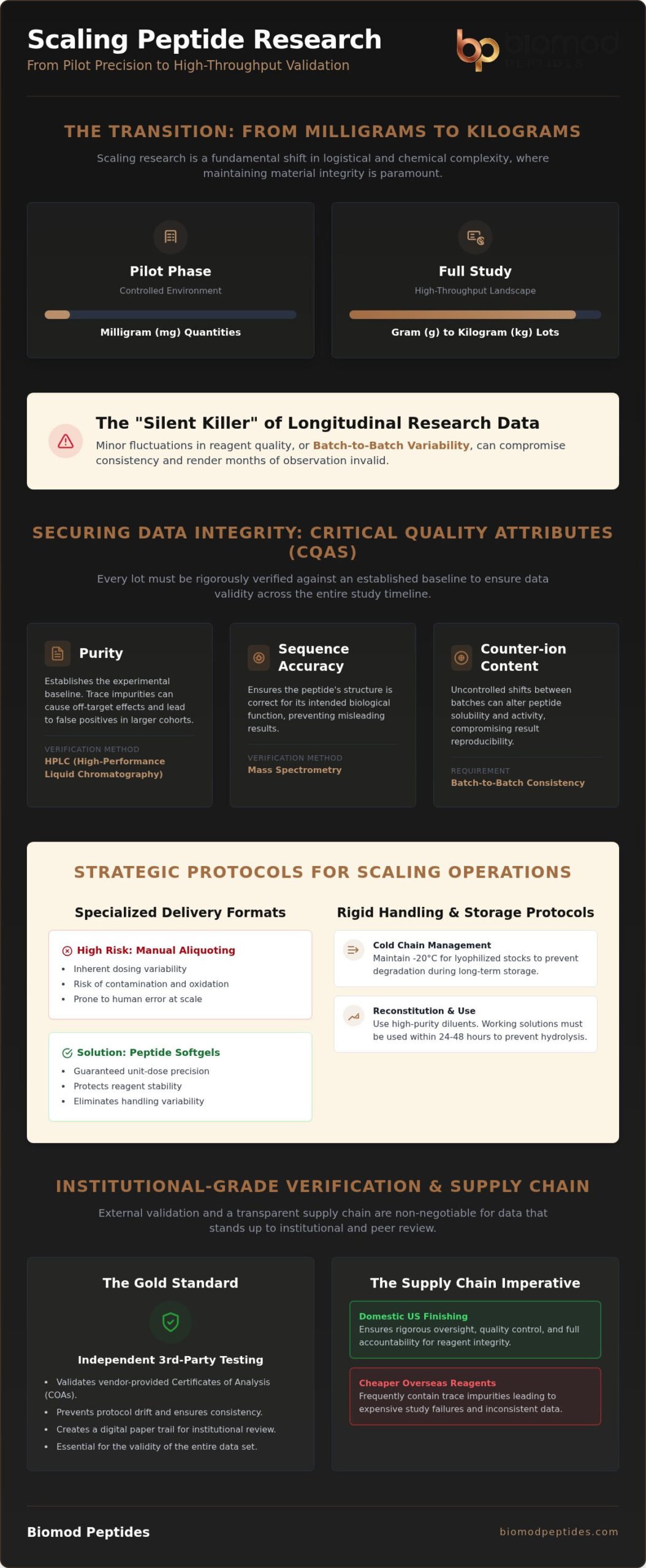
Transitioning from milligram pilot quantities to gram or kilogram experimental lots represents a fundamental shift in logistical and chemical complexity. Scaling up peptide research from pilot to full study isn’t simply a volume adjustment. It’s a risk management exercise. You’re moving from a controlled environment to a high-throughput landscape where minor errors compound. Precision is non-negotiable. Every lot must mirror the pilot’s profile exactly to ensure your data remains valid.
Batch-to-batch variability is the primary “silent killer” of longitudinal research data. Minor fluctuations in reagent quality can render months of observation invalid. Consistency is the only metric that matters. Rigorous standards are required for high-purity research peptides. You must establish a baseline for analytical verification before the full study commences. Most researchers rely on Solid-phase peptide synthesis as the foundational method, but increasing scale introduces new variables in reagent drift. This shift requires a meticulous audit of your supply chain to ensure long-term stability.
Identifying Critical Quality Attributes (CQAs) in Peptide Reagents
Purity, sequence accuracy, and counter-ion content are essential CQAs. Purity verification establishes your experimental baseline. Trace impurities often cause off-target effects in larger study cohorts. These artifacts mask true biological responses and lead to false positives. Verification must include HPLC and Mass Spectrometry for every lot. If your counter-ion content shifts between batches, your results won’t hold up. Precision at the gram scale is harder to maintain than at the milligram scale. You need a dedicated verification portal to track these attributes across the entire study timeline.
Strategic Protocols for Scaling Peptide Research Operations
Scaling up peptide research from pilot to full study requires a shift from manual handling to standardized, high-throughput protocols. You must conduct a comprehensive audit of reagent stability under these expanded conditions. High-volume handling often exposes peptides to thermal fluctuations during preparation. Transitioning to peptide softgels mitigates this risk by providing unit-dose consistency and protecting the core peptide from atmospheric oxidation. This format eliminates the variability inherent in manual aliquoting, ensuring that every subject receives an identical concentration.
Implement rigid reconstitution and storage protocols. Use only high-purity, sterile diluents to avoid microbial contamination. Every new batch must undergo a secondary verification loop to confirm it matches the pilot phase’s chemical profile. Consult our laboratory peptide supply guide to establish these analytical benchmarks before deployment. Maintaining a reliable research peptide source is the only way to ensure longitudinal success and data reproducibility.
Maintaining Stability Across High-Throughput Experimental Cycles
Effective cold chain management is critical for high-volume research. In Las Vegas facilities, specialized refrigeration systems must maintain -20°C for lyophilized stocks to prevent degradation. For specific experimental models, peptide spray products facilitate standardized intranasal delivery with minimal waste. Lyophilized storage remains superior for multi-month studies. Working solutions should be used within 24 to 48 hours to prevent hydrolysis and loss of potency. This disciplined approach ensures that your analytical integrity remains intact from the first vial to the last.
Verifying Analytical Standards During Longitudinal Research
Independent third-party testing is the only method to validate vendor-provided COAs during high-volume research. Scaling up peptide research from pilot to full study requires an unwavering commitment to data integrity through external validation. Relying solely on internal vendor data introduces unacceptable risks of protocol drift. A dedicated verification portal allows you to maintain a digital paper trail for institutional review boards or peer-reviewed publication. This level of transparency is essential for longitudinal studies where reagent consistency determines the validity of the entire data set.
The choice of supply chain often dictates study outcomes. Cheaper overseas reagents frequently contain trace impurities that lead to expensive study failures. These failures often manifest as unexplained off-target effects or inconsistent biological responses across cohorts. Domestic finishing ensures that quality control remains under rigorous oversight. It’s a matter of accountability. When you’re managing milligram-to-gram transitions, the cost of a failed cohort far outweighs the perceived savings of unverified materials.
Leveraging US-Manufactured Reagents for Scientific Rigor
US-based finishing and testing provide the transparency required for sophisticated Las Vegas laboratories. Sourcing high purity research peptides from domestic providers significantly reduces lead times and prevents shipping-related degradation. Peptides are sensitive to thermal fluctuations during international transit. Domestic logistics preserve the structural integrity of the reagents from the laboratory to the experimental bench. The Biomod verification portal provides researchers with empirical, lot-specific proof of reagent integrity to ensure every study cohort remains analytically sound.
Establishing Analytical Foundations for Longitudinal Success
The transition from milligram pilot data to high-throughput validation requires a fundamental shift in methodology and supply chain oversight. Success in scaling up peptide research from pilot to full study depends on your ability to mitigate batch-to-batch variability and reagent degradation. By prioritizing US-manufactured reagents and standardized delivery formats, you ensure that your experimental outcomes remain reproducible across every study cohort. Rigorous verification is the only defense against the analytical drift that often compromises longitudinal data.
Biomod Peptides provides the technical infrastructure needed for institutional-grade research. Every lot undergoes independent third-party HPLC and Mass Spec testing with instant access via our COA verification portal. Our US-based manufacturing and finishing processes provide the logistical transparency required for precise scientific inquiry. Secure your research integrity with US-manufactured peptides from Biomod Peptides. We look forward to supporting your next phase of discovery with uncompromising precision.
Frequently Asked Questions
How does batch-to-batch variability affect large-scale peptide studies?
Batch-to-batch variability introduces uncontrolled variables that can invalidate longitudinal data. Minor shifts in purity or counter-ion content alter the chemical profile, leading to inconsistent biological responses across cohorts. In Las Vegas laboratories, these discrepancies often mask true experimental outcomes. This variability is the primary reason why scaling up peptide research from pilot to full study requires rigorous analytical oversight and standardized sourcing.
What is the difference between pilot-scale and full-study reagent requirements?
Pilot-scale research focuses on target validation using milligram quantities, while full-scale studies require gram or kilogram lots for high-throughput testing. This transition increases the risk of reagent drift. Larger lots demand more robust stability profiles and specialized delivery formats, such as softgels or sprays, to maintain unit-dose consistency. Every lot must undergo identical verification to ensure the pilot’s baseline remains intact.
Why is third-party testing critical when scaling up research?
Third-party testing provides an objective validation of reagent integrity that vendor-provided COAs cannot guarantee alone. When scaling up peptide research from pilot to full study, external HPLC and Mass Spectrometry testing confirm that purity levels meet institutional benchmarks. This empirical proof is essential for peer-reviewed publication and institutional review. Biomod Peptides utilizes independent labs to ensure all US-manufactured lots remain analytically sound.
Can I use the same reconstitution protocol for large quantities of peptides?
Standard reconstitution protocols often fail at larger scales due to increased handling times and thermal exposure. High-volume studies require rigid, climate-controlled preparation environments to prevent hydrolysis. In Las Vegas, maintaining a strict cold chain during reconstitution is vital. Researchers should transition to pre-measured formats or implement specialized storage protocols to ensure working solutions don’t degrade before the high-throughput cycle is complete.
Disclaimer
BIOMOD products are sold strictly for laboratory, analytical, and scientific research use only. They are not intended for human or animal consumption, administration, application, ingestion, injection, or any therapeutic, diagnostic, or cosmetic use.
The statements made on this website have not been evaluated by the United States Food and Drug Administration. BIOMOD products are not intended to diagnose, treat, cure, mitigate, or prevent any disease or medical condition.
BIOMOD is a research chemical supplier. BIOMOD is not a compounding pharmacy or chemical compounding facility as defined under Section 503A of the Federal Food, Drug, and Cosmetic Act. BIOMOD is not an outsourcing facility as defined under Section 503B of the Federal Food, Drug, and Cosmetic Act.
By accessing this site, you confirm you are at least 21 years of age and that you have read and accepted the BIOMOD Terms of Sale, Privacy Policy, and Research Use Only Policy. BIOMOD does not provide dosing, medical, therapeutic, diagnostic, veterinary, or use guidance under any channel.