
A single batch of impure peptides can invalidate years of rigorous methodology and thousands in grant funding. You rely on Certificates of Analysis to guarantee structural integrity. However, a sudden shift in chromatographic data suggests the standard has slipped. It’s a frustrating realization that threatens your project’s timeline and data reliability. Understanding what to do when your supplier quality drops is critical to maintaining laboratory-grade standards.
This guide outlines the analytical protocols and procurement strategies required to isolate batch-to-batch variance and secure your research integrity. You’ll learn how to audit existing documentation, implement third-party verification, and transition to reliable US-manufactured sources that prioritize transparency. We provide a clear path to either fixing a compromised relationship or qualifying a new, verifiable source for your laboratory. Maintaining rigorous oversight is the only way to ensure your data remains beyond reproach.
Key Takeaways
- Define a quality drop as any deviation from stated Certificate of Analysis (COA) purity and isolate suspect lots immediately to protect longitudinal study data.
- Execute a formal Supplier Corrective Action Request (SCAR) supported by analytical chromatograms to demand a production-level root cause analysis.
- Establish a clear protocol for what to do when your supplier quality drops, focusing on a transition to US-based manufacturing and transparent verification portals.
- Secure long-term research integrity by implementing independent third-party testing to verify absolute batch-to-batch consistency across all peptide lots.
Immediate Analytical Verification: Diagnosing the Quality Drop
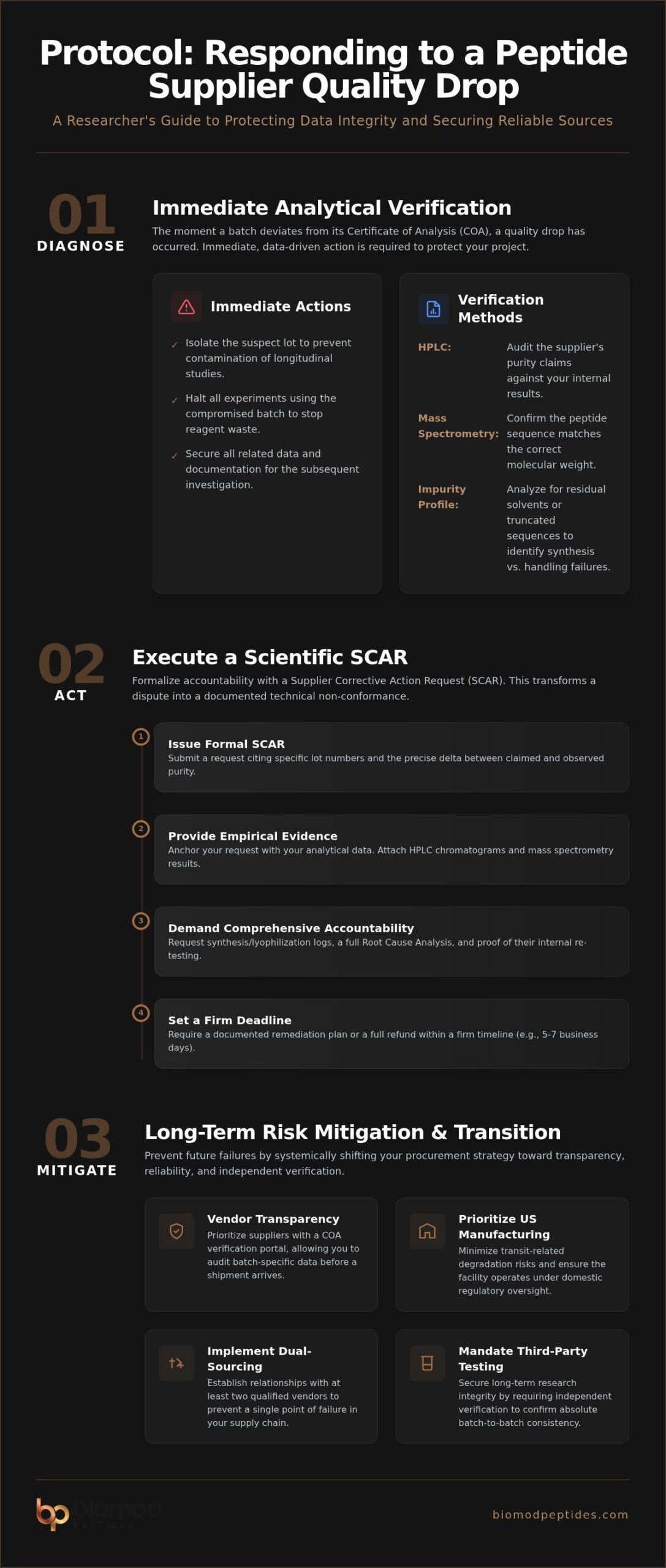
A quality drop in research peptides occurs the moment a batch deviates from the purity specifications stated on its Certificate of Analysis (COA). This is an analytical failure. If you detect inconsistencies in experimental results, you must know what to do when your supplier quality drops to protect your project’s integrity. Isolate the suspect lot immediately. This prevents the contamination of longitudinal studies and stops the waste of further reagents. Utilizing a dedicated COA verification portal allows for the immediate cross-referencing of batch data against independent laboratory results. By identifying exactly what to do when your supplier quality drops, you can mitigate the risk of compromised data.
Verification requires internal High-Performance Liquid Chromatography (HPLC) to audit the supplier’s purity claims. While a COA might report 98% purity, internal validation often reveals a different reality. Complement this with Mass Spectrometry. This confirms the peptide sequence matches the specific molecular weight requested. Discrepancies here indicate a fundamental synthesis error or a mislabeled product. Precise data is your only leverage when challenging a supplier’s output. It transforms a subjective dispute into a documented technical failure.
Distinguishing Between Batch Variation and Purity Degradation
Analyze the impurity profile for residual solvents, salts, or truncated sequences. These chemical markers help determine if the issue is a synthesis failure or degradation from improper cold chain handling during transit. Truncated sequences suggest poor coupling efficiency during the solid-phase synthesis process. Residual solvents may indicate inadequate washing or purification cycles. Referencing The Protocol for Peptide Purity Verification provides the baseline standards for these assessments. Systematic documentation of these findings is the first step in a Corrective and Preventive Action (CAPA) framework. This rigorous diagnostic approach ensures that your response is based on empirical proof rather than speculation. It moves the conversation from anecdotal complaints to technical non-conformance reports.
The Corrective Action Protocol: Executing a Scientific SCAR
When diagnostic data confirms a non-conformance, the next phase is formal accountability. You must know exactly what to do when your supplier quality drops to protect your laboratory’s operational integrity. This involves issuing a formal Supplier Corrective Action Request (SCAR). Unlike generic quality complaints, a scientific SCAR must be anchored by analytical chromatograms and mass spectrometry data. This documentation leaves no room for supplier ambiguity. It forces the provider to address the technical reality of the failure rather than offering anecdotal reassurances.
Formalizing the Supplier Corrective Action Request (SCAR)
Your SCAR should include specific lot numbers and the precise delta between the claimed purity and your observed findings. Demand the supplier provide synthesis and lyophilization logs for that specific production run. These logs reveal temperature fluctuations or coupling failures that lead to truncated sequences. Verification is simpler when you partner with providers who utilize third party tested peptides as a standard operating procedure. This baseline of transparency makes it easier to identify where the production chain failed.
Demand a comprehensive Root Cause Analysis from the supplier’s laboratory production team. It’s insufficient for a representative to offer a generic replacement. Require proof of internal re-testing of the retained batch samples stored at their facility. This verifies if the degradation occurred during synthesis or post-production handling. Establishing what to do when your supplier quality drops requires a firm timeline. Set a deadline of five to seven business days for the supplier to submit a documented remediation plan or process a full refund. If the supplier cannot provide this level of transparency, evaluate reliable US-manufactured alternatives that prioritize structural integrity.
Risk Mitigation: Transitioning to Higher Purity Standards
Transitioning away from a failing provider requires a systemic shift in procurement. You must determine what to do when your supplier quality drops to prevent future experimental failures. Evaluate the vendor’s transparency by checking for a COA verification portal. This infrastructure allows you to audit batch-specific data before a shipment arrives. Prioritize US-based manufacturing. This minimizes the risk of transit-related degradation and ensures the facility operates under domestic regulatory oversight.
Implement a robust dual-sourcing strategy. This prevents a single-point-of-failure in your laboratory supply chain. Relying on a single source is a systemic risk to your grant funding and project timelines. Transition to vendors providing independent, third-party validation for every individual lot. Don’t accept suppliers who only provide “typical” results or outdated chromatograms from previous years. Verified batch-to-batch consistency is the only way to secure longitudinal data. Knowing what to do when your supplier quality drops includes establishing these redundant, high-tier partnerships before a failure occurs.
Qualifying a US-Manufactured Research Partner
Verify the laboratory’s commitment to analytical grade standards and US finishing processes. Assess the availability of specialized formats that improve research precision. This includes peptide softgels for research or intranasal peptide research sprays. These complex formats require rigorous manufacturing controls and specialized laboratory equipment to maintain chemical stability. Ensure the vendor adheres to strict research-only protocols as detailed in the Biomod Peptides About page. A partner focused exclusively on the research sector understands the gravity of purity drops. They provide the structural integrity required for high-stakes scientific advancement. Analytical grade delivery systems and US finishing processes are the benchmarks of a reliable provider.
Securing Your Research Integrity Through Analytical Rigor
Maintaining experimental accuracy requires an uncompromising approach to quality control. You now have a rigorous protocol for what to do when your supplier quality drops, starting from immediate HPLC verification to the execution of a formal scientific SCAR. These analytical steps isolate non-conforming lots and force objective accountability from your providers. Long-term success depends on transitioning to vendors who prioritize batch-to-batch consistency and logistical transparency. This approach protects your grant funding and ensures your project’s data remains beyond reproach.
Secure your research with US-manufactured, third-party tested peptides from Biomod Peptides. We provide independent third-party HPLC/MS testing on every lot and maintain a publicly accessible COA verification portal for total transparency. Every product is manufactured and finished in the United States to ensure strict regulatory oversight and structural integrity. Protect your project’s data with verified standards.
Frequently Asked Questions
What are the most common causes of a drop in peptide purity?
Synthesis failures and logistical degradation are the primary drivers of purity loss. Incomplete amino acid coupling or inadequate washing cycles lead to truncated sequences and residual impurities. In high-temperature environments like Las Vegas, cold chain failures during transit often cause rapid chemical degradation. Knowing what to do when your supplier quality drops includes verifying if the failure occurred during manufacturing or during the final delivery phase to your facility.
How much batch-to-batch variation is acceptable in research grade peptides?
Acceptable variation depends on the sensitivity of your specific analytical protocol. Most high-tier research projects require a minimum of 98% purity with less than 1% variance between lots. Significant deviations suggest a lack of standardized manufacturing controls. Researchers in Las Vegas must demand lot-specific HPLC data to ensure that batch-to-batch consistency meets the rigorous requirements of their longitudinal studies and experimental benchmarks.
Can I salvage a batch of peptides if the purity is lower than 95%?
Salvaging a batch with less than 95% purity is not recommended for high-stakes research. Impurities such as residual solvents, salts, or incorrect sequences can interfere with experimental outcomes and produce unreliable data. When determining what to do when your supplier quality drops below analytical standards, the only scientifically sound option is to reject the lot. Using substandard reagents compromises the integrity of your entire project.
How do I verify a Certificate of Analysis (COA) is legitimate?
Legitimate COAs must be issued by independent, third-party laboratories rather than the manufacturer’s internal production staff. You can verify authenticity by cross-referencing the lot number on a dedicated COA verification portal. This provides a transparent data trail from the US-based manufacturing facility to the final testing report. Reliable providers like Biomod Peptides in Las Vegas offer these portals to ensure every chromatogram is verifiable and accurate.
Disclaimer
BIOMOD products are sold strictly for laboratory, analytical, and scientific research use only. They are not intended for human or animal consumption, administration, application, ingestion, injection, or any therapeutic, diagnostic, or cosmetic use.
The statements made on this website have not been evaluated by the United States Food and Drug Administration. BIOMOD products are not intended to diagnose, treat, cure, mitigate, or prevent any disease or medical condition.
BIOMOD is a research chemical supplier. BIOMOD is not a compounding pharmacy or chemical compounding facility as defined under Section 503A of the Federal Food, Drug, and Cosmetic Act. BIOMOD is not an outsourcing facility as defined under Section 503B of the Federal Food, Drug, and Cosmetic Act.
By accessing this site, you confirm you are at least 21 years of age and that you have read and accepted the BIOMOD Terms of Sale, Privacy Policy, and Research Use Only Policy. BIOMOD does not provide dosing, medical, therapeutic, diagnostic, veterinary, or use guidance under any channel.