
A single milligram of error during manual reconstitution can invalidate months of longitudinal data. It’s a risk that many laboratories take in the pursuit of lower overhead. You likely prioritize the purity of your raw materials, yet you’ve experienced the frustration of inconsistent assay results or rapid peptide degradation in non-stabilized solutions. This comparative analysis evaluates the analytical precision and experimental consistency of DIY vs pre-made peptide solutions for research.
We’ll examine how professional formulation impacts stability and why standardized dosing is critical for high-fidelity studies. By comparing manual reconstitution against laboratory-grade reagents with verified COAs, this article provides the technical evidence needed to refine your procurement strategy. We’ll outline the structural integrity of specialized formats, such as softgels and sprays, and their role in reducing experimental variables. The goal is to move beyond traditional industry norms toward a higher tier of execution and verifiable data integrity.
Key Takeaways
- Identify the specific analytical variables, such as pH fluctuations and peptide aggregation, that compromise the precision of manual laboratory reconstitution.
- Analyze the data-driven advantages of DIY vs pre-made peptide solutions for research, focusing on standardized dosing and the maintenance of long-term bioactivity.
- Evaluate how specialized formats like peptide softgels and sprays eliminate volumetric errors and extend the stability of sensitive reagents.
- Establish a rigorous framework for matching reagent formats to specific study requirements while ensuring supply chain transparency through US-based manufacturing and COA verification.
The Analytical Limitations of DIY Peptide Reconstitution
Manual reconstitution introduces a cascade of uncontrolled variables into the laboratory environment. Precision is the cornerstone of empirical data. In the debate of DIY vs pre-made peptide solutions for research, the primary concern remains the precision of the following factors:
- Solvent purity and reagent-grade water quality
- Exact pH balancing to prevent sequence denaturation
- Ambient temperature fluctuations during the reconstitution phase
Standard laboratory equipment often lacks the calibration required for industrial-grade homogeneity. Minor errors during mixing can trigger irreversible conformational changes. These deviations compromise the structural integrity of sensitive sequences. Precise volumetric measurement is difficult to maintain in a standard lab setting.
Non-standardized protocols increase the probability of peptide aggregation. This phenomenon leads to localized precipitation and inconsistent dosing within a single vial. Understanding Peptide synthesis methods is vital; if the final solution isn’t stabilized, the synthesized bonds are vulnerable. Aggregation isn’t just a physical change; it’s a chemical failure that renders the reagent useless for high-fidelity assays. It creates a heterogeneous mixture that defies standardized dosing, highlighting the inherent risks of DIY vs pre-made peptide solutions for research.
Stability and Degradation Risks in Manual Preparation
Oxidation and hydrolysis accelerate immediately upon exposure to atmospheric air and light. DIY mixing environments rarely match the vacuum-sealed, inert-gas conditions of professional manufacturing. This exposure results in rapid bioactivity loss. Stability is often sacrificed for perceived cost-efficiency in manual setups.
Before beginning any protocol, researchers must utilize HPLC tested peptides to confirm a baseline purity of 99% or higher. Professionally stabilized reagents maintain structural viability for months, whereas manually prepared solutions often degrade within days. For Las Vegas laboratories requiring standardized reagents, the lack of stabilized buffers makes long-term longitudinal studies nearly impossible to replicate.
Performance Benefits of Pre-formulated Research Solutions
Professional formulation represents a significant advancement over manual laboratory preparation. Lyophilized powders are stable in a vacuum; however, their integrity diminishes rapidly once reconstituted in a standard lab setting. Pre-formulated solutions utilize proprietary buffers to maintain a precise pH environment. These stabilizers prevent the hydrolysis and oxidation discussed in previous sections. Choosing DIY vs pre-made peptide solutions for research often determines the success of long-term bioactivity studies.
Labor efficiency is another critical metric. Manual preparation consumes valuable scientific resources. It forces researchers to spend hours on repetitive volumetric tasks. Standardized reagents allow for immediate experimental execution. This transition from preparation to observation increases the throughput of any laboratory. Researchers can access verified analytical reagents to ensure their time is spent on data interpretation rather than troubleshooting inconsistent mixtures.
Standardizing Dosage and Delivery in Experimental Models
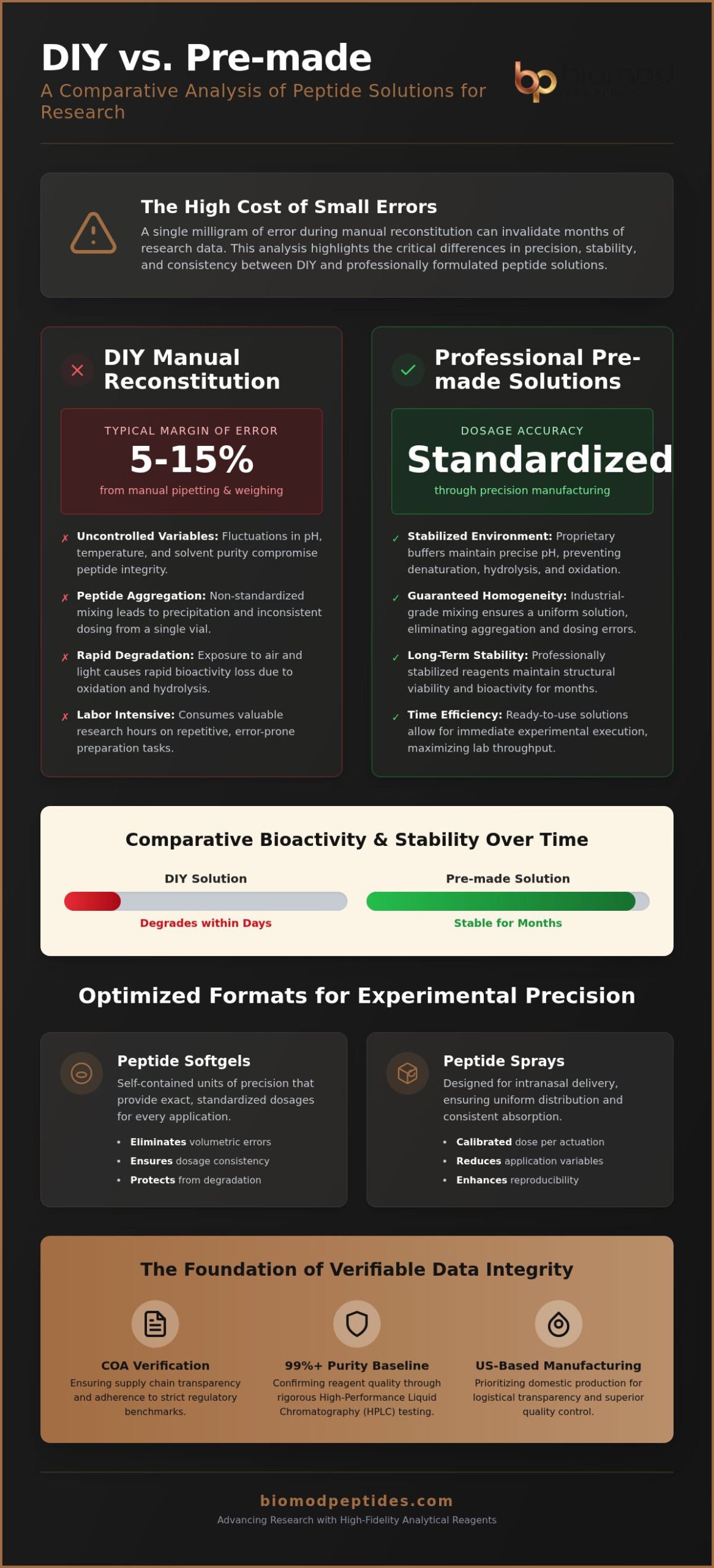
Manual pipetting and weighing typically introduce a 5-15% margin of error. This variance is unacceptable in high-precision modeling. Professional manufacturing of peptide softgels for research provides exact, standardized dosages. Each softgel is a self-contained unit of precision. It eliminates the volumetric risks inherent in liquid handling.
Intranasal delivery formats offer similar advantages for absorption consistency. The manufacturing of peptide spray products ensures a uniform distribution of the active reagent. Each actuation delivers a calibrated dose, reducing the outliers caused by uneven manual distribution. These systems reflect the core findings of Peptide Science 2026, which emphasizes the shift toward standardized delivery systems to enhance experimental reproducibility.
Selecting the Optimal Format for Laboratory Protocols
Selecting the correct medium is a critical procedural step. It requires matching the peptide format, such as softgel, spray, or powder, to the specific metabolic or longitudinal requirements of the study. For Las Vegas laboratories, prioritizing US-manufactured reagents ensures logistical transparency and adherence to strict regulatory benchmarks. Domestic finishing provides a layer of accountability that international sourcing lacks. When evaluating DIY vs pre-made peptide solutions for research, the decision hinges on the need for structural stability and standardized dosing. Standardized reagents eliminate the guesswork of variable reconstitution.
A rigorous procurement protocol is essential for maintaining laboratory standards. This framework must prioritize high-purity materials with documented provenance and structural integrity. Standardize your selection based on the expected bioactivity duration and the delivery route required for the model. Softgels offer protection against environmental degradation. Sprays ensure rapid, calibrated absorption. Each format serves a distinct analytical purpose. The choice should reflect the complexity of the experimental design.
Quality Assurance and Third-Party Verification Standards
Analytical Grade benchmarks require a minimum purity of 99% as verified by liquid chromatography. Substandard documentation often lacks lot-specific data or utilizes generic templates that fail to reflect the actual batch quality. Researchers must confirm mass spectrometry and HPLC results through an independent COA Verification Portal to ensure experimental integrity. This step confirms the molecular weight and purity profile before the study begins. Independent third-party testing is the mandatory standard for any peptide reagent used in published research. Verification provides the objective proof necessary to support peer-reviewed findings.
Advancing Laboratory Standards Through Precise Reagent Selection
Transitioning from manual reconstitution to standardized reagents eliminates the margin of error that compromises longitudinal data. Professional formulation ensures structural integrity through proprietary stabilization, protecting sensitive sequences from atmospheric degradation. The technical evidence regarding DIY vs pre-made peptide solutions for research favors standardized delivery systems, such as softgels and sprays, for maintaining experimental reproducibility. These formats provide a level of homogeneity that standard laboratory equipment doesn’t replicate.
Biomod Peptides provides US-manufactured and finished reagents, each subject to independent third-party testing. Our verification portal allows researchers to confirm mass spectrometry and HPLC data for every lot, ensuring absolute transparency. Secure High-Purity Reagents for Your Research at Biomod Peptides. We invite you to refine your procurement protocol and elevate the fidelity of your upcoming studies with our laboratory-grade solutions.
Frequently Asked Questions
Is it more cost-effective to use pre-made peptide solutions for long-term research?
While DIY vials have lower upfront unit costs, pre-made solutions reduce long-term expenses by preventing experimental failure. Precision saves resources. Inconsistent results from manual reconstitution often require repeating entire study phases. For Las Vegas laboratories, the labor hours saved and the reduction in wasted reagents make standardized solutions a more fiscally responsible choice for high-fidelity research.
How do pre-formulated peptide softgels compare to manual encapsulation in a lab?
Pre-formulated peptide softgels offer superior dosage precision and structural protection compared to manual encapsulation. Industrial standards matter. Manual lab processes struggle to achieve the airtight seal and uniform reagent distribution provided by industrial-grade manufacturing. Biomod Peptides finishes all softgels in the US, ensuring that each unit meets strict analytical benchmarks that manual lab methods can’t consistently replicate.
What are the primary stability concerns when using DIY peptide sprays?
The primary stability concerns for DIY peptide sprays involve rapid oxidation and microbial contamination in non-stabilized aqueous environments. Manual mixing often lacks the proprietary buffers needed to maintain a constant pH, leading to sequence denaturation. In the debate of DIY vs pre-made peptide solutions for research, pre-formulated sprays are superior because they’re vacuum-sealed and stabilized for extended shelf life.
Can I verify the purity of pre-made solutions through independent testing?
You can verify the purity of all Biomod Peptides products through our dedicated COA Verification Portal. Purity is verifiable. Every lot undergoes independent third-party testing to confirm mass spectrometry and HPLC data before it reaches your laboratory. This level of transparency provides researchers with the objective proof required for peer-reviewed publication and ensures the structural integrity of every reagent batch.
Disclaimer
BIOMOD products are sold strictly for laboratory, analytical, and scientific research use only. They are not intended for human or animal consumption, administration, application, ingestion, injection, or any therapeutic, diagnostic, or cosmetic use.
The statements made on this website have not been evaluated by the United States Food and Drug Administration. BIOMOD products are not intended to diagnose, treat, cure, mitigate, or prevent any disease or medical condition.
BIOMOD is a research chemical supplier. BIOMOD is not a compounding pharmacy or chemical compounding facility as defined under Section 503A of the Federal Food, Drug, and Cosmetic Act. BIOMOD is not an outsourcing facility as defined under Section 503B of the Federal Food, Drug, and Cosmetic Act.
By accessing this site, you confirm you are at least 21 years of age and that you have read and accepted the BIOMOD Terms of Sale, Privacy Policy, and Research Use Only Policy. BIOMOD does not provide dosing, medical, therapeutic, diagnostic, veterinary, or use guidance under any channel.