
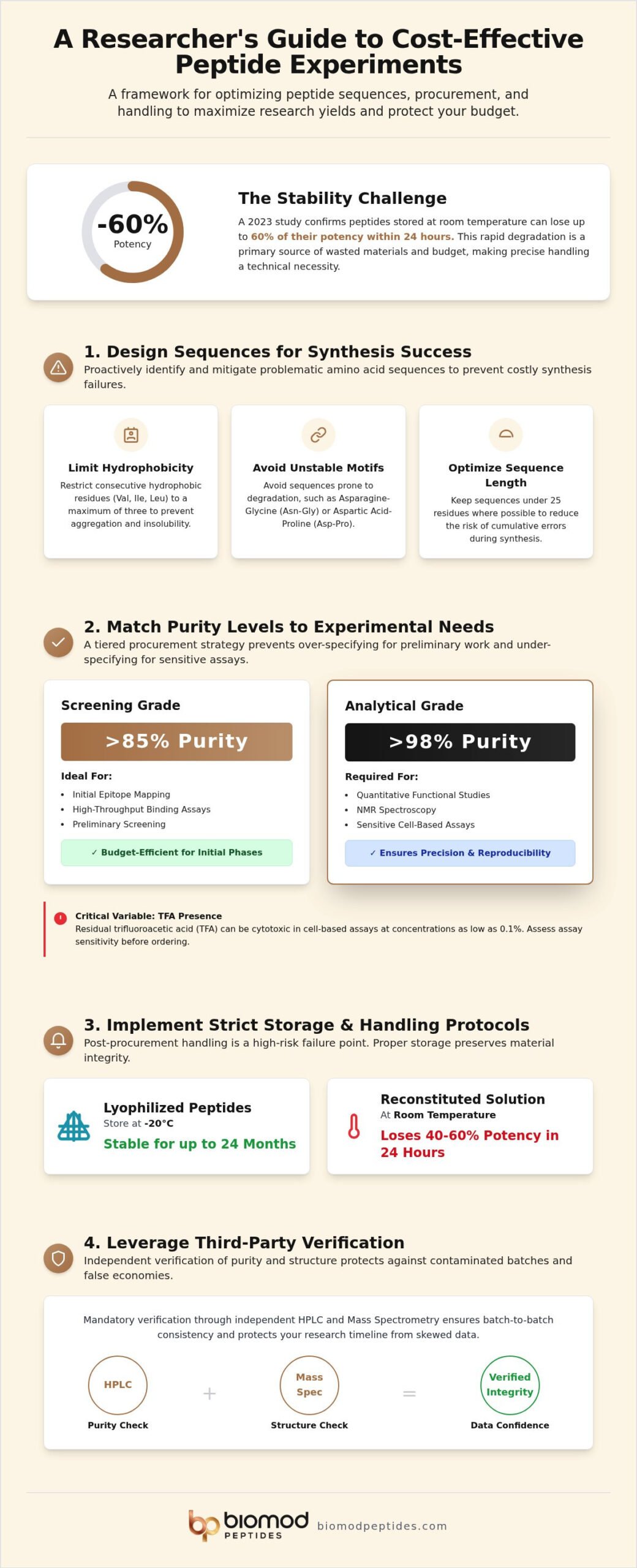
A 2023 study confirms that peptides stored at room temperature can lose up to 60% of their potency within 24 hours. This rapid degradation makes cost-effective peptide experiment design a technical necessity. You likely recognize the frustration of overpaying for 98% purity when a lower grade would suffice. Or the setback of a sequence failing synthesis due to design flaws. These inefficiencies drain capital. They stall critical data collection. Precision in the design phase is the only way to protect your research budget.
This guide provides a framework to optimize sequences and procurement strategies to maximize research yields. You’ll learn to align purity-to-application ratios, implement precise storage standards, and leverage third-party verification to protect your materials. We’ll examine how rigorous pre-validation and logistical transparency reduce waste and ensure analytical integrity. This methodology transforms procurement from a recurring expense into a disciplined tactical advantage for your laboratory.
Key Takeaways
- Identify and mitigate problematic amino acid sequences during the planning phase to prevent synthesis re-runs and unnecessary expenditure.
- Differentiate between screening-grade and analytical-grade requirements to ensure budget efficiency while maintaining the necessary precision for specific assays.
- Incorporate standardized storage protocols and optimized reconstitution volumes into your cost-effective peptide experiment design to maximize material yield.
- Leverage localized US logistics and independent COA verification to protect peptide stability and validate structural integrity before beginning research.
Optimizing Peptide Sequences for Synthesis Success and Budget Efficiency
Synthesis failure represents the primary driver of laboratory budget depletion. Identifying difficult sequences before procurement is the first pillar of cost-effective peptide experiment design. Modern peptide synthesis methods rely on efficient chain elongation; however, certain motifs trigger premature termination or aggregation. Computational tools now predict secondary structure interference with high accuracy. By simulating folding patterns, researchers can modify problematic residues before the first coupling step. This proactive validation prevents the high costs associated with synthesis re-runs and reagent waste.
Strategic Residue Selection to Prevent Aggregation
Aggregation often occurs when hydrophobic residues cluster, making the peptide insoluble in standard aqueous buffers. Strategic placement of polar residues can mitigate this risk without altering the core biological function. Sequence complexity directly correlates to synthesis failure rates.
- Limit consecutive hydrophobic amino acids like Valine, Isoleucine, or Leucine to three residues.
- Incorporate solubility-enhancing tags like poly-lysine or PEGylation only when the research goal necessitates increased hydrophilicity.
- Standardize the selection of stable motifs to avoid Asparagine-Glycine (Asn-Gly) or Aspartic Acid-Proline (Asp-Pro) sequences that are prone to rapid degradation.
Balancing sequence length against solubility is critical for experimental viability. Longer chains increase the probability of truncation. If a sequence exceeds 25 residues, the risk of cumulative errors in the synthesis cycle rises. Selecting stable motifs ensures that unstable elements don’t compromise the final yield. This systematic approach reduces the need for expensive purification steps. It directly supports a leaner research budget while maintaining analytical rigor.
Matching Purity Levels to Experimental Objectives
Allocating funds toward the highest available purity for every phase is a common budgetary error. True cost-effective peptide experiment design requires a tiered procurement strategy. Screening-grade peptides (typically >85% purity) suffice for initial epitope mapping or high-throughput binding assays. Analytical-grade reagents (>95% or >98% purity) are reserved for quantitative functional studies or NMR spectroscopy where minor impurities confound data. Over-specifying purity for preliminary work creates unnecessary overhead. Conversely, under-specifying for sensitive assays leads to irreproducible results.
Residual trifluoroacetic acid (TFA) presence is a critical variable. TFA is a standard counter-ion in synthesis, yet it exhibits cytotoxicity in specific cell-based assays at concentrations as low as 0.1%. Assessing assay sensitivity to TFA before ordering allows for targeted salt exchange, preventing experimental failure. Following established Peptide storage and handling guidelines ensures that once the correct purity is selected, the material remains stable during use.
The Role of Third-Party Testing in Reducing Long-Term Costs
Unverified reagents represent a false economy. Contaminated batches lead to skewed data that necessitates repeating months of research. Verification through independent HPLC and Mass Spectrometry is mandatory for maintaining structural integrity. Researchers should leverage the Biomod Peptides COA Verification Portal to confirm batch-to-batch consistency and purity levels before unsealing vials. Detailed analytical standards are available in The Protocol for Peptide Purity Verification. This rigorous documentation provides a technical baseline that protects the research timeline. Validating your research peptides through external portals ensures that experimental variables remain controlled and budgets remain optimized.
Storage Protocols and Reconstitution Strategies for Maximum Yield
Experimental integrity depends on post-procurement handling. In cost-effective peptide experiment design, the transition from lyophilized powder to solution is a high-risk failure point. Lyophilized peptides remain stable at -20°C for up to 24 months. However, once reconstituted, stability drops rapidly. A 2023 study confirms that peptides in solution can lose 40-60% of their potency within 24 hours at room temperature. To minimize residual loss in laboratory glassware, researchers must optimize reconstitution volumes based on the specific surface area of the vial. US-based logistics are essential for Las Vegas labs to maintain rigorous cold chain protocols and prevent thermal degradation during final-mile delivery.
Strategic format selection reduces procedural waste. Utilizing peptide softgels provides a precise, waste-free delivery method for analytical applications. These formats bypass the traditional reconstitution phase entirely, removing the risk of concentration errors. Maintaining strict lyophilization standards for long-term storage ensures that sensitive reagents retain their structural integrity until the moment of use. This discipline prevents the premature disposal of degraded materials and protects the laboratory’s bottom line.
Implementing Standardized Handling to Minimize Degradation
Repeated freeze-thaw cycles cause irreversible structural damage to the peptide backbone. Single-use aliquoting is the primary defense against this degradation. By dividing the stock into individual units, researchers protect the bulk material from atmospheric moisture and temperature fluctuations. For specialized laboratory models, intranasal peptide research sprays offer standardized delivery while ensuring batch consistency. Local research teams should refer to Peptide Stability for Research: Cold Chain Protocols for specific Las Vegas handling tips. These protocols ensure that analytical efficiency extends from the design phase through to the final assay.
Advancing Analytical Standards through Disciplined Design
Analytical efficiency is a direct result of technical discipline rather than luck. By prioritizing sequence pre-validation and matching purity levels to specific assay sensitivities, researchers eliminate the high costs of synthesis failure. Maintaining strict cold chain protocols and utilizing precise delivery formats ensure that reagents retain their structural integrity from the laboratory intake to the final assay. This integrated approach to cost-effective peptide experiment design protects your research timeline and budget simultaneously.
Professional confidence relies on empirical proof. Secure your laboratory’s supply of verified research peptides today at Biomod Peptides. Every batch is supported by US-based manufacturing and independent third-party HPLC testing. Our verification portal provides immediate access to COAs for every reagent, ensuring your data remains beyond reproach. Strengthen your methodology with materials designed for precision.
Frequently Asked Questions
What is the most cost-effective purity level for initial peptide screening?
Screening-grade peptides (typically >85% purity) are the most economical choice for initial assays. This level provides sufficient structural integrity for high-throughput binding or epitope mapping without the premium cost of 98% analytical grades. Reserving higher purity for quantitative functional studies ensures that budgets align with the specific sensitivity of each experimental phase. This tiered approach prevents overspending on preliminary data collection.
How does sequence length affect the overall cost of peptide synthesis?
Synthesis costs scale with sequence length because each added amino acid increases the risk of cumulative errors. Longer chains often require more complex purification steps to remove truncated sequences, which drives up reagent waste. Integrating cost-effective peptide experiment design involves optimizing length to avoid unnecessary residues while maintaining the core biological activity required for the research model. Shorter sequences generally yield higher purity at lower costs.
Can third-party testing actually save money in a research budget?
Yes, independent verification prevents the massive financial loss of irreproducible data. Using unverified reagents often leads to repeated experiments and wasted labor hours. Biomod Peptides provides a COA verification portal for every batch, ensuring batch-to-batch consistency. This transparency allows labs to validate structural integrity before starting high-stakes assays, protecting the entire project’s capital and preventing the purchase of contaminated lots.
What are the best storage practices to prevent peptide degradation in Las Vegas?
Las Vegas laboratories must prioritize strict cold chain protocols to counter regional heat. Lyophilized peptides should be stored at -20°C in airtight vials to prevent moisture ingress. Once reconstituted, reagents must remain at 2-8°C and be used within 30 days. Using US-based manufacturing and localized logistics reduces transit time. This minimizes thermal exposure that can degrade sensitive research materials during the final-mile delivery.
Disclaimer
BIOMOD products are sold strictly for laboratory, analytical, and scientific research use only. They are not intended for human or animal consumption, administration, application, ingestion, injection, or any therapeutic, diagnostic, or cosmetic use.
The statements made on this website have not been evaluated by the United States Food and Drug Administration. BIOMOD products are not intended to diagnose, treat, cure, mitigate, or prevent any disease or medical condition.
BIOMOD is a research chemical supplier. BIOMOD is not a compounding pharmacy or chemical compounding facility as defined under Section 503A of the Federal Food, Drug, and Cosmetic Act. BIOMOD is not an outsourcing facility as defined under Section 503B of the Federal Food, Drug, and Cosmetic Act.
By accessing this site, you confirm you are at least 21 years of age and that you have read and accepted the BIOMOD Terms of Sale, Privacy Policy, and Research Use Only Policy. BIOMOD does not provide dosing, medical, therapeutic, diagnostic, veterinary, or use guidance under any channel.