
A high impact score is no longer a shield against rejection if your methodology lacks verifiable reagent authentication. You likely recognize the heightened stakes under the 2026 NIH Simplified Peer Review Framework. Factor 2, Rigor and Feasibility, now demands more than just a promising hypothesis. It requires empirical proof that your biological materials are exactly what you claim they are. This guide demonstrates how impressing grant reviewers with quality control starts with rigorous peptide verification and third-party documentation. The fear of a “not discussed” designation due to reagent uncertainty is a valid concern in this competitive climate.
You’ll learn how to leverage COA portals and US-based analytical standards to build a bulletproof methodology section. We’ll outline the specific steps needed to satisfy current federal reproducibility requirements and secure your research funding through superior technical transparency. By the end of this article, you’ll have a roadmap for integrating high-tier verification into your next submission.
Key Takeaways
- Align your methodology with the 2026 NIH Simplified Peer Review Framework by addressing the specific “Rigor and Feasibility” criteria through reagent authentication.
- Implement HPLC and Mass Spectrometry documentation to provide reviewers with definitive evidence of chemical identity and analytical purity levels.
- Evaluate why sourcing US-manufactured, analytical-grade peptides provides the logistical transparency necessary for federal grant compliance.
- Leverage third-party verification portals as a primary tool for impressing grant reviewers with quality control and pre-empting reproducibility critiques.
The Role of Reagent Quality in Scientific Rigor and Grant Review
Scientific rigor is the bedrock of the scientific method. It directly influences modern funding decisions. The reproducibility crisis has forced a shift in how federal agencies evaluate research proposals. In 2026, the NIH Simplified Peer Review Framework emphasizes Factor 2: Rigor and Feasibility. Reviewers assign a score of 1 to 9 based on experimental robustness. If your reagents lack a clear authentication trail, your “Approach” score won’t meet expectations. Peptides are classified as “Key Biological Resources.” They require an explicit plan for characterization and validation within your application.
Using unverified reagents compromises long-term project feasibility. Impressing grant reviewers with quality control means proving your reagents are stable and chemically defined. Without this, your data remains anecdotal. Reviewers prioritize empirical proof over procedural promises. They want to see how you’ll authenticate your chemical resources before the first assay begins. Failure to provide this proof often leads to a “Not Discussed” designation during the review cycle.
Addressing the Reproducibility Crisis in Peptide Research
Impurity profiles drive the reproducibility crisis in biochemistry. Minor sequence variations or residual solvents can alter binding affinity. This leads to non-replicable outcomes that waste institutional resources. Reviewers are increasingly skeptical of “house-tested” data that lacks independent verification. They want objective proof. Establishing these analytical benchmarks is a core component of the current peptide science narrative. High-purity standards ensure your methodology remains bulletproof throughout the peer review process.
Strategic Documentation: Using HPLC and MS to Impress Reviewers
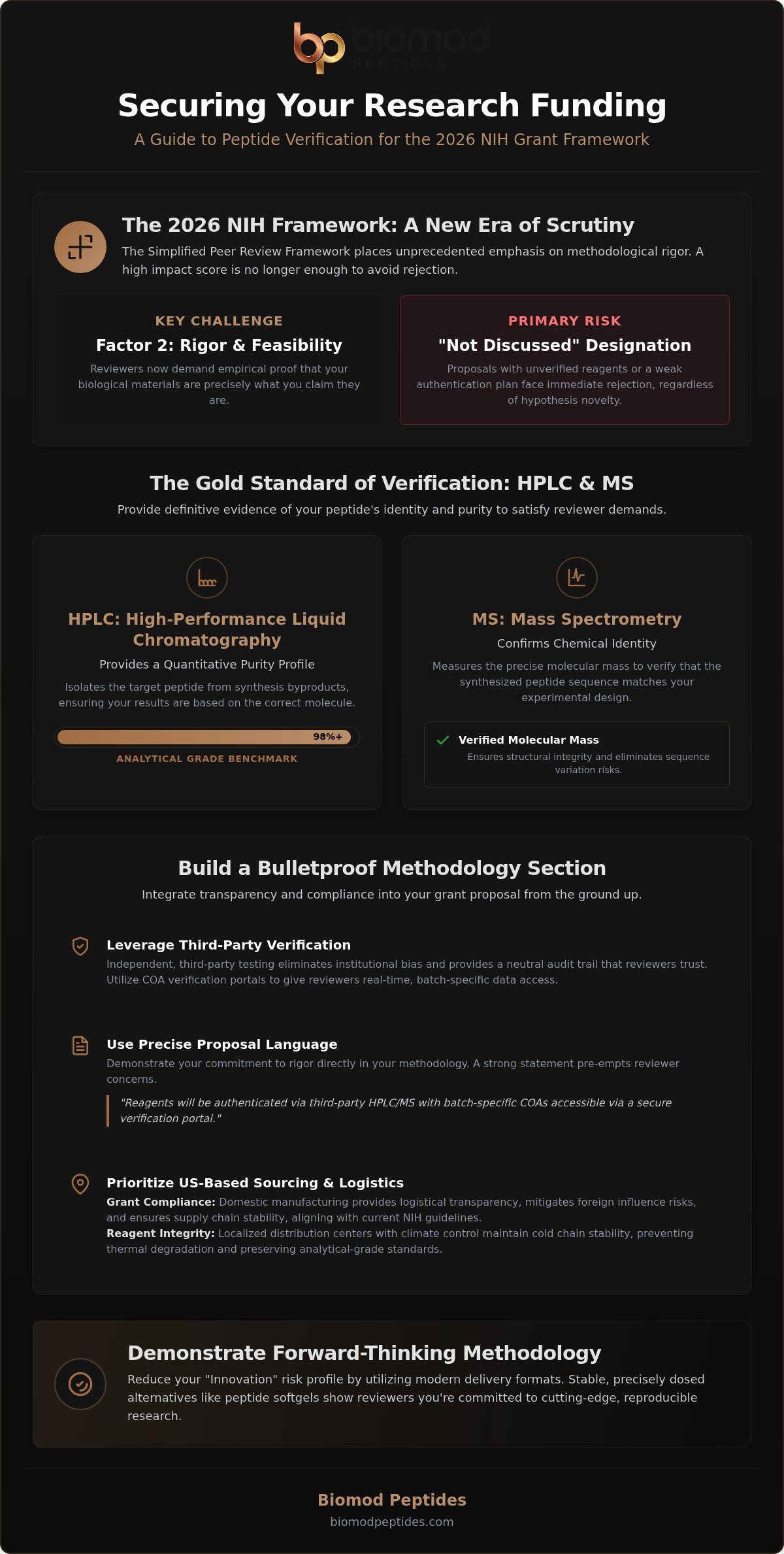
Analytical documentation transforms a vague methodology into a rigorous research plan. High-Performance Liquid Chromatography (HPLC) provides a quantitative purity profile. It isolates the target peptide from synthesis byproducts and residual solvents. A purity percentage above 98% is the benchmark for analytical grade. Mass Spectrometry (MS) complements this by confirming chemical identity. It measures the molecular mass to ensure the synthesized sequence aligns with your experimental design. These two reports are essential for impressing grant reviewers with quality control.
Independent verification is superior to internal lab data. Third-party testing eliminates institutional bias. It provides a neutral audit trail that reviewers trust. By including external reports, you demonstrate a commitment to objective standards. This transparency is vital for meeting the 2026 NIH reproducibility criteria. You can access these standards through a COA verification portal to ensure every batch meets your protocol requirements.
Integrating Certificates of Analysis (COAs) into Your Proposal
Citing verified peptide certificates of analysis strengthens your authentication plan. Don’t just mention purity; provide a specific verification method. Reviewers value digital transparency. A verification portal allows auditors to confirm batch-specific data in real-time. This level of detail pre-empts concerns about reagent drift.
Use precise language in your application. A sample sentence for your methodology might read: “Reagents will be authenticated via third-party HPLC/MS with batch-specific COAs accessible via a secure verification portal.” This statement proves your resources are validated. It shows your project is grounded in structural integrity and verified data.
Sourcing Analytical-Grade Peptides for Validated Outcomes
US-based manufacturing provides the logistical transparency required for federal grant compliance. Current NIH guidelines place a high premium on domestic sourcing to mitigate foreign influence risks and ensure supply chain stability. Domestic production ensures verifiable reagent origins and rigorous oversight. Maintaining cold chain stability is equally critical for reagent integrity. Our Las Vegas finishing and distribution center ensures peptide stability through localized climate control. This prevents thermal degradation during the final stages of delivery. It’s a logistical necessity for maintaining analytical-grade research standards.
Innovative delivery formats reduce the “Innovation” risk profile for grant committees. Utilizing peptide softgels for research demonstrates a commitment to modern methodology. It proves you’re exploring stable, precisely dosed alternatives to traditional lyophilized powders. This strategic foresight is instrumental in impressing grant reviewers with quality control. It shows your lab is prepared for the technical demands of high-stakes reproducibility.
The Biomod Advantage: A Partner in Scientific Accountability
The Biomod Peptides about page details our commitment to precision. We prioritize accountability at every stage of synthesis and finishing. Our COA Verification Portal automates the administrative burden of grant reporting. You don’t have to manually verify every batch or maintain physical folders of paper reports. The portal provides instant, third-party proof of reagent authenticity for auditors or reviewers.
Specialized delivery studies require diverse, validated formats. We provide intranasal peptide research sprays for targeted delivery research. These tools allow you to expand your experimental scope while maintaining analytical-grade purity. High-tier sourcing ensures your data remains reliable over the project’s lifecycle. It turns your methodology into a definitive roadmap for scientific progress.
Solidifying Funding Through Analytical Precision
Scientific rigor isn’t a suggestion; it’s a scored metric. The 2026 NIH framework requires definitive proof of reagent identity and purity. You’ve seen how batch-specific HPLC and Mass Spectrometry documentation pre-empts skepticism about experimental reproducibility. Impressing grant reviewers with quality control is a strategic requirement for competitive funding. It shifts your proposal from a theoretical plan to a validated methodology. US-based manufacturing and localized distribution further protect your research from logistical degradation. Every batch must undergo independent verification to maintain institutional standards. This transparency ensures your data remains resilient under the most intense peer review scrutiny.
Secure your grant’s success with verified, third-party tested research peptides from Biomod. Our platform provides batch-specific HPLC/MS reports and US-based manufacturing for maximum accountability. Rely on independent laboratory verification to build a bulletproof methodology section. Your work deserves a foundation of empirical certainty.
Frequently Asked Questions
What does the NIH mean by ‘Authentication of Key Biological Resources’?
NIH authentication requires a structured plan to verify the identity and validity of resources like research peptides. This is a mandatory requirement under the 2026 NIH Simplified Peer Review Framework. You must describe the specific methods used to ensure reagents remain consistent throughout the study. Reviewers evaluate these plans to confirm the research is reproducible and grounded in verified chemical standards.
How do I include third-party peptide testing data in my grant application?
Cite batch-specific HPLC and Mass Spectrometry reports in your “Authentication of Key Biological and/or Chemical Resources” attachment. Reference an independent COA verification portal to provide a transparent audit trail. This level of technical detail is a primary method for impressing grant reviewers with quality control. It demonstrates that your experimental data is built on a foundation of verified chemical identity.
Why is HPLC/MS data more important than simple purity percentages?
Purity percentages indicate the concentration of target material but don’t confirm its molecular structure. HPLC isolates the peptide from synthesis byproducts; while Mass Spectrometry verifies the molecular mass and sequence identity. Without MS data, you can’t prove the peptide sequence is correct. Reviewers prioritize this dual-validation because it eliminates the risk of using chemically incorrect reagents that yield non-replicable results.
Can using US-manufactured peptides help my grant get approved?
Domestic sourcing improves compliance with federal disclosure standards and Malign Foreign Talent Recruitment Program certifications. US-based manufacturing ensures greater accountability and logistical transparency. For example, our Las Vegas finishing center maintains cold chain stability to prevent reagent degradation. Proving a secure, domestic supply chain reduces the risk profile and satisfies reviewers concerned with reagent integrity and federal oversight.
Disclaimer
BIOMOD products are sold strictly for laboratory, analytical, and scientific research use only. They are not intended for human or animal consumption, administration, application, ingestion, injection, or any therapeutic, diagnostic, or cosmetic use.
The statements made on this website have not been evaluated by the United States Food and Drug Administration. BIOMOD products are not intended to diagnose, treat, cure, mitigate, or prevent any disease or medical condition.
BIOMOD is a research chemical supplier. BIOMOD is not a compounding pharmacy or chemical compounding facility as defined under Section 503A of the Federal Food, Drug, and Cosmetic Act. BIOMOD is not an outsourcing facility as defined under Section 503B of the Federal Food, Drug, and Cosmetic Act.
By accessing this site, you confirm you are at least 21 years of age and that you have read and accepted the BIOMOD Terms of Sale, Privacy Policy, and Research Use Only Policy. BIOMOD does not provide dosing, medical, therapeutic, diagnostic, veterinary, or use guidance under any channel.