
42% of online peptide products contain inaccurate quantities of the listed sequence. This statistic represents a silent threat to every laboratory relying on unverified reagents. You likely feel the mounting pressure to publish high-impact results while managing limited resources and strict timelines. It’s a precarious balance where speed often compromises precision.
The impact of peptide purity on research validity remains the primary variable in long-term professional stability. A single data error can lead to retractions that trigger permanent career attrition. This analysis examines the clinical and institutional fallout of publishing flawed data. We establish a rigorous protocol for reagent verification and explore how to maintain a reputation for precision in an increasingly scrutinized field. Through third-party validation and COA transparency, you can secure your research against avoidable failure.
Key Takeaways
- Analyze the long-term professional risks of the “Retraction Penalty,” where a single flawed publication can significantly degrade future citation rates and institutional standing.
- Identify how synthesis by-products like truncated sequences and deprotection failures introduce analytical noise that compromises experimental reproducibility.
- Evaluate the direct impact of peptide purity on research validity to prevent publishing data based on misidentified isomers or inaccurate molar concentrations.
- Implement a “Verification-First” procurement protocol using COA verification portals and US-manufactured reagents to safeguard your laboratory’s reputation for precision.
The Professional Consequences of Retracted Peptide Research
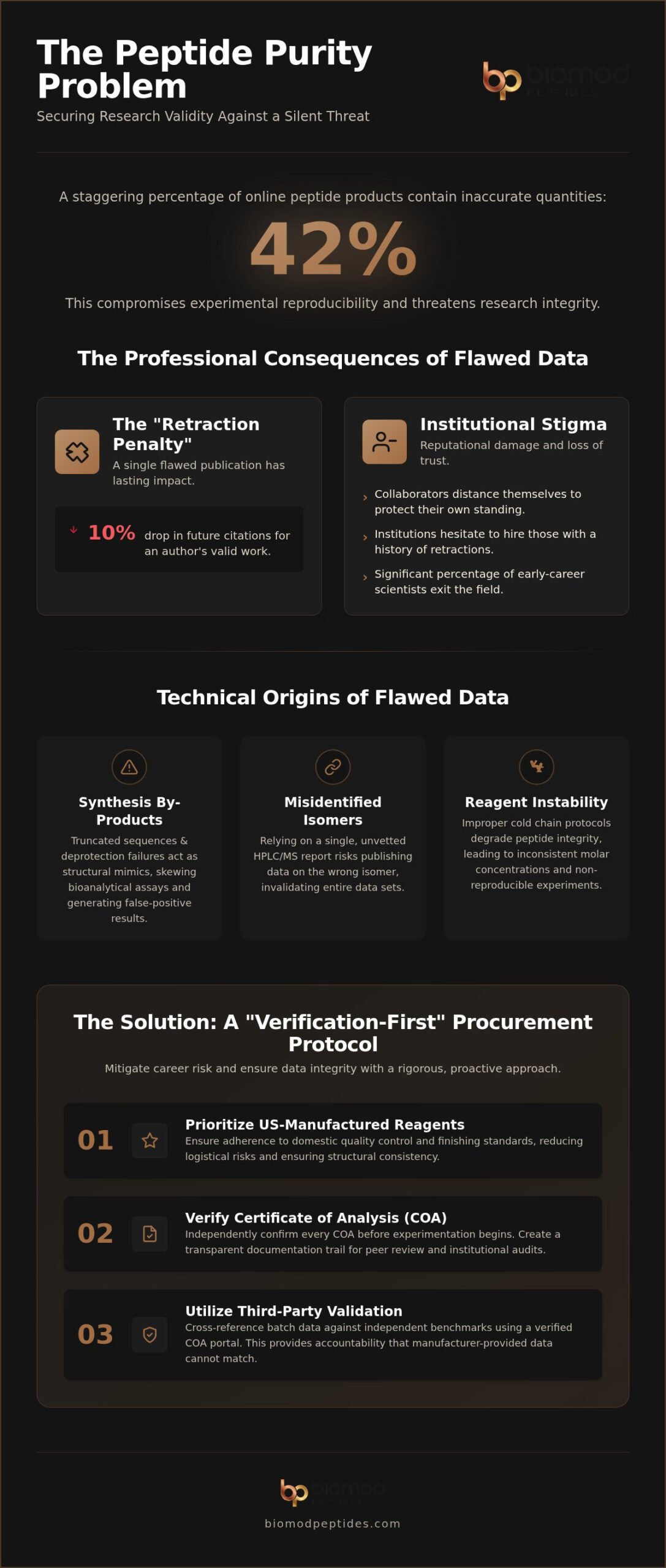
A research retraction is the official withdrawal of a published paper due to data invalidity, error, or misconduct. It’s a permanent public record of failure. In biochemistry, these errors frequently originate during the peptide synthesis process, where the use of unvetted reagents creates “noise” in bioanalytical assays. The impact of peptide purity on research validity is absolute; flawed reagents produce flawed data. The “Retraction Penalty” results in a 10% drop in future citations for an author’s valid, non-retracted work. This loss of professional standing is difficult to recover.
Attrition and the Stigma of Inaccuracy in Biochemistry
The impact of peptide purity on research validity directly influences researcher retention rates. Data corrections often lead to a significant percentage of early-career scientists exiting the field. Professional networks are fragile. Collaborators often distance themselves to protect their own reputations. This creates an “Institutional Memory” effect where laboratories and universities hesitate to hire individuals with a history of retractions, even if the error was unintentional.
Maintaining a reputation for clinical precision requires proactive measures. Adopting a Protocol for Peptide Purity Verification is the most effective defense against this stigma. This protocol ensures that every sequence is validated before experimentation begins. By prioritizing reagent integrity, researchers mitigate the risk of institutional fallout and ensure their career trajectory remains upward. Rigorous verification isn’t an elective step; it’s a fundamental requirement for modern laboratory leadership.
Technical Origins of Flawed Data: Synthesis By-products and Misidentification
Data integrity begins at the molecular level. The impact of peptide purity on research validity is often compromised by synthesis by-products that escape standard filtration. Truncated sequences and deprotection failures aren’t inert; they act as structural mimics that skew bioanalytical assays. These artifacts generate false-positive results, leading to conclusions that cannot be replicated. Relying on a single HPLC/MS report from an unvetted supplier is a significant risk. Without secondary verification, researchers may unknowingly publish data on the wrong isomer. This “mirage” of purity masks underlying chemical inconsistencies that invalidate entire data sets.
Stability also plays a critical role in analytical precision. Improper cold chain protocols degrade peptide integrity before the reagent even reaches the bench. This degradation leads to inconsistent molar concentrations across different batches. Such variability ensures that experimental outcomes remain non-reproducible, directly threatening a laboratory’s professional standing. Securing high-quality research peptides from domestic sources reduces these logistical risks.
The Critical Role of Third-Party Verification in Data Integrity
Independent validation provides a level of accountability that manufacturer-provided data cannot match. To maintain a clean publishing record, researchers should utilize a verified peptide certificates of analysis portal. This cross-references batch data against independent benchmarks, ensuring the impact of peptide purity on research validity is fully documented. Analytical-grade standards differ from lower-tier reagents because they provide a complete impurity profile. Verification isn’t just a safety step; it’s the only path to empirical certainty in modern biochemistry. Meticulous pioneers prioritize these standards to ensure their findings withstand institutional scrutiny.
Mitigating Career Risk Through Rigorous Reagent Procurement
Procurement is the primary defensive strategy against data invalidity. Prioritizing US-manufactured research peptides ensures adherence to domestic quality control and finishing standards. The impact of peptide purity on research validity is too high to risk on unverified imports that may lack structural consistency. Laboratories must implement a “Verification-First” culture. No experiment begins until the Certificate of Analysis (COA) is independently confirmed. It’s a proactive approach that creates a transparent documentation trail. This provides a clear audit trail for peer review inquiries, ensuring every result is backed by empirical reagent data.
Establishing a Verification Protocol for Las Vegas Laboratories
Research facilities in the Las Vegas hub can leverage specialized laboratory peptide supply networks that offer full transparency. When vetting vendors, researchers should follow a strict checklist. This checklist must confirm the availability of batch-specific HPLC and mass spectrometry reports. Verification must happen before the seal is broken on any new reagent batch. This discipline prevents the introduction of analytical noise into sensitive assays.
Specialized formats, including peptide softgels for research, should only be used when purity is documented and stability is verified. These delivery systems require the same level of rigorous oversight as traditional lyophilized powders. By maintaining uncompromising standards for every reagent source, researchers protect their professional standing. The impact of peptide purity on research validity remains the defining metric for clinical precision and institutional trust.
Advancing Clinical Precision Through Analytical Accountability
Precision is the only currency in biochemical research. The impact of peptide purity on research validity determines the longevity of a scientific career and the stability of institutional funding. Retractions are not merely administrative corrections; they are professional liabilities that erode citation rates and collaborator trust. By identifying synthesis by-products and implementing rigorous procurement protocols, you eliminate the analytical noise that leads to non-reproducible data.
Accountability requires transparent documentation. Every batch undergoes independent third-party HPLC and MS testing to ensure absolute sequence integrity. Our products are manufactured and finished in the United States for maximum quality control. Access our COA Verification Portal for full analytical transparency. Secure your research integrity with Biomod Peptides’ third-party verified reagents. It’s time to protect your professional reputation through uncompromising reagent selection.
Frequently Asked Questions
What is the most common cause of flawed data in peptide research?
The primary cause of flawed data is the use of unverified reagents containing synthesis by-products. Truncated sequences and deprotection failures act as structural mimics that skew bioanalytical assays. This noise leads to false-positive results that compromise the impact of peptide purity on research validity. Researchers often overlook these impurities when they rely on manufacturer-provided data without secondary, independent validation protocols.
Can a single retraction end a scientific career in biochemistry?
A single retraction can trigger permanent career attrition due to the “Retraction Penalty.” Statistical evidence shows a 10% decline in future citations for an author’s valid work following a data correction. In competitive hubs like Las Vegas, laboratories prioritize institutional memory and may hesitate to hire researchers with a history of retractions. Maintaining a reputation for clinical precision is essential for securing long-term funding.
How do I verify the purity of a research peptide batch?
Verification requires cross-referencing batch data through an independent COA verification portal. Researchers must demand batch-specific HPLC and mass spectrometry (MS) reports from an independent laboratory. This process ensures the impact of peptide purity on research validity is documented before experimentation begins. Meticulous procurement involves checking these analytical benchmarks to confirm that the reagent matches the documented sequence and molar concentration.
Why is US manufacturing important for peptide research data integrity?
US manufacturing ensures adherence to rigorous domestic quality control and finishing standards that unverified imports often bypass. Domestic facilities provide a higher level of logistical transparency and accountability. For Las Vegas research facilities, sourcing US-manufactured peptides minimizes the risk of degradation during transit. This proximity allows for better oversight of the cold chain, ensuring that reagents maintain structural integrity from synthesis to the laboratory bench.
Disclaimer
BIOMOD products are sold strictly for laboratory, analytical, and scientific research use only. They are not intended for human or animal consumption, administration, application, ingestion, injection, or any therapeutic, diagnostic, or cosmetic use.
The statements made on this website have not been evaluated by the United States Food and Drug Administration. BIOMOD products are not intended to diagnose, treat, cure, mitigate, or prevent any disease or medical condition.
BIOMOD is a research chemical supplier. BIOMOD is not a compounding pharmacy or chemical compounding facility as defined under Section 503A of the Federal Food, Drug, and Cosmetic Act. BIOMOD is not an outsourcing facility as defined under Section 503B of the Federal Food, Drug, and Cosmetic Act.
By accessing this site, you confirm you are at least 21 years of age and that you have read and accepted the BIOMOD Terms of Sale, Privacy Policy, and Research Use Only Policy. BIOMOD does not provide dosing, medical, therapeutic, diagnostic, veterinary, or use guidance under any channel.