
Scientific integrity isn’t a byproduct of successful results. It’s the direct output of rigid containment and analytical verification. Maintaining a sterile environment remains a constant challenge for independent researchers. The risks of cross-contamination and the inherent volatility of lyophilized compounds often threaten the reproducibility of your data. You likely recognize that even minor storage errors or improper handling can lead to irreversible peptide degradation.
This article establishes the essential lab safety guidelines for peptide research to protect your work and your laboratory’s standing. You’ll master the protocols required to maintain structural integrity and professional accountability. We’ll detail sterile handling procedures, clarify the legal parameters of Research Use Only (RUO) materials, and explain how third-party verification through COA portals serves as a critical safety benchmark for modern methodology.
Key Takeaways
- Establish a sterile field using ISO-certified PPE to eliminate cross-contamination risks during peptide handling and reconstitution.
- Execute rigorous lab safety guidelines for peptide research by managing humidity and light exposure to prevent oxidation and deamidation.
- Validate every lot through independent HPLC and MS analysis to ensure analytical safety and eliminate experimental variables.
- Secure institutional compliance by maintaining transparent documentation and strictly observing the legal boundaries of RUO materials.
Core Safety Protocols for Peptide Handling and Storage
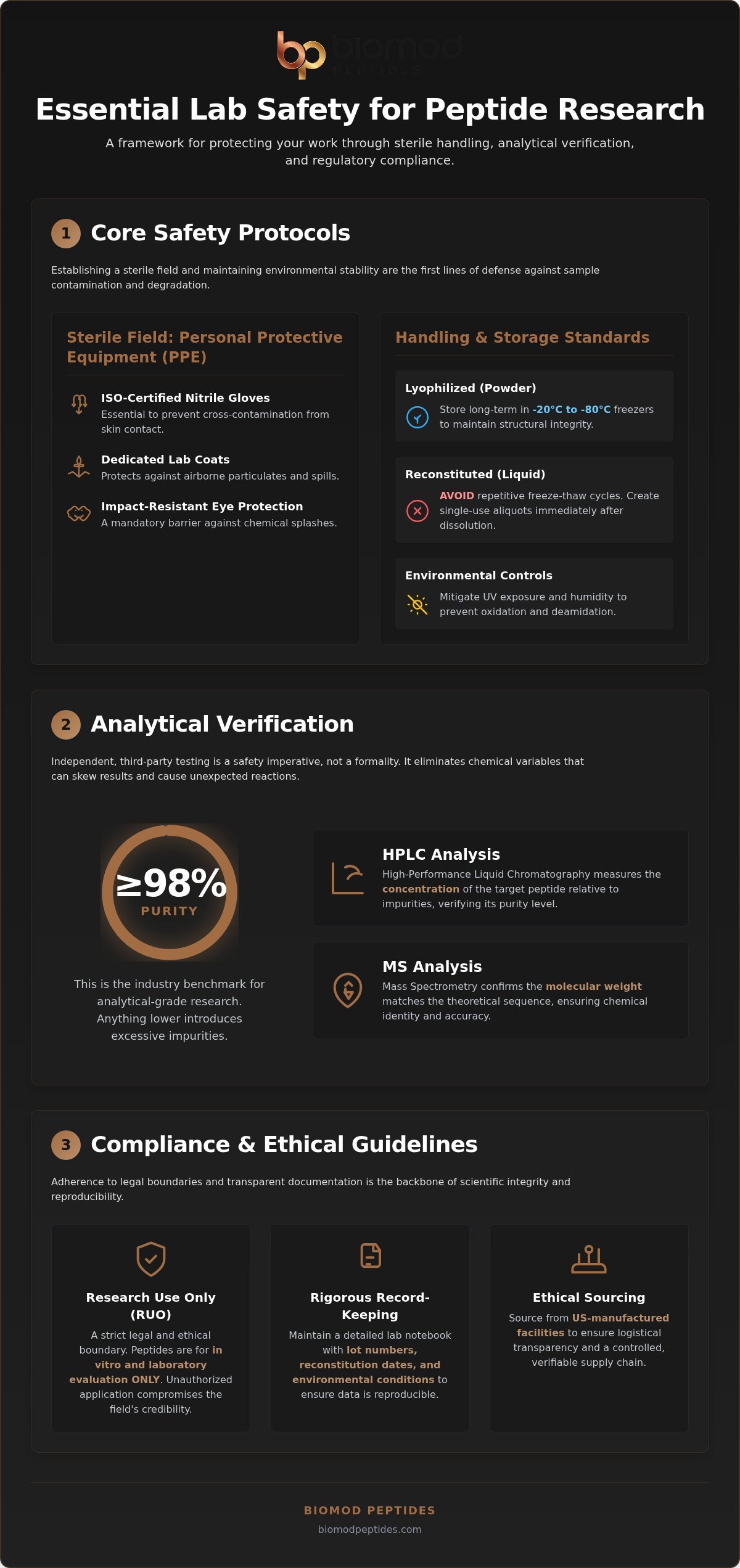
Scientific precision starts at the bench. Establishing a sterile field is the first layer of defense against sample contamination. Researchers must utilize ISO-certified nitrile gloves, dedicated lab coats, and impact-resistant eye protection. These requirements are foundational lab safety guidelines for peptide research. Cross-contamination often occurs through skin contact or airborne particulates, making physical barriers essential for preserving sample purity and experimental accuracy.
Environmental stability is equally critical. High humidity and UV exposure accelerate peptide oxidation and deamidation, which compromises the structural integrity of the compound. Controlled laboratory environments should maintain low moisture levels and utilize amber vials or opaque secondary containment to mitigate light sensitivity. Waste management must adhere to local Las Vegas protocols for biohazardous materials and chemical reagents. This involves using puncture-resistant sharps containers and following Southern Nevada Health District regulations for hazardous waste disposal to maintain a compliant workspace.
Lyophilized Handling and Reconstitution Standards
Aseptic technique is mandatory during reconstitution. Use only bacteriostatic water or sterile saline to prevent microbial growth. Introduce the diluent slowly along the vial wall to avoid mechanical shearing or excessive agitation. For long-term preservation, store lyophilized peptides in -20°C or -80°C freezers. Once reconstituted, the stability window narrows significantly. You shouldn’t subject samples to repetitive freeze-thaw cycles. Create single-use aliquots immediately after dissolution to prevent the formation of ice crystals that damage delicate peptide bonds. Adhering to these lab safety guidelines for peptide research ensures your analytical results remain reproducible and scientifically valid.
Analytical Safety: Verification and Purity Standards
Analytical verification is the cornerstone of lab safety guidelines for peptide research. Impurities like residual solvents or truncated sequences aren’t merely statistical noise. They represent chemical variables that can skew biological assays or cause unexpected reactions. Residual trifluoroacetic acid (TFA) or acetonitrile can alter pH levels and cellular viability. Truncated sequences, which are incomplete peptide chains, can compete for receptor sites and produce false-positive results. These risks make verification a safety imperative rather than a technical formality.
True safety requires a verification-first workflow. You shouldn’t commence any laboratory procedure without first confirming the reagent identity through independent third-party testing. Every batch must be accompanied by High-Performance Liquid Chromatography (HPLC) and Mass Spectrometry (MS) data. These methods provide the only definitive proof of sequence accuracy and chemical purity. HPLC measures the concentration of the target peptide relative to impurities, while MS confirms the molecular weight matches the theoretical sequence. This data ensures that your research environment remains controlled and your results remain valid.
Utilizing COA Portals for Lot Validation
Modern researchers utilize the Biomod Peptides verification portal to cross-reference batch numbers against third-party reports. A purity level of 98% or higher is the industry benchmark for analytical-grade research. Anything lower introduces excessive impurities that threaten data reproducibility. Maintaining a digital trail of these Certificates of Analysis (COA) is vital for laboratory audits and peer-reviewed transparency. This documentation confirms that the lab safety guidelines for peptide research have been met at the molecular level. By validating your materials before use, you ensure your work meets the highest standards of precision research peptides.
Regulatory Compliance and Ethical Guidelines for Independent Researchers
Research Use Only (RUO) isn’t a suggestion. It defines the legal and ethical operational space of the independent scientist. Adhering to lab safety guidelines for peptide research includes recognizing that these compounds are strictly for in vitro or laboratory evaluation. Violation of this boundary compromises the entire field’s credibility and invites regulatory scrutiny. Professional integrity requires a clear distinction between analytical inquiry and unauthorized application.
Rigorous record-keeping is the backbone of scientific transparency. Every independent researcher must maintain a detailed lab notebook. This includes lot numbers, reconstitution dates, and specific environmental conditions during the experiment. These records facilitate peer review and ensure that data remains reproducible over time. Ethical procurement also involves sourcing from US-manufactured facilities. Domestic manufacturing and finishing provide logistical transparency that overseas providers often lack. It ensures that the structural integrity of the peptide is maintained through controlled, verifiable supply chains.
Ethical Standards for Non-Institutional Research
Independent researchers often operate without the oversight of a formal Institutional Review Board (IRB). This absence necessitates a high degree of self-regulation. You must strictly follow the Biomod Peptides terms of sale, which mandate laboratory-only use and prohibit any form of human or animal consumption. Maintaining these standards is essential for the advancement of peptide science within the Las Vegas research community. Professional accountability isn’t optional. It’s the primary factor that distinguishes a disciplined researcher from an amateur. By upholding these lab safety guidelines for peptide research, you contribute to a culture of objective verification and institutional-grade reliability.
Advancing Precision Through Methodological Rigor
Scientific progress depends on the stability of your reagents and the discipline of your protocols. Adhering to lab safety guidelines for peptide research ensures that your findings are based on empirical truth rather than contamination or degradation. By integrating sterile handling with rigorous analytical verification, you protect the long-term viability of your work and the integrity of the independent research community. Professional excellence isn’t found in shortcuts; it’s the result of uncompromising standards at the bench.
Biomod Peptides provides the structural foundation for this precision. We utilize US-based manufacturing and finishing to maintain logistical transparency. Every compound is validated through independent third-party testing, with results accessible via our dedicated COA verification portal. Secure high-purity, US-manufactured peptides for your next project at Biomod Peptides. Your commitment to scientific excellence deserves a provider that doesn’t compromise on data or structural integrity.
Frequently Asked Questions
What are the mandatory PPE requirements for peptide research?
Mandatory PPE includes ISO-certified nitrile gloves, full-length lab coats, and high-impact safety goggles. These barriers prevent the introduction of skin oils and microbes into the sample while protecting the researcher from chemical exposure. Adhering to these lab safety guidelines for peptide research is the first step in maintaining a sterile field. Consistent use of PPE ensures that analytical results remain untainted by external biological variables.
How do I verify the purity of my research peptides?
You verify purity by reviewing third-party HPLC and Mass Spectrometry (MS) reports through a dedicated COA portal. These documents confirm the sequence identity and molecular weight of the compound. Look for a purity benchmark of 98% or higher to ensure the absence of truncated sequences or residual solvents. This analytical verification is a core component of lab safety guidelines for peptide research and data reproducibility.
What is the proper way to dispose of peptide waste in Las Vegas?
Peptide waste must be disposed of according to Southern Nevada Health District regulations and OSHA standards. All used needles and glass vials require containment in puncture-resistant, leak-proof sharps containers. Chemical reagents used during reconstitution should be processed as hazardous waste through authorized disposal services. This prevents environmental contamination and ensures the laboratory remains compliant with local Las Vegas safety mandates for small-scale research facilities.
Can research peptides be stored in a standard household refrigerator?
No, research peptides shouldn’t be stored in household refrigerators due to temperature fluctuations and contamination risks. Lyophilized compounds require stable environments at -20°C or -80°C for long-term preservation. Household units often cycle through defrost modes that cause thermal stress. Storing research-only materials near food items violates basic laboratory safety protocols and compromises the integrity of the compounds through exposure to light and humidity.
Disclaimer
BIOMOD products are sold strictly for laboratory, analytical, and scientific research use only. They are not intended for human or animal consumption, administration, application, ingestion, injection, or any therapeutic, diagnostic, or cosmetic use.
The statements made on this website have not been evaluated by the United States Food and Drug Administration. BIOMOD products are not intended to diagnose, treat, cure, mitigate, or prevent any disease or medical condition.
BIOMOD is a research chemical supplier. BIOMOD is not a compounding pharmacy or chemical compounding facility as defined under Section 503A of the Federal Food, Drug, and Cosmetic Act. BIOMOD is not an outsourcing facility as defined under Section 503B of the Federal Food, Drug, and Cosmetic Act.
By accessing this site, you confirm you are at least 21 years of age and that you have read and accepted the BIOMOD Terms of Sale, Privacy Policy, and Research Use Only Policy. BIOMOD does not provide dosing, medical, therapeutic, diagnostic, veterinary, or use guidance under any channel.