
A 98% purity claim on a certificate of analysis means nothing if the underlying data cannot withstand a patent examiner’s scrutiny. You recognize the risk. A single gap in your characterization data often leads to a rejection based on a lack of enablement or a failure to prove molecular identity. Rigorous peptide quality control for patent applications is the only safeguard against these legal vulnerabilities. Uncertainty regarding mandatory HPLC versus MS data shouldn’t stall your filing.
This guide details the analytical standards required to characterize novel sequences for successful enablement and long-term legal defensibility. You’ll learn the mandatory protocols for chromatography and spectrometry. We also analyze the role of reproducible data from US-manufactured, analytical-grade reagents. We provide a roadmap for laboratory-grade verification that satisfies both scientific and legal benchmarks. Precision is not optional. It’s the foundation of your intellectual property.
Key Takeaways
- Define the legal necessity of enablement and how precise characterization allows a person skilled in the art to replicate your invention.
- Master the specific roles of HPLC and Mass Spectrometry in verifying the purity profile and structural integrity of novel peptide sequences.
- Implement rigorous peptide quality control for patent applications by utilizing US-manufactured research reagents to prevent data drift during the filing process.
- Establish an immutable chain of custody for your analytical evidence through independent third-party testing and certificate of analysis verification portals.
The Role of Analytical Quality Control in Patent Enablement
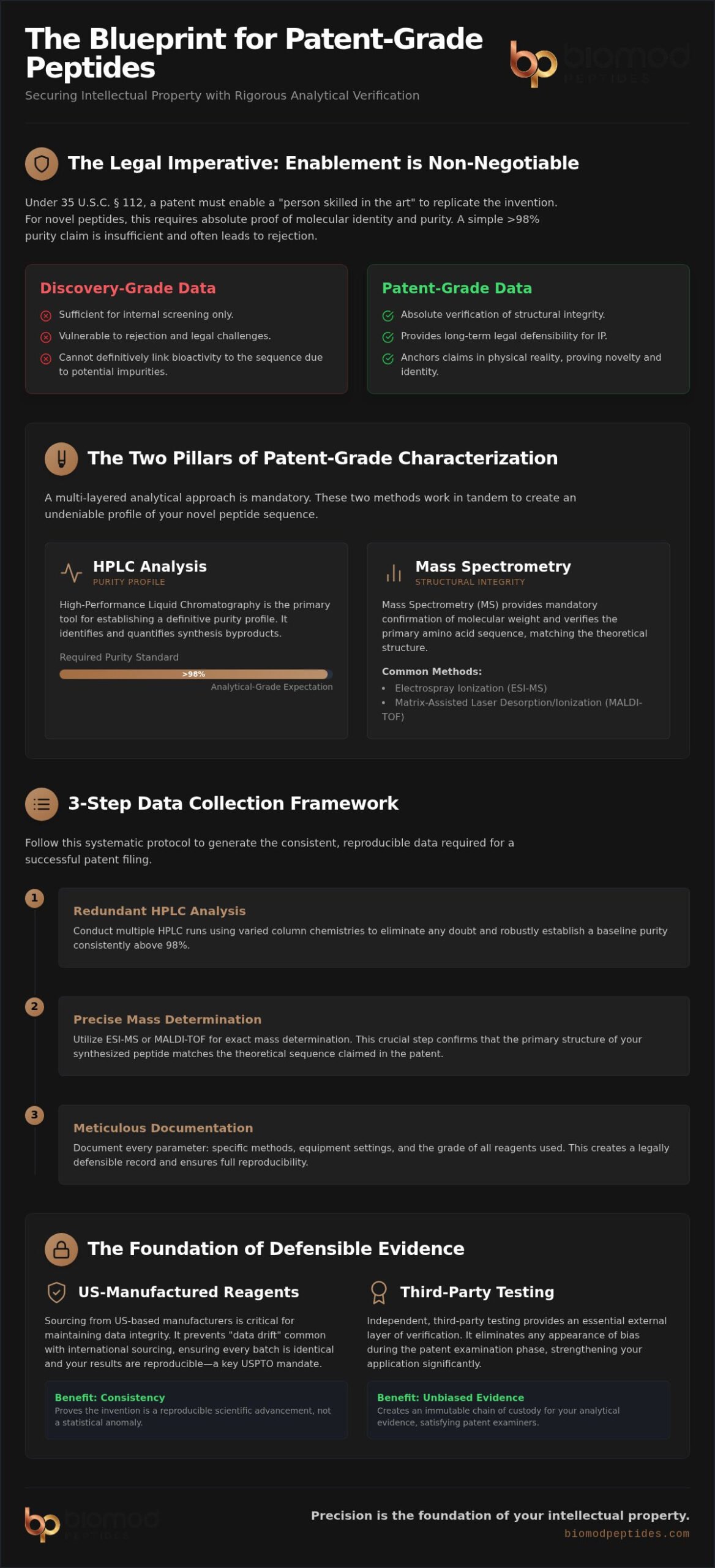
Enablement is the cornerstone of a defensible patent. Under 35 U.S.C. § 112, your application must provide sufficient detail for a person skilled in the art to replicate the invention without undue experimentation. For novel sequences, this requires more than a simple amino acid string. It demands rigorous peptide quality control for patent applications. Failure to provide comprehensive characterization data often results in immediate rejection or severely narrowed claims. Insufficient documentation leaves your intellectual property vulnerable to future litigation or invalidation.
There is a sharp divide between discovery-grade and patent-grade data. Discovery-grade analysis might suffice for internal screening, but patent-grade data requires absolute verification of structural integrity. High-purity standards are non-negotiable. Without them, you can’t definitively link biological activity to the specific peptide sequence. Impurities from the Peptide Synthesis process can mask results or produce false positives, undermining your legal claims. Sourcing US-manufactured reagents from Biomod Peptides ensures the baseline purity required for these high-stakes filings.
Characterizing Identity and Novelty in Peptide Sequences
Documenting amino acid composition and sequence order is vital to distinguish your invention from prior art. You must prove that your sequence is unique through empirical evidence rather than theoretical models. Standardized characterization protocols prevent the data drift that often plagues international research pipelines. Sequence verification serves as the primary evidence for peptide novelty in 2026. This process anchors your claims in physical reality, ensuring that your specific sequence is recognized as a distinct, patentable entity.
Essential Laboratory Protocols for Patent-Grade Characterization
Patent-grade characterization requires a multi-layered analytical approach that transcends standard research benchmarks. High-Performance Liquid Chromatography (HPLC) is the primary tool for establishing a definitive purity profile. It identifies and quantifies synthesis byproducts, effectively defining the physical substance described in your legal claims. Mass Spectrometry (MS) provides the mandatory confirmation of molecular weight and structural integrity. These methods align with FDA Q6B Specifications for biotechnological products. Impurity profiling is critical. You must quantify related substances to ensure the patent’s scope remains defensible against future challenges. Stability testing further supports your filing by validating shelf-life and delivery mechanism efficacy under controlled conditions. This level of peptide quality control for patent applications eliminates technical ambiguity in your disclosures.
A Step-by-Step Data Collection Framework for Patent Filings
Consistency is the priority. Follow this systematic protocol to generate the reproducible data required for a successful filing:
- Step 1: Conduct redundant HPLC analysis using varied column chemistries. Establish a baseline purity consistently above 98% to meet analytical-grade expectations.
- Step 2: Utilize Electrospray Ionization (ESI-MS) or Matrix-Assisted Laser Desorption/Ionization (MALDI-TOF) for precise mass determination. This step confirms the primary structure matches your theoretical sequence.
- Step 3: Document all specific methods, equipment parameters, and reagent grades used. This ensures reproducibility in Las Vegas labs or any standardized facility globally.
Reliable characterization begins with verified materials. Utilizing US-manufactured research peptides provides the structural consistency needed to maintain an immutable chain of custody for your analytical evidence. Precise documentation of these protocols transforms raw data into a legally defensible record.
Securing Defensible Evidence via Verified Research Reagents
US-based manufacturing is a critical requirement for maintaining data integrity. International sourcing often introduces data drift. This variability in reagent purity compromises the reproducibility of experimental results. For a successful filing, every batch used in your proof-of-concept must be identical. Consistency proves the invention is not a statistical anomaly but a reproducible scientific advancement. This methodology aligns with the USPTO Biotechnology Process Patent Guidelines, which mandate clear and reproducible process descriptions.
Unbiased evidence is the primary currency for patent examiners. Third-party testing provides an external layer of verification that internal lab reports cannot match. It eliminates the appearance of bias during the examination phase. By utilizing analytical-grade purity standards, researchers ensure their peptide quality control for patent applications meets the highest evidentiary thresholds. This rigorous approach prevents “one-off” flukes from undermining the legal defensibility of a novel sequence.
Documentation Integrity and the COA Verification Portal
Your patent’s “Example” section must correlate directly with verified laboratory reports. Using the Biomod COA Verification Portal allows your legal team to audit reagent quality in real-time. This digital chain of custody provides a transparent record of structural integrity. It bridges the gap between raw laboratory output and formal Analytical Standards for Research. Relying on US-manufactured and finished peptides ensures that the data used to secure your claims remains immutable throughout the multi-year examination process. Precision in peptide quality control for patent applications protects the longevity of your intellectual property.
Advancing Intellectual Property Through Analytical Purity
The strength of a peptide patent rests on structural integrity and data reproducibility. Enablement isn’t a suggestion. It’s a legal mandate requiring absolute transparency in characterization. Implementing standardized HPLC and MS protocols eliminates the technical gaps that lead to examiner rejections. Rigorous peptide quality control for patent applications transforms raw sequences into defensible assets. Documenting these standards requires reagents with zero data drift. Every batch must be verified by independent third parties to provide unbiased evidence. Utilizing US-manufactured reagents and a secure COA verification portal maintains the chain of custody from synthesis to filing. This meticulous approach ensures your invention is a reproducible discovery rather than a statistical fluke.
Secure high-purity research peptides for your patent-track studies at Biomod Peptides. Your intellectual property deserves the highest tier of analytical verification.
Frequently Asked Questions
What is the minimum purity required for a peptide patent application?
Minimum purity levels generally start at 95%, though 98% or higher is the preferred analytical standard for establishing enablement. High-purity thresholds are critical for ensuring that observed biological activity is directly attributable to the specific peptide sequence. This level of peptide quality control for patent applications prevents claims from being undermined by the presence of unidentified synthesis byproducts or contaminants.
Can I use in-house HPLC reports for my patent filing, or is third-party testing required?
In-house HPLC reports are legally acceptable, but independent third-party testing provides a significantly higher level of evidentiary weight. Unbiased verification from an external laboratory removes the appearance of conflict of interest during the patent examination process. Utilizing third-party data creates a more robust record that survives the scrutiny of examiners and potential future litigation challenges regarding molecular identity.
How does peptide sequence verification impact the scope of my patent claims?
Precise sequence verification directly defines the legal boundaries of your intellectual property. Accurate documentation of amino acid composition and sequence order allows for broader, more secure claims by clearly distinguishing your invention from existing prior art. Without empirical verification, your claims may be restricted to the specific examples provided; this leaves your broader conceptual invention vulnerable to competitors utilizing slight structural variations.
Why is US manufacturing considered a trust signal in patent-track peptide research?
US manufacturing is a trust signal because it ensures adherence to rigorous analytical protocols and provides logistical transparency. This regional focus minimizes the risk of data drift often associated with international supply chains. Ensuring that your research reagents are US-manufactured and finished provides the consistent baseline needed for long-term patent defense and the successful replication of your experimental findings.
Disclaimer
BIOMOD products are sold strictly for laboratory, analytical, and scientific research use only. They are not intended for human or animal consumption, administration, application, ingestion, injection, or any therapeutic, diagnostic, or cosmetic use.
The statements made on this website have not been evaluated by the United States Food and Drug Administration. BIOMOD products are not intended to diagnose, treat, cure, mitigate, or prevent any disease or medical condition.
BIOMOD is a research chemical supplier. BIOMOD is not a compounding pharmacy or chemical compounding facility as defined under Section 503A of the Federal Food, Drug, and Cosmetic Act. BIOMOD is not an outsourcing facility as defined under Section 503B of the Federal Food, Drug, and Cosmetic Act.
By accessing this site, you confirm you are at least 21 years of age and that you have read and accepted the BIOMOD Terms of Sale, Privacy Policy, and Research Use Only Policy. BIOMOD does not provide dosing, medical, therapeutic, diagnostic, veterinary, or use guidance under any channel.