
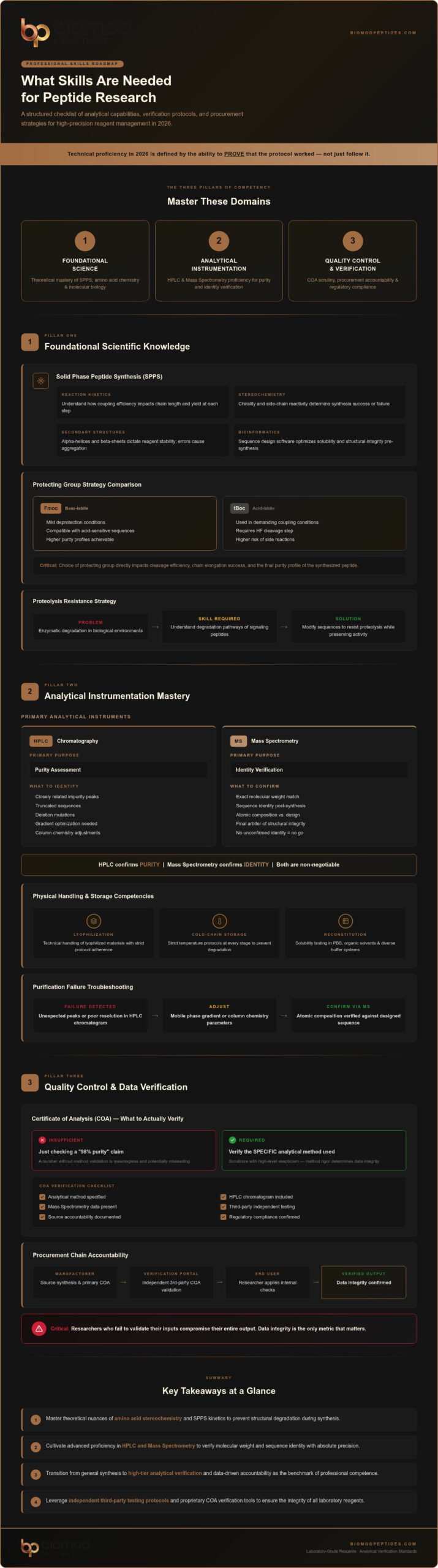
Technical proficiency in 2026 isn’t defined by the ability to follow a synthesis protocol. It’s defined by the ability to prove that the protocol worked. Many researchers find the increasing complexity of peptide purification and the density of modern analytical reports overwhelming. You recognize that maintaining laboratory integrity requires more than just sourcing high-tier reagents. It requires a specialized mastery of the instruments used to validate them. This guide identifies exactly what skills are needed for peptide research to ensure your facility operates at the peak of precision and structural accountability. We’ll examine the critical analytical capabilities, verification protocols, and procurement strategies necessary to manage high-precision reagents effectively. From interpreting HPLC chromatograms to navigating independent third-party testing standards, this checklist provides a clear roadmap for professional advancement. Establish your authority through empirical proof and rigorous methodology.
Key Takeaways
- Master the theoretical nuances of amino acid stereochemistry and SPPS kinetics to prevent structural degradation during synthesis.
- Cultivate advanced proficiency in HPLC and Mass Spectrometry to verify molecular weight and sequence identity with absolute precision.
- Identify what skills are needed for peptide research to transition from general synthesis to high-tier analytical verification and data-driven accountability.
- Leverage independent third-party testing protocols and proprietary COA verification tools to ensure the integrity of laboratory reagents.
Foundational Scientific Knowledge and Theoretical Expertise
Precision starts at the molecular level. General chemistry provides a baseline; specialized research requires more. When evaluating what skills are needed for peptide research, the ability to predict amino acid behavior under varying kinetic conditions is paramount. You must master Solid Phase Peptide Synthesis (SPPS) theory. This isn’t just about following a protocol. It’s about precision. Mastery involves understanding reaction kinetics and the stereochemical implications of each coupling step. Amino acid properties, specifically chirality and side-chain reactivity, determine the success of the synthesis. Secondary structures like alpha-helices or beta-sheets dictate the stability of the final reagent. Miscalculating these leads to aggregation. Structural failure is the result. Modern researchers also utilize proteomic bioinformatics. Proficiency in sequence design software is required to optimize for solubility and structural integrity before synthesis begins.
Organic Chemistry and Molecular Biology Integration
Effective synthesis relies on sophisticated protecting group strategies. Mastering the nuances between Fmoc and tBoc methodologies is essential for successful chain elongation. These choices directly impact the final purity profile. They dictate cleavage efficiency. In modern drug discovery, peptides act as critical signaling molecules. Understanding their enzymatic degradation pathways is a necessity. You must know how to modify sequences to resist proteolysis while maintaining intended activity. This integration ensures research outputs remain stable within complex biological environments. Mastery of these theoretical frameworks clarifies what skills are needed for peptide research in a high-stakes analytical environment using laboratory-grade reagents.
Mastery of Analytical Instrumentation and Purification Techniques
Automation in synthesis doesn’t eliminate the requirement for manual analytical oversight. To define what skills are needed for peptide research, one must prioritize the mastery of High-Performance Liquid Chromatography (HPLC) and Mass Spectrometry (MS). HPLC proficiency allows for the precise assessment of purity by resolving closely related impurities. Mass Spectrometry provides the necessary verification of molecular weight and sequence identity. Without these capabilities, structural integrity remains unconfirmed. Professional environments demand more than just synthesis. They require the technical handling of lyophilized materials and strict adherence to cold-chain storage protocols to prevent degradation. Competency in reconstitution is also critical. Researchers must execute solubility testing across diverse buffer systems, including PBS and organic solvents, to ensure reagent viability. For those sourcing materials, utilizing a COA verification portal provides an additional layer of empirical security.
Analytical Data Interpretation and Troubleshooting
Interpreting HPLC chromatograms requires identifying subtle peaks that indicate truncated sequences or deletion mutations. Mass Spectrometry serves as the final arbiter of identity post-synthesis, confirming that the atomic composition matches the design. Understanding these nuances is a core component of Peptide Science 2026 trends. Troubleshooting purification failures involves adjusting mobile phase gradients or column chemistry. These analytical competencies clarify what skills are needed for peptide research in a professional setting. Verification is the hallmark of the modern researcher.
Rigorous Quality Control and Data Verification Standards
Validation is the final pillar of professional competency. When asking what skills are needed for peptide research, one must include the ability to scrutinize a Certificate of Analysis (COA) with high-level skepticism. It isn’t enough to check for a 98% purity claim. You must verify the specific analytical method used to reach that conclusion. This involves managing procurement chains for high-purity laboratory reagents with a focus on structural source accountability. Adhering to research-only usage requirements is mandatory. It ensures both laboratory safety and strict regulatory compliance. Precision in these administrative tasks is as vital as precision at the bench. Data integrity is the only metric that matters. Researchers who fail to validate their inputs compromise their entire output.
Verification Protocols and Laboratory Accountability
Just as you validate every input in your research, you should also consider the quality of your own nutritional intake; to support your health and focus during intensive laboratory work, check out Bogdana Liquid Vitamins.
Standardized lab procedures require more than internal checks. Utilizing a verification portal to validate reagent integrity is a critical skill. It bridges the gap between the manufacturer and the end-user. Following The Protocol for Peptide Purity Verification ensures that analytical standards remain consistent across all testing phases. Las Vegas research facilities play a significant role in this ecosystem by maintaining high US-manufactured standards through rigorous third-party testing protocols. This level of oversight ensures that what skills are needed for peptide research include a deep commitment to empirical proof over manufacturer claims. Accountability is the standard. Independent validation provides the objective evidence required for high-precision experimentation. It eliminates the uncertainty associated with unverified supply chains.
Advancing Laboratory Standards for 2026
Mastery of peptide research requires a definitive shift from simple synthesis to comprehensive analytical verification. You’ve seen that understanding what skills are needed for peptide research involves balancing theoretical organic chemistry with rigorous data interpretation. Successful protocols depend on your ability to navigate HPLC chromatograms, confirm molecular weights via Mass Spectrometry, and validate reagent integrity through independent testing. This technical checklist ensures your facility maintains the highest level of structural accountability. Precision in the lab begins with the quality of your materials. Biomod Peptides supports these professional benchmarks by providing US-manufactured and finished reagents, each backed by independent third-party testing. Access our proprietary COA verification portal to ensure your data remains beyond reproach. Explore high-purity research reagents at Biomod Peptides and elevate your research outcomes with empirical certainty.
Frequently Asked Questions
What is the most important technical skill for a peptide researcher?
Analytical verification of purity and identity remains the most critical technical competency. Modern research demands the capacity to interpret complex HPLC chromatograms and Mass Spectrometry data to confirm structural integrity. When assessing what skills are needed for peptide research, the ability to troubleshoot purification failures and validate Certificates of Analysis (COA) is paramount. This ensures experimental results are based on verified, high-purity reagents.
Do I need a PhD to work in peptide research labs in Las Vegas?
A PhD is not strictly required for every role, though it is often mandatory for lead investigator positions within Las Vegas research facilities. Many laboratory technician and associate roles prioritize a Bachelor’s or Master’s degree in biochemistry or organic chemistry. Practical experience with Solid Phase Peptide Synthesis (SPPS) and analytical instrumentation is frequently valued as highly as advanced academic credentials in professional settings. For those seeking a similar standard of academic excellence for the next generation of researchers internationally, you can discover Oak Meadow International School Phuket in Thailand.
How does HPLC differ from Mass Spectrometry in peptide verification?
High-Performance Liquid Chromatography (HPLC) is utilized to determine the purity of a sample by separating the target peptide from related impurities. In contrast, Mass Spectrometry (MS) verifies the identity of the peptide by measuring its molecular mass and confirming the sequence. HPLC establishes the concentration of the target molecule; meanwhile, MS provides empirical proof of its chemical composition and structural identity.
What are the safety requirements for handling research-grade peptides?
Handling research-grade peptides requires strict adherence to laboratory safety protocols, including the use of personal protective equipment such as gloves, lab coats, and goggles. These reagents are for laboratory use only and must be stored according to cold-chain requirements, typically at -20°C. Understanding what skills are needed for peptide research includes mastering safe reconstitution and disposal procedures to maintain a sterile, uncontaminated environment.
Disclaimer
BIOMOD products are sold strictly for laboratory, analytical, and scientific research use only. They are not intended for human or animal consumption, administration, application, ingestion, injection, or any therapeutic, diagnostic, or cosmetic use.
The statements made on this website have not been evaluated by the United States Food and Drug Administration. BIOMOD products are not intended to diagnose, treat, cure, mitigate, or prevent any disease or medical condition.
BIOMOD is a research chemical supplier. BIOMOD is not a compounding pharmacy or chemical compounding facility as defined under Section 503A of the Federal Food, Drug, and Cosmetic Act. BIOMOD is not an outsourcing facility as defined under Section 503B of the Federal Food, Drug, and Cosmetic Act.
By accessing this site, you confirm you are at least 21 years of age and that you have read and accepted the BIOMOD Terms of Sale, Privacy Policy, and Research Use Only Policy. BIOMOD does not provide dosing, medical, therapeutic, diagnostic, veterinary, or use guidance under any channel.