
A brilliant hypothesis is worthless if the underlying reagents lack empirical validation. Many reviewers reject otherwise sound proposals because the methodology fails to account for the technical volatility of synthetic chains. Successful grant writing for peptide research requires more than a compelling narrative; it demands a rigorous defense of your analytical standards. You understand the frustration of justifying the premium cost of high-purity reagents to a skeptical committee. It’s a common hurdle that stalls vital laboratory progress.
This technical guide provides a framework to master the nuances of drafting high-impact proposals. We’ll examine how to integrate HPLC and MS data into your Research Strategy section to build institutional trust. You’ll learn to secure funding by prioritizing purity verification and leveraging transparent documentation like third-party lot testing and COA verification portals. This approach transforms your reagent budget from a liability into a cornerstone of your study’s integrity.
Key Takeaways
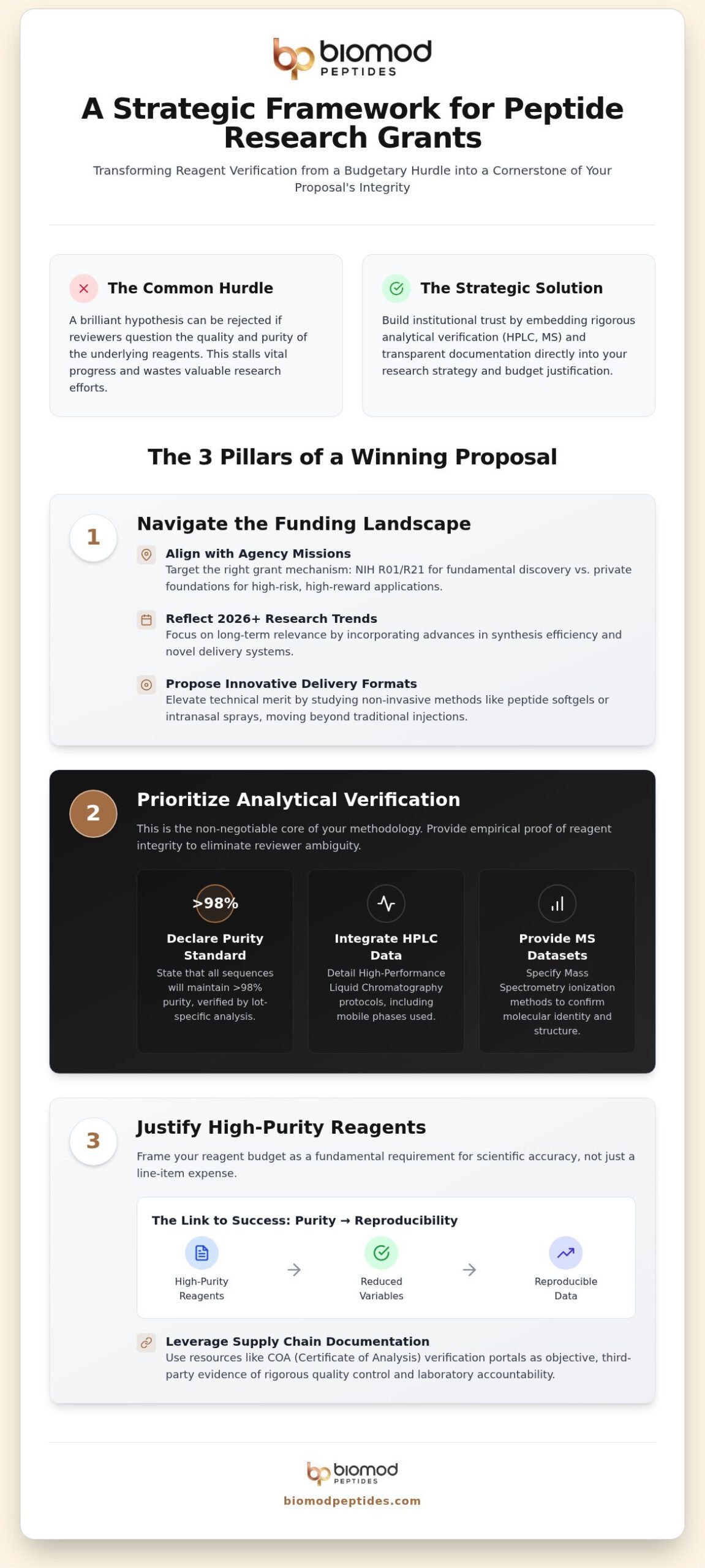
- Identify high-impact funding agencies and align proposals with 2026 trends in synthesis and delivery to ensure long-term study relevance.
- Strengthen the methodology section by integrating specific HPLC and MS verification protocols, a critical component of successful grant writing for peptide research.
- Establish a direct correlation between high-purity reagents and data reproducibility to justify budget allocations for analytical-grade materials.
- Leverage supply chain documentation and COA verification portals as objective evidence of laboratory accountability and reagent integrity.
Navigating the Funding Landscape for Peptide-Based Studies
Securing capital for complex molecular studies requires precision in agency selection. High-impact grant writing for peptide research begins by differentiating between the broad scope of NIH R01/R21 mechanisms and the specialized focuses of private life science foundations. While the NIH prioritizes fundamental mechanism discovery, private foundations often fund high-risk applications. Success depends on strategic alignment with the specific mission of the funding body.
Reviewers increasingly prioritize proposals that reflect peptide science trends projected for 2026. This includes a focus on synthesis efficiency and delivery optimization. Proposals supporting US-based laboratory priorities, particularly in research hubs like Las Vegas, must demonstrate logistical transparency. Utilizing US-manufactured reagents provides a competitive edge by ensuring supply chain reliability and regulatory compliance.
Innovation scores often fluctuate based on the novelty of delivery systems. Traditional parenteral routes face scrutiny regarding pharmacokinetic variability and procedural complexity. Proposing studies that utilize peptide softgels or intranasal delivery formats can significantly elevate the technical merit of your application. These formats represent a structural leap in research execution.
Identifying High-Impact Funding Agencies
The NIH Division of Chemistry and Chemical Biology evaluates proposals based on chemical rigor and biological relevance. It’s essential to target niche grants that explore intranasal peptide research sprays to capitalize on current interests in non-invasive delivery. Every proposal must include a comprehensive plan for laboratory peptide supply. Reviewers demand proof that reagents meet standardized analytical benchmarks. This documentation anchors your research strategy in empirical fact rather than procedural assumption.
Drafting the Research Strategy: Prioritizing Analytical Verification
Success in grant writing for peptide research depends on your ability to prove reagent integrity. The methodology section must transcend basic sequence descriptions to define the exact parameters of synthesis and validation. Reviewers prioritize data reproducibility and structural accountability. Providing explicit protocols for peptide purity verification establishes a baseline of scientific integrity that justifies your requested budget.
Prioritize High-Performance Liquid Chromatography (HPLC) and Mass Spectrometry (MS) datasets to provide empirical proof. These standards are non-negotiable for high-impact grant writing for peptide research. Your methodology should detail the mobile phases used in HPLC and the specific ionization methods employed for MS. This technical density prevents reviewer ambiguity regarding molecular identity. Additionally, address the stability of your lyophilized reagents. Specify cold-chain storage requirements and exact reconstitution protocols to ensure molecular stability and consistent bioactivity throughout the study duration.
Defining Purity Standards and Impurity Profiles
Drafting a declarative statement regarding purity benchmarks is essential for technical merit. State clearly that all sequences will maintain >98% purity as verified by lot-specific HPLC. This standard minimizes the risk of off-target effects caused by truncated sequences or residual synthesis solvents. Justifying the use of US-manufactured reagents further strengthens the proposal by ensuring logistical transparency and rigorous internal quality control. For researchers seeking verified reagents to support their aims, Biomod Peptides provides the analytical documentation and third-party verification necessary to satisfy these rigorous grant requirements.
Budgeting and Sourcing: Justifying High-Purity Reagents
Reviewers view data reproducibility as a primary metric of study viability. Budgeting for sub-standard reagents invites experimental failure and committee skepticism. Effective grant writing for peptide research necessitates a transparent justification for analytical-grade materials. You must link purity levels directly to the reduction of confounding variables in your experimental model. This correlation transforms a line-item expense into a fundamental requirement for scientific accuracy.
Utilizing the Biomod Peptides COA portal serves as objective evidence of rigorous supply chain management. It demonstrates that the laboratory possesses real-time verification tools to maintain accountability. Use the ‘Facilities and Other Resources’ section to highlight access to US-manufactured reagents. This logistical transparency mitigates concerns regarding lot-to-lot variability and ensures that the study’s reagents meet the highest technical benchmarks.
Justifying the cost of specialized formats like peptide softgels requires framing them as essential for comparative analysis. These formats allow for the evaluation of pharmacokinetic profiles against traditional delivery methods. Including these in your budget adds a layer of technical sophistication. It shows a forward-thinking approach to delivery optimization that aligns with current funding trends in molecular science.
Leveraging Third-Party Testing for Grant Credibility
Independent validation is a cornerstone of a robust ‘Quality Assurance’ subsection. Utilize verified peptide certificates of analysis to confirm that every reagent lot undergoes rigorous external testing. This practice ensures experimental precision and provides reviewers with the empirical proof they require. It moves the proposal from a statement of intent to a documented plan for structural integrity and laboratory-grade execution.
Advancing Structural Integrity in Peptide Research Applications
Mastering grant writing for peptide research requires a shift from conceptual hypotheses to empirical verification. Reviewers value proposals that minimize experimental risk through rigorous analytical standards. By integrating HPLC and MS data into your methodology and justifying the use of US-manufactured reagents, you establish a baseline of laboratory accountability. These technical nuances distinguish high-impact studies from rejected applications. Transparency in your supply chain isn’t just a logistical detail; it’s a cornerstone of data reproducibility.
Ensure your next submission meets the highest benchmarks for precision. You can source high-purity reagents for your funded research at Biomod Peptides to leverage US-manufactured, analytical-grade materials. Every lot undergoes independent third-party testing, with results accessible via our COA Verification Portal. This level of documentation provides the objective proof committees demand. Your commitment to methodological excellence will drive the next generation of peptide science forward.
Frequently Asked Questions
What is the most important section of a peptide research grant?
The Research Strategy is the most critical component. Reviewers focus on the Methodology subsection to evaluate scientific rigor. You must demonstrate that your reagents are verified for purity and identity. Effective grant writing for peptide research hinges on proving that your results won’t be skewed by contaminants or truncated sequences. A detailed validation plan ensures your data is reproducible and structurally sound.
How do I justify the cost of high-purity research peptides in my budget?
Justify premium costs by linking reagent quality to experimental reproducibility. Explain that high-purity peptides are essential to eliminate off-target effects and baseline noise. Grant writing for peptide research requires highlighting the risks of lower-grade materials, which often lead to false positives or failed replications. Committees prioritize data integrity over cost savings, viewing analytical-grade reagents as a prerequisite for high-impact results.
Should I include HPLC and MS reports in the grant appendix?
Including representative HPLC and Mass Spectrometry reports in the appendix provides empirical proof of reagent quality. If space is limited, explicitly mention your access to a COA verification portal in the Facilities and Other Resources section. This indicates a commitment to objective validation. Providing these datasets preemptively addresses reviewer concerns regarding molecular identity. It demonstrates a sophisticated level of laboratory accountability and technical precision.
Can I use US-manufactured peptides to satisfy domestic sourcing preferences in federal grants?
Yes. Utilizing US-manufactured reagents aligns with domestic preference requirements often found in federal solicitations. Beyond compliance, sourcing domestically ensures greater logistical transparency and oversight of the finishing process. This choice reduces supply chain volatility and simplifies the verification of Certificates of Analysis. It reinforces the study’s structural integrity by utilizing reagents finished in facilities that adhere to rigorous US-based analytical standards.
Disclaimer
BIOMOD products are sold strictly for laboratory, analytical, and scientific research use only. They are not intended for human or animal consumption, administration, application, ingestion, injection, or any therapeutic, diagnostic, or cosmetic use.
The statements made on this website have not been evaluated by the United States Food and Drug Administration. BIOMOD products are not intended to diagnose, treat, cure, mitigate, or prevent any disease or medical condition.
BIOMOD is a research chemical supplier. BIOMOD is not a compounding pharmacy or chemical compounding facility as defined under Section 503A of the Federal Food, Drug, and Cosmetic Act. BIOMOD is not an outsourcing facility as defined under Section 503B of the Federal Food, Drug, and Cosmetic Act.
By accessing this site, you confirm you are at least 21 years of age and that you have read and accepted the BIOMOD Terms of Sale, Privacy Policy, and Research Use Only Policy. BIOMOD does not provide dosing, medical, therapeutic, diagnostic, veterinary, or use guidance under any channel.