
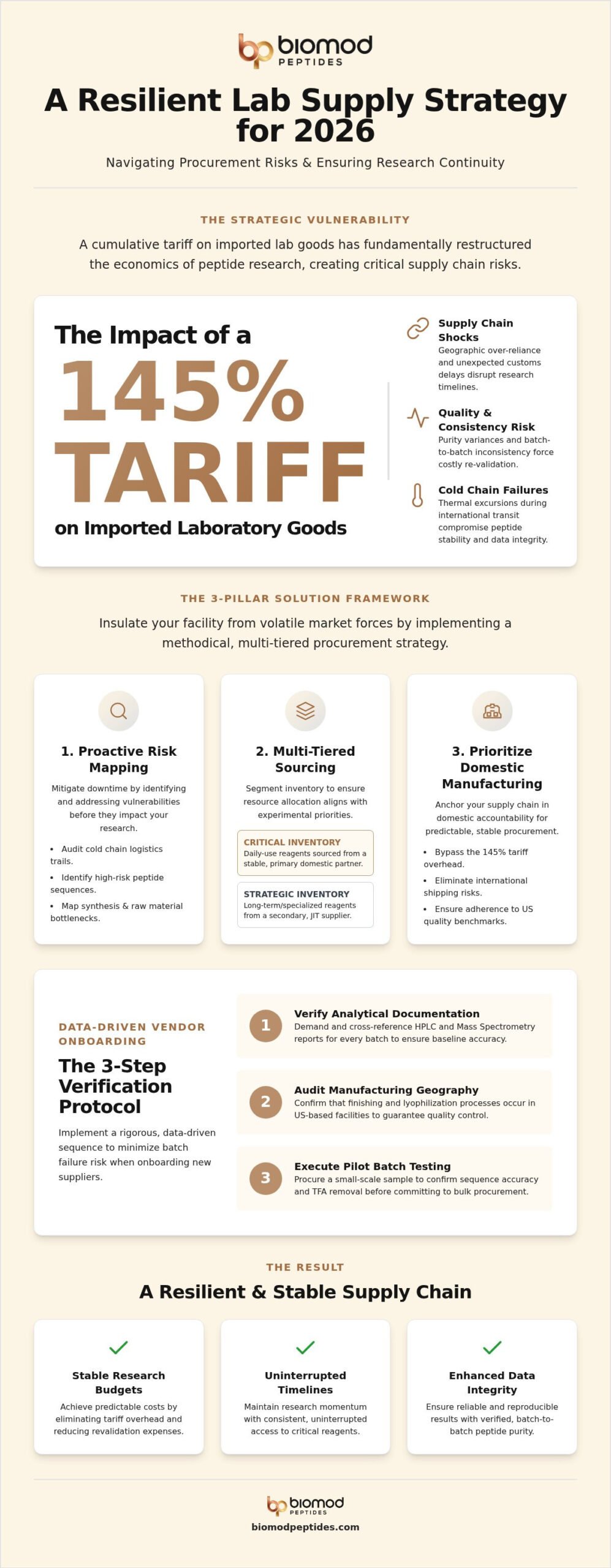
A 145% cumulative tariff on imported lab goods has fundamentally restructured the economics of peptide research. Procurement is no longer a routine logistical task. It’s a strategic vulnerability. You’ve likely experienced the frustration of purity variances that stall timelines or cold chain failures that compromise critical reagents. Creating a resilient lab supply strategy is the only way to insulate your facility from these volatile market forces.
It’s clear that your research shouldn’t be held hostage by the unpredictability of overseas quality control or shifting trade barriers. This guide provides a methodical framework to mitigate procurement risks and ensure a stable supply of analytical-grade reagents. We’ll examine domestic manufacturing advantages, dual-sourcing protocols, and the role of third-party COA verification in maintaining batch consistency throughout 2026.
Key Takeaways
- Audit cold chain logistics and identify high-risk peptide sequences prone to synthesis bottlenecks. Proactive mapping mitigates the risk of stability loss and unexpected research downtime.
- Segment laboratory inventory into critical daily-use and strategic long-term categories. This multi-tiered sourcing framework ensures resource allocation remains aligned with experimental priorities.
- Prioritize US-manufactured peptides when creating a resilient lab supply strategy to bypass international shipping risks and 145% tariff overhead. Domestic partnerships provide a stable, predictable baseline for 2026 procurement budgets.
- Integrate digital verification portals into standard procurement workflows to automate quality assurance. Utilizing third-party COA portals reduces the internal cost of revalidation and ensures batch-to-batch consistency.
Mapping Vulnerabilities in Research Peptide Procurement
Supply chain fragility in 2026 stems from geographic over-reliance and biochemical sensitivity. Identifying high-risk peptide sequences is the first step in creating a resilient lab supply strategy. Sequences featuring multiple hydrophobic residues or complex disulfide bridges often face synthesis bottlenecks. These issues are compounded when raw material precursors are restricted by trade barriers, such as the 145% tariff on laboratory goods from China. Labs must identify which reagents in their catalog are most susceptible to these external shocks.
Logistical audits must extend beyond simple arrival dates. You must analyze the “Cold Chain” audit trail to identify where transit delays compromise peptide stability. Transit holds at international borders frequently lead to thermal excursions. Even minor temperature fluctuations during extended customs inspections can initiate peptide degradation. This renders the reagent unsuitable for high-precision analytical work and compromises the integrity of your data sets.
Quantifying the Risk of Quality Drift and Supply Shocks
Quality drift occurs when batch-to-batch inconsistency forces the repetition of entire experimental blocks. To assess the financial impact, calculate your cost-per-failed-experiment by factoring in labor hours, lost reagents, and delayed publication timelines. Unverified purity levels are the primary driver of these losses. There is also a significant hidden cost of revalidation when switching between international and domestic vendors. Every new source requires a rigorous internal validation protocol to ensure baseline alignment with previous data. In the field of peptide science, supply chain resilience is defined as the ability to maintain uninterrupted access to verified, high-purity reagents despite global economic or logistical shifts. Transitioning to a domestic-first model reduces these revalidation cycles and stabilizes long-term research budgets.
Designing a Multi-Tiered Sourcing Framework
Efficient inventory management in 2026 rejects the “lean” model in favor of strategic redundancy. Creating a resilient lab supply strategy requires segmenting your reagents into two distinct categories. ‘Critical’ inventory includes peptides used in daily assays where a stockout halts all progress. ‘Strategic’ inventory consists of sequences reserved for long-term, high-stakes experimental milestones. This dual-track system ensures that essential research continues even if global supply chains fracture. It’s a necessary shift from reactive purchasing to proactive resource allocation.
Establishing a primary domestic partner is the most effective way to bypass the 145% tariff overhead and customs volatility associated with international imports. This partner serves as the stable foundation for your critical supply. Simultaneously, utilize a secondary Just-in-Time (JIT) supplier for specialized sequences and diverse delivery formats. For instance, sourcing peptide softgels from a specialized domestic provider allows for precision in analytical research without the burden of excessive long-term storage costs. You can view verified analytical standards to benchmark your current domestic sourcing options.
Implementing Verification Protocols for Vendor Onboarding
Onboarding new providers requires a rigorous, data-driven approach to minimize the risk of batch failure. Follow this three-step validation sequence to ensure your supply chain remains robust:
- Verify analytical documentation: Demand HPLC and Mass Spectrometry reports for every batch. These documents must be cross-referenced via a peptide purity verification protocol to ensure baseline accuracy.
- Audit manufacturing geography: Confirm that the finishing and lyophilization processes occur in US-based facilities. This ensures adherence to domestic quality benchmarks and eliminates international logistical risks.
- Execute pilot batch testing: Procure a small-scale sample to confirm sequence accuracy and TFA removal before initiating bulk procurement.
Leveraging Domestic Partnerships for Long-Term Resilience
Prioritizing US-manufactured peptides is the most direct method for eliminating the 145% tariff overhead and international shipping risks that characterized 2025. Domestic production removes the volatility of customs inspections and the inherent instability of long-distance cold chain transit. Creating a resilient lab supply strategy requires shifting from a globalized model to one anchored in domestic accountability. Analytical-grade reagents require documented structural integrity that international shipping often compromises. Sourcing domestically eliminates the risk of thermal excursions during customs holds. It ensures your procurement budget remains predictable despite fluctuating trade barriers.
Integrate digital verification portals into your laboratory’s procurement workflow to automate quality assurance. A dedicated COA verification portal serves as a centralized repository for batch-specific data. This transparency allows lab managers to verify peptide purity and sequence accuracy before unboxing. It transforms quality control from a reactive hurdle into a streamlined, digital process. Digital verification is a cornerstone of creating a resilient lab supply strategy in 2026. Additionally, maintain a ‘Critical Materials Register’ that syncs with your primary supplier’s stock levels. This data-sharing protocol prevents stockouts of essential reagents by providing real-time visibility into current availability.
Localized Supply for Las Vegas Laboratory Facilities
Regional distribution significantly reduces transit time for sensitive intranasal peptide research sprays. Utilizing Biomod Peptides as a Las Vegas-based anchor provides high-purity reagent access with minimal logistical friction. Localized partnerships allow for direct communication channels between researchers and manufacturers. These links ensure you receive early alerts regarding synthesis delays or raw material shortages before they impact your experimental timelines. Proximity ensures the stability of lyophilized powders and specialized delivery formats throughout the final mile of delivery.
Stabilizing Analytical Outcomes through Strategic Procurement
Precision in 2026 requires more than rigorous bench science. It demands a sophisticated approach to reagent logistics. You’ve identified high-risk sequences and established a multi-tiered sourcing framework to bypass global trade volatility. Creating a resilient lab supply strategy centers on domestic accountability and transparent verification. By prioritizing US-manufactured reagents, you eliminate the threat of 145% tariff overhead and shipping-induced degradation. Independent third-party HPLC/MS testing and a comprehensive COA verification portal provide the empirical proof necessary for high-stakes research. Our Las Vegas-based distribution ensures rapid fulfillment without the risks of international transit holds. Stability is the foundation of analytical success. Secure your laboratory supply chain with US-manufactured peptides from Biomod. Data integrity depends on a stable, verified supply. Maintain your research momentum with professional confidence.
Frequently Asked Questions
How do 2025 tariffs affect the price of research peptides in 2026?
Tariffs implemented in April 2025 impose a 145% cumulative rate on laboratory goods sourced from China. These trade barriers significantly inflate the procurement costs of imported reagents throughout 2026. When creating a resilient lab supply strategy, domestic sourcing allows labs to bypass these overheads and customs volatility. This ensures that research budgets remain predictable while avoiding the logistical surcharges associated with global trade disputes.
What is the difference between a primary and secondary vendor in a lab supply strategy?
A primary vendor provides the stable foundation for critical daily-use inventory, while a secondary vendor offers redundancy or specialized delivery formats. This tiered approach is a core component of creating a resilient lab supply strategy. Secondary providers often manage Just-in-Time orders for niche sequences. This structure prevents total research halts if a primary supplier faces synthesis bottlenecks or raw material shortages during global supply chain shifts.
How can a COA verification portal reduce laboratory downtime?
Digital verification portals provide immediate access to independent third-party testing data, allowing for rapid batch authentication. This transparency prevents the use of sub-purity reagents that lead to failed experiments and data inconsistency. By automating the quality assurance step, labs reduce the time spent on internal revalidation. This process ensures that every peptide meets analytical standards before it ever reaches the research bench, minimizing operational interruptions.
Why is US-based manufacturing critical for peptide stability?
Domestic manufacturing eliminates the risk of thermal excursions during extended international customs inspections. Peptides are highly sensitive to temperature fluctuations; even minor delays can compromise their biochemical stability. US-based synthesis and finishing ensure a tighter cold chain audit trail. This proximity preserves the structural integrity of lyophilized powders and research sprays, ensuring that the analytical results remain consistent and reproducible across every batch.
Disclaimer
BIOMOD products are sold strictly for laboratory, analytical, and scientific research use only. They are not intended for human or animal consumption, administration, application, ingestion, injection, or any therapeutic, diagnostic, or cosmetic use.
The statements made on this website have not been evaluated by the United States Food and Drug Administration. BIOMOD products are not intended to diagnose, treat, cure, mitigate, or prevent any disease or medical condition.
BIOMOD is a research chemical supplier. BIOMOD is not a compounding pharmacy or chemical compounding facility as defined under Section 503A of the Federal Food, Drug, and Cosmetic Act. BIOMOD is not an outsourcing facility as defined under Section 503B of the Federal Food, Drug, and Cosmetic Act.
By accessing this site, you confirm you are at least 21 years of age and that you have read and accepted the BIOMOD Terms of Sale, Privacy Policy, and Research Use Only Policy. BIOMOD does not provide dosing, medical, therapeutic, diagnostic, veterinary, or use guidance under any channel.