
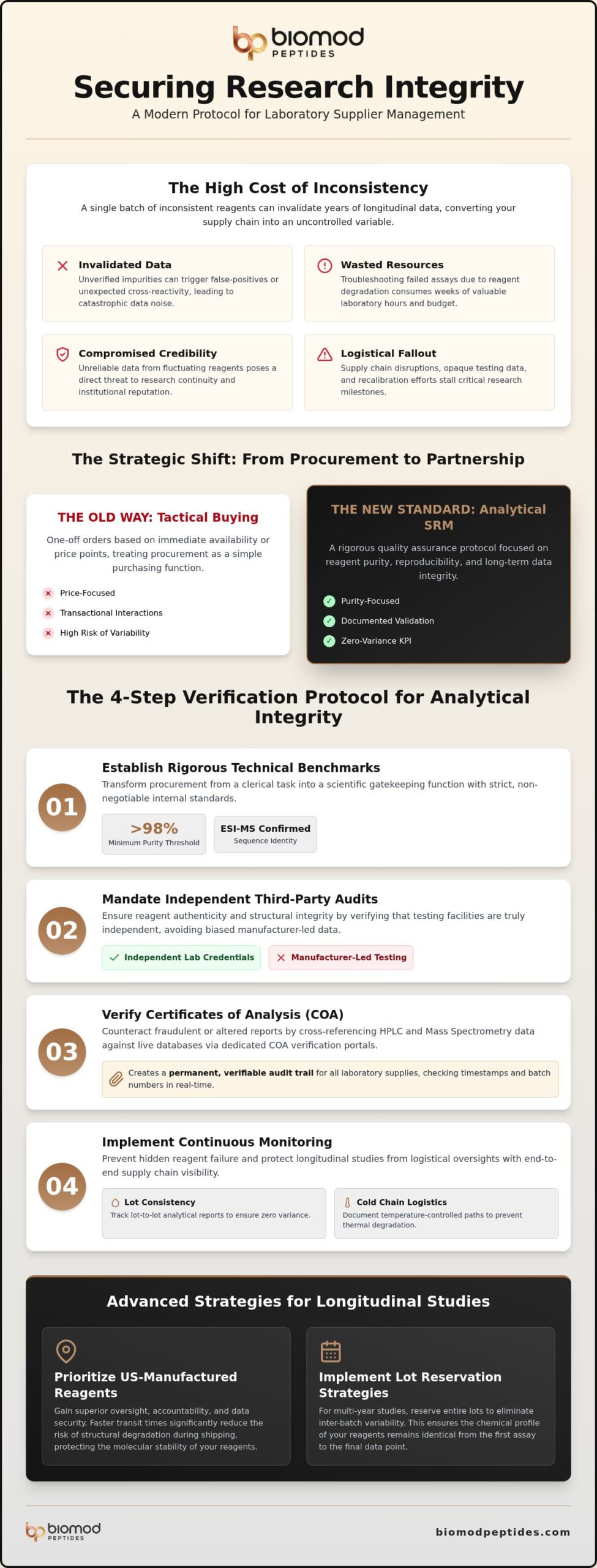
A single batch of inconsistent reagents can invalidate years of longitudinal data. For high-stakes research, procurement isn’t just a logistical necessity; it’s a primary vulnerability. You’ve likely faced the frustration of opaque testing data or supply chain disruptions that stall critical milestones. These variables introduce unacceptable noise into sensitive analytical environments. Effective supplier relationship management for labs requires moving beyond simple vendor lists toward a rigorous, verification-led framework. This protocol prioritizes analytical integrity over mere availability.
You’ll master a streamlined verification process designed to ensure reagent purity and research continuity. We’ll examine how to leverage US-manufactured reagents and dedicated COA verification portals to build documented audit trails. This guide outlines the transition from passive purchasing to active quality oversight. By the end, you’ll have the tools to secure your supply chain against batch-to-batch variability. Precision starts with the source.
Key Takeaways
- Transition from tactical procurement to a strategic model of supplier relationship management for labs. It’s the standard for long-term purity.
- Establish a 4-step protocol. Mandatory technical benchmarks and independent audits ensure analytical integrity.
- Utilize US-based manufacturing. Lot-reservation strategies eliminate inter-batch variability in longitudinal studies.
- Leverage dedicated COA verification portals. They’re essential for maintaining documented audit trails for all reagents.
Shifting from Tactical Procurement to Analytical SRM
Laboratory procurement often defaults to tactical buying. This involves one-off orders based on immediate availability or price points. High-stakes research demands a transition toward Supplier Relationship Management (SRM). Implementing supplier relationship management for labs ensures that vetting and monitoring are focused on reagent purity. It’s not a purchasing function. It’s a quality assurance protocol. Defining Laboratory SRM requires looking past the invoice to the HPLC report. Strategic SRM prioritizes long-term purity assurance over short-term cost savings.
Effective supplier relationship management for labs aligns procurement with the requirements of the scientific method. Reproducibility hinges on the stability of variables. When reagents fluctuate, data becomes unreliable. The primary KPI for this framework is zero-variance in batch-to-batch analytical reports. Achieving this requires moving beyond transactional interactions. It demands a rigorous partnership focused on documented validation and consistent chemical profiles. High-purity research peptides must be backed by transparent, third-party data to maintain these standards.
The Hidden Cost of Substandard Reagent Management
Substandard reagents introduce catastrophic noise into complex experimental models. Unverified impurities often trigger false-positive results or unexpected cross-reactivity. These errors lead researchers down expensive, dead-end pathways. The logistical fallout is equally severe; troubleshooting a failed assay due to reagent degradation can consume weeks of laboratory hours. Every hour spent recalibrating for a dirty batch is an hour lost on discovery. This isn’t just a procurement issue. It’s a direct threat to research continuity and institutional credibility. Relying on unverified sources converts your supply chain into an uncontrolled variable.
Implementing a 4-Step Protocol for Peptide Supplier Verification
Establishing rigorous technical benchmarks is the first requirement for analytical integrity. Reagents must meet a minimum purity threshold of 98%. Anything less introduces unacceptable variables into sensitive assays. Sequence identity must be confirmed through electrospray ionization mass spectrometry (ESI-MS). This level of detail is the cornerstone of supplier relationship management for labs. It transforms procurement from a clerical task into a scientific gatekeeping function. Precision begins with strict internal standards.
The second step involves a mandatory audit of third-party testing protocols. You must verify that the testing facility is truly independent and maintains high-tier laboratory credentials. A comprehensive supplier quality management system avoids the trap of internal manufacturer testing. Manufacturer-led data often lacks the objectivity required for high-stakes research. Independent validation is non-negotiable for ensuring reagent authenticity and structural integrity.
Third, verify all Certificates of Analysis (COA) via independent portals to confirm data integrity. Finally, implement continuous monitoring of lot consistency and cold chain logistics. Thermal degradation during transit causes hidden reagent failure. Document the temperature-controlled path of your reagents. Ensure molecular stability upon arrival. This end-to-end oversight prevents longitudinal studies from being compromised by logistical oversights.
Leveraging COA Verification Portals for Real-Time Validation
Cross-referencing HPLC and Mass Spectrometry data with manufacturer claims is essential for identifying fraudulent analytical reports. In the peptide industry, static PDF reports are frequently altered to represent different batches. You must check timestamps and batch numbers against live databases. Biomod Peptides provides this level of scrutiny through a dedicated COA verification portal. This transparency, further detailed on the About Biomod page, ensures that every vial is backed by verifiable data. Integrating these tools into your supplier relationship management for labs creates a permanent audit trail for all laboratory supplies.
Optimizing Bulk Procurement and Regional Supply Logistics
Longitudinal research depends on chemical consistency. Managing inter-batch variability is a critical pillar of supplier relationship management for labs. You should implement lot-reservation strategies for multi-year studies. This ensures that the chemical profile of your reagents remains identical from the first assay to the final data point. US-manufactured reagents offer superior oversight and accountability compared to global alternatives. Faster transit times reduce the risk of structural degradation during shipping. It’s a matter of data security.
Strategic bulk procurement must balance volume with molecular stability. Storing large quantities requires precise environmental controls. You can diversify your inventory by integrating specialized formats. For instance, peptide softgels provide a stable medium for specific analytical models. This approach reduces the need for frequent, high-risk shipments while maintaining the integrity of the supply chain. Effective supplier relationship management for labs treats inventory as a live variable that needs constant monitoring. Documenting storage conditions is as important as the reagent’s initial purity.
The Las Vegas Advantage: Regional Logistics for Local Labs
Nevada-based facilities gain a strategic edge by sourcing from Las Vegas suppliers. Shorter transit distances minimize exposure to thermal fluctuations. This is vital for temperature-sensitive peptide spray products. Reducing the logistical tail ensures that reagents arrive at the bench in their optimal state. Faster delivery cycles allow for leaner inventory without risking research delays. It’s a logistical solution for a scientific problem. Accessing US-manufactured reagents locally provides a layer of transparency that global supply chains can’t match.
Securing the Future of Analytical Precision
Analytical integrity is not a static achievement. It’s a continuous process of verification and logistical oversight. Transitioning from tactical buying to a strategic model of supplier relationship management for labs ensures that reagents remain a controlled variable. This framework demands rigorous technical benchmarks and the utilization of transparent validation tools. By prioritizing US-manufactured reagents and independent third-party testing on every batch, you eliminate the risks associated with global supply chain instability. Documented audit trails and dedicated COA verification portals provide the empirical proof required for high-stakes research. Precision starts with a disciplined supply chain. Secure your laboratory supply chain with Biomod Peptides today. Your data deserves the certainty of verified purity and structural integrity. Build your next milestone on a foundation of professional accountability.
Frequently Asked Questions
What are the essential criteria for a laboratory peptide supplier audit?
Essential criteria include verification of US-based manufacturing sites and the evaluation of internal quality control logs. An audit must confirm the supplier’s ability to maintain a 98% purity threshold via HPLC. It also requires a review of cold chain logistics to ensure molecular stability during transit. These technical benchmarks distinguish reliable providers from high-volume distributors.
How does supplier relationship management impact research reproducibility?
Effective supplier relationship management for labs stabilizes the chemical variables inherent in longitudinal studies. By eliminating batch-to-batch inconsistency, researchers can ensure that experimental outcomes are the result of the variables under study rather than reagent fluctuations. This rigorous oversight prevents the introduction of noise into analytical models; it’s a prerequisite for data integrity and institutional credibility.
Why is third-party testing critical for SRM in peptide procurement?
Third-party testing provides an objective layer of validation that internal manufacturer reports cannot replicate. It’s critical for identifying impurities or sequence errors that might be overlooked during the production phase. In the context of supplier relationship management for labs, independent testing serves as a primary gatekeeper; it ensures that every lot meets established benchmarks for purity and identity.
What is the role of a COA verification portal in lab management?
A COA verification portal acts as a transparent, digital audit trail for all laboratory reagents. It allows researchers to cross-reference HPLC and ESI-MS data directly with independent laboratory results in real-time. This prevents the use of fraudulent or recycled analytical reports. By centralizing these verification documents, lab managers maintain a comprehensive record of reagent integrity for every research phase.
Disclaimer
BIOMOD products are sold strictly for laboratory, analytical, and scientific research use only. They are not intended for human or animal consumption, administration, application, ingestion, injection, or any therapeutic, diagnostic, or cosmetic use.
The statements made on this website have not been evaluated by the United States Food and Drug Administration. BIOMOD products are not intended to diagnose, treat, cure, mitigate, or prevent any disease or medical condition.
BIOMOD is a research chemical supplier. BIOMOD is not a compounding pharmacy or chemical compounding facility as defined under Section 503A of the Federal Food, Drug, and Cosmetic Act. BIOMOD is not an outsourcing facility as defined under Section 503B of the Federal Food, Drug, and Cosmetic Act.
By accessing this site, you confirm you are at least 21 years of age and that you have read and accepted the BIOMOD Terms of Sale, Privacy Policy, and Research Use Only Policy. BIOMOD does not provide dosing, medical, therapeutic, diagnostic, veterinary, or use guidance under any channel.