
A disorganized chemical inventory is more than a logistical nuisance. It’s a direct threat to analytical integrity. When high-purity reagents are misplaced or improperly documented, the foundation of your research begins to erode. Understanding how to manage a lab’s chemical inventory requires a transition from reactive tracking to a protocol-driven methodology. Precision at the bench starts with precision in the stockroom.
You likely recognize the frustration of duplicate orders caused by manual entry errors or the looming pressure of an upcoming Tier II safety audit. Maintaining 100% inventory accuracy is a rigorous standard. It’s essential for ensuring reagent stability and regulatory compliance. This guide provides a definitive framework for tracking, storing, and verifying laboratory reagents. We’ll examine systematic verification methods, including the use of COA portals, to eliminate procurement waste and secure your laboratory’s operational future.
Key Takeaways
- Establish the three core pillars of inventory management to ensure regulatory compliance and personnel safety. This structural approach transforms a static list into a dynamic research asset.
- Master the five-step protocol on how to manage a lab’s chemical inventory by centralizing procurement and implementing universal QR-based tracking.
- Utilize COA verification portals to validate the structural integrity of high-purity research reagents upon arrival. This step prevents the use of compromised materials.
- Integrate cold-chain monitoring for lyophilized peptides to prevent degradation. Precise temperature tracking is essential for maintaining analytical reproducibility across long-term studies.
The Architecture of a Modern Chemical Inventory System
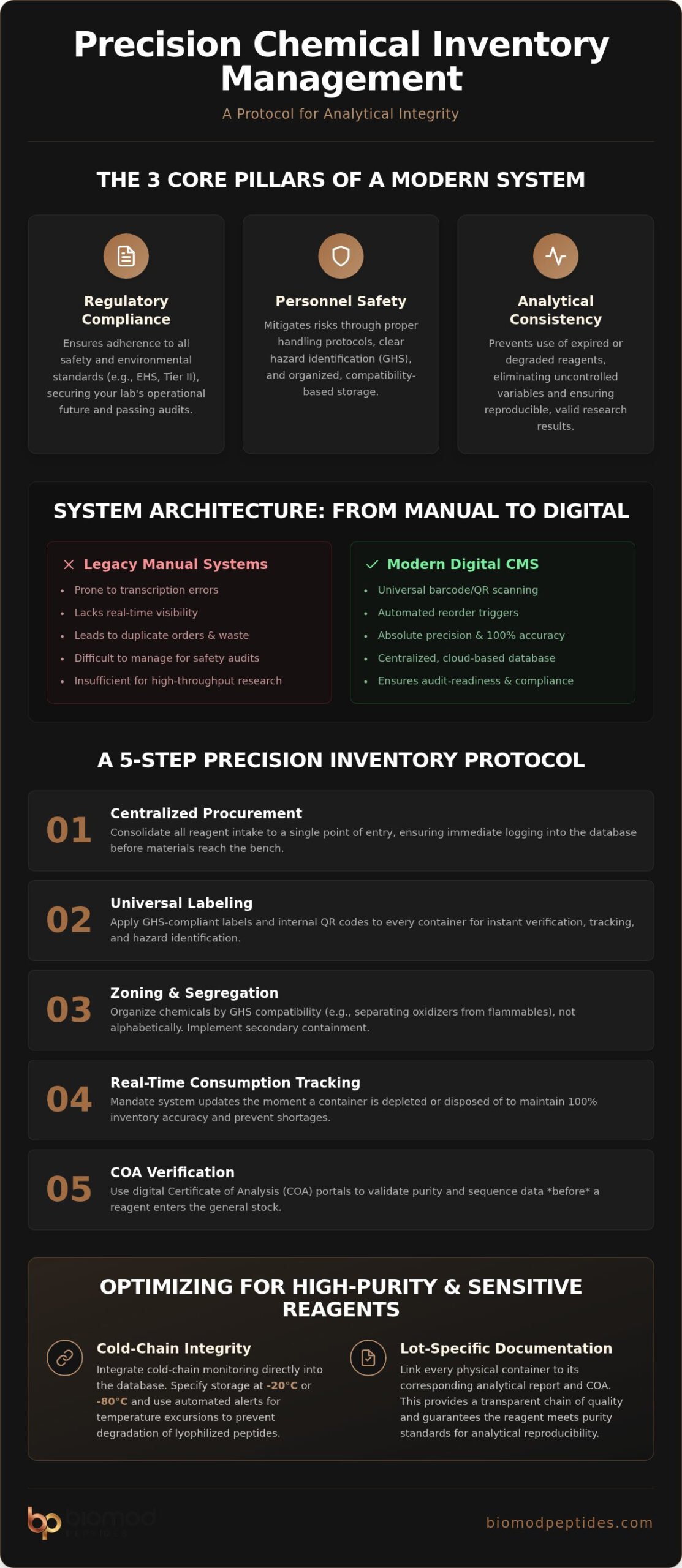
A chemical inventory isn’t a static ledger. It’s a dynamic database designed to track the procurement, exact location, and expiration of every laboratory reagent. This system serves as the central nervous system for research operations. Mastering how to manage a lab’s chemical inventory requires a commitment to three foundational pillars: regulatory compliance, personnel safety, and analytical consistency. Without these, a lab risks catastrophic data failure.
Analytical consistency is the critical link between inventory and results. Using reagents that have undergone thermal degradation or passed their expiration dates introduces uncontrolled variables. This compromises reproducibility. For facilities in Las Vegas, these protocols must also integrate Nevada-specific Environmental Health and Safety (EHS) standards. Precise documentation ensures that high-purity materials remain within validated specifications throughout their lifecycle.
Digital vs. Manual Tracking Architectures
Legacy spreadsheet systems are insufficient for high-throughput research. They’re prone to transcription errors and lack the real-time visibility required for complex logistics. Transitioning to a cloud-based Chemical Management System (CMS) provides a superior architecture. These platforms utilize universal barcode scanning and automated reorder triggers to maintain stock levels. This digital approach eliminates duplicate orders. It ensures that sensitive reagents are tracked with absolute precision. Automated systems provide the structural integrity and objective verification needed to survive rigorous safety audits and Tier II reporting cycles.
Implementing a Precision Inventory Protocol: A 5-Step Guide
Operationalizing a laboratory requires a rigorous, step-by-step approach to material logistics. Learning how to manage a lab’s chemical inventory begins with Centralized Procurement. Consolidate all reagent intake to a single point of entry. This ensures immediate logging into the database before the material reaches the bench. Universal Labeling follows. Every container must feature GHS-compliant labels and internal QR codes to facilitate instant verification.
Zoning and Segregation are the next critical phases. Abandon alphabetical storage. It’s dangerous. Instead, organize chemicals by compatibility, separating oxidizers from flammables and acids from bases. Finally, enforce Real-Time Consumption Tracking. Researchers must update the system the moment a container is depleted or disposed of. This maintains 100% accuracy and prevents procurement waste. This level of oversight is essential for high-throughput environments. When sourcing high-purity materials from Biomod Peptides, this protocol ensures that every vial is accounted for from arrival through disposal.
Hazard Classification and Storage Zoning
Utilize the Globally Harmonized System (GHS) to define distinct storage zones. This classification methodology identifies the physical and health hazards of each reagent. Implement secondary containment protocols for particularly hazardous substances to mitigate spill risks. Adhere to the ‘Minimum Essential Quantity’ principle: only maintain the smallest volume of a chemical necessary to support active research objectives. This reduces unnecessary accumulation and simplifies your safety reporting requirements.
Optimizing Inventory for High-Purity Reagents and Peptide Stability
Managing sensitive research peptides presents unique stability challenges that standard bulk chemicals don’t face. Lyophilized reagents are particularly susceptible to moisture and thermal fluctuations. Precision in how to manage a lab’s chemical inventory requires integrating cold-chain monitoring directly into the tracking database. Every entry must specify storage requirements, such as -20°C or -80°C, with automated alerts for temperature excursions. This prevents the silent degradation of high-value stock.
Establish a protocol for Lot-Specific Documentation. This links every physical container to its corresponding analytical report. Utilizing verified peptide certificates of analysis ensures a transparent chain of quality. This documentation is the only way to guarantee that the reagent used in an experiment matches the purity standards required for analytical reproducibility. US-based manufacturing and finishing provide a higher tier of execution for these sensitive materials, anchoring your inventory in logistical transparency.
Integrating Certificate of Analysis (COA) Verification
Digital COA portals allow lab managers to verify purity and sequence data before a reagent enters the general stock. This pre-verification step is a critical gatekeeper for data integrity. Third-party independent testing validates the laboratory peptide supply, ensuring that purity isn’t compromised by logistical friction. These protocols verify structural integrity before any research begins.
Conduct monthly audits of high-value stocks. This prevents ‘ghost inventory,’ where depleted or degraded reagents remain on the ledger but are chemically unsuitable for research. Objective verification remains the benchmark of a professional inventory system. By auditing regularly, you ensure that your inventory reflects the actual, viable reagents available for immediate use.
Securing Analytical Integrity Through Systematic Oversight
Precision in the laboratory is impossible without a rigorous inventory framework. Transitioning from legacy spreadsheets to a digital architecture ensures that reagents remain within validated specifications. By implementing centralized procurement and strict storage zoning, you eliminate procurement waste and mitigate safety risks. Mastering how to manage a lab’s chemical inventory isn’t just a regulatory hurdle; it’s a continuous process of verification and refinement. It bridges the gap between logistical management and analytical reproducibility.
Integrity starts with the quality of your materials. Biomod Peptides provides the structural transparency required for high-throughput research. Every lot undergoes independent third-party testing and is manufactured in the US to ensure maximum stability. You can secure your laboratory’s precision with US-manufactured, third-party tested research peptides from Biomod Peptides. Access our COA verification portal for absolute data confidence. Establish your protocol today to protect your research outcomes.
Frequently Asked Questions
What are the legal requirements for a lab’s chemical inventory in 2026?
OSHA requires maintaining an updated inventory for hazard communication. In 2026, facilities must verify current Tier II reporting thresholds under EPCRA for hazardous substances stored above specific quantities. Compliance mandates that Safety Data Sheets are immediately accessible for every inventoried item. Accurate documentation prevents legal friction during state-level environmental health and safety inspections and federal audits.
How often should a physical chemical inventory audit be conducted?
Conduct a comprehensive physical audit at least once per year. High-throughput facilities or those managing sensitive research peptides should perform targeted monthly reconciliations for high-value reagents. This frequency ensures the digital database matches physical stock levels. Frequent verification cycles prevent the accumulation of ghost inventory and ensure that reagents haven’t exceeded their stability windows or undergone thermal degradation.
What is the best way to handle expired chemicals in a research lab?
Expired chemicals must be immediately segregated from active stock and labeled for disposal. Using degraded reagents compromises analytical reproducibility and introduces uncontrolled variables into your study. Follow established hazardous waste protocols for neutralisation or off-site removal. Effective strategies on how to manage a lab’s chemical inventory prioritize the removal of compromised materials to maintain the structural integrity of your research data.
How can a chemical inventory improve lab safety during an emergency?
A precise inventory provides first responders with a definitive map of chemical hazards during an emergency. Real-time data allows for the rapid identification of flammables, oxidizers, and toxic substances within specific laboratory zones. This logistical transparency reduces the risk of incompatible chemical reactions during fire suppression. It ensures that emergency protocols are informed by objective verification of the materials currently present on-site.
Disclaimer
BIOMOD products are sold strictly for laboratory, analytical, and scientific research use only. They are not intended for human or animal consumption, administration, application, ingestion, injection, or any therapeutic, diagnostic, or cosmetic use.
The statements made on this website have not been evaluated by the United States Food and Drug Administration. BIOMOD products are not intended to diagnose, treat, cure, mitigate, or prevent any disease or medical condition.
BIOMOD is a research chemical supplier. BIOMOD is not a compounding pharmacy or chemical compounding facility as defined under Section 503A of the Federal Food, Drug, and Cosmetic Act. BIOMOD is not an outsourcing facility as defined under Section 503B of the Federal Food, Drug, and Cosmetic Act.
By accessing this site, you confirm you are at least 21 years of age and that you have read and accepted the BIOMOD Terms of Sale, Privacy Policy, and Research Use Only Policy. BIOMOD does not provide dosing, medical, therapeutic, diagnostic, veterinary, or use guidance under any channel.