
The assumption that injectable administration is the only path to high-precision data is increasingly outdated. While lyophilized powders offer a traditional baseline, the logistical friction of reconstitution often compromises study integrity. You likely recognize that inconsistent bioavailability and complex handling are significant hurdles when comparing softgel vs injectable peptide research models. Maintaining strict laboratory standards requires a more stable, efficient methodology that eliminates the degradation risks associated with cold chain transit.
This analysis provides a technical framework for evaluating delivery systems, focusing on verified pharmacokinetic data and environmental stability benchmarks. We’ll examine the structural advantages of encapsulated delivery systems and establish clear protocols for long-term storage. By evaluating high-purity reagents from US-based manufacturers, you can determine which format minimizes procedural variables and ensures data integrity. This guide details the transition from traditional methods to advanced analytical standards.
Key Takeaways
- Contrast immediate systemic entry of injectables with the enzymatic protection provided by softgel encapsulation in simulated gastric environments.
- Evaluate the stability advantages of anaerobic softgel environments over the strict cold-chain requirements of traditional lyophilized powders.
- Identify the critical analytical standards required when comparing softgel vs injectable peptide research models to ensure data reproducibility.
- Establish rigorous procurement protocols by utilizing third-party HPLC/MS testing and US-based manufacturing to secure high-purity reagents.
Pharmacokinetic Divergence: Softgel vs. Injectable Research Models
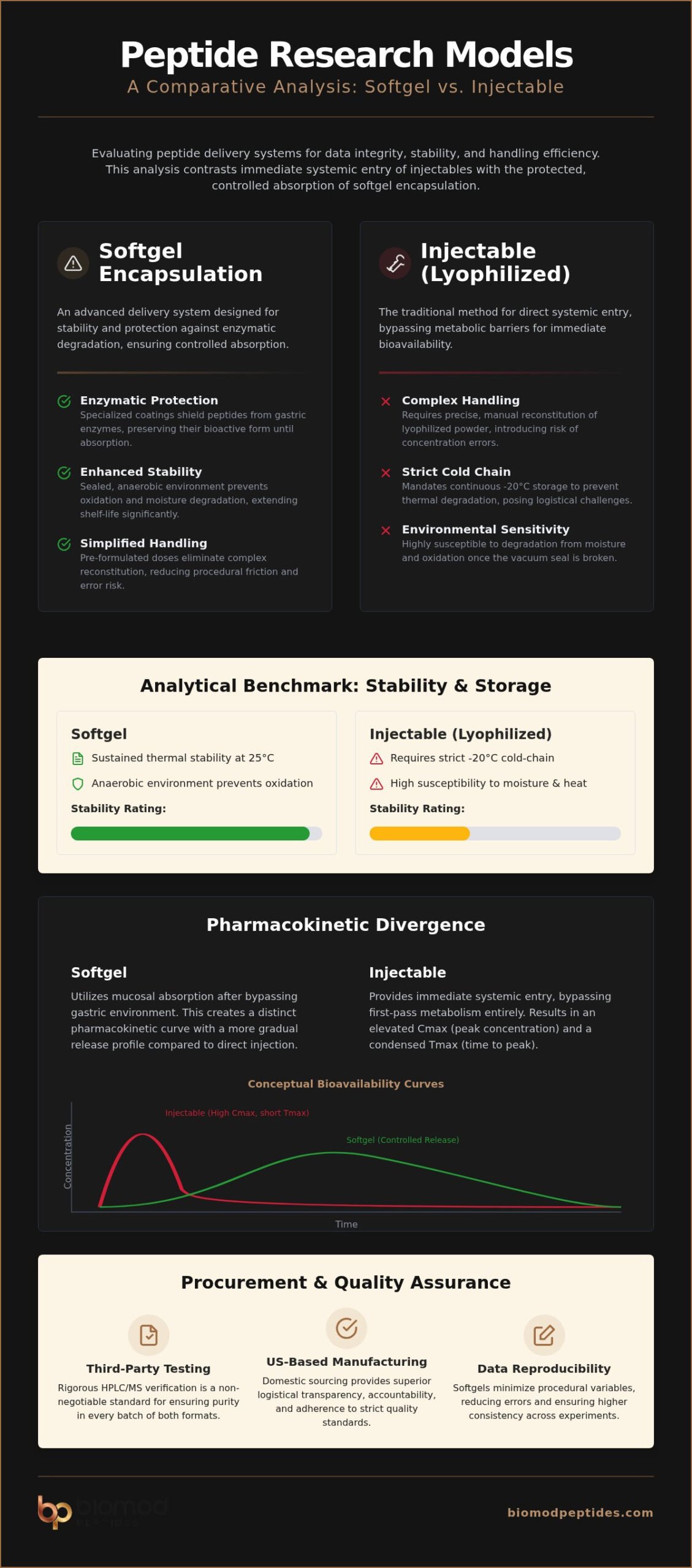
Effective peptide research requires a precise understanding of drug delivery methods and their impact on systemic availability. Injectable models provide immediate systemic entry. They bypass hepatic first-pass metabolism entirely. This results in an elevated Cmax and a condensed Tmax, often achieved within minutes of administration. Conversely, oral models utilize softgel encapsulation to shield sensitive peptide sequences. This protective barrier prevents enzymatic degradation within simulated gastric environments. Comparing softgel vs injectable peptide research models requires a rigorous analysis of how these physiological barriers influence the final systemic concentration. In the 2026 research context, bioavailability is the specific percentage of a peptide dose that reaches systemic circulation in its original, bioactive form.
First-Pass Metabolism and Delivery Efficiency
Softgel technology represents a leap in methodology over traditional lyophilized powders. Specialized coatings mitigate the impact of proteolytic enzymes. These coatings ensure the peptide remains stable until it reaches the optimal site for mucosal absorption. This process involves the transport of molecules across the intestinal epithelium. It’s a process that creates a pharmacokinetic curve distinct from direct injection. When comparing softgel vs injectable peptide research models, laboratories must account for these absorption variables. You can learn more about our softgel research products to see how these models streamline laboratory handling. This approach reduces the errors associated with complex reconstitution protocols while maintaining high-purity analytical standards. It eliminates the procedural friction often found in high-throughput environments.
Analytical Benchmarks: Stability, Storage, and Degradation
Analytical benchmarks for research reagents prioritize long-term structural integrity. Lyophilized powders require strict cold-chain management to prevent thermal degradation. These reagents are highly susceptible to moisture sensitivity and rapid oxidation once the vacuum seal is compromised during reconstitution. In contrast, softgels provide a sealed, anaerobic environment. This specialized encapsulation extends the shelf-life of volatile peptide chains by eliminating direct atmospheric exposure. It’s a method that effectively prevents the hydrolytic cleavage often observed in aqueous solutions.
Comparing softgel vs injectable peptide research models highlights the critical importance of environmental resilience. External variables, such as humidity and ambient heat, directly influence the Factors on the Pharmacokinetics of Peptides by altering the peptide’s primary structure before administration. US-manufactured softgels demonstrate sustained thermal stability at 25°C. This baseline allows for simplified laboratory protocols and more predictable data outcomes than temperature-sensitive powders can offer.
Cold Chain Protocols for Las Vegas Laboratories
Desert climates present extreme logistical challenges for sensitive biochemicals. Maintaining a consistent -20°C environment for injectable reagents in Nevada requires significant energy and specialized infrastructure. Softgel storage offers distinct advantages for high-throughput research facilities because they don’t require the same intensive cooling during temporary laboratory exposure. This shift represents a broader evolution in methodology for arid environments. You can review our guide on peptide science trends for 2026 to understand these shifting standards. To ensure your lab utilizes the most stable delivery formats, explore our full range of research peptides.
Methodological Selection: Procurement and Quality Assurance
Methodological selection hinges on rigorous quality assurance. High-purity reagents require third-party High-Performance Liquid Chromatography (HPLC) and Mass Spectrometry (MS) testing for every batch. This applies equally to both delivery formats. When comparing softgel vs injectable peptide research models, procurement sources significantly impact data reliability. US-based manufacturing offers a level of accountability that international supply chains often lack. For Las Vegas laboratories, domestic oversight ensures logistical transparency and strict adherence to finishing standards. It provides a direct line of verification that international vendors cannot replicate.
Transitioning to pre-formulated softgels streamlines laboratory workflows. It reduces the procedural friction inherent in manual reconstitution. You eliminate the risk of concentration errors during the titration process. This allows researchers to focus on data collection rather than reagent preparation. Learn more about our US-based manufacturing and testing protocols to understand our commitment to structural integrity. Our finishing processes happen in domestic facilities to guarantee a higher tier of execution compared to the industry status quo.
Verification Protocols and COA Transparency
Data transparency is the foundation of scientific validation. Utilizing a centralized verification portal ensures batch-to-batch consistency for all research reagents. This is essential for Las Vegas-based scientific institutions requiring empirical proof of purity before commencing a study. Independent validation removes the ambiguity of self-reported data. Review our protocol for peptide purity verification and analytical standards to see how we maintain these benchmarks. Rigorous documentation isn’t a luxury; it’s a requirement for modern methodology. It anchors the manufacturing process in objective verification.
Advancing Analytical Standards in Peptide Research
Precision in methodology requires a transition toward more stable and efficient delivery systems. Comparing softgel vs injectable peptide research models reveals that while injectables provide a traditional baseline, softgels offer superior environmental resilience and reduced procedural friction. You can eliminate the logistical burden of cold-chain management and the analytical risks associated with manual reconstitution. Our US-manufactured and finished reagents undergo independent 3rd party testing to ensure structural integrity. Every batch is documented through our COA verification portal access for absolute transparency. It’s time to refine your laboratory protocols with high-tier, laboratory-grade reagents. Procure Analytical Grade Peptide Softgels for Your Laboratory to secure the data integrity your research demands. We’re committed to supporting your pursuit of empirical excellence.
Frequently Asked Questions
Can softgels achieve comparable research results to injectable peptide models?
Softgels achieve comparable systemic exposure when the study design accounts for the distinct pharmacokinetic profiles of oral delivery. While injectables offer rapid systemic entry, softgels ensure sustained release and protection against enzymatic degradation. Researchers must adjust dosage frequency to match the intended systemic concentration. Comparing softgel vs injectable peptide research models requires a focus on total bioavailability rather than peak concentration timing.
What are the specific storage requirements for peptide softgels in Las Vegas labs?
Peptide softgels remain stable at a controlled room temperature of 25°C, providing a significant advantage in arid desert climates. Unlike lyophilized powders that require consistent -20°C cold-chain management, encapsulated formats resist thermal degradation during laboratory handling. This stability reduces the logistical burden on infrastructure in Nevada labs. Researchers should still avoid direct UV exposure to maintain the structural integrity of the softgel matrix.
How does encapsulation affect the purity of BPC-157 research reagents?
Encapsulation doesn’t alter the molecular purity of BPC-157 but serves as a barrier against environmental contaminants. The anaerobic environment within the softgel prevents oxidation and moisture absorption, which are common causes of reagent degradation in open-vial models. This protective layer ensures that the reagent remains at its verified analytical standard throughout the research project, preventing hydrolytic cleavage and ensuring long-term data reproducibility.
Why is third-party testing more critical for softgel delivery systems than traditional powders?
Third-party testing is essential for softgels to verify the precise peptide concentration within the complex lipid or gelatin matrix. Unlike traditional powders, softgel formulations require specialized HPLC and MS protocols to ensure the encapsulation process hasn’t compromised the peptide’s primary structure. Comparing softgel vs injectable peptide research models necessitates transparent COA verification to confirm that the delivery system meets strict, laboratory-grade purity benchmarks.
Disclaimer
BIOMOD products are sold strictly for laboratory, analytical, and scientific research use only. They are not intended for human or animal consumption, administration, application, ingestion, injection, or any therapeutic, diagnostic, or cosmetic use.
The statements made on this website have not been evaluated by the United States Food and Drug Administration. BIOMOD products are not intended to diagnose, treat, cure, mitigate, or prevent any disease or medical condition.
BIOMOD is a research chemical supplier. BIOMOD is not a compounding pharmacy or chemical compounding facility as defined under Section 503A of the Federal Food, Drug, and Cosmetic Act. BIOMOD is not an outsourcing facility as defined under Section 503B of the Federal Food, Drug, and Cosmetic Act.
By accessing this site, you confirm you are at least 21 years of age and that you have read and accepted the BIOMOD Terms of Sale, Privacy Policy, and Research Use Only Policy. BIOMOD does not provide dosing, medical, therapeutic, diagnostic, veterinary, or use guidance under any channel.