
A visually perfect actuation does not guarantee a precise molecular dose. In rigorous laboratory settings, the assumption of mechanical reliability is often the primary catalyst for irreproducible data. You likely recognize that even minor fluctuations in plume geometry or droplet size distribution can skew results. Evaluating peptide spray consistency for lab experiments requires more than a cursory check; it demands a systematic verification of the integrated delivery system. Precision isn’t an accident of manufacturing; it’s a result of rigorous analytical oversight.
Mastering the analytical protocols for dosage accuracy is essential for maintaining experimental integrity. This guide details the gravimetric validation methods and USP <601> standards necessary to verify delivery uniformity across multiple trials. You’ll learn to identify mechanical delivery failures and implement standardized protocols that ensure your research reagents perform with clinical precision. We’ll examine the technical benchmarks required to transform inconsistent spray delivery into a reliable, documented variable in your research.
Key Takeaways
- Differentiate between chemical stability and mechanical precision to identify the root cause of dosage fluctuations in your data.
- Implement gravimetric analysis protocols for evaluating peptide spray consistency for lab experiments to establish a reproducible baseline for dosage.
- Standardize the priming sequence for each actuator to ensure the delivery chamber remains fully loaded across sequential trials.
- Prioritize US-manufactured reagents and COA verification portals to ensure tighter manufacturing tolerances and logistical transparency.
Variables Affecting Dosage Accuracy in Peptide Spray Research
Spray consistency represents the uniformity of active peptide concentration per metered actuation. It is the primary determinant of experimental reproducibility. When evaluating peptide spray consistency for lab experiments, researchers must look beyond raw material purity. A high HPLC score confirms chemical integrity but does not account for mechanical delivery dynamics. Physical properties like viscosity and surface tension directly dictate droplet size and velocity. Solutions with high viscosity typically produce larger droplets, which can compromise the efficiency of nasal administration simulations by failing to aerosolize correctly.
Mechanical Precision vs. Formulation Stability
Distinguishing between actuator failure and peptide degradation is vital for data integrity. A pure peptide in an unstable liquid medium can yield inconsistent results if the formulation precipitates or reacts with the container closure system. Conversely, mechanical failure in the pump mechanism can result in under-dosing even if the chemical solution remains stable. In Las Vegas lab environments, ambient temperature fluctuations present a specific challenge. Excessive heat can lower fluid viscosity, causing wider plume angles and smaller droplets that deviate from the standard 90–111% equivalence range required for peptide spray products. Metered-dose uniformity is the critical benchmark for research sprays, defined as the precise mass of active ingredient delivered in every single actuation. Evaluating peptide spray consistency for lab experiments must therefore address the actuator and the chemical payload as an integrated system.
Step-by-Step Protocol for Validating Delivery Uniformity
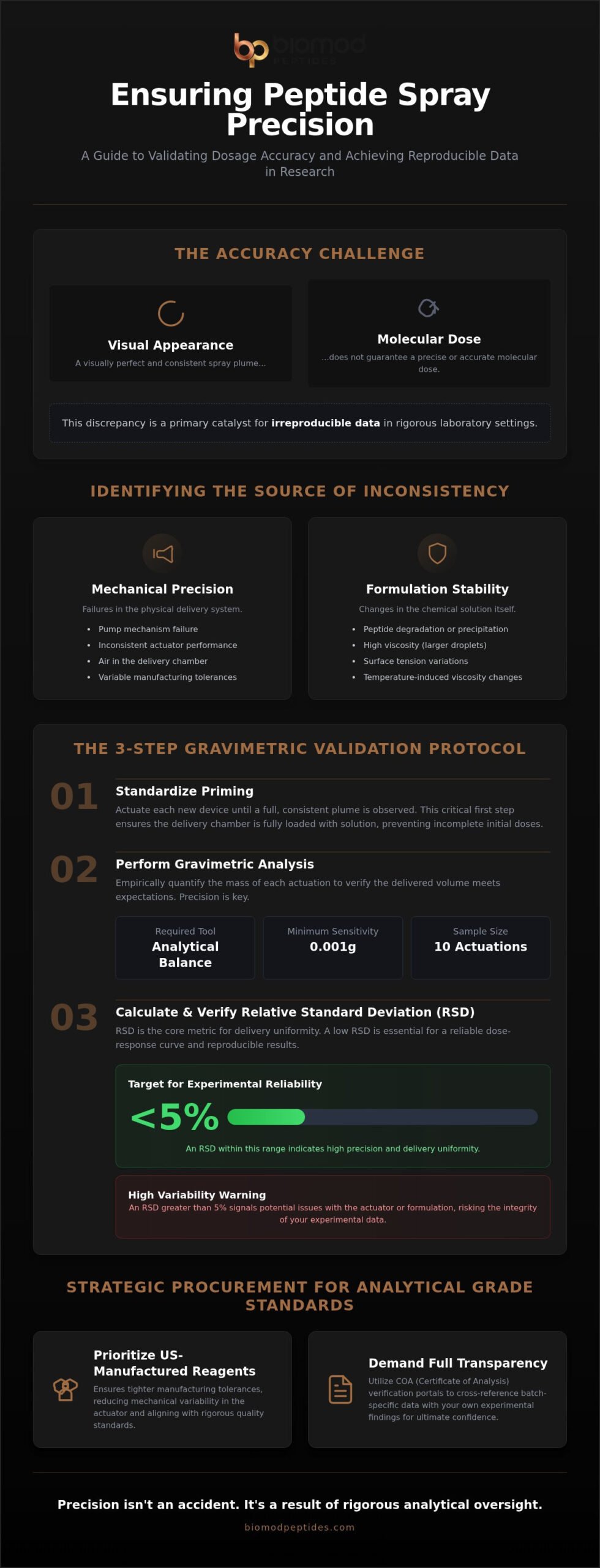
Precision requires empirical validation. Gravimetric analysis remains the most accessible and reliable method for evaluating peptide spray consistency for lab experiments. This process quantifies the mass of each actuation to verify that the mechanical pump delivers the intended volume. Researchers must utilize an analytical balance with a sensitivity of at least 0.001g. Recording the mass to three decimal places is necessary to detect subtle deviations in actuator performance.
Standardizing the priming process is the first procedural step. A new actuator often contains air in the delivery chamber. You must actuate the device until a full, consistent plume is observed. This ensures the chamber is fully loaded with the peptide solution. Failure to prime correctly results in incomplete doses during the initial phases of an experiment.
Gravimetric Analysis and Volumetric Verification
To assess delivery uniformity, collect a sample set of ten sequential actuations. Calculate the mean delivered mass by weighing the container before and after each spray. This data allows for the determination of the relative standard deviation (RSD), which is a core metric when evaluating peptide spray consistency for lab experiments. An RSD of less than 5% is generally targeted to ensure experimental reliability. High variability in these measurements often indicates issues with the formulation’s physical properties, such as those discussed in studies of therapeutic peptide aerosols. If your RSD exceeds acceptable limits, the integrity of your dose-response curve is at risk.
Using intranasal peptide research sprays with verified mechanical tolerances reduces these variables. Documenting these values provides the logistical transparency required for high-tier publication. For laboratories requiring rigorous documentation and analytical grade reagents, Biomod Peptides offers the verification tools necessary to maintain these standards.
Strategic Procurement: Ensuring Analytical Grade Spray Standards
Reliable data starts with strategic procurement. Evaluating peptide spray consistency for lab experiments requires a vendor that prioritizes manufacturing integrity. Prioritizing US-manufactured peptides ensures tighter tolerances during the finishing process. This reduces mechanical variability in the actuator. It also aligns with the rigorous characterization standards found in FDA guidance on nasal spray manufacturing. Tighter tolerances mean fewer outliers in your standard deviation.
Documentation is the primary defense against irreproducible results. A dedicated COA verification portal allows researchers to cross-reference batch-specific data with their own experimental findings. This level of transparency is critical for Las Vegas laboratories requiring rigorous analytical oversight and rapid procurement. Evaluating peptide spray consistency for lab experiments is impossible without access to batch-specific mechanical testing data. Third-party validation provides the objective proof necessary for high-tier research. It moves beyond the generic claims of retail-grade suppliers. Reliable vendors provide documentation that covers both chemical purity and mechanical performance benchmarks.
The Role of US-Manufactured Quality Control
Domestic finishing processes mitigate risks associated with international logistics. Contamination and mechanical defects often arise during extended transit or unregulated storage. By maintaining US-based quality control, providers ensure that the actuator and formulation function as a cohesive unit. Researchers should leverage established peptide purity verification protocols during the initial procurement phase. This proactive step secures the structural integrity of the research material before it enters the laboratory. For consistent delivery and verified accuracy, sourcing peptide spray products from domestic, analytical-grade providers remains the gold standard.
Advancing Experimental Precision Through Standardized Validation
Reliable research depends on the convergence of chemical purity and mechanical precision. You’ve seen that evaluating peptide spray consistency for lab experiments requires a disciplined approach, from gravimetric validation to standardized priming sequences. By treating the actuator and the peptide formulation as a single, integrated system, you eliminate the variables that lead to irreproducible data. Tighter manufacturing tolerances and rigorous analytical oversight are the foundation of credible science.
Maintain the integrity of your next trial with reagents that meet these benchmarks. Biomod Peptides provides analytical grade solutions supported by independent third-party testing and US-manufactured finishing processes. Utilize our COA verification portal access to ensure your batch data remains beyond reproach. Secure Analytical Grade Peptide Sprays for Your Laboratory today. Elevate your research with the precision your methodology demands.
Frequently Asked Questions
How do I prime a peptide spray for laboratory use?
Actuate the device repeatedly into a waste container until a full, uniform plume is observed. This typically requires three to five actuations. Priming ensures the dip tube and metering chamber are entirely purged of air. It’s a foundational step when evaluating peptide spray consistency for lab experiments to ensure the first recorded dose is volumetrically complete.
What is the acceptable variance for dosage accuracy in peptide research?
Acceptable variance is generally defined by USP <601> standards, which target a range of 75–125% of the labeled dose for individual actuations. For high-precision laboratory trials, researchers often aim for a tighter Relative Standard Deviation (RSD) of less than 5%. Deviations beyond these benchmarks suggest mechanical instability or formulation errors that could compromise the integrity of your data.
Can temperature fluctuations in Las Vegas affect spray consistency?
Ambient temperature directly influences the viscosity and surface tension of the liquid formulation. High temperatures common in Las Vegas can reduce fluid viscosity, leading to smaller droplet sizes and altered plume geometry. These physical changes disrupt metered-dose uniformity. Maintaining a climate-controlled environment is essential when evaluating peptide spray consistency for lab experiments to prevent environmental variables from skewing results.
Does third-party testing cover the spray actuator performance?
Standard third-party testing primarily focuses on the HPLC purity and concentration of the peptide within the solution. While COA data verifies chemical integrity, mechanical actuator performance is typically validated through internal quality control and gravimetric analysis. Biomod Peptides ensures that US-manufactured finishing processes maintain tight mechanical tolerances, though researchers should still perform independent volumetric verification to confirm delivery uniformity.
Disclaimer
BIOMOD products are sold strictly for laboratory, analytical, and scientific research use only. They are not intended for human or animal consumption, administration, application, ingestion, injection, or any therapeutic, diagnostic, or cosmetic use.
The statements made on this website have not been evaluated by the United States Food and Drug Administration. BIOMOD products are not intended to diagnose, treat, cure, mitigate, or prevent any disease or medical condition.
BIOMOD is a research chemical supplier. BIOMOD is not a compounding pharmacy or chemical compounding facility as defined under Section 503A of the Federal Food, Drug, and Cosmetic Act. BIOMOD is not an outsourcing facility as defined under Section 503B of the Federal Food, Drug, and Cosmetic Act.
By accessing this site, you confirm you are at least 21 years of age and that you have read and accepted the BIOMOD Terms of Sale, Privacy Policy, and Research Use Only Policy. BIOMOD does not provide dosing, medical, therapeutic, diagnostic, veterinary, or use guidance under any channel.