
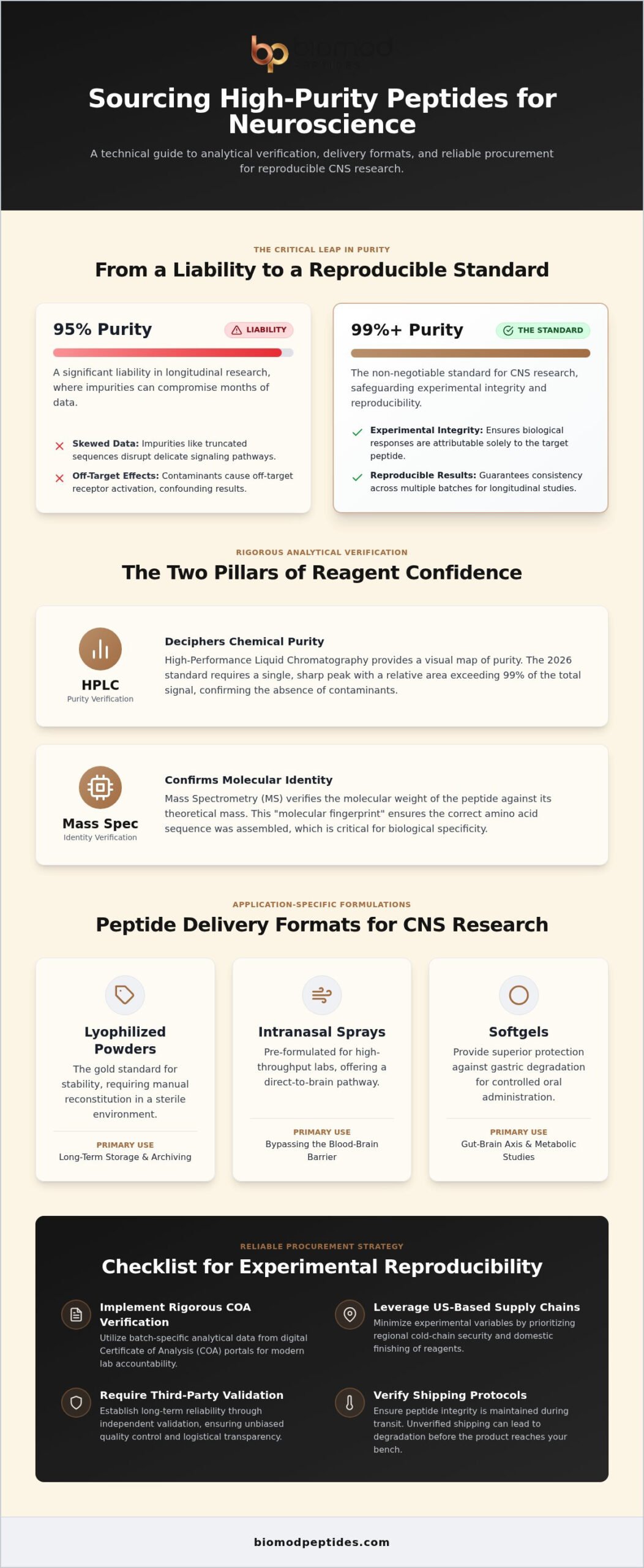
A 95% purity standard is a liability in longitudinal neuroscience research. When batch inconsistency compromises months of data, the cost of sub-par reagents becomes astronomical. Securing high-quality research peptides for neuroscience labs requires more than a simple catalog order. It demands rigorous analytical verification and a supply chain that prioritizes structural integrity above all else.
You understand that experimental reproducibility depends on the transparency of your Certificate of Analysis. Relying on outdated documentation or unverified shipping protocols often leads to peptide degradation before the product reaches the bench. This guide will help you master the technical criteria for sourcing high-purity neuro-peptides. You’ll learn to navigate analytical verification and specialized delivery formats that bypass traditional research hurdles.
We examine the 2026 standards for HPLC and Mass Spectrometry verification. We also detail how to establish a reliable US-based supply chain and access specialized formats like intranasal sprays for targeted CNS research.
Key Takeaways
- Identify the analytical benchmarks required for neurological reagents, focusing on the transition from 95% to 99% purity standards for receptor studies.
- Evaluate the technical advantages of diverse delivery formats, including the laboratory applications of specialized research sprays and softgels.
- Implement a rigorous verification protocol for sourcing research peptides for neuroscience labs using batch-specific analytical data and digital COA portals.
- Minimize experimental variables by leveraging US-manufactured supply chains that prioritize regional cold-chain security and domestic finishing.
- Establish a reliable procurement strategy that ensures long-term experimental reproducibility through independent third-party validation and logistical transparency.
Establishing Analytical Standards for Neuroscience Peptide Reagents
Precision in Central Nervous System (CNS) research leaves no margin for chemical ambiguity. High-purity reagents are the foundation of experimental integrity. For researchers sourcing research peptides for neuroscience labs, the distinction between 95% and 99% purity isn’t just a technicality; it’s a safeguard against off-target receptor activation. Impurities, such as truncated sequences or residual salts from the synthesis process, can skew binding affinity data and disrupt delicate signaling pathways.
Standardized analytical verification is non-negotiable. Longitudinal studies require reagents that remain consistent across multiple batches to prevent baseline drift. Identifying synthesis by-products that interfere with CNS data ensures that the observed biological responses are attributable solely to the target peptide. Meticulous documentation through a digital COA verification portal provides the transparency necessary for modern laboratory accountability.
Deciphering High-Performance Liquid Chromatography (HPLC) Reports
A chromatogram provides a visual map of chemical purity. In 2026, the industry standard for research peptides for neuroscience labs requires a single, sharp peak with a relative area exceeding 99% of the total signal. Secondary peaks, even minor ones, indicate contaminants that could compromise understanding neuropeptides and their specific interactions within the synaptic cleft. Quantitative reagent concentration is directly correlated to the peak area; any deviation suggests a compromised or unstable reagent.
Mass Spectrometry and Sequence Verification
HPLC confirms purity, but Mass Spectrometry (MS) confirms identity. This process verifies the molecular weight of the synthesized molecule against its theoretical mass to ensure the correct amino acid sequence was assembled. Establishing this molecular fingerprint is a critical prerequisite for in-vivo studies. Without MS verification, researchers risk observing effects from incorrect sequences that mimic the target’s physical properties but lack its biological specificity. This structural integrity is the baseline for any peer-reviewed neurological model.
Comparative Analysis of Peptide Delivery Formats for CNS Research
Selecting a delivery format is a critical variable in experimental design. While lyophilized powders remain the standard for long-term storage, pre-formulated peptide spray products offer logistical advantages for high-throughput research peptides for neuroscience labs. Choosing between formats requires balancing reagent stability with the practicalities of dosage administration.
Stability considerations dictate the shelf-life and reagent integrity of your compounds. Reconstitution of lyophilized vials introduces a window of vulnerability to contamination or degradation if not handled in a sterile environment. Liquid formulations must utilize precise buffers to maintain molecular structure. Standardizing dosage across these delivery mechanisms is essential for maintaining analytical standards and NIH guidelines regarding research reproducibility.
- Lyophilized Powders: Maximum stability for long-term storage; requires manual reconstitution.
- Intranasal Sprays: Targeted CNS delivery bypassing the blood-brain barrier.
- Softgels: Optimized for gut-brain axis research and metabolic studies.
Intranasal Delivery Systems in Neuroscience
Utilizing intranasal peptide research sprays allows investigators to explore direct-to-brain pathways. Technical precision in atomization is required to ensure consistent volumetric delivery. Labs must verify the mechanical reliability of the delivery device to prevent dosage variance during in-vivo trials. This format minimizes systemic exposure while maximizing CNS concentrations.
Oral and Softgel Research Applications
The gut-brain axis is a primary focus of modern metabolic and neurological crossover studies. Investigating this pathway often involves the use of peptide softgels for research, which provide a controlled alternative to traditional oral administration. These peptide softgels offer superior protection against gastric degradation compared to crude oral powders. This stability is vital for establishing reliable bioavailability data in longitudinal models when utilizing research peptides for neuroscience labs. For facilities requiring high-purity compounds, sourcing verified research reagents ensures that formulation variables do not compromise data quality.
Strategic Sourcing for US-Based Neuroscience Facilities
Supply chain security is a fundamental component of laboratory risk management. For research peptides for neuroscience labs, domestic manufacturing eliminates the uncertainties of international customs and prolonged transit. US-manufactured and finished reagents provide a level of oversight that outsourced compounds can’t match. This proximity ensures that quality control benchmarks remain rigorous from synthesis to final distribution.
Regional logistics play a decisive role in maintaining reagent integrity. For facilities in Las Vegas and across the Southwest, heat-sensitive compounds require specialized handling. Cold-chain integrity must be maintained through every stage of delivery to prevent thermal degradation. Strategic procurement involves establishing a relationship with providers who prioritize regional logistics and rapid turnaround times.
- Domestic Finishing: Reduces exposure to uncontrolled environments during shipping.
- Bulk Lot Procurement: Ensures consistency across large-scale neurological trials.
- Audit Readiness: Maintains a clear chain of custody for institutional reviews.
Accountability through Digital Verification
Maintaining a precise audit trail is mandatory for modern research. The Biomod Peptides portal simplifies this requirement by providing immediate access to batch-specific data. Utilizing the COA Verification Portal allows labs to authenticate their reagents in real-time. This digital infrastructure supports the peptide purity verification process; it enables the seamless integration of third-party test results into peer-reviewed submissions and laboratory documentation.
Regional Support for Las Vegas Laboratories
Proximity matters for high-stakes neurological research. A local Las Vegas presence facilitates rapid turnaround, which is essential for time-sensitive projects. Nevada-based research institutions and private biotech firms benefit from reduced transit times. This significantly lowers the risk of reagent degradation during the final mile of delivery. Strategic sourcing from a regional provider ensures that research peptides for neuroscience labs arrive with their structural integrity fully intact, supporting the most demanding longitudinal models.
Advancing Experimental Integrity in Neurological Research
Precision is the only variable that shouldn’t be a variable. We’ve established that 99% purity and independent HPLC/MS testing are mandatory benchmarks to prevent off-target effects in CNS studies. Specialized delivery formats, including intranasal sprays and oral softgels, provide the mechanical control necessary for modern longitudinal models. Sourcing research peptides for neuroscience labs requires a procurement strategy that prioritizes objective data over marketing claims.
Biomod Peptides ensures every batch is US-manufactured and finished, providing the regional supply chain security your facility requires. Our dedicated COA verification portal offers immediate access to third-party validation, ensuring your laboratory documentation remains audit-ready and scientifically sound. This commitment to structural integrity allows you to focus on the complexity of your data rather than the reliability of your reagents.
Access the Biomod Peptides Research Catalog to secure high-purity compounds backed by independent third-party testing. Your research reproducibility depends on the integrity of your chemical foundations; build your next study on a platform of verifiable excellence.
Frequently Asked Questions
How do I verify the certificate of analysis (COA) for neuroscience peptides?
Verification is achieved by entering the specific batch number into a dedicated digital COA verification portal. This system provides immediate access to third-party analytical data, including HPLC chromatograms and Mass Spectrometry reports. Researchers must confirm that the documentation reflects the exact lot received rather than a generic template. This level of transparency is essential for validating the identity and purity of reagents before initiating experimental protocols.
Why is US manufacturing critical for research peptides used in neuroscience?
US manufacturing ensures stringent oversight and regional supply chain security. Domestic facilities minimize the risk of environmental exposure during international transit, which often compromises the stability of sensitive compounds. Finishing products in the USA allows for rigorous quality control benchmarks that meet the standards required for research peptides for neuroscience labs. This proximity also facilitates faster logistics and more reliable cold-chain management for Southwest research institutions.
What is the recommended storage protocol for lyophilized neuro-peptides?
Lyophilized neuro-peptides should be stored at -20°C to maintain long-term stability. For extended preservation exceeding several months, storage at -80°C is often recommended to prevent peptide degradation. Vials must be kept in a desiccated environment and protected from light exposure. It’s critical to minimize freeze-thaw cycles after reconstitution, as these thermal fluctuations can disrupt the molecular structure and compromise experimental reproducibility.
Can I buy research peptides for neuroscience labs in bulk for longitudinal studies?
Bulk procurement is recommended for longitudinal studies to ensure batch-to-batch consistency. Sourcing a single lot of research peptides for neuroscience labs eliminates the chemical variability that can occur between different synthesis runs. This approach is vital for maintaining a stable baseline across multi-month trials. Labs should verify that their supplier can provide sufficient quantities from a single, analytically verified batch to support the entire duration of the neurological study.
Disclaimer
BIOMOD products are sold strictly for laboratory, analytical, and scientific research use only. They are not intended for human or animal consumption, administration, application, ingestion, injection, or any therapeutic, diagnostic, or cosmetic use.
The statements made on this website have not been evaluated by the United States Food and Drug Administration. BIOMOD products are not intended to diagnose, treat, cure, mitigate, or prevent any disease or medical condition.
BIOMOD is a research chemical supplier. BIOMOD is not a compounding pharmacy or chemical compounding facility as defined under Section 503A of the Federal Food, Drug, and Cosmetic Act. BIOMOD is not an outsourcing facility as defined under Section 503B of the Federal Food, Drug, and Cosmetic Act.
By accessing this site, you confirm you are at least 21 years of age and that you have read and accepted the BIOMOD Terms of Sale, Privacy Policy, and Research Use Only Policy. BIOMOD does not provide dosing, medical, therapeutic, diagnostic, veterinary, or use guidance under any channel.