
The integrity of a preclinical study is only as robust as the chemical purity of its inputs. For researchers in the Mojave, obtaining reliable Las Vegas preclinical research supplies often means navigating a landscape of inconsistent lot quality and opaque documentation. You likely recognize the risk of utilizing imported reagents that lack rigorous analytical proof. A single batch variance can compromise months of data and jeopardize compliance with 21 CFR Part 58.1 standards.
This guide provides a professional framework for identifying and procuring high-purity peptide reagents and laboratory supplies within the Nevada regulatory environment. You’ll learn how to establish a supply chain that prioritizes US-manufactured products and verifiable Certificates of Analysis. We’ll detail the process for verifying reagent integrity through dedicated portals and navigating the registration requirements of the Nevada State Board of Pharmacy. By prioritizing structural transparency and domestic manufacturing, you can eliminate logistical delays and ensure your research rests on a foundation of empirical proof.
Key Takeaways
- Identify the critical distinctions between standard laboratory consumables and the high-purity reagents required for rigorous analytical accuracy.
- Implement a standardized verification protocol for Las Vegas preclinical research supplies by requiring comprehensive HPLC and Mass Spectrometry documentation for every lot.
- Ensure batch-to-batch consistency by sourcing US-manufactured reagents backed by independent third-party testing and transparent COA portal access.
- Evaluate the technical advantages of specialized delivery systems, including research-grade peptide softgels and precision intranasal sprays, to optimize laboratory workflows.
Navigating the Landscape of Preclinical Research Supplies in Las Vegas
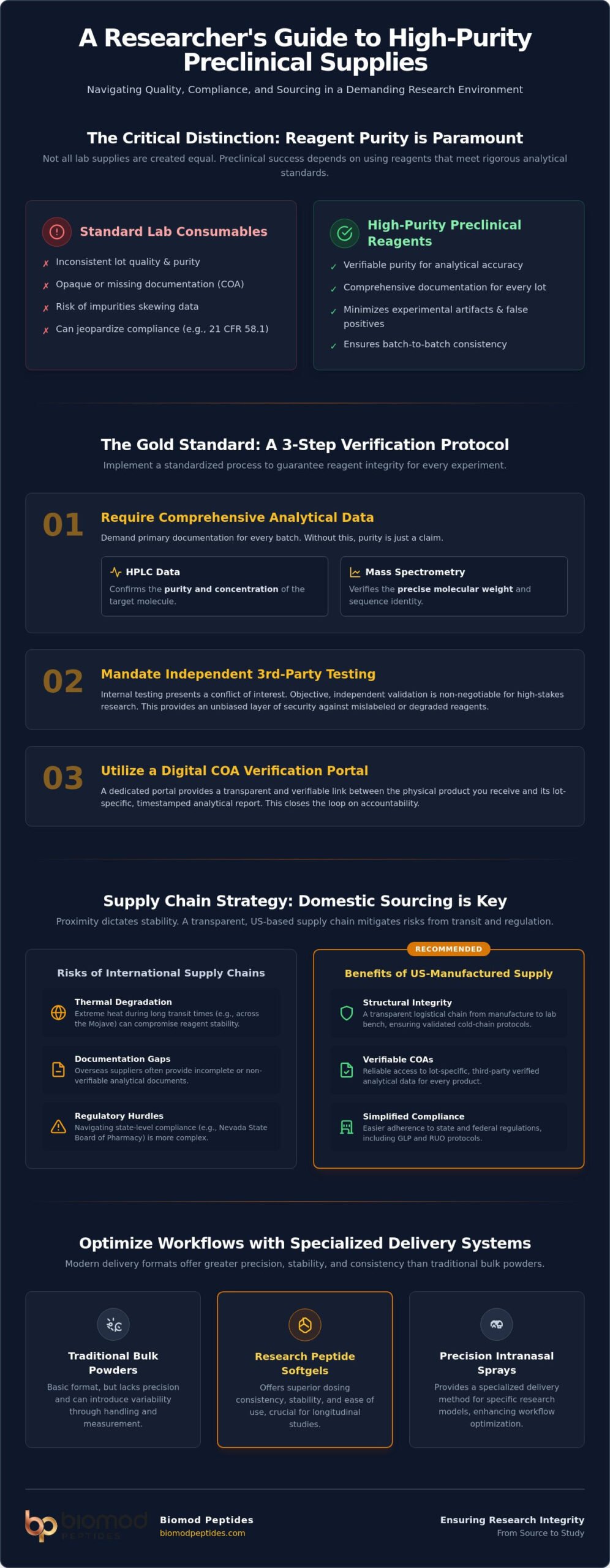
General laboratory vendors in Nevada focus on bulk consumables. State-contracted entities like Fisher Scientific or VWR provide essential equipment and standardized chemicals. However, specialized reagents require a different caliber of oversight. Procuring Las Vegas preclinical research supplies necessitates a move away from generic catalogs toward high-purity, US-manufactured reagents. Technical grade chemicals may suffice for basic bench work, but they lack the analytical depth required for advanced Preclinical development. Researchers must also navigate state-level compliance; the Nevada State Board of Pharmacy regulates research involving specific substances, making domestic sourcing a matter of both quality and regulatory ease.
Regional vs. National Supply Chains
Proximity dictates stability. For Nevada laboratories, relying on international supply chains introduces variables like extreme heat exposure during transit across the desert. Regional distribution for Las Vegas preclinical research supplies reduces the risk of thermal degradation. Local accountability prevents the documentation gaps common in reagents sourced from overseas. US-manufactured supplies provide a baseline of structural integrity. They ensure the logistical chain remains transparent from the point of manufacture to the laboratory bench, minimizing the “dead time” where reagents might sit in unmonitored environments.
The Role of Specialized Reagents in Preclinical Models
Experimental reproducibility depends on chemical purity. Technical grade supplies often contain impurities that skew metabolic data and lead to false positives. Analytical grade reagents, specifically high-purity peptides, minimize these experimental artifacts. Precise data requires precise inputs. Modern laboratories are increasingly utilizing advanced delivery formats, such as peptide softgels for research, to ensure stability within their models. These specialized formats offer a level of precision that traditional bulk powders cannot match. This is particularly vital in longitudinal studies where dosing consistency is paramount to the integrity of the results.
Technical Standards for Validating Preclinical Research Supplies
Validation isn’t an elective step; it’s the core of structural integrity. For researchers managing Las Vegas preclinical research supplies, the burden of proof lies in the documentation. Every lot must be accompanied by primary analytical data. This includes High-Performance Liquid Chromatography (HPLC) and Mass Spectrometry (MS). Adherence to FDA preclinical research requirements ensures that data generated in the lab meets the minimum standards for Good Laboratory Practices (GLP). All materials must strictly follow “Research Use Only” (RUO) protocols to maintain experimental boundaries.
Interpreting Analytical Verification Data
HPLC purity reports confirm the concentration of the target molecule. A single peak indicates a high-purity sample. Mass spectrometry provides the precise molecular weight, verifying the sequence identity. Without both, the researcher can’t account for isomeric impurities or residual solvents. Following a standardized protocol for peptide purity verification allows for cross-lab comparability. This level of detail is necessary to eliminate variables that could lead to irreproducible outcomes.
Accountability Through Third-Party Testing
Internal testing by a manufacturer creates a conflict of interest. High-stakes research requires objective validation from independent laboratories. A valid report in 2026 must be lot-specific and include a verifiable timestamp. It’s not enough to rely on a “typical” analysis. Researchers should utilize a digital COA Verification Portal to confirm that the physical product matches the laboratory’s findings. This provides a layer of security for those procuring Las Vegas preclinical research supplies against mislabeled or degraded reagents. For those seeking reagents with this level of oversight, reviewing analytical-grade research supplies ensures every batch meets rigorous internal benchmarks.
Optimizing Procurement with Specialized Delivery Systems
Precision in the laboratory is often compromised by degradation during the final stages of the supply chain. For regional facilities, managing Las Vegas preclinical research supplies requires specific attention to thermal stability. The high ambient temperatures of the Mojave Desert necessitate a validated cold-chain protocol. Standard shipping methods often fail to maintain the sub-zero temperatures required for sensitive peptide sequences. Effective procurement strategies must therefore prioritize logistics that minimize transit time and utilize insulated, monitored packaging to prevent structural compromise.
Specialized delivery systems offer a technical solution to traditional stability challenges. Researchers are increasingly evaluating the advantages of peptide softgels for research in analytical models. These formats protect the integrity of the compound from oxidation and moisture, providing a more stable baseline than bulk powders in certain experimental designs. Similarly, the precision of intranasal peptide research sprays allows for consistent dosing in neurological or systemic models without the complexities of manual reconstitution.
Advanced Formulation Stability
Lyophilized powders remain the industry standard for long-term storage, yet liquid research sprays offer immediate utility in high-throughput environments. Scientific grade peptide softgels must adhere to strict manufacturing standards to ensure uniform fill weights and shell integrity. Streamlining bulk procurement through verified laboratory peptide supply channels ensures that these specialized formats arrive with their analytical profiles intact. This level of standardization is essential for maintaining the reproducibility of Las Vegas preclinical research supplies.
Strategic Sourcing from Biomod Peptides
Domestic manufacturing is the most effective safeguard against logistical volatility. Biomod Peptides serves as a primary source for US-manufactured research reagents, ensuring all products are finished under rigorous quality controls. This regional advantage is critical for Las Vegas labs requiring rapid access to high-purity materials without the risks of international customs delays. The availability of specialized spray products and softgels further supports advanced research methodologies that demand both chemical purity and structural stability.
Advancing Analytical Accuracy in Nevada Research
Reliable data starts with the structural integrity of your reagents. Establishing a robust supply chain for Las Vegas preclinical research supplies requires moving beyond generic lab vendors. You’ve seen the necessity of HPLC and Mass Spectrometry validation for every lot. You’ve evaluated the stability advantages of specialized delivery formats like softgels and sprays. These standards aren’t just preferences; they’re the foundation of experimental reproducibility and regulatory compliance within the Nevada research ecosystem.
Precision is a choice made at the point of procurement. Biomod Peptides provides the technical infrastructure to support this precision. Every reagent is US-manufactured and finished, ensuring logistical transparency and regional stability. We provide independent third-party validation for every lot, accessible through our transparent COA verification portal. This eliminates the uncertainty of unverified imports. Access the Biomod Peptides Research Catalogue to secure the analytical standards your laboratory requires. Your commitment to rigorous methodology deserves a supply chain that reflects those same benchmarks.
Frequently Asked Questions
Where can I find HPLC-tested preclinical research supplies in Las Vegas?
Biomod Peptides provides HPLC-tested Las Vegas preclinical research supplies through a centralized US-based distribution network. Every lot undergoes rigorous analytical testing to confirm chemical purity and sequence accuracy before regional dispatch. Researchers can access these materials directly through our validated catalogue, ensuring that every reagent meets the high-purity benchmarks required for advanced analytical models and longitudinal studies.
What are the requirements for purchasing research peptides for laboratory use?
Procurement requires strict adherence to “Research Use Only” (RUO) protocols and compliance with federal Good Laboratory Practices under 21 CFR Part 58.1. In Nevada, researchers involving controlled substances must register with the Nevada State Board of Pharmacy and provide a research protocol. These biennial registrations expire on October 31 of even-numbered years, ensuring all laboratory operations remain within established legal and scientific boundaries.
How do Las Vegas labs verify the COA of their research reagents?
Verification is managed through a digital COA Verification Portal that matches physical batch numbers to independent third-party analytical reports. This process confirms that the HPLC and Mass Spectrometry data provided are specific to the received lot rather than a generic analysis. Utilizing these portals allows Las Vegas laboratories to maintain objective proof of reagent integrity for their internal documentation and audit trails.
Why is US-based manufacturing important for preclinical supplies?
US-based manufacturing provides logistical transparency and protects Las Vegas preclinical research supplies from environmental degradation during transit. Domestic production eliminates the unpredictability of international customs and reduces the exposure of sensitive reagents to extreme desert temperatures. This proximity ensures that the structural integrity of peptides is preserved from the point of manufacture to the final laboratory destination.
Disclaimer
BIOMOD products are sold strictly for laboratory, analytical, and scientific research use only. They are not intended for human or animal consumption, administration, application, ingestion, injection, or any therapeutic, diagnostic, or cosmetic use.
The statements made on this website have not been evaluated by the United States Food and Drug Administration. BIOMOD products are not intended to diagnose, treat, cure, mitigate, or prevent any disease or medical condition.
BIOMOD is a research chemical supplier. BIOMOD is not a compounding pharmacy or chemical compounding facility as defined under Section 503A of the Federal Food, Drug, and Cosmetic Act. BIOMOD is not an outsourcing facility as defined under Section 503B of the Federal Food, Drug, and Cosmetic Act.
By accessing this site, you confirm you are at least 21 years of age and that you have read and accepted the BIOMOD Terms of Sale, Privacy Policy, and Research Use Only Policy. BIOMOD does not provide dosing, medical, therapeutic, diagnostic, veterinary, or use guidance under any channel.