
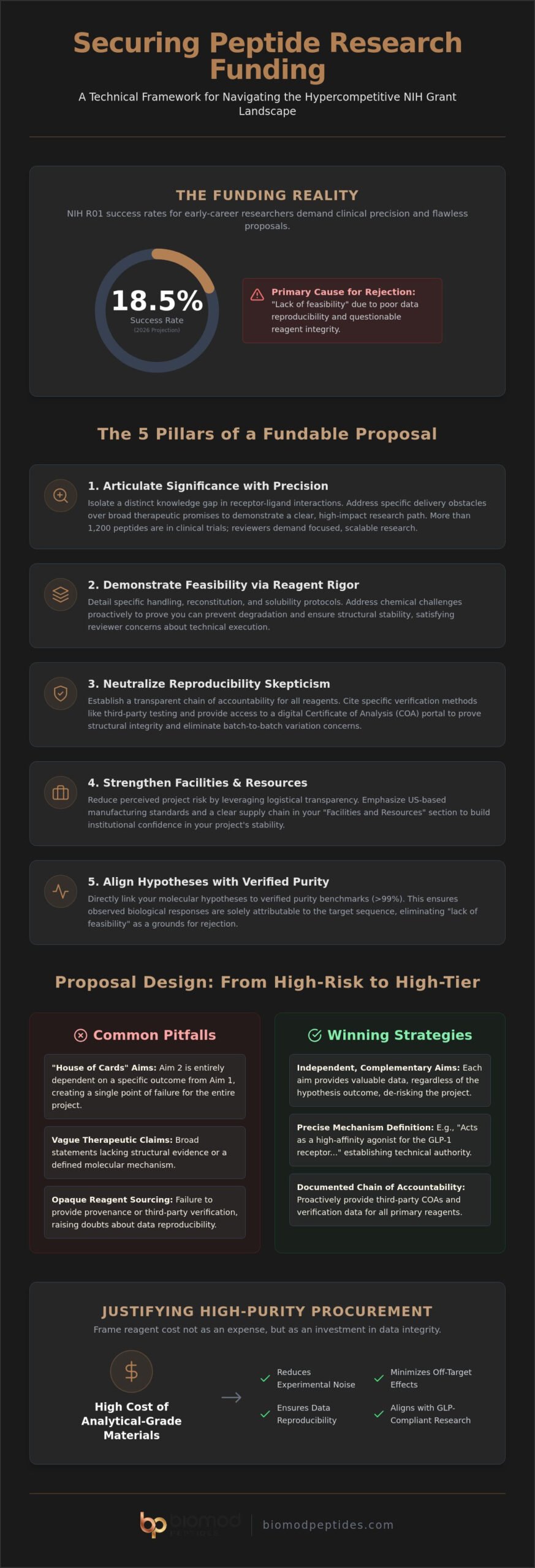
NIH R01 success rates for early-career researchers have fallen to 18.5% in 2026. This reality demands a shift from broad exploration to clinical precision. You’ve likely faced reviewer skepticism regarding data reproducibility or struggled to justify the costs of analytical-grade reagents. These hurdles often lead to the dreaded “lack of feasibility” rejection. Mastering specific grant writing tips for peptide research funding is the only way to navigate this hypercompetitive environment.
Precision is your primary currency. We’ll show you how to align a rigorous molecular hypothesis with documented reagent accountability to satisfy even the most critical reviewers. This guide provides a technical framework for aim-setting and the specific justifications required for advanced formats like peptide sprays or softgels. You’ll learn to leverage verification tools, such as third-party COA portals, to prove your study’s structural integrity from day one. By prioritizing transparency and objective verification, you can transform a standard proposal into a high-tier research plan that commands institutional confidence and secures the necessary capital for advancement.
Key Takeaways
- Identify specific knowledge gaps in receptor-ligand interactions to articulate research significance beyond the immediate molecular target.
- Apply technical grant writing tips for peptide research funding by detailing reagent stability, solubility protocols, and rigorous reconstitution methods.
- Neutralize reviewer skepticism regarding data reproducibility by providing a transparent chain of accountability and third-party verification for all primary reagents.
- Strengthen the “Facilities and Resources” section by leveraging logistical transparency and US-based manufacturing standards to reduce project risk.
- Align molecular hypotheses with verified purity benchmarks to eliminate “lack of feasibility” as a primary cause for proposal rejection.
Framing the Peptide Research Narrative: Specificity and Significance
Successful funding depends on your ability to isolate a distinct knowledge gap within the current scientific literature. Reviewers prioritize projects that address specific receptor-ligand interactions or unresolved delivery obstacles over broad therapeutic promises. While Grant writing basics often emphasize general clarity, applying technical grant writing tips for peptide research funding requires a higher tier of technical granularity. You must articulate how your work advances the field beyond the immediate molecular target. With more than 1,200 peptides currently in clinical trials worldwide, reviewers are looking for research that addresses scalability and clinical relevance from the outset.
Your Specific Aims must be independent yet complementary. A common failure point in grant applications is the “house of cards” structure; if the success of Aim 2 depends entirely on a specific result from Aim 1, the proposal is deemed high-risk. Design aims that provide valuable data regardless of the hypothesis outcome. Utilize clinical and rigorous terminology to align your proposal with modern peptide research standards. This demonstrates that your work is positioned at the forefront of modern synthesis and verification trends, ensuring your methodology remains relevant through 2026 benchmarks.
Defining Molecular Mechanisms and Aims
Precision is more fundable than breadth. A narrow, well-defined mechanism provides a clear path for verification and data collection. Avoid vague therapeutic claims that lack structural evidence. For example, your proposal might state: “Our primary peptide candidate acts as a high-affinity agonist for the GLP-1 receptor, specifically targeting the extracellular domain to initiate intracellular cyclic AMP signaling.” This level of detail establishes immediate technical authority. These grant writing tips for peptide research funding help transform abstract ideas into actionable laboratory protocols that satisfy rigorous peer review.
The Executive Summary: Your Technical Elevator Pitch
Condense your proposal into a high-level objective that answers the “So what?” factor immediately. Reviewers have limited time; they need to see the innovation and the impact in the first paragraph. Highlight advanced delivery systems to demonstrate feasibility and modern methodology. Integrating peptide spray products into your protocol can showcase an innovative approach to bypassing the blood-brain barrier. This technical specificity proves you aren’t just following standard industry norms but are actively refining research methodology to address the complexity of modern peptide science.
Demonstrating Feasibility through Reagent Rigor and Protocol Design
Feasibility is the benchmark of a fundable proposal. Reviewers frequently flag peptide studies for a lack of rigor when reagent provenance is opaque. You must establish a documented chain of accountability. This involves citing specific verification methods, such as independent third-party testing and digital COA portals. Utilizing these grant writing tips for peptide research funding ensures your experimental design withstands scrutiny regarding batch-to-batch variation and data reproducibility. Precision in sourcing is as critical as the hypothesis itself.
Technical feasibility is non-negotiable for R01 and R21 submissions. According to the NIH grant application guide, your protocol must explicitly address the chemical challenges inherent in the study. Detail your specific handling and reconstitution protocols, focusing on improving peptide solubility and maintaining structural stability. Reviewers expect a methodical approach to preventing degradation, which can compromise months of data collection.
Justifying High-Purity Peptide Procurement in Budgets
Reviewers often question the high cost of analytical-grade materials. You must link the procurement of analytical grade peptides directly to the reduction of experimental noise. High-purity reagents minimize off-target effects. They ensure that observed biological responses are attributable solely to the target sequence. Include third-party testing costs as a standard line item to align with GLP-compliant research requirements. This transparency builds trust in your project’s fiscal and scientific integrity.
Specialized Delivery Formats: Softgels and Sprays
Modernize your design by incorporating advanced delivery formats. Using peptide softgels for research allows for standardized dosage in oral delivery models. This solves common variability issues in pharmacokinetic studies. For systemic bypass or mucosal absorption models, peptide spray products offer a technical leap in methodology. This methodological refinement is a core element of effective grant writing tips for peptide research funding, positioning your proposal as a forward-thinking contribution to the field. Researchers can verify reagent integrity through the Biomod COA verification portal to strengthen their feasibility narrative.
Navigating the Submission: Quality Assurance and Reviewer Alignment
The final hurdle of any proposal is surviving the data management audit. Rejection often follows a lack of a robust verification plan. Reviewers demand empirical proof that results aren’t artifacts of impure reagents. Integrating specific grant writing tips for peptide research funding means moving beyond simple procurement descriptions. You must demonstrate logistical transparency. Leveraging US-manufactured supply chains, such as facilities in Las Vegas, reduces the risk of batch-to-batch variation. This geographic anchor provides a layer of accountability that international sourcing often lacks.
Verification is the core of a successful submission. Utilize a COA verification portal to provide reviewers with immediate, digital proof of sequence identity. This level of documentation satisfies the “Data Management” requirements that now heavily influence funding decisions. Finalize your proposal with a rigorous internal peer-review phase. This institutional check ensures your technical justifications align with the highest benchmarks of scientific integrity before the formal submission deadline.
Managing Data Reproducibility and Documentation
Implement a “Purity First” protocol. Validate every batch via HPLC/MS before any in vivo or in vitro applications. This ensures baseline data is grounded in chemical certainty. US-based manufacturing guarantees adherence to strict laboratory-grade standards. It eliminates the variables introduced by unregulated finishing processes. Documenting this rigorous chain of custody in your proposal directly addresses reviewer concerns regarding data reproducibility. It transforms a standard protocol into a high-tier research framework.
Responding to Reviewer Critiques
Technical skepticism is an opportunity for refinement. Treat reviewer comments as a roadmap for strengthening your methodology. Address concerns about reagent integrity with data-backed verification. Highlighting Biomod Peptides as a reference point for sourcing demonstrates a commitment to analytical excellence. These grant writing tips for peptide research funding focus on evidence-based persuasion. By prioritizing objective proof over theoretical claims, you secure the trust of the review committee and the future of your research.
Securing the Future of Peptide Innovation through Technical Rigor
Funding success requires more than a compelling hypothesis. It demands a documented commitment to reagent accountability and methodological precision. You’ve learned to frame your narrative through specific molecular mechanisms and to justify costs by linking high-purity procurement to reduced experimental noise. Implementing these grant writing tips for peptide research funding ensures your proposal meets the highest standards of the 2026 funding landscape. By prioritizing transparency and objective verification, you eliminate the feasibility gaps that often lead to rejection.
Secure your research feasibility with analytical grade peptides from Biomod Peptides. Our reagents are US-manufactured and finished to provide total logistical transparency. Every lot undergoes independent third-party testing to ensure structural integrity. You can access instant COA verification via our secure portal to support your data management plan. Your research deserves a foundation of uncompromising quality. Proceed with the confidence that your reagents match the precision of your science.
Technical FAQs for Peptide Grant Submissions
How do I justify the higher cost of HPLC-tested peptides in my grant budget?
Justify the expense by linking reagent purity directly to the reduction of experimental noise and off-target effects. High-purity reagents validated via HPLC/MS ensure that biological responses are attributable solely to the target sequence. This precision is essential for data reproducibility. Budgeting for verified reagents demonstrates a commitment to rigorous methodology that satisfies reviewer concerns regarding project feasibility and structural integrity.
What is the most common reason peptide research grants are rejected by the NIH?
The most frequent cause for rejection is a perceived lack of feasibility rooted in poor reagent characterization. Reviewers often express skepticism regarding the structural integrity and purity of the peptides used in the study. Without a clear plan for verifying sequence identity and stability, the proposal is deemed high-risk. Utilizing grant writing tips for peptide research funding that emphasize documented reagent accountability can mitigate this risk.
Can I include specialized delivery formats like intranasal sprays in a TOFU-stage research proposal?
You can include specialized delivery formats in early-stage proposals if they’re supported by a clear technical justification. Utilizing formats like peptide spray products demonstrates methodological innovation and a proactive approach to overcoming delivery obstacles. Detail how the format ensures consistent mucosal absorption and how it aligns with your molecular hypothesis. This specificity proves your research is positioned at the forefront of modern delivery trends.
How does sourcing US-manufactured peptides affect my proposal’s feasibility score?
Sourcing US-manufactured peptides improves your feasibility score by demonstrating logistical transparency and reduced batch variation. US-based synthesis ensures adherence to stringent laboratory-grade standards and minimizes the potential for technical delays. This geographic anchor provides reviewers with confidence in your supply chain. It proves that your research reagents are finished in a controlled environment, ensuring consistent purity throughout the duration of the study.
What documentation should I include to prove peptide purity to reviewers?
Include HPLC chromatograms and Mass Spectrometry data to provide empirical proof of sequence identity and purity. These records should be referenced in your “Facilities and Resources” or supplemental sections. Utilizing a secure COA verification portal allows reviewers to validate these metrics independently. This level of documentation reinforces the structural integrity of your study and satisfies the rigorous requirements of modern peer-review committees.
Is it necessary to include a data management plan for small-scale peptide studies?
A data management plan is mandatory for all research project grants to ensure data reproducibility and transparency. Small-scale studies are not exempt from the need for rigorous documentation regarding reagent verification and storage. Your plan should detail how HPLC/MS data and experimental results will be stored and validated. Incorporating these grant writing tips for peptide research funding establishes a professional register that reflects institutional reliability and scientific precision.
Disclaimer
BIOMOD products are sold strictly for laboratory, analytical, and scientific research use only. They are not intended for human or animal consumption, administration, application, ingestion, injection, or any therapeutic, diagnostic, or cosmetic use.
The statements made on this website have not been evaluated by the United States Food and Drug Administration. BIOMOD products are not intended to diagnose, treat, cure, mitigate, or prevent any disease or medical condition.
BIOMOD is a research chemical supplier. BIOMOD is not a compounding pharmacy or chemical compounding facility as defined under Section 503A of the Federal Food, Drug, and Cosmetic Act. BIOMOD is not an outsourcing facility as defined under Section 503B of the Federal Food, Drug, and Cosmetic Act.
By accessing this site, you confirm you are at least 21 years of age and that you have read and accepted the BIOMOD Terms of Sale, Privacy Policy, and Research Use Only Policy. BIOMOD does not provide dosing, medical, therapeutic, diagnostic, veterinary, or use guidance under any channel.