
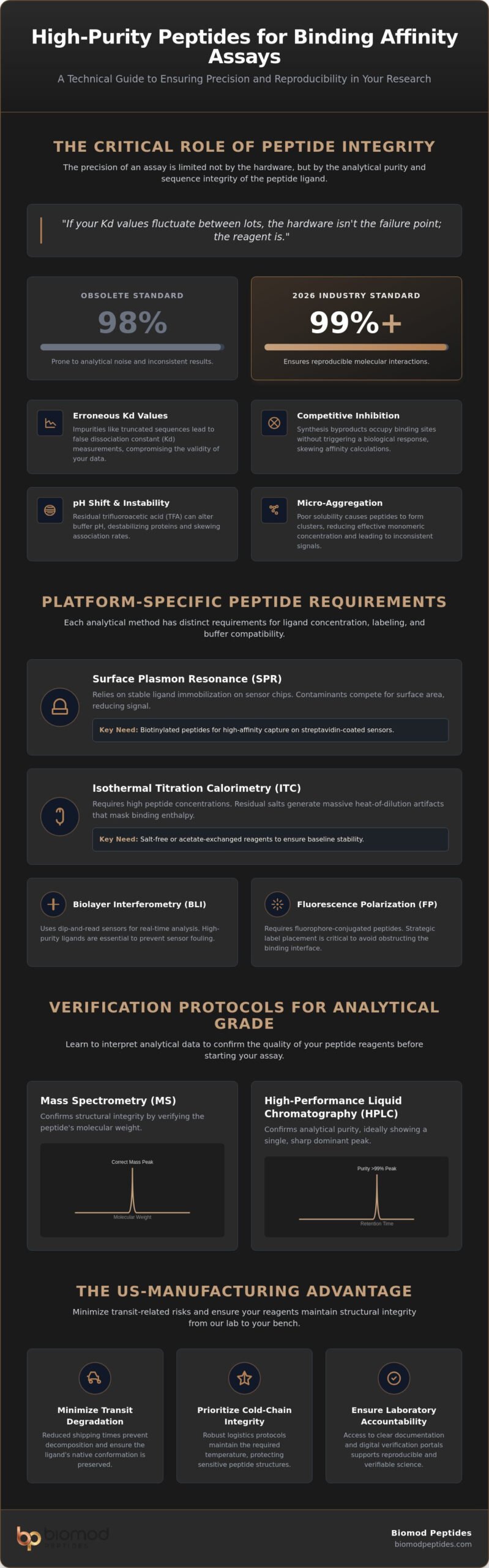
The precision of a binding affinity assay is limited not by the detection hardware, but by the analytical purity and sequence integrity of the peptide ligand. If your Kd values fluctuate between lots, the hardware isn’t the failure point; the reagent is. Selecting peptides for binding affinity assays requires an uncompromising approach to quality control that moves beyond the now-obsolete 98% purity benchmark. By 2026, the industry standard has shifted to 99% to eliminate noise and ensure reproducible molecular interactions.
Researchers frequently encounter the frustration of inconsistent signal-to-noise ratios or questionable documentation from international vendors. These variables introduce unacceptable risk into kinetic studies. This guide establishes a rigorous technical framework for selecting and verifying high-purity peptides to ensure precision in your research. We’ll detail how to validate structural integrity through mass spectrometry, the logistical advantages of US-manufactured reagents in preventing degradation, and the role of digital verification portals in maintaining laboratory accountability.
Key Takeaways
- Understand why residual trifluoroacetic acid (TFA) and sequence truncations lead to erroneous dissociation constant (Kd) measurements in molecular studies.
- Identify platform-specific reagent requirements, including biotinylation for Surface Plasmon Resonance (SPR) and high-concentration stability for Isothermal Titration Calorimetry (ITC).
- Learn to interpret HPLC and Mass Spectrometry data to confirm the analytical grade of peptides for binding affinity assays.
- Minimize transit-related degradation by utilizing US-manufactured ligands that prioritize cold-chain integrity and structural preservation from the lab to the bench.
The Critical Role of Peptide Integrity in Binding Affinity Assays
Binding affinity quantifies the equilibrium interaction between a peptide ligand and its target protein. This value, expressed as the dissociation constant (Kd), dictates the potency and specificity of a molecular interaction. In any professional ligand binding assay, the hardware’s sensitivity is secondary to the chemical integrity of the reagent. If the peptide is compromised, the resulting data is analytically void.
Purity remains the most significant variable in kinetic studies. Truncated sequences, which are common synthesis byproducts, often possess enough structural similarity to occupy binding sites without triggering the intended biological response. This competitive inhibition by impurities leads to erroneous affinity calculations. Residual trifluoroacetic acid (TFA) from the cleavage process can also shift the assay buffer’s pH. This shift destabilizes the target protein or alters the ionization state of the peptide, skewing association rates. While 98% purity is the traditional laboratory standard, the 2026 industry benchmark has shifted toward 99% to eliminate analytical noise in high-precision studies.
Solubility also plays a decisive role in determining kinetic association and dissociation rates. Peptides with poor solubility profiles tend to form micro-aggregates. These clusters reduce the effective monomeric concentration of the peptides for binding affinity assays, leading to sluggish association kinetics and inconsistent signal-to-noise ratios. High-quality peptides for binding affinity assays must maintain a monomeric state to provide accurate thermodynamic data. Ensuring structural integrity through US-based manufacturing helps mitigate these risks by preserving the ligand’s native conformation during transit.
Ligand-Binding vs. Competitive Assay Mechanisms
Direct binding assays quantify the saturation of a target by measuring the signal from a labeled peptide reagent. These require labels that don’t obstruct the binding interface. In contrast, competitive assays utilize high-purity unlabeled peptides to displace a known tracer from the binding site. The dissociation constant (Kd) is the specific concentration where 50% of the target protein binding sites are occupied at equilibrium. For researchers requiring high-precision reagents, Biomod Peptides provides US-manufactured research peptides with verified purity profiles to ensure assay reproducibility.
Comparative Analysis of Peptide Reagents Across Detection Platforms
Detection platforms dictate the specific chemical formulation of peptides for binding affinity assays. Each analytical method has distinct requirements for ligand concentration, labeling, and buffer compatibility. Surface Plasmon Resonance (SPR) relies on stable ligand immobilization. This frequently necessitates biotinylated peptides to facilitate high-affinity capture on streptavidin-coated sensor chips. Reagent purity is vital in SPR; contaminants compete for limited chip surface area, which reduces the effective signal and complicates kinetic modeling.
Isothermal Titration Calorimetry (ITC) provides a complete thermodynamic profile but requires significantly higher peptide concentrations than optical methods. Buffer mismatch or residual salts in the peptide lyophilized cake generate massive heat-of-dilution artifacts. These artifacts often mask the actual binding enthalpy. Researchers characterizing peptides with protein binding affinity must prioritize salt-free or acetate-exchanged reagents for ITC to ensure baseline stability and accurate stoichiometry.
Biolayer Interferometry (BLI) offers real-time kinetic analysis through dip-and-read sensors. While BLI is less sensitive to refractive index changes than SPR, it still requires high-purity ligands to prevent sensor fouling. For high-throughput screening, Fluorescence Polarization (FP) remains the preferred modality. It utilizes fluorophore-conjugated peptides to measure molecular rotation. The choice of fluorophore and its position on the sequence are critical to maintaining the native interaction. For high-precision screening, sourcing research peptides with verified conjugation sites ensures the label doesn’t obstruct the binding interface.
Label-Free vs. Labelled Peptide Requirements
Label-free detection methods like SPR and ITC preserve the native peptide conformation. They avoid the steric hindrance introduced by bulky chemical tags. When labeling is required for FP or FRET, the position of the tag is the primary design consideration. Placing a fluorophore at the N-terminus versus the C-terminus can fundamentally change the binding profile if that terminus is involved in the active site. Strategic placement ensures the label remains distal to the binding pocket, preserving the integrity of the molecular interaction.
Verification Protocols for Analytical Grade Research Peptides
Analytical consistency depends on rigorous pre-assay validation. Before initiating a 48-hour kinetic study, researchers must verify the chemical identity and purity of their ligands. High-Performance Liquid Chromatography (HPLC) chromatograms should show a single, sharp peak with minimal baseline noise. Retention times must be consistent across lots. Mass Spectrometry (MS) data must confirm the theoretical molecular weight within a narrow tolerance. These reports are the only objective proof that the peptides for binding affinity assays meet the required purity standards.
Lot-to-lot reproducibility is a common failure point in high-throughput research. Utilizing a COA verification portal allows for the immediate cross-referencing of batch-specific data against internal laboratory standards. This transparency ensures that the reagents used in 2026 match the specifications of those used in previous quarters. Beyond documentation, physical integrity must be preserved. Lyophilized peptides should be stored at -20°C or -80°C in a desiccator. Exposure to ambient moisture during weighing can trigger deamidation or oxidation, which fundamentally alters the peptide’s binding kinetics.
Procurement and Logistics for Las Vegas Research Facilities
Minimizing transit-related degradation is essential for maintaining reagent quality. Sourcing from a regional Las Vegas peptide supplier reduces the risk of cold-chain failure. International shipments often face customs delays that compromise temperature-sensitive peptides for binding affinity assays. Local US-based manufacturing supports the rapid pace of Nevada biotech hubs by ensuring reagents arrive in their native, lyophilized state without structural compromise. This logistical efficiency, combined with strict research-only procurement terms, provides the accountability required for institutional compliance and high-precision molecular discovery.
Advancing Molecular Discovery through Analytical Precision
The reliability of molecular interaction data rests entirely on the chemical fidelity of the ligands utilized. As detection technologies become more sensitive, the demand for higher purity standards in peptides for binding affinity assays becomes absolute. Precision in binding kinetics isn’t achieved through hardware alone; it requires a disciplined approach to reagent selection, validation, and storage.
Establishing a robust analytical framework involves verifying sequence integrity through mass spectrometry and ensuring that every batch meets the current industry benchmarks for purity. By prioritizing US-manufactured reagents and utilizing transparent verification portals, researchers can eliminate the variables that lead to assay failure. All products from Biomod Peptides are US manufactured and finished, supported by independent third-party testing for every lot. You can access our dedicated verification portal for full Certificates of Analysis to maintain absolute laboratory accountability.
Browse Analytical Grade Peptides for Research to secure the structural integrity your studies require. High-precision discovery starts with uncompromising quality control.
Frequently Asked Questions
What is the minimum peptide purity required for binding affinity studies?
The industry benchmark for quantitative binding studies has shifted to 99% purity as of 2026. While 95% or 98% was previously acceptable for initial screenings, these levels are now considered analytically insufficient for precise kinetic modeling. High-purity peptides for binding affinity assays eliminate truncated sequences that compete for binding sites, ensuring that the calculated dissociation constant (Kd) reflects the true molecular interaction without interference from synthesis byproducts.
How does residual TFA affect peptide binding assays?
Residual trifluoroacetic acid (TFA) acts as a potent counter-ion that can fundamentally alter the pH of your assay buffer. Even minor pH fluctuations destabilize target proteins or change the ionization state of the peptide ligand. These shifts skew association and dissociation rates, leading to inconsistent data. For sensitive thermodynamic measurements like ITC, researchers should prioritize salt-exchanged peptides to remove TFA and ensure baseline stability during titration.
Can I use peptide softgels for binding affinity research?
Peptide softgels are a finished product format and are generally unsuitable for direct binding affinity research. Quantitative assays require precise control over molar concentrations and specific buffer environments that pre-formulated softgels don’t provide. Researchers should utilize lyophilized research peptides, which allow for exact reconstitution in the specialized buffers required by SPR, BLI, or ITC hardware to maintain the integrity of the kinetic study.
Why is third-party testing critical for peptides used in SPR or ITC?
Independent third-party testing provides objective verification that the reagent’s chemical identity matches its documentation. Sensitive platforms like SPR and ITC detect minute changes in mass or heat; therefore, any sequence errors or contaminants will produce erroneous kinetic data. Utilizing a COA verification portal ensures that every lot has been analytically validated for purity and sequence integrity. This protects the reproducibility of your data and prevents the loss of expensive laboratory resources.
Disclaimer
BIOMOD products are sold strictly for laboratory, analytical, and scientific research use only. They are not intended for human or animal consumption, administration, application, ingestion, injection, or any therapeutic, diagnostic, or cosmetic use.
The statements made on this website have not been evaluated by the United States Food and Drug Administration. BIOMOD products are not intended to diagnose, treat, cure, mitigate, or prevent any disease or medical condition.
BIOMOD is a research chemical supplier. BIOMOD is not a compounding pharmacy or chemical compounding facility as defined under Section 503A of the Federal Food, Drug, and Cosmetic Act. BIOMOD is not an outsourcing facility as defined under Section 503B of the Federal Food, Drug, and Cosmetic Act.
By accessing this site, you confirm you are at least 21 years of age and that you have read and accepted the BIOMOD Terms of Sale, Privacy Policy, and Research Use Only Policy. BIOMOD does not provide dosing, medical, therapeutic, diagnostic, veterinary, or use guidance under any channel.