
In the precision-driven world of molecular biology, the margin for error is non-existent. The distinction between a breakthrough and a failed experiment often rests on a single percentage point of purity. You recognize that the regulatory landscape for BPC157 and TB500 is shifting rapidly. With the FDA’s Pharmacy Compounding Advisory Committee meeting in July 2026 and staff recommendations leaning against clinical compounding, the need for verifiable, research-grade reagents is urgent. Inconsistent purity and missing documentation aren’t just inconveniences. They’re direct threats to your data integrity.
This guide delivers a rigorous technical analysis of molecular profiles and the analytical verification standards required for professional laboratory use. You’ll gain a clear understanding of the biochemical differences between these sequences and how to identify reliable US-manufactured sources. We’ll examine specific research mechanisms, HPLC purity benchmarks, and the role of third-party COA verification in modern protocol design. This is an objective look at the data. It prioritizes empirical proof over industry hype and focuses on the structural integrity of the compounds used in your facility.
Key Takeaways
- Define the molecular architecture of BPC-157 and TB-500 to ensure sequence-specific accuracy in experimental design.
- Evaluate the synergistic mechanisms of BPC157 and TB500, contrasting gastric-derived angiogenesis with actin-sequestering cellular migration.
- Implement rigorous verification protocols using HPLC and Mass Spectrometry to confirm reagent purity and sequence identity.
- Adopt high-tier procurement standards for laboratory-grade materials, focusing on US-manufactured reagents and transparent COA verification portals.
Understanding the Molecular Profiles of BPC-157 and TB-500
Precise molecular identification is the foundation of reproducible research. BPC157 and TB500 represent two distinct classes of peptide sequences utilized in regenerative modeling. While both are synthesized for laboratory use, their chemical origins and structural complexities differ significantly. These compounds serve as high-purity biochemical reagents; they’re designed for analytical testing and in vitro assays rather than clinical application. Maintaining sequence integrity is paramount for establishing valid experimental benchmarks.
BPC-157: The Gastric Pentadecapeptide Reagent
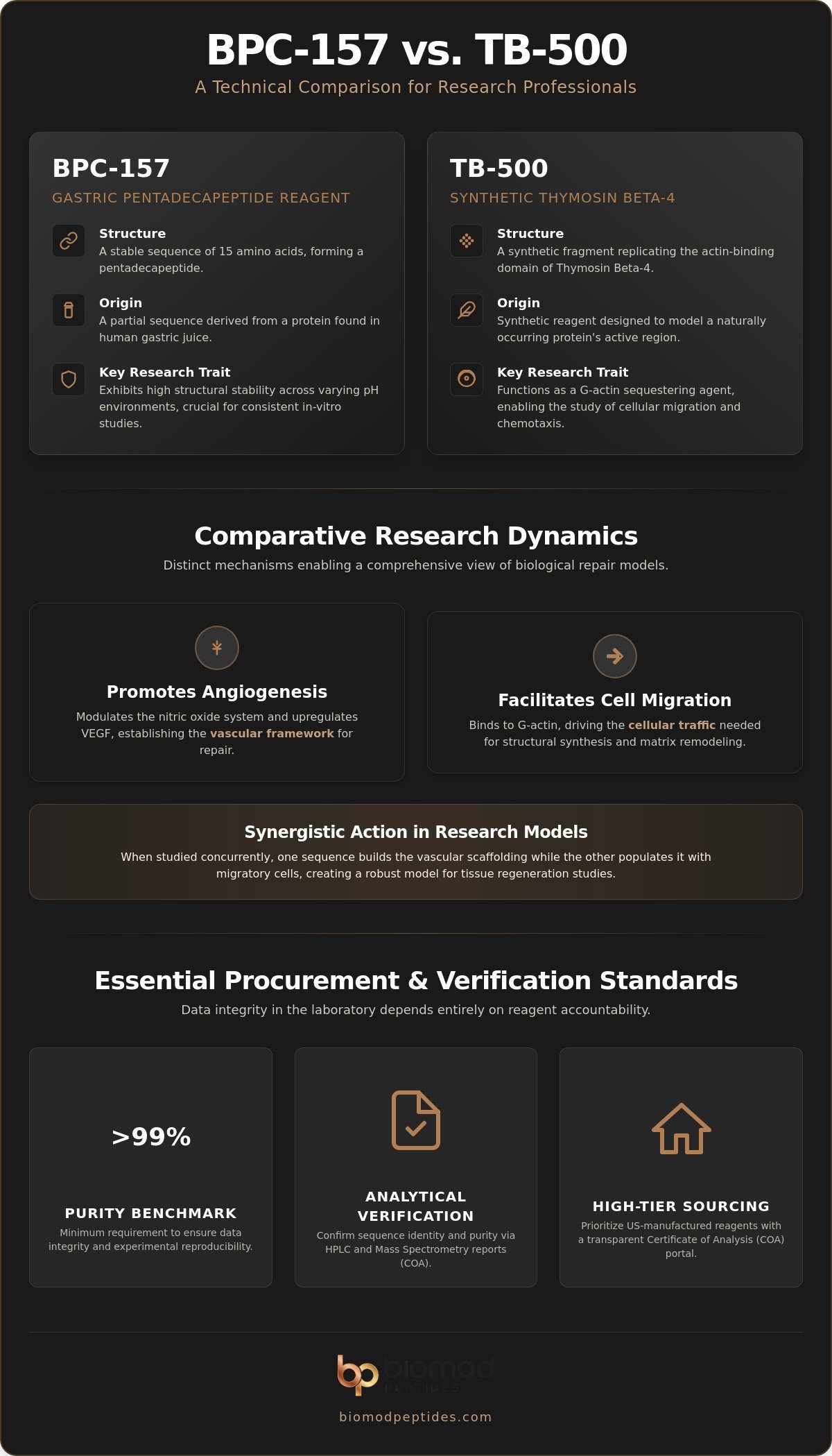
BPC-157 is a pentadecapeptide consisting of 15 amino acids. It’s a partial sequence of a larger protein originally isolated from human gastric juice. Research models focus on its inherent structural stability. The sequence remains resilient across varying pH environments, a trait that distinguishes it from more volatile signaling proteins. In laboratory settings, investigators analyze its influence on cytoprotective pathways and nitric oxide signaling. These studies prioritize the peptide’s role in modulating vascular responses within controlled, non-clinical environments.
TB-500: Synthetic Thymosin Beta-4 Derivative
TB-500 is a synthetic peptide fragment. It replicates the 17-38 amino acid sequence of the naturally occurring protein Thymosin Beta-4. This specific region is identified as the G-actin sequestering domain. In laboratory assays, researchers utilize this sequence to study cellular migration and chemotaxis. Its lower molecular weight compared to the full-length protein allows for different diffusion rates in cellular cultures. This makes it a specialized tool for observing actin-binding dynamics in real-time modeling.
Lyophilized formats of these reagents require strict temperature controls to maintain structural integrity. BPC-157 and TB-500 exhibit different molecular weights; this dictates their specific concentration calculations in experimental solutions. Verification of these profiles through mass spectrometry ensures the synthetic sequence matches the theoretical model. Precision in these metrics is mandatory for valid data collection in any professional research facility.
Comparative Research Dynamics: Angiogenesis and Cellular Migration
Differentiating BPC157 and TB500 requires a deep dive into their specific biochemical targets. BPC-157 functions primarily through the modulation of the nitric oxide system and the upregulation of vascular endothelial growth factor (VEGF). This promotes organized angiogenesis in experimental models. Conversely, TB-500 operates via actin-sequestration. By binding to G-actin, it facilitates the rapid migration of cells to the site of interest. Researchers often cite Therapeutic Peptides in Orthopaedics when discussing these distinct but overlapping roles in tissue repair simulations. One sequence establishes the vascular framework. The other drives the cellular traffic needed for structural synthesis.
Complementary Pathways in Molecular Research
In laboratory environments, BPC-157 shows a capacity to modulate growth factor expression, particularly within the early stages of the repair cascade. TB-500 influences extracellular matrix (ECM) remodeling by promoting the expression of matrix metalloproteinases. When studied concurrently, these sequences provide a comprehensive view of biological repair mechanisms. Analytical researchers must account for these variations when designing multi-peptide assays. This synergy is a frequent focus in non-human experimental tissue regeneration models where spatial organization of new tissue is critical.
Stability and Formulation for Laboratory Storage
Environmental factors in the Las Vegas research corridor necessitate strict adherence to storage protocols. Lyophilized BPC-157 generally exhibits higher thermal stability than the more delicate TB-500 sequence. However, both require protection from UV light and temperature fluctuations to prevent peptide cleavage. Standardized reconstitution protocols for analytical research involve the use of bacteriostatic water or sterile saline, depending on the specific assay requirements. Maintaining a stable environment ensures that the verified research peptides used in your protocols remain chemically active and yield reproducible data. Precise reconstitution is the only way to maintain the integrity of the molecular concentration across multiple test groups.
Procurement Standards for Las Vegas Research Facilities
Data integrity in laboratory environments depends entirely on the chemical accountability of the reagents used. For investigators analyzing BPC157 and TB500, procurement is not a matter of retail availability. It’s a matter of analytical verification. Standardized procurement protocols must prioritize High-Performance Liquid Chromatography (HPLC) and Mass Spectrometry. These tests provide the empirical proof that a sequence is both pure and correctly synthesized. Without this documentation, experimental reproducibility is impossible to guarantee.
US-manufactured and finished peptides offer a level of logistical transparency that generic imports cannot match. This is particularly relevant for high-stakes research where batch-to-batch consistency is mandatory. Utilizing a COA verification portal allows researchers to cross-reference batch numbers with independent third-party data. This creates a closed loop of accountability from the synthesis stage to the laboratory bench. Procurement is the final gatekeeper of experimental validity.
Verifying Reagent Integrity in 2026
Interpreting HPLC purity percentages requires a strict technical threshold. Researchers should aim for reagents with a purity level exceeding 99%. Lower percentages indicate the presence of truncated sequences or residual solvents. It’s also critical to identify TFA (Trifluoroacetic acid) levels. While TFA is a common byproduct of peptide synthesis, high concentrations can interfere with sensitive in vitro assays. Mass Spectrometry serves as the definitive identity check. It confirms the exact amino acid sequence, ensuring the pentadecapeptide or Thymosin fragment matches the theoretical model exactly.
Sourcing Analytical Grade Peptides in Las Vegas
When sourcing BPC157 and TB500, Las Vegas facilities require reagents that can withstand local logistical challenges. Biomod Peptides provides US-finished reagents with rigorous third-party validation. Direct procurement ensures that the cold chain remains intact, reducing the risk of peptide degradation during transit. This regional efficiency supports the high-throughput needs of modern laboratories while maintaining analytical grade standards. Precision in sourcing is just as important as precision in the lab.
Advancing Laboratory Standards Through Analytical Precision
Precision in the laboratory starts with rigorous reagent accountability. We’ve established the molecular differences between the gastric pentadecapeptide and the synthetic Thymosin fragment. We’ve also analyzed how their distinct mechanisms drive angiogenesis and cellular migration in experimental models. Relying on verified BPC157 and TB500 is the only way to ensure your findings are based on empirical fact rather than chemical variance. Inconsistent materials jeopardize years of data collection; they have no place in a professional research environment.
Your facility’s data integrity is our priority. Biomod Peptides bridges the gap between complex research and logistical transparency. Every reagent is US manufactured and finished. Each batch undergoes independent third-party testing and remains accessible via our verification portal for COAs. This commitment to analytical purity removes the uncertainty from your procurement process. Order HPLC-Verified Research Peptides to secure the high-purity materials your facility requires for its next milestone. Consistent results begin with uncompromising quality.
Frequently Asked Questions
What is the primary difference between BPC-157 and TB-500 in a laboratory setting?
BPC-157 is a 15-amino acid pentadecapeptide that primarily modulates nitric oxide signaling and vascular endothelial growth factor (VEGF) expression. TB-500 is a synthetic fragment of Thymosin Beta-4 that targets G-actin sequestering to facilitate cellular migration. While both are studied in regenerative models, their biochemical pathways are distinct. One focuses on vascular framework stability while the other drives the movement of cells to the site of interest.
Can BPC-157 and TB-500 be reconstituted in the same solution for research?
Combining BPC157 and TB500 in a single vial is technically feasible but often avoided in high-precision analytical modeling. Mixing sequences in one solution makes it difficult to monitor individual degradation rates or specific molecular interactions. Most laboratories maintain separate vials to ensure the concentration of each reagent remains exact. This separation allows for more controlled observations during multi-phase experimental protocols and prevents sequence-specific interference.
How should research-grade BPC-157 and TB-500 be stored to ensure molecular stability?
Lyophilized peptides require a stable, climate-controlled environment at temperatures between -20°C and -80°C for long-term preservation. Once you’ve reconstituted the powder, you must refrigerate the solution at 2°C to 8°C. It’s vital to protect these sequences from direct UV light and avoid excessive agitation. Mechanical stress or temperature fluctuations can cause peptide cleavage, which compromises the structural integrity of the reagent and leads to unreliable data.
Why is third-party testing critical for BPC-157 and TB-500 procurement?
Third-party testing provides an objective layer of accountability that internal manufacturer reports can’t replicate. Independent HPLC and Mass Spectrometry reports confirm that the BPC157 and TB500 you’ve procured meet a purity threshold of at least 99%. This verification ensures the absence of truncated sequences or residual synthesis solvents like TFA. Without documented proof of purity, your laboratory’s experimental results lack the baseline of chemical certainty required for professional publication.
Disclaimer
BIOMOD products are sold strictly for laboratory, analytical, and scientific research use only. They are not intended for human or animal consumption, administration, application, ingestion, injection, or any therapeutic, diagnostic, or cosmetic use.
The statements made on this website have not been evaluated by the United States Food and Drug Administration. BIOMOD products are not intended to diagnose, treat, cure, mitigate, or prevent any disease or medical condition.
BIOMOD is a research chemical supplier. BIOMOD is not a compounding pharmacy or chemical compounding facility as defined under Section 503A of the Federal Food, Drug, and Cosmetic Act. BIOMOD is not an outsourcing facility as defined under Section 503B of the Federal Food, Drug, and Cosmetic Act.
By accessing this site, you confirm you are at least 21 years of age and that you have read and accepted the BIOMOD Terms of Sale, Privacy Policy, and Research Use Only Policy. BIOMOD does not provide dosing, medical, therapeutic, diagnostic, veterinary, or use guidance under any channel.