
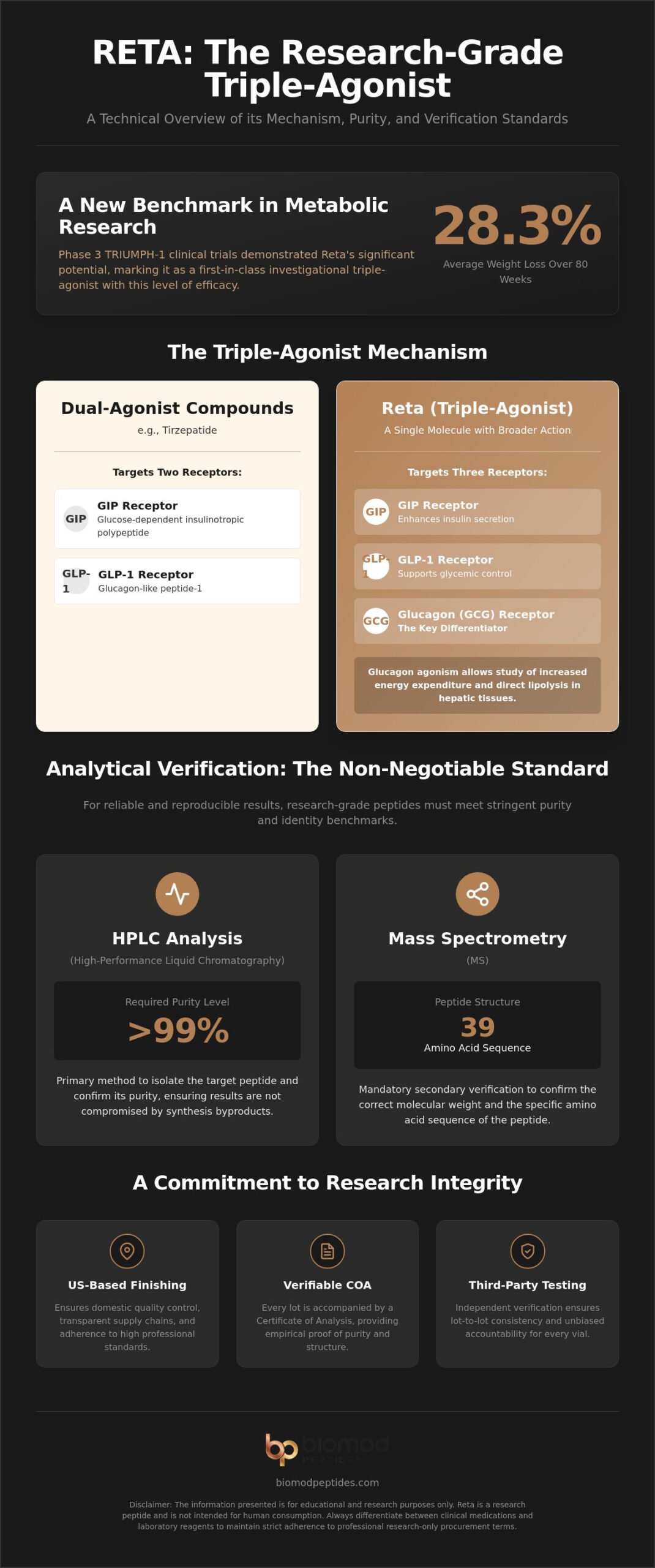
Participants in Phase 3 TRIUMPH-1 clinical trials achieved an average weight loss of 28.3% over 80 weeks. This data marks a significant shift in metabolic research, positioning Reta as the first investigational triple-agonist to reach this level of efficacy. You likely recognize that the transition from dual-receptor compounds to a mechanism targeting GLP-1, GIP, and glucagon simultaneously requires a new tier of analytical precision. Finding US-manufactured reagents with transparent documentation is often difficult in a market saturated with unverified imports.
This guide provides a technical overview of the triple-receptor agonist mechanism and the synthesis standards required for rigorous laboratory study. We’ll outline the specific protocols for verifying research peptides through HPLC and Mass Spectrometry to ensure 99% purity. You’ll learn how to audit quality control documentation and distinguish between clinical trial data and laboratory-grade requirements. We examine the structural integrity of the peptide and the importance of US-based verification in maintaining the professional standards your research demands.
Key Takeaways
- Analyze the triple-agonist mechanism of Reta and how its simultaneous activation of GIP, GLP-1, and glucagon receptors differentiates it from dual-agonist compounds.
- Identify the analytical benchmarks required for laboratory reagents, including the necessity of HPLC for establishing a >99% purity baseline.
- Learn why Mass Spectrometry is mandatory for verifying the specific peptide sequence and molecular weight of research-grade materials.
- Evaluate the importance of US-based manufacturing and finishing to ensure domestic research integrity and logistical transparency.
- Differentiate between clinical medications and laboratory reagents to maintain strict adherence to professional research-only procurement terms.
The Biochemistry of Reta: Triple-Agonist Mechanisms in Research
Reta is a synthetic peptide engineered for high-affinity binding across three distinct metabolic pathways. It functions as a single molecule that simultaneously activates the glucose-dependent insulinotropic polypeptide (GIP), glucagon-like peptide-1 (GLP-1), and glucagon (GCG) receptors. For 2026 biochemical research, Reta is defined as a triple-agonist molecule intended for the investigation of complex metabolic signaling pathways. This structural sophistication represents a leap beyond dual-agonist precursors like Tirzepatide. While dual agonists target GIP and GLP-1, the addition of the glucagon receptor allows for the study of increased energy expenditure and direct lipolysis within hepatic tissues.
The molecule consists of a 39-amino acid sequence. This specific backbone is optimized for metabolic stability and a prolonged half-life, which are critical variables in longitudinal in-vitro and in-vivo studies. By utilizing Retatrutide’s triple hormone receptor agonist mechanism, researchers can observe the integrated effects of nutrient-stimulated hormone secretion alongside glucagon-mediated thermogenesis. This triad creates a unique experimental environment for analyzing metabolic flux and cellular energy homeostasis.
Receptor Synergism and Experimental Objectives
Experimental models now prioritize the synergistic interaction between incretin mimetics and glucagon activation. In a laboratory setting, glucagon receptor agonism is studied for its ability to modulate hepatic fat oxidation. This mechanism works in tandem with GLP-1 and GIP to balance insulin sensitivity with metabolic rate. Researchers utilize these interactions to establish new benchmarks for metabolic regulation that dual-receptor compounds cannot achieve.
Current 2026 Research Trends
In 2026, the focus of triple-agonist studies has expanded into specialized pathology models. High-priority research now targets Metabolic-Associated Steatotic Liver Disease (MASLD) and long-term cardiovascular outcome simulations. These studies evaluate how triple-receptor agonism influences fibrotic markers and arterial health. The objective is to quantify the physiological limits of multi-pathway metabolic intervention in controlled environments.
Analytical Standards: Synthesis and Purity Verification for Reta
High-performance liquid chromatography (HPLC) is the primary method for establishing the analytical baseline of Reta. For laboratory research, a purity level of >99% is required to ensure that experimental results aren’t compromised by synthesis byproducts. HPLC isolates the target peptide from impurities, providing a clear chromatogram that validates chemical integrity. Without this verification, researchers risk introducing variables that can invalidate metabolic flux data. This standard is non-negotiable for high-tier analytical studies.
Mass Spectrometry (MS) serves as a mandatory secondary verification tool. While HPLC confirms purity, MS verifies the specific 39-amino acid sequence and molecular weight of the peptide. This ensures the material is exactly what the synthesis protocol intended. Additionally, identifying and quantifying Trifluoroacetic acid (TFA) levels in lyophilized research peptides is a critical step. TFA is a common counter-ion used during the purification process. Excessive residual TFA can impact cell viability in in-vitro models or alter the pH of experimental buffers. Biomod Peptides utilizes independent third-party testing to maintain lot-to-lot consistency. This rigorous oversight ensures that every vial delivered to a laboratory meets pre-defined structural and purity specifications.
Utilizing the COA Verification Portal
Transparency is the cornerstone of domestic research integrity. Every Reta lot must be accompanied by a verifiable Certificate of Analysis (COA). This document provides the empirical proof of the analytical standards discussed above. It’s not enough to rely on a generic specification sheet. Researchers can learn more about our verification protocols to understand how we match batch numbers directly to independent analytical reports. This process ensures full accountability for every reagent used in a study. By reviewing the HPLC and MS data before beginning an experiment, you can confirm the structural integrity of your materials. For those seeking reagents that meet these strict benchmarks, you can source HPLC-verified research peptides through our specialized catalog.
Sourcing Research-Grade Reta: Procurement for Las Vegas Laboratories
Domestic research integrity relies on transparent supply chains. Sourcing Reta from US-based facilities eliminates the variables associated with unverified international imports. When finishing and quality control occur within the United States, laboratories benefit from standardized manufacturing protocols and accessible documentation. This logistical transparency is essential for maintaining the professional register required in modern metabolic studies. Reliable procurement ensures that the structural integrity discussed in previous sections remains intact from the laboratory bench to the final analysis.
It’s vital to maintain strict adherence to research-only terms. Differentiating laboratory reagents from clinical medications isn’t just a regulatory requirement; it’s a fundamental aspect of scientific discipline. These compounds are intended strictly for in-vitro and animal model studies. Procurement protocols must reflect this distinction, focusing on analytical purity rather than pharmaceutical branding. High-throughput screening and longitudinal studies often require bulk procurement strategies. Securing a large volume from a single, HPLC-verified lot reduces inter-batch variability, which is a critical factor for the statistical power of your data.
Cold chain logistics are a primary concern for maintaining peptide stability. Lyophilized peptides are thermolabile and sensitive to environmental fluctuations. Transit to Las Vegas facilities requires monitored thermal packaging to prevent degradation, especially during peak temperature months. Proper handling ensures that the peptide’s 39-amino acid sequence doesn’t undergo premature hydrolysis or aggregation before reconstitution. Precision in logistics is as important as precision in synthesis.
Biomod Peptides: Precision Supply in the United States
Our Las Vegas-based focus supports national scientific advancement by providing reliable access to verified reagents. This localized presence allows for expedited logistics and a higher tier of accountability compared to offshore providers. We prioritize the advancement of metabolic research through rigorous internal benchmarks and logistical efficiency.
Specialized experimental designs often require innovative delivery formats. Utilizing analytical grade spray products allows researchers to investigate mucosal absorption pathways and alternative delivery mechanisms in controlled models. These formats provide the flexibility needed for diverse research objectives. You can explore our full catalog of high-purity research peptides to find the specific reagents and formats required for your next metabolic study.
Advancing Metabolic Research Standards
Advancing the frontier of metabolic science requires more than just access to novel compounds. It demands an uncompromising commitment to analytical rigor and logistical transparency. By prioritizing triple-agonist precision and HPLC-verified purity, your laboratory can maintain the highest standards of empirical data integrity. Every study involving Reta must be supported by verifiable proof, moving beyond the inherent uncertainties of unverified international supply chains. This transition ensures that your findings are built on a foundation of structural accuracy and professional accountability.
Securing domestic reagents ensures that cold chain protocols and structural stability remain uncompromised throughout the procurement process. Our commitment to US-manufactured and finished products provides the logistical transparency necessary for high-throughput screening and longitudinal studies. Through independent third-party HPLC/MS testing and our secure COA verification portal, we deliver the precision your refined methodology requires. It’s time to align your sourcing with the technical sophistication of your experimental design and internal benchmarks.
View Analytical Grade Reta and Verify COAs at Biomod Peptides
Elevate your experimental outcomes with reagents engineered for the next generation of metabolic discovery and scientific advancement.
Frequently Asked Questions
Is Reta approved for human consumption in 2026?
Retatrutide is an investigational compound and is not FDA-approved for human consumption as of July 2026. Its legal application is limited strictly to laboratory research. Administering this peptide for clinical use outside of registered trials is illegal. Formal approval is not expected until late 2027 or 2028. Researchers must adhere to these regulatory boundaries to maintain the integrity of their institutions and experimental data.
What is the required purity level for Reta in analytical research?
Analytical research requires a minimum purity baseline of 99% as verified by High-Performance Liquid Chromatography (HPLC). Using Reta with lower purity levels introduces synthesis byproducts that can compromise metabolic data. These impurities often create chemical variables that interfere with receptor affinity studies. Maintaining this 99% standard is essential for ensuring that experimental results are reproducible and accurate across different laboratory environments.
How should lyophilized Reta be stored to maintain stability?
Lyophilized Reta must be stored at -20°C to maintain long-term stability and prevent molecular degradation. Short-term storage at 4°C is acceptable for periods under three months. Vials should remain in a desiccated, dark environment to protect the peptide from moisture and light. These controlled conditions preserve the structural integrity of the 39-amino acid sequence, ensuring the compound remains viable for precise metabolic analysis.
Why is third-party testing critical for Reta batches?
Third-party testing provides an objective verification of a reagent’s identity and purity. Independent High-Performance Liquid Chromatography (HPLC) and Mass Spectrometry (MS) confirm that the batch matches its technical specifications. This process identifies potential contaminants, such as residual TFA, which could alter experimental pH or cell viability. Relying on external validation is the only way to ensure that synthesis protocols meet rigorous scientific standards.
Disclaimer
BIOMOD products are sold strictly for laboratory, analytical, and scientific research use only. They are not intended for human or animal consumption, administration, application, ingestion, injection, or any therapeutic, diagnostic, or cosmetic use.
The statements made on this website have not been evaluated by the United States Food and Drug Administration. BIOMOD products are not intended to diagnose, treat, cure, mitigate, or prevent any disease or medical condition.
BIOMOD is a research chemical supplier. BIOMOD is not a compounding pharmacy or chemical compounding facility as defined under Section 503A of the Federal Food, Drug, and Cosmetic Act. BIOMOD is not an outsourcing facility as defined under Section 503B of the Federal Food, Drug, and Cosmetic Act.
By accessing this site, you confirm you are at least 21 years of age and that you have read and accepted the BIOMOD Terms of Sale, Privacy Policy, and Research Use Only Policy. BIOMOD does not provide dosing, medical, therapeutic, diagnostic, veterinary, or use guidance under any channel.