
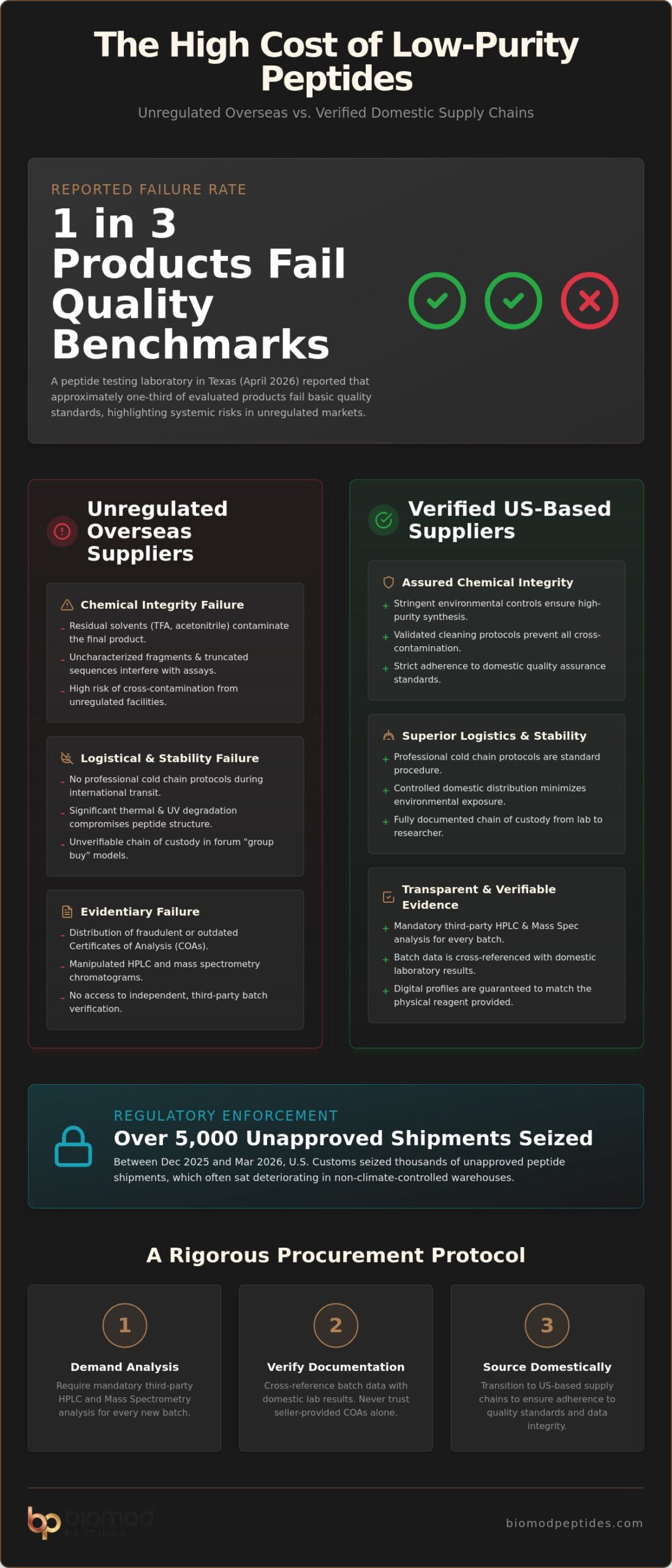
A peptide testing laboratory in Texas reported in April 2026 that approximately one-third of the thousands of products it evaluates fail basic quality benchmarks. This statistic highlights the structural failures inherent in unregulated markets. Many researchers rely on peer-vetted vendors to manage costs, yet the risks of buying peptides from overseas forums often outweigh the perceived financial benefits. Community consensus is not a substitute for high-performance liquid chromatography or mass spectrometry.
You require reagents that meet strict experimental standards without compromising the integrity of your data. This article provides a clinical examination of the chemical, logistical, and evidentiary failures found in unverified peptide supply chains. We’ll analyze technical pitfalls such as batch-to-batch inconsistency and potential cross-contamination in unregulated facilities. By the end of this analysis, you’ll understand how to establish a rigorous protocol for verifying reagent integrity and how to identify reliable US-based supply chains that prioritize analytical transparency.
Key Takeaways
- Unregulated manufacturing environments frequently introduce residual solvents and uncharacterized fragments into the peptide matrix.
- International transit lacks professional cold chain protocols, leading to significant thermal degradation of sensitive peptide sequences.
- Understanding the technical risks of buying peptides from overseas forums is essential for maintaining experimental reproducibility and data integrity.
- Implementation of a rigorous procurement protocol requires mandatory third-party HPLC and mass spectrometry analysis for every batch.
- Transitioning to US-based supply chains ensures adherence to domestic quality assurance standards and verified analytical documentation.
Chemical Integrity and the Impurity Profiles of Overseas Peptides
Unregulated manufacturing facilities often lack the stringent environmental controls required for high-purity synthesis. These labs frequently bypass the rigorous peptide synthesis process necessary to ensure molecular precision. In these environments, atmospheric contaminants and humidity fluctuations compromise the chemical reaction. The result is a reagent that fails to meet the structural benchmarks required for consistent laboratory data. Accuracy in research depends entirely on the stability of the compound’s primary sequence.
The risks of buying peptides from overseas forums extend to the specific impurity profiles found in these batches. Common contaminants include residual solvents like acetonitrile and trifluoroacetic acid (TFA) salts. These substances remain in the final product when purification stages are rushed or omitted. Additionally, uncharacterized peptide fragments often populate the matrix. These fragments are not merely inert filler; they can interfere with assay results and lead to non-reproducible data. Truncated sequences, where the peptide chain is incomplete, represent a failure in the synthesis cycle that unregulated labs often ignore.
Cross-contamination remains a critical vulnerability in facilities producing multiple compounds simultaneously. Without validated cleaning protocols and dedicated equipment for each peptide type, carryover is inevitable. A batch of BPC-157 may contain trace amounts of unrelated growth factors or synthetic stimulants. In an analytical setting, these unintended additions introduce uncontrolled variables. This lack of structural integrity makes it impossible to isolate the effects of the specific peptide under study.
The Reality of Fraudulent Certificates of Analysis (COA)
Overseas vendors frequently distribute HPLC reports that are either outdated or belong to entirely different batches. These documents provide a false sense of security. Mass spectrometry data is also subject to manipulation. Technicians can edit chromatograms to mask the presence of synthesis byproducts or heavy metals. Relying on documentation provided by the seller creates an evidentiary vacuum. It’s a fundamental failure in the chain of custody. Verification requires an independent verification portal to cross-reference batch data with domestic laboratory results. This step is the only way to confirm that the physical reagent matches its digital profile.
Logistical Failures: Stability and the Forum Group Buy Dynamic
Peptides are inherently sensitive to environmental stressors. International transit exposes these compounds to extreme temperature fluctuations and UV radiation. Overseas shippers rarely utilize professional cold chain protocols. This neglect leads to significant peptide degradation before the reagent even reaches the laboratory. Lyophilization quality also varies drastically between facilities. Proper freeze-drying is essential for maintaining shelf-life and ensuring rapid solubility. Unregulated labs often rush this stage, resulting in collapsed cakes and insoluble aggregates that compromise experimental accuracy.
The forum “group buy” model is fundamentally flawed. It lacks a documented chain of custody. Community-led testing often relies on a single sample from a massive lot, which is an approach that remains scientifically unverifiable. It ignores the variance between individual vials and the conditions they face during transport. Recent enforcement actions, such as the FDA warning on unapproved peptides, demonstrate that regulatory bodies are increasingly targeting vendors who bypass quality standards. Between December 2025 and March 2026, U.S. Customs and Border Protection seized over 5,000 shipments of unapproved peptides. Many of these units sat in non-climate-controlled warehouses for weeks before seizure or delivery.
The risks of buying peptides from overseas forums include more than just legal seizure. You also face the total loss of reagent potency. For researchers prioritizing data reproducibility, sourcing from a verified domestic supply chain is the only way to mitigate these logistical failures.
Peptide Stability and Degradation During Transit
Kinetic energy and thermal stress impact the structural integrity of even lyophilized peptides. High temperatures during customs clearance accelerate primary sequence breakdown. Constant vibration during long-haul flights can induce aggregation in sensitive sequences. US-manufactured reagents provide superior stability because they utilize controlled distribution networks that minimize environmental exposure. Understanding the latest advancements in peptide science is vital for recognizing why delivery-system stability cannot be left to chance. Professional logistics ensure that the chemical profile you purchase is the same profile that arrives at your bench.
Establishing a Rigorous Laboratory Procurement Protocol
Researchers must implement a systematic approach to procurement to mitigate the risks of buying peptides from overseas forums. Domestic manufacturing is the primary safeguard. It ensures adherence to US quality assurance standards that unregulated labs routinely ignore. A reliable provider maintains a transparent chain of custody from synthesis to final distribution. This structural accountability is essential for maintaining the integrity of your experimental outcomes.
Every lot requires independent, third-party verification. High-Performance Liquid Chromatography (HPLC) and Mass Spectrometry (MS) are non-negotiable standards. These tests confirm both purity and molecular identity. Investigative reports have highlighted the documented safety concerns for unregulated peptides, including immune reactions caused by synthesis impurities. Analytical grade reagents must be free from these contaminants to ensure experimental validity. Without this data, your laboratory results remain vulnerable to uncontrolled variables.
Verification should also extend to specialized delivery formats. Advanced systems like peptide softgels or spray products are only viable when supported by batch-specific analytical data. Vendors must adhere strictly to research-only terms. This focus ensures the facility prioritizes the precision required for laboratory use rather than mass-market retail. It’s a marker of professional intent and technical capability.
The Biomod Standard: US Manufacturing and Verification
Biomod Peptides finishes all products within the United States. This geographic anchor allows for rigorous oversight of the final stabilization and packaging stages. Our COA verification portal provides researchers with empirical proof of purity before any experiment begins. It eliminates the guesswork common in forum-sourced procurement. You can read more about Biomod and our commitment to institutional-grade laboratory transparency. We prioritize data-driven validation over community anecdotes. Every reagent we provide is a product of meticulous verification and structural integrity.
Refining Procurement Standards for Analytical Success
Community consensus is a poor substitute for rigorous laboratory standards. We’ve analyzed the chemical vulnerabilities and logistical failures that define unregulated supply chains. The risks of buying peptides from overseas forums include more than just batch inconsistency; they encompass the total failure of experimental reproducibility. High-purity synthesis requires the environmental controls and documented chain of custody that forum vendors simply cannot provide. Relying on unverified sources introduces variables that compromise your entire data set.
Biomod Peptides bridges the gap between availability and institutional-grade quality. Our methodology includes independent third-party testing on all batches and a secure COA verification portal for researchers. Every product is finished in the United States to ensure domestic quality benchmarks are met without exception. We provide the empirical proof required for sophisticated research environments and demanding analytical protocols.
Secure Analytical Grade Peptides from Biomod Peptides
Data integrity begins with the quality of your reagents. By prioritizing verified supply chains, you ensure your research remains grounded in empirical truth and professional precision.
Frequently Asked Questions
Why is third-party testing essential for research peptides?
Third-party testing provides objective validation of a reagent’s chemical profile. It eliminates vendor bias. Independent HPLC and Mass Spectrometry (MS) analysis verify that the peptide sequence matches the intended molecular structure. This verification stage is the only way to confirm purity levels exceed 99% before initiating laboratory protocols.
How does international shipping affect peptide purity?
International shipping exposes peptides to uncontrolled thermal stress. Most overseas vendors don’t utilize professional cold chain logistics. Heat and kinetic energy during long-distance transit accelerate the degradation of sensitive amino acid chains. This process leads to the formation of insoluble aggregates and reduced potency in the final research reagent.
Can I trust the HPLC reports provided by overseas peptide forums?
Documentation from forum-based vendors is often recycled or falsified. These reports frequently lack batch-specific timestamps and verifiable lab credentials. One of the primary risks of buying peptides from overseas forums is the reliance on manipulated chromatograms designed to hide synthesis failures or heavy metal contamination.
What are the most common impurities found in bootleg peptides?
The risks of buying peptides from overseas forums often manifest as high concentrations of residual solvents. Acetonitrile and TFA salts are common byproducts of incomplete purification. You’ll also find truncated sequences where the peptide chain is incomplete. These impurities interfere with receptor binding and lead to non-reproducible data in analytical settings.
Is there a difference between “research grade” and “analytical grade” peptides?
Analytical grade peptides meet a higher threshold of verification than generic research grade labels. They require comprehensive documentation of their impurity profile. This includes quantitative data on residual salts and heavy metals. Researchers prioritize analytical grade reagents when molecular precision is paramount for data integrity and experimental reproducibility.
How can I verify the authenticity of a peptide manufacturer in the USA?
Authenticity is confirmed through logistical transparency and verifiable documentation. Legitimate US providers offer a secure portal to cross-reference batch numbers with independent third-party lab results. Verify that the supplier maintains a domestic finishing facility. Avoid vendors that use colloquial language or marketing tactics inconsistent with institutional laboratory standards.
Disclaimer
BIOMOD products are sold strictly for laboratory, analytical, and scientific research use only. They are not intended for human or animal consumption, administration, application, ingestion, injection, or any therapeutic, diagnostic, or cosmetic use.
The statements made on this website have not been evaluated by the United States Food and Drug Administration. BIOMOD products are not intended to diagnose, treat, cure, mitigate, or prevent any disease or medical condition.
BIOMOD is a research chemical supplier. BIOMOD is not a compounding pharmacy or chemical compounding facility as defined under Section 503A of the Federal Food, Drug, and Cosmetic Act. BIOMOD is not an outsourcing facility as defined under Section 503B of the Federal Food, Drug, and Cosmetic Act.
By accessing this site, you confirm you are at least 21 years of age and that you have read and accepted the BIOMOD Terms of Sale, Privacy Policy, and Research Use Only Policy. BIOMOD does not provide dosing, medical, therapeutic, diagnostic, veterinary, or use guidance under any channel.