
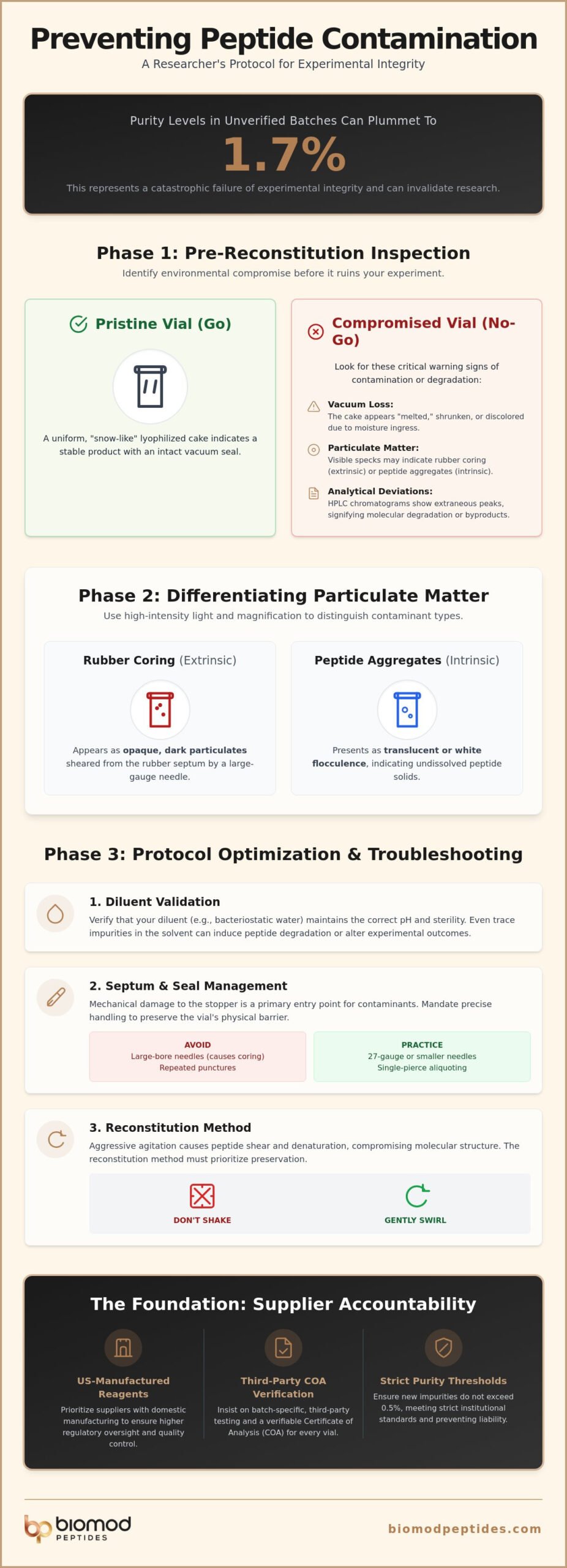
Independent testing of research peptides has shown purity levels plummeting as low as 1.7% in unverified batches. This isn’t just a minor variance. It’s a catastrophic failure of experimental integrity. For researchers in high-throughput environments, preventing peptide contamination in lab settings is the difference between a breakthrough and a retracted paper. Inconsistent assay data often stems from invisible impurities that bypass basic visual inspections. When synthetic peptides must meet strict thresholds where new impurities cannot exceed 0.5%, even a microscopic lapse in protocol becomes an institutional liability.
You’ve likely faced the frustration of losing expensive reagents to cross-contamination or unexplained degradation. It’s a significant drain on laboratory resources and institutional confidence. This article provides a rigorous protocol for identifying, diagnosing, and neutralizing contamination sources within your workflow. We’ll move from broad diagnostic markers to specific chemical and biological identification. We’ll utilize a clinical checklist to help you make a definitive “go/no-go” decision on any suspect vial. You’ll learn to isolate protocol failures and refine your internal standards according to ISO 10012:2026 requirements to ensure absolute structural integrity.
Key Takeaways
- Conduct pre-reconstitution inspections to detect vacuum loss or moisture ingress that compromises the integrity of lyophilized peptide cakes.
- Differentiate between undissolved peptide solids and rubber stopper coring through standardized visual particulate analysis.
- Validate diluent sterility and pH levels as a primary procedural step for preventing peptide contamination in lab settings.
- Refine injection protocols by optimizing needle gauge and insertion angles to preserve septum integrity and prevent exogenous particulate entry.
- Establish supplier accountability by prioritizing US-manufactured reagents that include batch-specific third-party testing and COA verification.
Clinical Indicators: Identifying Contamination in Lyophilized Peptide Vials
A rigorous diagnostic process begins before reconstitution. Structural integrity starts with the physical state of the lyophilized cake. A pristine vial contains a uniform, “snow-like” structure. Any deviation suggests environmental compromise. Identifying these markers early is essential for preventing peptide contamination in lab workflows. Moisture ingress often causes the cake to appear “melted” or shrunken. This indicates a loss of vacuum seal. A compromised seal exposes the reagent to atmospheric contaminants and humidity, accelerating degradation and compromising experimental reliability.
Visual Diagnostic Cues
Visual inspection requires high-intensity lighting and magnification. Distinguish between intrinsic peptide properties and extrinsic contaminants. “Coring” occurs when a needle shears small fragments from the rubber septum. These appear as opaque, dark particulates. In contrast, undissolved peptide typically presents as translucent or white flocculence. While following proper sterilization methods for the vial top minimizes microbial entry, it cannot rectify structural damage to the septum itself. If particulates remain after gentle agitation, the vial’s integrity is compromised.
Analytical Verification Standards
Visual cues provide the first line of defense; analytical data provides the final verdict. Researchers must utilize a standardized peptide purity verification protocol to compare new batch data against established baselines. Analyze HPLC chromatograms for extraneous peaks. These often signify oxidation or deamidation. High baseline noise in mass spectrometry reports may indicate residual solvents or biological impurities. Rigorous documentation ensures that preventing peptide contamination in lab settings remains a data-driven objective rather than a subjective assessment.
- Vacuum Loss: Indicated by a collapsed, “melted,” or discolored cake.
- Particulate Matter: Differentiate between rubber coring (extrinsic) and peptide aggregates (intrinsic).
- pH Shifts: Unexpected acidity or alkalinity post-reconstitution suggests chemical leaching or microbial metabolism.
- HPLC Deviations: Extraneous peaks confirm molecular degradation or the presence of synthesis byproducts.
The Troubleshooting Checklist: Identifying Sources of Experimental Interference
Isolating the origin of contamination requires a forensic approach to laboratory protocol. When experimental data fluctuates, the investigator must audit every touchpoint between the lyophilized powder and the final assay. Step 1 involves diluent validation. Verify that bacteriostatic water or acetic acid maintains the correct pH and sterility. Even trace impurities in the solvent can induce peptide degradation. Step 3 focuses on atmospheric exposure. Minimize the duration a vial remains open to non-sterile environments. Following established aseptic processing guidelines ensures that environmental microbes or airborne particulates don’t compromise the reagent during the reconstitution phase.
Evaluating Reconstitution Protocols
Reconstitution mechanics are a frequent, yet overlooked, source of structural failure. Aggressive agitation causes peptide shear and denaturation. Don’t shake the vial. Instead, utilize a gentle “swirl” method to preserve secondary structure integrity. Standardize the use of antimicrobial diluents for all multi-use research vials to inhibit microbial growth over time. Documenting these steps is a cornerstone of preventing peptide contamination in lab environments, ensuring that every researcher follows a verified, repeatable methodology.
Septum and Seal Management
Step 2 requires an evaluation of septum integrity. Mechanical damage to the stopper often introduces rubber particulates into the solution. Mandate the use of 27-gauge or smaller needles. Large-bore needles increase the risk of “coring,” which compromises the physical barrier. Establish a “single-pierce” protocol for aliquoting whenever possible. Repeated punctures create micro-channels for contamination. By maintaining a strict insertion angle and using fine-gauge instruments, you preserve the seal’s structural integrity and protect your high-purity research peptides from exogenous interference.
- Step 1: Validate diluent sterility and pH levels.
- Step 2: Audit needle gauge and insertion angles to prevent coring.
- Step 3: Quantify atmospheric exposure times.
- Step 4: Review reconstitution mechanics to prevent molecular shear.
Protocol Optimization: Mitigating Future Contamination in Laboratory Settings
Mitigation is a systemic requirement that extends beyond the sterile hood. Laboratory leaders must account for environmental variables that occur before a vial ever reaches the bench. Logistical transparency is paramount. For instance, ambient loading dock temperatures in arid climates like Las Vegas can exceed 110°F. Such extremes create an immediate threat to vial seal integrity and peptide stability. Preventing peptide contamination in lab environments starts with a controlled cold chain and immediate verification upon receipt. Transitioning to alternative delivery formats, such as peptide softgels or spray products, can further minimize manual handling risks by eliminating the need for repeated reconstitution and needle entry.
Regional Stability Considerations
Laboratories operating in high-heat regions must implement rigorous receiving protocols. The “cold chain” isn’t merely a suggestion; it’s a structural necessity. We recommend immediate COA verification for every shipment to ensure structural integrity hasn’t been compromised during transit. This alignment with modern peptide science standards ensures that baseline data remains untainted by logistical failures. Documentation must include the exact time of transfer from transit packaging to stabilized storage.
Advanced Storage Protocols
Structural degradation often presents as contamination. To prevent moisture-induced hydrolysis, utilize desiccant-lined secondary containment for all lyophilized reagents. Implementing a strict “thaw-aliquot-refreeze” log is essential for preventing peptide contamination in lab settings caused by repeated thermal cycling. Each cycle increases the risk of atmospheric exposure and condensation. By integrating analytical grade standards into your procurement and storage workflows, you establish a foundation of empirical proof that protects the long-term viability of your research reagents.
- Logistical Control: Audit shipping durations and loading dock temperatures to protect vial seals.
- Format Diversification: Use pre-measured sprays or softgels to reduce manual puncture frequency.
- Cycle Management: Enforce one-time aliquoting to eliminate freeze-thaw degradation.
- Environmental Shielding: Employ secondary desiccant containment to neutralize humidity risks.
Advancing Experimental Integrity Through Protocol Rigor
Experimental success depends on the intersection of diagnostic vigilance and material purity. Identifying visual markers like vacuum loss and implementing strict 27-gauge needle protocols are essential first steps. However, true reliability requires a foundation of empirical proof. Preventing peptide contamination in lab environments is only possible when the source material meets uncompromising analytical standards. Every variable, from regional climate stability to reconstitution mechanics, must be documented and controlled to ensure data reproducibility.
Biomod Peptides provides the structural integrity your research demands. We ensure transparency through US-based manufacturing and finishing. Every batch undergoes independent third-party HPLC/MS testing to verify purity levels before it reaches your facility. You can access these results immediately through our direct COA verification portal. Secure your research with US-manufactured, third-party tested peptides from Biomod Peptides. Precision isn’t just a goal; it’s our baseline. We’re committed to the advancement of your methodology through absolute quality control.
Frequently Asked Questions
How can I tell if a lyophilized peptide vial has lost its vacuum seal?
Loss of vacuum is identified by the physical morphology of the lyophilized cake. A compromised seal allows moisture ingress, causing the once-uniform, snow-like structure to appear shrunken, discolored, or melted. This structural collapse indicates atmospheric exposure and potential degradation. Vials showing these signs should be discarded to maintain experimental integrity. Maintaining a rigorous inspection protocol is a primary step in preventing peptide contamination in lab environments before reconstitution occurs.
What does cloudiness (turbidity) in a reconstituted peptide vial indicate?
Turbidity usually signals either incomplete peptide dissolution or microbial proliferation. If the solution remains cloudy after gentle swirling, the peptide may have reached its solubility limit or started to aggregate. However, if cloudiness appears after a period of stable storage, it likely indicates bacterial or fungal contamination. This shift often coincides with unexpected pH changes. Immediate analytical verification is required to distinguish between harmless precipitates and active biological interference.
Can a peptide vial contaminated with rubber coring still be used for research?
Vials containing rubber particulates from septum coring are generally unsuitable for high-precision research. These fragments introduce extrinsic polymers and chemicals into the solution, potentially interfering with spectrophotometric readings or causing mechanical blockages in automated injection systems. While the peptide itself may remain chemically intact, the presence of macroscopic particulates compromises the standardized purity required for reproducible data. Transitioning to 27-gauge needles helps mitigate this specific risk.
How does TFA counter-ion contamination affect experimental results?
Trifluoroacetic acid (TFA) is a common byproduct of solid-phase synthesis that can drastically alter experimental outcomes. High residual TFA concentrations lower the solution pH, which may induce cytotoxicity in cell-based assays or interfere with protein-protein interactions. For sensitive biological systems, researchers must quantify TFA levels through HPLC. Preventing peptide contamination in lab workflows often involves selecting acetate or salt-free alternatives when baseline noise must be minimized for accurate quantification.
Disclaimer
BIOMOD products are sold strictly for laboratory, analytical, and scientific research use only. They are not intended for human or animal consumption, administration, application, ingestion, injection, or any therapeutic, diagnostic, or cosmetic use.
The statements made on this website have not been evaluated by the United States Food and Drug Administration. BIOMOD products are not intended to diagnose, treat, cure, mitigate, or prevent any disease or medical condition.
BIOMOD is a research chemical supplier. BIOMOD is not a compounding pharmacy or chemical compounding facility as defined under Section 503A of the Federal Food, Drug, and Cosmetic Act. BIOMOD is not an outsourcing facility as defined under Section 503B of the Federal Food, Drug, and Cosmetic Act.
By accessing this site, you confirm you are at least 21 years of age and that you have read and accepted the BIOMOD Terms of Sale, Privacy Policy, and Research Use Only Policy. BIOMOD does not provide dosing, medical, therapeutic, diagnostic, veterinary, or use guidance under any channel.