
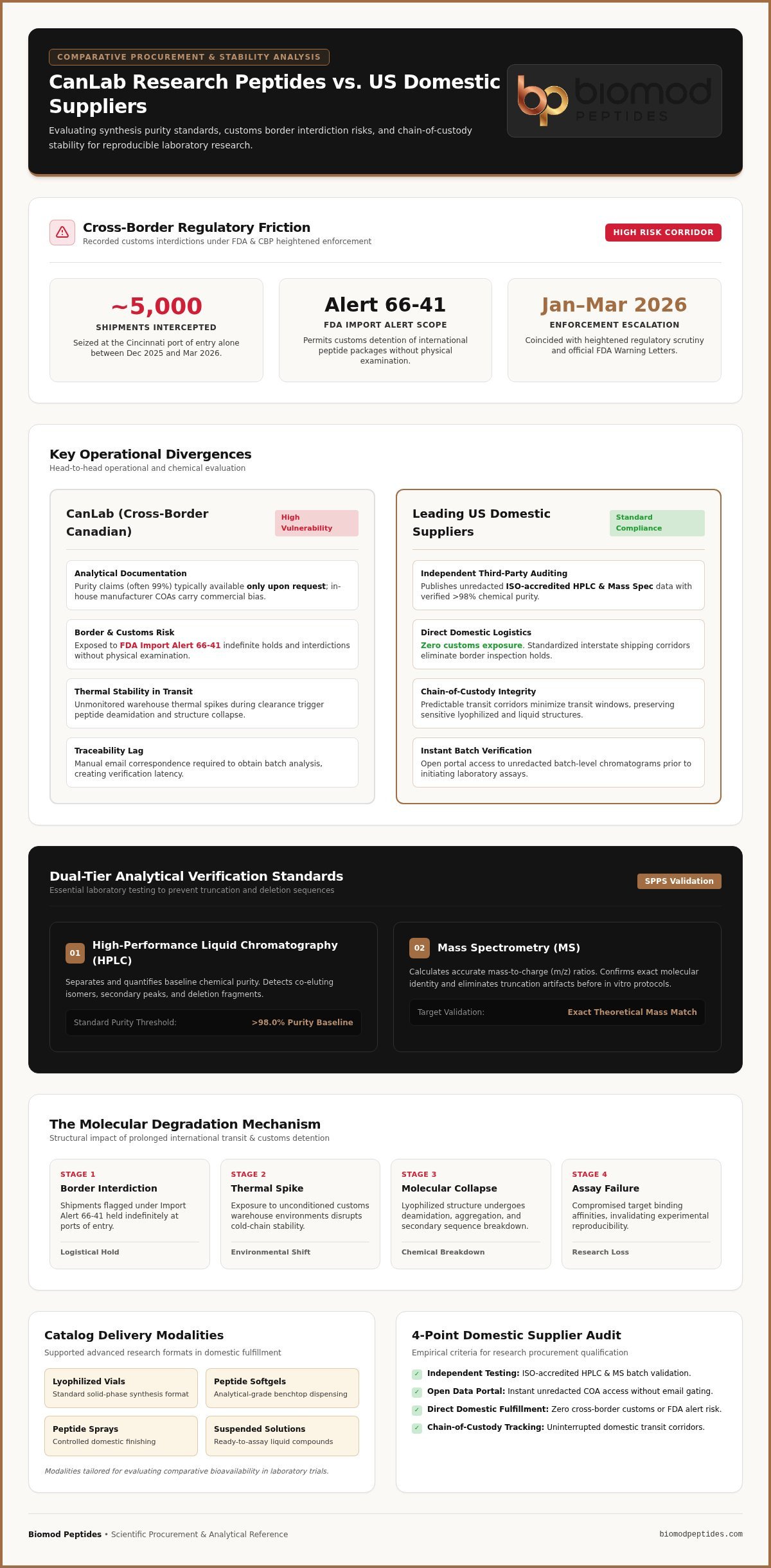
Between December 2025 and March 2026, U.S. Customs and Border Protection intercepted approximately 5,000 peptide shipments at the Cincinnati port of entry alone. When evaluating CanLab research peptides vs US suppliers, that regulatory friction changes the procurement equation entirely. Every principal investigator understands that reproducible data demands exact purity and zero logistical friction. An unexpected customs seizure or an unmonitored thermal spike during international transit doesn’t just stall a project timeline; it fundamentally degrades sensitive lyophilized peptide structures before assays even begin.
You need absolute certainty that every vial matches its stated molecular weight and purity profile. This comparative analysis evaluates synthesis purity, customs exposure, and analytical verification between CanLab and domestic US suppliers. Below, we examine third-party HPLC and mass spectrometry standards, regulatory border interdiction risks, and domestic fulfillment logistics to help your laboratory maintain uninterrupted experimental schedules.
Key Takeaways
- Assess analytical verification standards by confirming that independent, third-party HPLC chromatography and mass spectrometry data accompany every synthesis batch.
- Evaluating CanLab research peptides vs US suppliers reveals how cross-border freight introduces severe thermal fluctuations and regulatory inspection holds that degrade sensitive peptide sequences.
- Prioritize suppliers utilizing open batch-level COA verification portals to ensure structural identity and prevent truncation errors before initiating laboratory protocols.
- Implement a structured supplier audit checklist to evaluate domestic manufacturing protocols across multiple reagent formats, from lyophilized vials to research-grade peptide softgels.
Evaluating Purity Standards: CanLab vs Domestic US Suppliers
Precision defines reproducible research. Solid-phase peptide synthesis (SPPS) requires uncompromising fidelity at every coupling step. In comparing CanLab research peptides vs US suppliers, the primary divergence lies in analytical transparency. While Canadian entities often claim 99% purity with documentation available only upon request, leading domestic facilities publish unredacted data openly. Flaws during the peptide synthesis process create deletion sequences and truncation artifacts that compromise target binding affinities.
High-Performance Liquid Chromatography (HPLC) isolates these secondary peaks to confirm baseline chemical purity above 98%. Simultaneously, mass spectrometry calculates molecular mass to verify sequence fidelity. Without dual-tier testing, synthesis errors remain undetectable to the researcher.
Independent Third-Party Verification vs In-House Purity Reports
Internal manufacturer Certificates of Analysis (COAs) present structural blind spots. Self-reported documentation carries an inherent commercial bias. Institutional laboratories require validation from independent, ISO-accredited testing facilities that have no financial stake in batch turnover.
- Resolution Auditing: Inspect baseline chromatogram separation to detect co-eluting isomers.
- Spectral Identification: Confirm clear mass-to-charge (m/z) ratios that match theoretical targets exactly.
- Batch-Level Traceability: Demand instantly accessible reports rather than manual email requests.
When assessing CanLab research peptides vs US suppliers, automated portal access to third-party data eliminates verification lag. Immediate documentation protects research compliance, letting investigators audit spectral purity before initiating in vitro protocols.
Logistical Reliability: Customs Clearance vs Domestic US Shipping
Cross-border procurement introduces acute operational risks. When evaluating CanLab research peptides vs US suppliers, freight transit represents the most volatile variable in maintaining reagent stability. Between January and March 2026, heightened regulatory enforcement reflected in official FDA Warning Letters coincided with increased border scrutiny. Under FDA Import Alert 66-41, customs officials regularly detain cross-border peptide shipments without physical examination. These indefinite holds jeopardize sensitive experimental schedules.
Domestic distribution removes international checkpoints entirely. Standardized transit corridors prevent bureaucratic delays, ensuring compounds move smoothly from manufacturing directly to the laboratory bench.
Protecting Molecular Integrity During Reagent Shipping and Handling
Lyophilized peptides remain sensitive to thermal degradation. Prolonged customs holds expose packages to unconditioned warehouse environments, triggering secondary structure collapse, deamidation, and aggregation. Contrast this with established domestic transit routes:
- Predictable Transit Windows: Predictable interstate routes minimize overall transit duration.
- Chain-of-Custody Control: Domestic couriers offer traceable, uninterrupted handoffs.
- Formulation Stability: Controlled domestic finishing preserves delicate formats, including specialized peptide spray products and suspended solutions.
In analyzing CanLab research peptides vs US suppliers, domestic synthesis and finishing clearly eliminate international customs exposure. Investigators seeking reliable fulfillment and protected molecular integrity can evaluate compliant research reagents through Biomod Peptides for verifiable domestic consistency.
Selecting a Dependable US Research Peptide Supply Partner
Rigorous vendor qualification requires systematic auditing. Crowdsourced review platforms cannot substitute for empirical compliance audits. When comparing CanLab research peptides vs US suppliers, procurement teams must look past marketing promises and verify laboratory-grade controls. Every approved reagent source must demonstrate verifiable domestic synthesis, traceable finishing protocols, and complete catalog versatility.
Modern experimental methodologies often extend beyond conventional lyophilized powders. Laboratories frequently require diverse delivery modalities to evaluate bioavailability in comparative trials. Reliable domestic providers support advanced formats, providing stabilized research solutions alongside analytical-grade peptide softgels tailored specifically for precise benchtop dispensing.
Batch Accountability and Instant Certificate of Analysis Verification
Data access should be immediate. Institutional compliance standards require accessible documentation before opening purchase orders. Rather than waiting on customer service responses, researchers should demand transparent systems:
- Direct Lot Verification: Query unique batch numbers directly through an integrated portal.
- Unfiltered Spectral Data: Confirm both HPLC retention times and mass spectrometry profiles match the exact delivered container.
- Compliance Terms: Partner strictly with suppliers operating under explicit laboratory research-use designations.
For scientific teams weighing CanLab research peptides vs US suppliers, operational transparency remains the deciding factor. Evaluating domestic facilities like Biomod Peptides ensures access to US-manufactured reagents verified by independent analytical testing and supported by instant online documentation.
Advancing Experimental Accuracy Through Domestic Verification
Deciding between CanLab research peptides vs US suppliers fundamentally comes down to mitigating procedural risk. International customs holds introduce severe vulnerabilities, exposing delicate peptide sequences to uncontrolled thermal degradation while stalling critical project timelines. At the same time, restricted COA access leaves purity assertions unverified before testing begins. Defensible scientific outcomes demand verifiable synthesis standards and uninterrupted domestic supply chains.
Protect your research workflow with 100% US manufactured and finished laboratory reagents validated by independent third-party HPLC and mass spectrometry testing. Immediate batch transparency eliminates analytical guesswork and safeguards structural integrity at every stage. Explore verified, US-finished reagents at Biomod Peptides today and confirm purity metrics instantly through our real-time online batch COA verification portal.
Frequently Asked Questions
Can US research facilities legally order laboratory peptides from Canadian suppliers?
Yes, facilities can legally order non-controlled compounds for laboratory research use, but cross-border freight faces strict import scrutiny. Under FDA Import Alert 66-41, border agents can detain unapproved international shipments without physical examination. In assessing CanLab research peptides vs US suppliers, importing across the border carries recurring risks of regulatory confiscation, whereas domestic sourcing completely avoids international import protocols.
What is the main shipping risk when ordering peptides internationally?
Thermal degradation during unpredictable customs holds presents the most severe shipping hazard. When packages sit inside unconditioned international freight terminals, ambient heat accelerates hydrolytic cleavage and structural aggregation. These temperature spikes disrupt delicate peptide bonds before delivery, compromising baseline viability and causing irreproducible analytical results during benchwork assays.
How do third-party HPLC reports differ between Canadian and US peptide vendors?
Data accessibility represents the primary operational difference. Canadian vendors frequently rely on in-house documentation or supply third-party reports only after manual requests. Leading US suppliers provide publicly accessible verification portals. This setup lets researchers immediately audit unredacted High-Performance Liquid Chromatography peak separation and mass spectrometry identity profiles before logging inventory into lab protocols.
Why do research laboratories prefer domestic US suppliers for peptide softgels and sprays?
Complex delivery formats require rapid domestic transit to maintain chemical stability and carrier suspension integrity. When evaluating CanLab research peptides vs US suppliers, facilities across regional hubs, including academic and biotech institutions in Las Vegas, prefer US providers like Biomod Peptides. Domestic manufacturing and finishing eliminate border checkpoints that can destabilize sensitive emulsion matrixes and specialized peptide softgels.
Disclaimer
BIOMOD products are sold strictly for laboratory, analytical, and scientific research use only. They are not intended for human or animal consumption, administration, application, ingestion, injection, or any therapeutic, diagnostic, or cosmetic use.
The statements made on this website have not been evaluated by the United States Food and Drug Administration. BIOMOD products are not intended to diagnose, treat, cure, mitigate, or prevent any disease or medical condition.
BIOMOD is a research chemical supplier. BIOMOD is not a compounding pharmacy or chemical compounding facility as defined under Section 503A of the Federal Food, Drug, and Cosmetic Act. BIOMOD is not an outsourcing facility as defined under Section 503B of the Federal Food, Drug, and Cosmetic Act.
By accessing this site, you confirm you are at least 21 years of age and that you have read and accepted the BIOMOD Terms of Sale, Privacy Policy, and Research Use Only Policy. BIOMOD does not provide dosing, medical, therapeutic, diagnostic, veterinary, or use guidance under any channel.