
Field-moist arid soils can hydrolyze synthetic signaling molecules in minutes, quietly compromising months of stress physiology experiments. If you manage environmental bioassays, you already know the frustration of rapid proteolysis, high-salinity interference, and unverified batch purity. When reagents aren’t rigorously controlled, false positives skew your baseline readings. Deploying analytical peptides for arid land ecology research is essential to eliminate chemical variance across delicate plant and soil-microbiome models.
This guide examines how analytical-grade peptides advance arid land ecology research, soil microbiome studies, and drought-adaptation investigations. We review target mechanisms like the CLE25 signaling pathway, outline reconstitution protocols to counter abiotic sorption in alkaline soils, and define the verification standards required to safeguard longitudinal datasets.
Key Takeaways
- Explore how synthetic signaling peptides direct root architecture and stomatal conservation during acute drought events.
- Implement cold-quenching and chemical inhibition controls to prevent rapid enzymatic cleavage in field-moist soil matrices.
- Neutralize abiotic sorption risks caused by alkaline pH regimes and mineral-dense soil models.
- Utilize analytical-grade peptides for arid land ecology research verified via independent HPLC and mass spectrometry to ensure zero batch-to-batch variation.
Mechanisms of Peptides in Arid Land Ecology and Stress Physiology
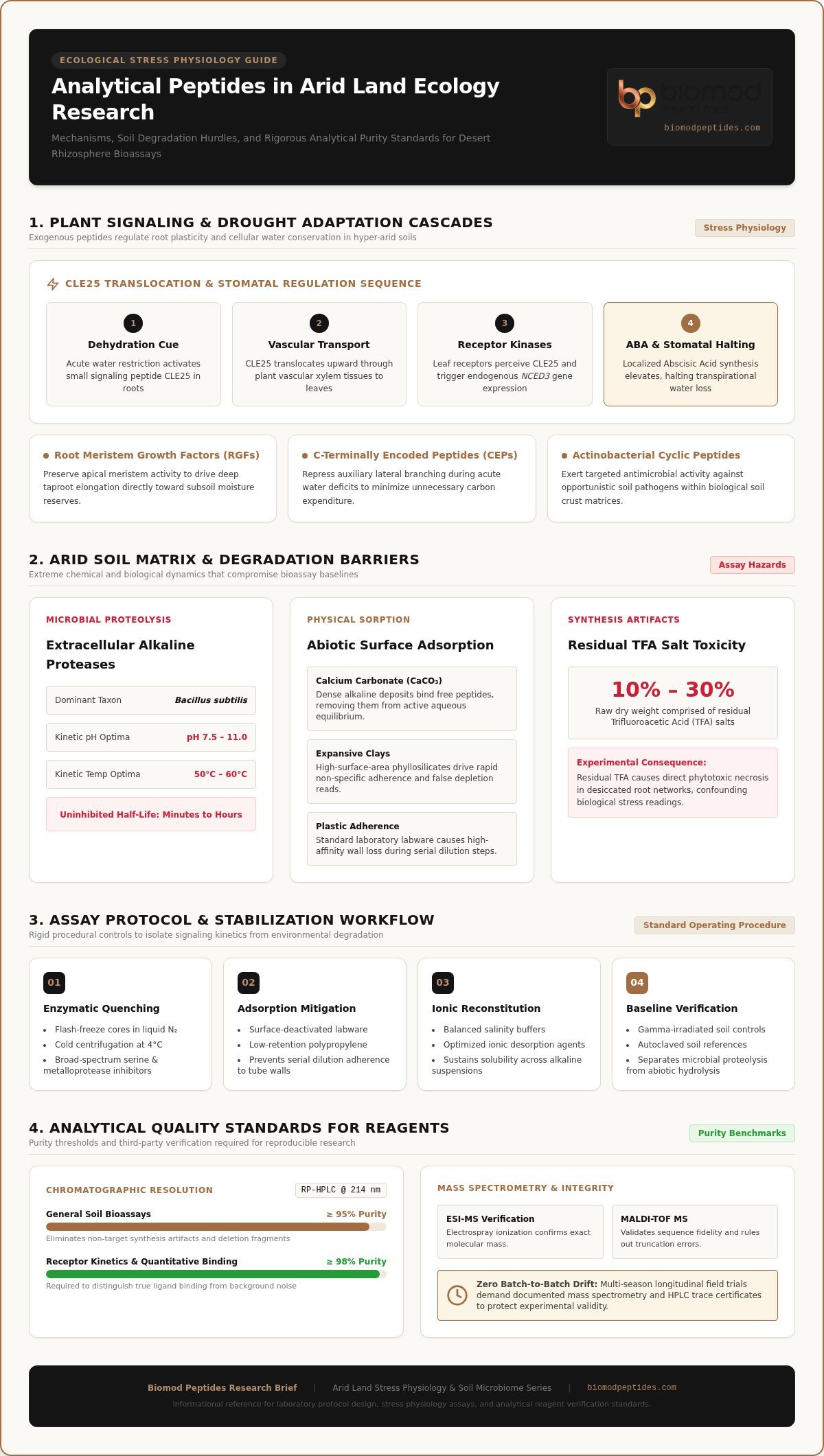
Exogenous signaling molecules bridge the gap between genomic potential and phenotypic survival. In water-restricted regimes, synthetic plant peptide hormones simulate acute environmental cues, driving stomatal conservation and cellular osmotic adjustments. Small signaling peptides like CLE25 translocate through vascular xylem tissue during severe dehydration. Once perceived by leaf receptor kinases, they induce NCED3 expression, elevating localized abscisic acid synthesis to halt transpirational water loss. Concurrently, microbial non-ribosomal peptides govern nutrient partitioning within desert biological soil crusts. Applying verified peptides for arid land ecology research lets investigators systematically isolate these cascades from background environmental noise.
Xerophytic Signaling Cascades and Antimicrobial Defense Pathways
Root plasticity in hyper-arid soils requires precise chemical mediation. Target peptides dictate specialized structural adaptations across the rhizosphere:
- Root Meristem Growth Factors (RGFs): Preserve apical meristem activity to promote deep taproot elongation toward subsoil moisture.
- C-Terminally Encoded Peptides (CEPs): Repress auxiliary lateral branching during acute water deficits.
- Actinobacterial Cyclic Peptides: Exert targeted antimicrobial activity against opportunistic soil pathogens in dry crust matrices.
Assay integrity depends entirely on sequence fidelity. Without analytical reagents, researchers can’t distinguish true receptor-ligand kinetics from non-specific microbial nutrient consumption. Sourcing verified peptides for arid land ecology research ensures reliable baseline data across variable plant-microbe soil interfaces.
Protocol Design: Managing Stability and Degradation in Arid Soil Assays
Arid soil models present extreme biochemical hurdles. Dominant desert taxa like Bacillus subtilis produce extracellular alkaline proteases with kinetic optima spanning pH 7.5 to 11.0 and temperatures between 50°C and 60°C. In uninhibited, field-moist soil samples, these enzymes reduce exogenous peptide half-lives to minutes or hours. At the same time, high concentrations of calcium carbonate and expansive clays drive non-specific abiotic adsorption. Without rigid procedural controls, researchers risk confusing swift proteolytic degradation with cellular signal transduction.
Stabilization Measures and Reconstitution Parameters for Field Samples
Controlled experimental designs require strict stabilization workflows to preserve peptide integrity before assay quantification:
- Enzymatic Quenching: Flash-freeze core samples in liquid nitrogen, apply cold centrifugation at 4°C, and introduce broad-spectrum serine and metalloprotease inhibitor cocktails during extraction.
- Abiotic Adsorption Mitigation: Deploy low-retention, surface-deactivated polypropylene plastics to prevent non-specific wall adherence during serial dilutions.
- Ionic Reconstitution: Balance high-salinity regimes with optimized ionic desorption agents to sustain solubility in alkaline suspensions.
Establishing baseline negative controls with gamma-irradiated or autoclaved soil is critical. This isolates microbial proteolysis from passive chemical hydrolysis when evaluating plant signaling peptides in abiotic stress responses. Calibrating clean concentration gradients requires verified materials; sourcing analytical research peptides helps eliminate baseline reagent instability and safeguards your longitudinal environmental assays.
Analytical Quality Standards for Ecological Peptide Research Supplies
Reagent purity dictates the reliability of desert soil bioassays. Non-target synthesis artifacts, such as truncated sequences or deletion fragments, introduce chemical noise that alters fragile microbial profiles. Worse, residual trifluoroacetic acid (TFA) salts from solid-phase synthesis routinely account for 10% to 30% of raw dry weight. This residual acid induces direct phytotoxicity in desiccated root networks, clouding experimental outcomes. Securing dependable peptides for arid land ecology research requires verifiable purity standards that rule out reagent-driven artifacts.
Verification Protocols and Third-Party Reagent Traceability
Multi-season longitudinal field trials demand documented reproducibility across every batch. Sourcing workflows must enforce stringent analytical benchmarks:
- Chromatographic Resolution: High-performance liquid chromatography (RP-HPLC) at 214 nm confirms baseline purity tiers, requiring 95% or higher for bioassays and 98% or higher for receptor kinetics.
- Mass Verification: Electrospray ionization or MALDI-TOF mass spectrometry confirms exact molecular mass and sequence alignment.
- Biological Safety Limits: Bacterial endotoxin loads must remain strictly below 1 EU/mg to avoid triggering defense-related PAMP cascades.
Analytical accountability can’t rely on unverified vendor claims. Researchers should examine documented test data via an independent COA verification portal before deploying reagents into field microcosms. Every batch from Biomod Peptides is finished in the United States under strict quality controls and tested by third-party laboratories. Integrating documented, analytical-grade peptides for arid land ecology research eliminates hidden synthetic variance and ensures your environmental stress datasets withstand peer review.
Elevating Empirical Precision in Arid Ecosystem Science
Ecological validity in water-stressed soil models hinges on strict analytical controls. Managing alkaline enzymatic turnover, counter-ion toxicity, and abiotic adsorption ensures synthetic cues reflect true plant-microbe signaling. Sourcing validated peptides for arid land ecology research provides the baseline stability necessary to isolate these intricate stress pathways. When your reagents are chemically verified, your downstream conclusions remain defensible.
Biomod Peptides delivers high-purity research compounds finished and manufactured in the United States under strict analytical standards. Every batch includes independent third-party RP-HPLC and mass spectrometry verification, accessible directly through our online COA portal. Procure analytical-grade research peptides validated by comprehensive third-party testing protocols to secure reproducible datasets across every field season.
Frequently Asked Questions
Why are analytical-grade peptides required for arid soil microbial ecology experiments?
Analytical-grade peptides eliminate non-target synthesis artifacts and cytotoxic counter-ions that distort microbial responses. Crude reagents often introduce residual solvents and truncated sequences, which soil microorganisms consume as non-specific nitrogen sources. Using verified peptides for arid land ecology research guarantees that measured microbial shifts stem directly from targeted signaling cascades rather than experimental impurities.
How does high soil alkalinity in arid zones affect peptide stability during testing?
Alkaline pH regimes alter amino acid net surface charges, inducing premature precipitation or structural denaturation. Hyper-arid soils, such as those found throughout Southern Nevada and surrounding desert basins, frequently exceed pH 8.0 and contain abundant carbonates. These alkaline conditions maximize the enzymatic velocity of native microbial proteases, which rapidly cleave unprotected peptide backbones within hours of soil application.
Can synthetic peptide hormones be used to simulate drought signaling in xerophytes?
Yes, synthetic peptide homologs allow researchers to recreate endogenous stress cues without relying on whole-plant dehydration cycles. Applying exogenous peptides for arid land ecology research, such as synthetic CLE or CEP analogs, activates drought cascades like vascular NCED3 expression. This precise application triggers stomatal closure and root elongation under controlled laboratory and microcosm conditions.
What analytical methods verify that research peptides remain intact under desert field conditions?
Stable-isotope-labeled internal standards paired with triple-quadrupole liquid chromatography–tandem mass spectrometry (LC-MS/MS) provide the definitive benchmark for field recovery. Investigators also rely on reversed-phase HPLC paired with MALDI-TOF mass spectrometry to monitor real-time degradation rates. Standardized testing confirms sequence integrity and isolates biological degradation from non-specific mineral sorption.
Disclaimer
BIOMOD products are sold strictly for laboratory, analytical, and scientific research use only. They are not intended for human or animal consumption, administration, application, ingestion, injection, or any therapeutic, diagnostic, or cosmetic use.
The statements made on this website have not been evaluated by the United States Food and Drug Administration. BIOMOD products are not intended to diagnose, treat, cure, mitigate, or prevent any disease or medical condition.
BIOMOD is a research chemical supplier. BIOMOD is not a compounding pharmacy or chemical compounding facility as defined under Section 503A of the Federal Food, Drug, and Cosmetic Act. BIOMOD is not an outsourcing facility as defined under Section 503B of the Federal Food, Drug, and Cosmetic Act.
By accessing this site, you confirm you are at least 21 years of age and that you have read and accepted the BIOMOD Terms of Sale, Privacy Policy, and Research Use Only Policy. BIOMOD does not provide dosing, medical, therapeutic, diagnostic, veterinary, or use guidance under any channel.