
What if the most expensive line item in your budget is actually the most cost-effective way to secure your funding? Reviewers frequently scrutinize reagent costs. They often question why a laboratory requires analytical grade compounds over cheaper alternatives. You likely understand that substandard materials jeopardize experimental reproducibility, but articulating this necessity to a skeptical committee requires a specific technical strategy. This article provides the framework for a robust peptide research grant budget justification reagents section. You’ll learn to master the financial logic needed to defend high-purity procurement. We preview the critical links between US-manufactured quality, independent HPLC verification, and the ultimate success of your proposal. This guide moves beyond simple cost-per-milligram metrics. It focuses on the structural integrity of your data. We examine how to document the necessity of >98% purity to ensure your next application survives rigorous peer review.
Key Takeaways
- Define reagent categories within modular budget formats to ensure precise quantification of pilot studies and replicates.
- Strengthen your peptide research grant budget justification reagents section by documenting how >98% HPLC purity prevents off-target effects.
- Leverage independent third-party COAs and sequence verification via Mass Spectrometry as non-negotiable standards for laboratory accountability.
- Prioritize US-manufactured reagents to mitigate logistical risks like extended lead times or compromised cold-chain integrity during procurement.
Structuring Your Reagent Budget Justification for Peptide Research
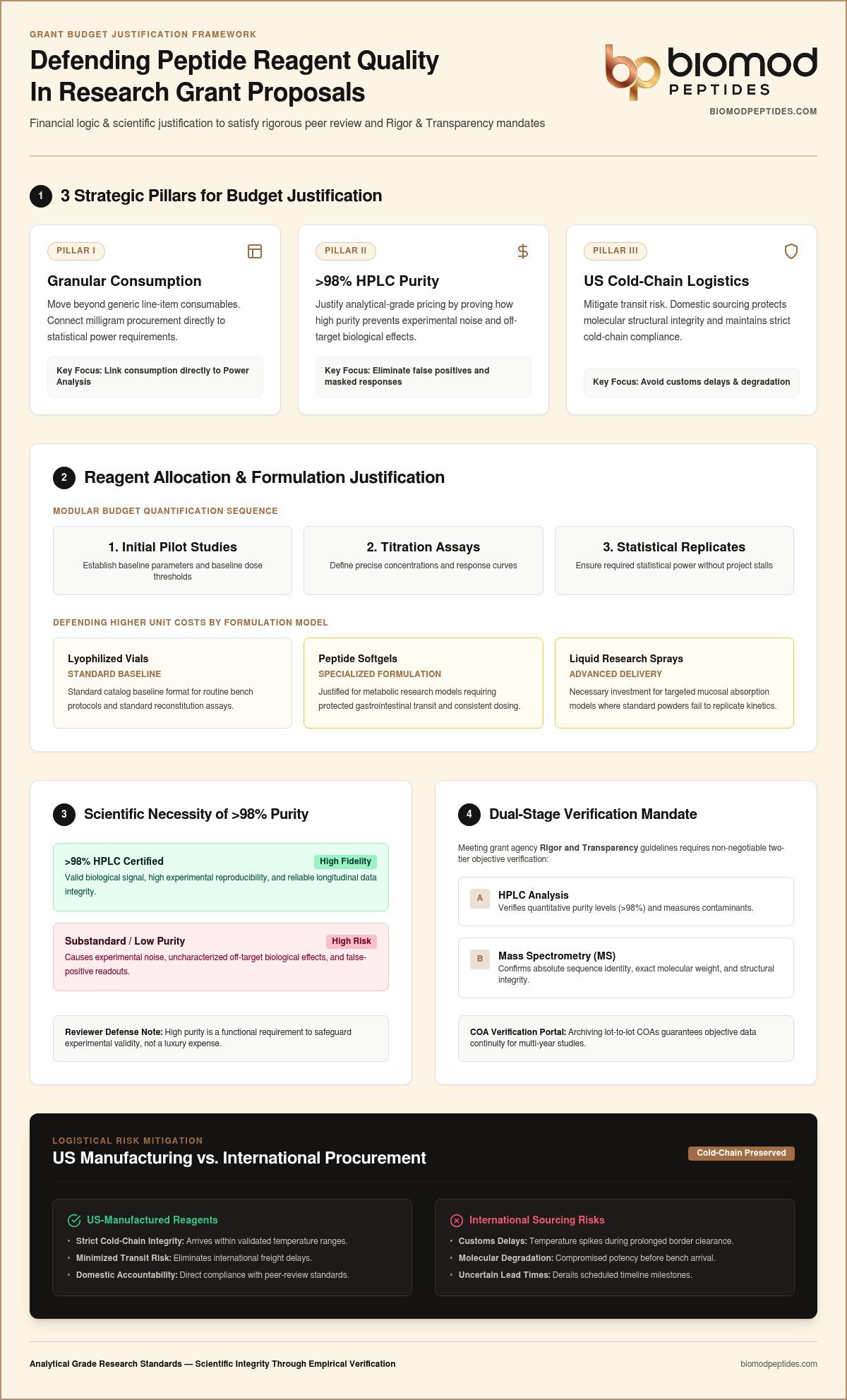
Structuring the budget begins with a granular definition of the “Materials and Supplies” category. It’s not enough to list a bulk sum for consumables. You must quantify consumption based on your specific experimental design. Account for initial pilot studies, titration assays, and the necessary replicates to achieve statistical significance. A robust peptide research grant budget justification reagents section links these specific quantities directly to your Power Analysis. This demonstrates fiscal accountability while ensuring the project doesn’t stall due to reagent depletion. High-quality peptide synthesis reagents and purity standards are essential for maintaining this experimental continuity.
Categorizing Peptides: Catalog Reagents vs. Specialized Formulations
Reviewers distinguish between standard catalog reagents and specialized delivery formats. Standard lyophilized vials remain the baseline for many protocols. However, specific analytical models require advanced vehicles to maintain stability or facilitate absorption. You might justify the procurement of peptide softgels for research by citing the need for protected, consistent dosing in metabolic studies. Similarly, liquid peptide research sprays offer distinct advantages for mucosal absorption models that lyophilized powders cannot replicate. The cost variance reflects the additional processing and stabilization required for these formats. Clearly state how these specialized systems reduce experimental variables. This technical logic transforms a high price point into a necessary investment for data integrity. Precision in these descriptions prevents reviewers from suggesting cheaper, less effective alternatives that could compromise your results.
Articulating the Scientific Necessity of High-Purity Standards
Scientific integrity depends on the precision of your molecular tools. Reviewers prioritize reproducibility. They expect a technical defense of reagent specifications. High-purity standards, specifically HPLC purity exceeding 98%, are not luxury items. They’re functional requirements. Impurities in peptide reagents introduce experimental noise and unpredictable off-target effects. These contaminants can mask true biological responses or produce false positives. Your peptide research grant budget justification reagents section must explicitly link purity levels to data validity. Verification via Mass Spectrometry (MS) is equally critical. It confirms sequence identity and structural integrity. Without this dual-stage validation, the risk of experimental failure increases. Referencing The Protocol for Peptide Purity Verification provides a standardized framework for these essential analytical benchmarks.
Quantifying Reproducibility: Why COA Verification Matters
Granting agencies now enforce strict “Rigor and Transparency” mandates. Compliance requires independent third-party testing for all critical reagents. A Certificate of Analysis (COA) is the primary document of proof. It ensures lot-to-lot consistency, which is vital for long-term longitudinal studies where reagent variability can derail years of data collection. You can strengthen your proposal by citing the use of a COA verification portal to track and archive reagent quality. This level of laboratory accountability demonstrates a commitment to objective verification. It signals to reviewers that your methodology is anchored in empirical proof rather than manufacturer promises. For labs requiring this tier of documentation, sourcing analytical grade research peptides ensures that every milligram meets the stated purity thresholds. This disciplined approach to procurement mitigates the risk of non-reproducible results.
Strategic Procurement: Aligning Budget with Laboratory Standards
Selecting a laboratory peptide supply vendor is a strategic decision that directly impacts project timelines and data reliability. Reviewers evaluate logistical feasibility alongside scientific merit. US-manufactured reagents minimize the inherent risks of international transit. Specifically, cold-chain integrity is frequently compromised during customs delays or extended shipping routes. Domestic production ensures that reagents arrive within validated temperature ranges. This preservation of molecular structure is non-negotiable for high-stakes bioanalytical research. Strategic procurement ensures that the peptide research grant budget justification reagents section reflects a commitment to operational stability.
Domestic finishing provides a level of accountability that offshore manufacturing cannot replicate. It ensures strict adherence to quality control protocols required by federal and private grantors. When you justify these costs, emphasize the significant reduction in lead times. Rapid procurement allows for iterative experimental adjustments without the months of downtime associated with overseas shipments. This logistical efficiency increases the total throughput of the funded project. It ensures that every dollar of the award is utilized toward active discovery rather than administrative delays. Accountability is paramount. Logistics dictate outcomes.
Sourcing US-Manufactured Reagents for Grant Compliance
A defensible budget must explicitly state why a premium for domestic reagents is necessary. Use language such as: “We have prioritized US-manufactured reagents to ensure immediate accountability and adherence to domestic quality standards, mitigating the risk of experimental failure inherent in international supply chains.” Independent third-party validation acts as a final safeguard. It confirms that internal benchmarks meet the external requirements of the scientific community. This dual-verification model significantly increases the overall success rate of the funded project. It eliminates the variable of reagent inconsistency, providing the empirical proof reviewers demand.
Advancing Laboratory Accountability Through Precise Procurement
Securing funding requires a transition from cost-based accounting to risk-based justification. A successful peptide research grant budget justification reagents section emphasizes the link between analytical grade standards and experimental reproducibility. You’ve seen how >98% HPLC purity and US-based manufacturing are essential to mitigate off-target effects and logistical disruptions. For the Las Vegas research community, these standards aren’t optional; they’re the foundation of credible data. By prioritizing independent third-party verification and domestic finishing, you demonstrate a commitment to the highest tiers of laboratory rigor. This meticulous approach to procurement ensures your methodology remains defensible during peer review. Secure High-Purity Reagents for Your Research at Biomod Peptides to leverage US-manufactured analytical grade peptides and an instant COA verification portal. Your next breakthrough depends on the integrity of your starting materials. Precision in your budget today ensures the validity of your discovery tomorrow.
Frequently Asked Questions
How do I justify the cost of custom peptide synthesis versus catalog peptides?
Justify custom synthesis by citing unique sequence requirements or specific chemical modifications necessary to achieve your primary research objectives. While catalog reagents suffice for standard assays, custom synthesis ensures the molecular structure aligns perfectly with your experimental model. This precision reduces the risk of data misinterpretation caused by using near-match sequences that don’t satisfy the study’s technical demands.
Is a Certificate of Analysis (COA) required for grant budget documentation?
A Certificate of Analysis (COA) is a critical component of your peptide research grant budget justification reagents section because it provides empirical proof of quality. While some grantors don’t require the physical document at the submission stage, you must budget for reagents that include this verification. It ensures your lab meets federal mandates for experimental rigor by documenting HPLC purity and Mass Spectrometry results.
Can I include the cost of third-party purity testing in my grant budget?
You can include independent third-party testing costs within the Materials and Supplies or Consultant Services categories. Budgeting for external validation demonstrates a proactive approach to quality control. In the Las Vegas research community, labs often utilize these funds to verify that US-manufactured reagents meet the required analytical grade standards before commencing long-term longitudinal studies to ensure data reproducibility.
How do I explain the need for >98% purity to a non-specialist grant reviewer?
Explain that >98% purity is a functional requirement to eliminate experimental noise. Frame it as a risk-mitigation strategy; even 5% impurity can introduce hundreds of unknown variables that interfere with biological signaling. This level of precision ensures observed effects result from the peptide itself rather than manufacturing byproducts, protecting the grantor’s investment from inconclusive results that compromise the project.
Disclaimer
BIOMOD products are sold strictly for laboratory, analytical, and scientific research use only. They are not intended for human or animal consumption, administration, application, ingestion, injection, or any therapeutic, diagnostic, or cosmetic use.
The statements made on this website have not been evaluated by the United States Food and Drug Administration. BIOMOD products are not intended to diagnose, treat, cure, mitigate, or prevent any disease or medical condition.
BIOMOD is a research chemical supplier. BIOMOD is not a compounding pharmacy or chemical compounding facility as defined under Section 503A of the Federal Food, Drug, and Cosmetic Act. BIOMOD is not an outsourcing facility as defined under Section 503B of the Federal Food, Drug, and Cosmetic Act.
By accessing this site, you confirm you are at least 21 years of age and that you have read and accepted the BIOMOD Terms of Sale, Privacy Policy, and Research Use Only Policy. BIOMOD does not provide dosing, medical, therapeutic, diagnostic, veterinary, or use guidance under any channel.