
If your dermatological research relies on an offshore COA without independent verification, you’re risking more than a single batch; you’re compromising your entire dataset. High-purity reagents are the non-negotiable bedrock of valid experimental outcomes. Most researchers understand that inconsistent reagent quality and the difficulty of interpreting overseas HPLC/Mass Spec reports create significant barriers to reproducibility. It’s a logistical bottleneck that undermines the precision of laboratory work.
This article delivers a rigorous technical overview of the skin-targeting peptide analytical standards research driving dermatological study in 2026. We’ll provide a clear protocol for COA verification and examine the structural integrity of sequences like GHK-Cu and Melanotan II. You’ll also learn how a domestic, US-manufactured supply chain eliminates the volatility of offshore procurement. We’ll move from broad analytical requirements to specific laboratory benchmarks to ensure your research remains precise, verifiable, and reproducible.
Key Takeaways
- Identify the distinct biological mechanisms of melanocortin agonists and copper-binding tripeptides to optimize dermatological experimental design and tissue remodeling studies.
- Apply skin-targeting peptide analytical standards research to verify 99%+ purity levels through rigorous HPLC and Mass Spectrometry sequence validation.
- Compare the stability and absorption kinetics of specialized research formats, specifically peptide softgels and intranasal sprays for mucosal pathway analysis.
- Secure US-manufactured supply chains by utilizing verification portals to validate HPLC and Mass Spec reports for every research batch.
Defining the Mechanisms of Glow Peptide Research
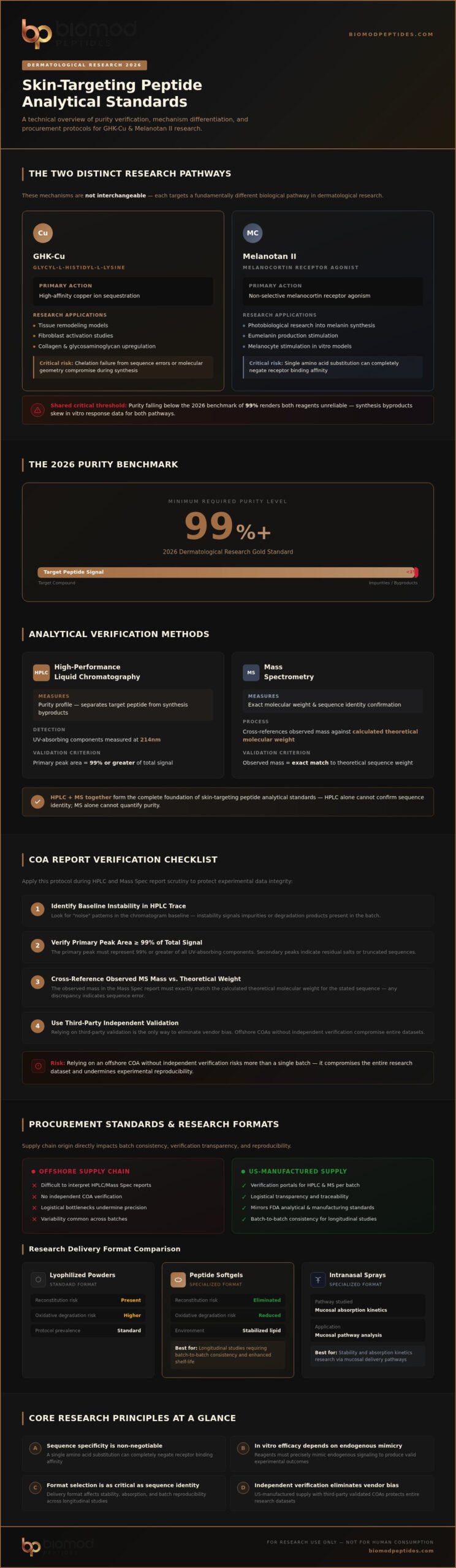
Dermatological study in 2026 requires a granular understanding of the biological pathways mediated by specialized ligands. Research into “glow” outcomes focuses on two distinct mechanisms: the activation of melanocortin receptor agonists and the sequestration of copper ions by tripeptides. These pathways aren’t interchangeable. Melanotan II acts as a non-selective agonist of melanocortin receptors, primarily driving photobiological research into melanin synthesis. Conversely, GHK-Cu (Glycyl-L-histidyl-L-lysine) is utilized for its high affinity for copper, serving as a critical reagent in tissue remodeling and fibroblast activation models.
The efficacy of these reagents in vitro depends entirely on their ability to mimic endogenous signaling. In fibroblast studies, GHK-Cu facilitates the upregulation of collagen and glycosaminoglycans. Melanotan II research focuses on the stimulation of eumelanin production within melanocytes. Without precise skin-targeting peptide analytical standards research, these experimental models fail to produce reproducible data. Sequence errors as small as a single amino acid substitution can completely negate receptor binding affinity, particularly when purity levels fall below the 2026 benchmark of 99%.
Sequence Specificity in Dermatological Reagents
Binding affinity is a direct function of peptide structure and biochemical properties. In laboratory settings, sequence accuracy is the primary determinant of experimental validity. For Las Vegas research facilities, maintaining structural integrity in GHK-Cu batches is essential to prevent chelation failures. These labs require rigorous verification to ensure that the reagent’s molecular geometry remains intact during synthesis. Adherence to the Biomod Peptides standards ensures that every sequence meets the precise benchmarks required for advanced skin-targeting peptide analytical standards research. It’s the only way to guarantee that observed in vitro responses result from the peptide itself rather than synthesis byproducts.
Analytical Verification of Peptide Purity and Sequence
High-Performance Liquid Chromatography (HPLC) remains the primary method for establishing a 99%+ purity profile; it’s the gold standard in dermatological studies. This process separates the target peptide from synthesis byproducts. It ensures that experimental results are not skewed by residual salts or truncated sequences. While HPLC measures purity, Mass Spectrometry (MS) is required to confirm the exact molecular weight and sequence identity. Together, these methods form the foundation of skin-targeting peptide analytical standards research. Following The Protocol for Peptide Purity Verification is essential for laboratories that prioritize data integrity over cost-cutting.
Adherence to FDA analytical and manufacturing standards for peptide compounds provides a necessary framework for quality control. Although research-grade materials are not for human consumption, mirroring these rigorous benchmarks prevents the variability common in offshore supply chains. Researchers should source materials from a verified US-based peptide provider to ensure logistical transparency and batch consistency.
Interpreting HPLC and Mass Spec Reports
Analytical reports contain complexities that require careful scrutiny. Researchers must evaluate chromatograms for secondary peaks that indicate impurities or degradation. Use this checklist during verification:
- Identify baseline instability or “noise” in the HPLC trace.
- Verify the primary peak area represents 99% or greater of the total signal.
- Cross-reference the observed mass in MS with the calculated theoretical molecular weight.
HPLC purity in 2026 is defined as the quantitative measurement of a single peptide species relative to all other UV-absorbing components at 214nm. Relying on third-party validation is the only way to eliminate vendor bias. Las Vegas facilities that implement independent verification protocols for skin-targeting peptide analytical standards research significantly reduce the risk of experimental failure.
Procurement Standards for Specialized Research Formats
Selecting the appropriate delivery format is as critical as verifying the sequence identity. While lyophilized powders remain the standard for many protocols, they introduce risks during the reconstitution phase. In contrast, peptide softgels for research provide a pre-measured, stabilized lipid environment that enhances shelf-life and reduces the potential for oxidative degradation. These specialized formats are essential for longitudinal studies where batch-to-batch consistency is paramount. It’s a logistical advantage that preserves the structural integrity of the reagent over time.
Research into mucosal absorption pathways has expanded the use of intranasal peptide research sprays. These delivery systems allow for the investigation of rapid uptake kinetics without the proteolytic interference common in other models. For skin-targeting peptide analytical standards research, using US-manufactured reagents is a prerequisite for a defensible supply chain. Domestic production eliminates the logistical opacity of offshore vendors. It ensures that every batch undergoes rigorous domestic finishing and verification before reaching the lab.
Cold Chain Protocols and Reconstitution
Maintaining a strict cold chain is non-negotiable for peptide stability. Reagents must be stored at -20°C for short-term use or -80°C for extended durations to prevent hydrolysis. When moving materials to Las Vegas facilities, transit times and temperature monitoring must be documented. Don’t overlook these variables, as they directly impact the validity of skin-targeting peptide analytical standards research. Reconstitution should be performed using bacteriostatic water in a sterile environment to maintain multi-use viability. Researchers should consult relevant spray product documentation to ensure consistent dosing in every experimental iteration.
Advancing Dermatological Research Through Analytical Rigor
The transition toward more sophisticated skin-targeting peptide analytical standards research requires a move beyond traditional procurement methods. Establishing 99%+ purity through HPLC and Mass Spectrometry is the only way to ensure the integrity of in vitro models. Researchers must also consider the stability benefits of specialized delivery formats, such as peptide softgels and intranasal sprays, to maintain reagent consistency. Every batch requires third-party validation to eliminate the risks inherent in offshore supply chains.
Biomod Peptides provides US-manufactured research reagents that meet these exacting benchmarks. By prioritizing logistical transparency and rigorous documentation, you protect the reproducibility of your scientific output. Access our COA Verification Portal for high-purity research peptides to confirm the sequence integrity of your laboratory materials. We’re committed to supporting the next generation of dermatological discovery through uncompromising quality control.
Frequently Asked Questions
What is a glow peptide in a laboratory research context?
In a clinical laboratory context, a glow peptide refers to a ligand that modulates specific dermatological pathways, such as melanocortin receptor agonists or copper-binding tripeptides. These reagents, including GHK-Cu and Melanotan II, are used to study fibroblast activation and melanin synthesis in vitro. Researchers utilize these compounds to investigate tissue remodeling and photobiological responses within controlled experimental models. These materials are strictly for research use.
How do researchers verify the purity of GHK-Cu or other skin-focused peptides?
Researchers verify purity through High-Performance Liquid Chromatography (HPLC) to establish a 99% purity profile and Mass Spectrometry (MS) to confirm sequence identity. Adhering to skin-targeting peptide analytical standards research ensures that the molecular weight matches the theoretical value. Utilizing a COA verification portal allows for the transparent cross-referencing of third-party laboratory reports; this is essential for maintaining the integrity of dermatological study datasets.
Why is third-party testing mandatory for research-grade peptides?
Third-party testing is mandatory to eliminate vendor bias and ensure the structural integrity of every batch. For Las Vegas research facilities, independent validation provides a level of accountability that offshore supply chains cannot match. It confirms that the reagent is free from synthesis byproducts that could skew experimental results. This rigorous verification process is the only way to guarantee that data produced in the lab is reproducible.
Can specialized formats like sprays or softgels be used in analytical research?
Specialized formats like peptide softgels and intranasal sprays are frequently utilized in analytical research to study specific delivery kinetics. Softgels offer enhanced stability for studying lipid-based absorption, while spray products are ideal for investigating mucosal pathways. These formats allow researchers to evaluate how different delivery systems affect the degradation and uptake of a peptide sequence. Biomod Peptides provides these US-manufactured formats for laboratory applications.
Disclaimer
BIOMOD products are sold strictly for laboratory, analytical, and scientific research use only. They are not intended for human or animal consumption, administration, application, ingestion, injection, or any therapeutic, diagnostic, or cosmetic use.
The statements made on this website have not been evaluated by the United States Food and Drug Administration. BIOMOD products are not intended to diagnose, treat, cure, mitigate, or prevent any disease or medical condition.
BIOMOD is a research chemical supplier. BIOMOD is not a compounding pharmacy or chemical compounding facility as defined under Section 503A of the Federal Food, Drug, and Cosmetic Act. BIOMOD is not an outsourcing facility as defined under Section 503B of the Federal Food, Drug, and Cosmetic Act.
By accessing this site, you confirm you are at least 21 years of age and that you have read and accepted the BIOMOD Terms of Sale, Privacy Policy, and Research Use Only Policy. BIOMOD does not provide dosing, medical, therapeutic, diagnostic, veterinary, or use guidance under any channel.