
In 2026, the difference between a Nature-branded publication and a desk rejection often comes down to a single document; your Certificate of Analysis. Understanding how to get your peptide study in a high-impact journal requires absolute transparency in reagent integrity. You’ve likely spent months refining your experimental model, only to face reviewers who demand more rigorous characterization or proof of peptide stability. It’s frustrating to see high-quality research stalled by “insufficient characterization” critiques during peer review.
This guide provides the definitive roadmap for mastering the analytical benchmarks and documentation standards required today. We will examine the mandatory 98% HPLC purity thresholds, the necessity of batch-specific mass spectrometry, and how utilizing a COA verification portal secures your methodology. You’ll learn to navigate NIH publication cost caps while maintaining the rigorous standards that lead to high citation counts and professional recognition.
Key Takeaways
- Adhere to the 2026 benchmark of ≥98% purity verified through HPLC to prevent manuscript rejection based on insufficient characterization.
- Prioritize delivery innovation and bioavailability data to distinguish your research from standard peptide studies in prestige-tier publications.
- Learn how to get your peptide study in a high-impact journal by leveraging US-based manufacturing and third-party validation to ensure absolute data reproducibility.
- Utilize dedicated COA verification portals to provide reviewers with the objective analytical documentation required for top-tier scientific recognition.
Establishing Analytical Rigor: Purity and Characterization Benchmarks
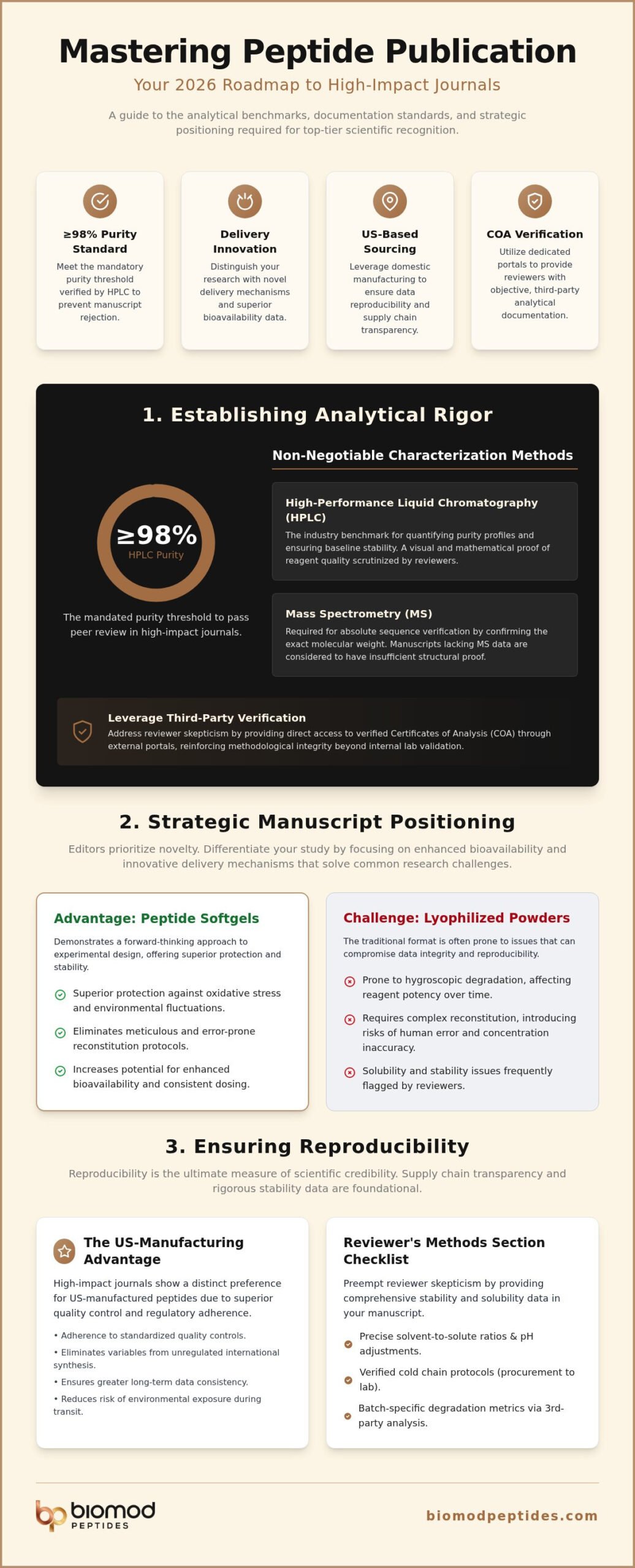
Precision is the primary metric for editorial acceptance in 2026. High-impact journals now mandate a minimum purity threshold of 98% for synthetic peptides. This standard ensures that experimental results reflect the activity of the target molecule rather than the influence of contaminants. A rigorous analytical foundation distinguishes elite research from standard laboratory output. Achieving this level of refinement requires a deep understanding of Peptide Synthesis Methods, as different production routes introduce unique impurity profiles that must be documented.
High-Performance Liquid Chromatography (HPLC) remains the industry benchmark for quantifying these profiles. It’s a visual and mathematical representation of purity that reviewers scrutinize for baseline stability. Additionally, Mass Spectrometry (MS) is a non-negotiable requirement for sequence verification. Without MS data confirming the exact molecular weight, a manuscript lacks the structural proof needed to withstand rigorous peer review. These analytical steps are central to how to get your peptide study in a high-impact journal.
Leveraging Third-Party Verification for Peer Review
Internal laboratory validation often encounters skepticism from top-tier editorial boards. Reviewers prioritize objective data over self-reported results to mitigate concerns regarding calibration bias. Integrating verified peptide certificates of analysis directly into your supplementary materials addresses this skepticism. This transparency reinforces your methodology. Utilizing external verification portals provides a layer of structural integrity that internal testing cannot replicate. It offers reviewers a direct path to validate reagent identity and purity. This transparency is a critical component of how to get your peptide study in a high-impact journal while building a reputation for meticulous scientific conduct.
Strategic Manuscript Positioning: Novelty and Delivery Innovation
High-impact journals in 2026 favor studies that push beyond basic biochemical analysis. Editors prioritize research demonstrating enhanced bioavailability or novel delivery mechanisms. Traditional lyophilized powders are often prone to hygroscopic degradation. They require meticulous, error-prone reconstitution protocols. In contrast, specialized formats like peptide softgels for research offer superior protection against oxidative stress and environmental fluctuations. This technological differentiation is often the catalyst for editorial interest. It demonstrates a forward-thinking approach to experimental design. Mastering these nuances is central to how to get your peptide study in a high-impact journal.
Addressing Stability and Solubility in the Methods Section
Scientific reproducibility relies on reagent stability. Reviewers frequently flag studies with insufficient documentation of cold chain integrity or degradation kinetics. High-impact editors view stability data as a core component of study validity. You must provide comprehensive peptide solubility for research data to preempt skepticism regarding concentration accuracy. Ensure your methods section includes:
- Precise solvent-to-solute ratios and documented pH adjustments.
- Verified cold chain protocols from procurement to laboratory application.
- Batch-specific degradation metrics confirmed by third-party analysis.
Documenting specific storage temperatures and solvent interactions ensures your methodology remains beyond reproach. For researchers aiming for top-tier publication, sourcing reagents that meet these rigorous documentation standards is essential. You can verify these benchmarks through precision-manufactured research peptides that provide batch-specific stability metrics. Detailed solubility profiles reduce the risk of precipitate formation. This ensures your quantitative data remains accurate across all experimental replicates. This level of technical detail is a prerequisite for how to get your peptide study in a high-impact journal.
Ensuring Reproducibility: Sourcing and Supply Chain Transparency
Reproducibility is the primary metric for scientific credibility. Reagent origin directly influences long-term data consistency and, by extension, your laboratory’s reputation. High-impact journals in 2026 show a distinct preference for US-manufactured peptides. Domestic production ensures adherence to standardized quality controls that international sources often bypass. This eliminates variables introduced by unregulated synthesis or environmental exposure during transit. It’s a critical factor in how to get your peptide study in a high-impact journal. Transparently citing your laboratory peptide supply in your bibliography provides reviewers with a verifiable chain of custody. This level of logistical transparency protects your findings against future challenges regarding reagent integrity.
Las Vegas Laboratory Standards and Regional Compliance
Las Vegas-based research facilities must align their protocols with international analytical standards to remain competitive. Utilizing local, US-based manufacturing sites facilitates high-throughput research environments. It reduces logistical lag and ensures that peptides reach the bench without degradation. Before finalizing your submission, verify that your documentation is complete. High-impact editors expect a comprehensive data package. This includes your batch-specific Certificate of Analysis, MS/MS data for structural confirmation, and validated stability reports covering the full experimental duration. Adhering to these rigorous sourcing and documentation standards is essential for anyone learning how to get your peptide study in a high-impact journal. It transforms raw experimental data into a defensible, high-citation scientific narrative.
Advancing Analytical Standards for Global Recognition
Securing publication in elite journals requires more than novel data; it demands a foundation of absolute analytical integrity. By prioritizing ≥98% purity verified through HPLC and documenting stability in specialized delivery formats, you eliminate the primary grounds for manuscript rejection. Transparency in your supply chain serves as the final safeguard for long-term reproducibility. Understanding how to get your peptide study in a high-impact journal involves transforming your methods section into a defensible record of verification.
To support your research objectives, secure high-purity peptides for your next study at Biomod Peptides. Our US-manufactured, analytical grade research reagents undergo independent third-party testing to ensure lot-to-lot consistency. Use our dedicated COA verification portal to provide reviewers with the objective proof they require. It’s essential that meticulous preparation today ensures your methodology withstands the scrutiny of rigorous peer review processes. Your contribution to the field depends on the precision of your reagents.
Frequently Asked Questions
What is the minimum purity required for Nature or Science peptide studies?
High-impact journals like Nature or Science generally mandate a minimum purity of 98% for synthetic peptides. This threshold ensures that physiological observations result from the target sequence rather than residual impurities. Researchers in Las Vegas labs must provide HPLC chromatograms and Mass Spectrometry data for every batch to meet these rigorous editorial expectations. Characterization must be batch-specific to ensure absolute data integrity.
How do I cite third-party purity verification in my manuscript?
Citing third-party verification involves documenting the independent laboratory’s name, the specific batch number, and the date of analysis within your “Materials and Methods” section. You should also include a reference to a COA verification portal in your supplementary data. This transparency allows reviewers to validate reagent identity externally. It is a critical step for those learning how to get your peptide study in a high-impact journal.
Can I use research-grade sprays or softgels in a high-impact study?
Yes, utilizing specialized formats like research-grade softgels or spray products can actually enhance your manuscript’s novelty. Editors prioritize studies demonstrating improved stability or bioavailability over traditional lyophilized forms. When using these formats, you must document the specific delivery matrix and provide comparative stability data. This approach highlights methodological advancement, which is key to how to get your peptide study in a high-impact journal.
Why is US-based manufacturing important for high-impact journal acceptance?
US-based manufacturing is vital because it guarantees adherence to standardized quality control protocols that ensure long-term reproducibility. High-impact journals favor domestic reagents to eliminate variables associated with unregulated international supply chains. For Las Vegas researchers, local finishing and US-based synthesis provide a verifiable chain of custody. This logistical transparency reduces the risk of batch-to-batch variation that often leads to inconsistent experimental results.
Disclaimer
BIOMOD products are sold strictly for laboratory, analytical, and scientific research use only. They are not intended for human or animal consumption, administration, application, ingestion, injection, or any therapeutic, diagnostic, or cosmetic use.
The statements made on this website have not been evaluated by the United States Food and Drug Administration. BIOMOD products are not intended to diagnose, treat, cure, mitigate, or prevent any disease or medical condition.
BIOMOD is a research chemical supplier. BIOMOD is not a compounding pharmacy or chemical compounding facility as defined under Section 503A of the Federal Food, Drug, and Cosmetic Act. BIOMOD is not an outsourcing facility as defined under Section 503B of the Federal Food, Drug, and Cosmetic Act.
By accessing this site, you confirm you are at least 21 years of age and that you have read and accepted the BIOMOD Terms of Sale, Privacy Policy, and Research Use Only Policy. BIOMOD does not provide dosing, medical, therapeutic, diagnostic, veterinary, or use guidance under any channel.