
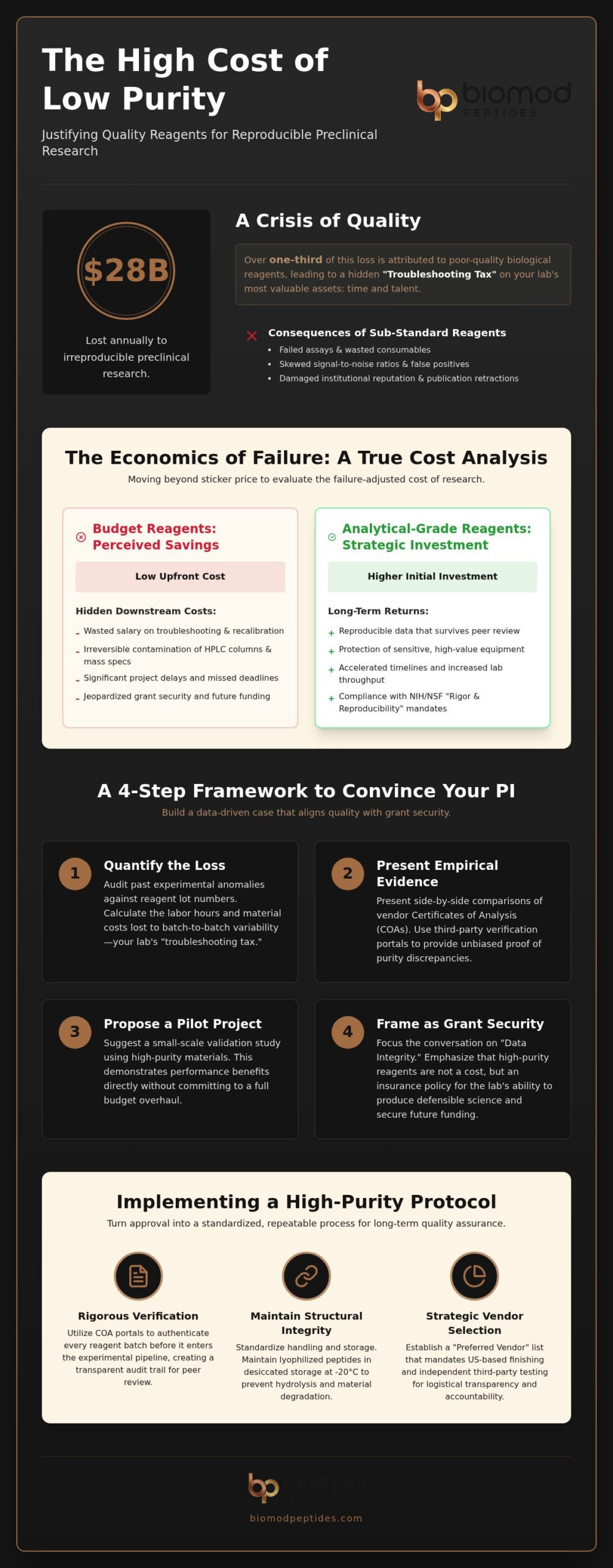
Over one-third of the $28 billion lost annually to irreproducible preclinical research is attributed to poor-quality biological reagents. You’ve likely experienced the frustration of a failed assay or spent weeks troubleshooting a protocol only to discover that an inconsistent impurity profile was the culprit. It’s a measurable drain on your labor and the lab’s grant security. Convincing your PI to invest in reagent quality requires moving beyond the sticker price to discuss the failure-adjusted cost of your research. This article provides a strategic framework to justify the procurement of analytical-grade reagents by aligning quality with data integrity. We’ll outline how to present a business case that treats high-purity materials as an insurance policy for your most valuable asset: time.
Key Takeaways
- Quantify the “troubleshooting tax” by calculating labor hours lost to batch-to-batch variability and inconsistent impurity profiles.
- Build a data-driven case for convincing your PI to invest in reagent quality by auditing past experimental anomalies against vendor-supplied Certificates of Analysis.
- Utilize third-party verification portals to provide empirical proof of purity, ensuring that every research peptide meets rigorous analytical standards.
- Establish standardized procurement and handling protocols to maintain the structural integrity of lyophilized reagents throughout the project lifecycle.
Quantifying the Real Cost of Sub-Standard Reagent Quality
The “troubleshooting tax” is a hidden drain on laboratory productivity. When batch-to-batch variability occurs, researchers lose dozens of hours recalibrating assays and chasing phantom variables. These inconsistencies often stem from a lack of adherence to reagent-grade purity standards. In peptide research, even trace impurities can skew signal-to-noise ratios, masking critical biological responses or generating false positives. Precision is impossible without baseline material integrity.
Reagent-driven irreproducibility is the primary threat to lab throughput in 2026. Beyond immediate technical failure, sub-standard materials introduce significant publication risks. Data that cannot be replicated leads to retractions and damages the institutional reputation of the lab. Establishing a rigorous procurement standard is the only way to safeguard your data against these systemic vulnerabilities.
The Economics of Laboratory Labor and Resource Waste
Strategic budgeting requires evaluating the failure-adjusted cost of an experiment. A failed four-week study represents thousands of dollars in wasted salary, facility overhead, and consumable loss. This loss far exceeds the marginal price premium of verified, high-purity reagents. High-quality standards also protect sensitive downstream equipment, such as HPLC columns and mass spectrometers, from irreversible contamination or performance degradation. Investing in quality is a preventative maintenance strategy for your most expensive hardware.
Aligning procurement with the “Rigors and Reproducibility” mandates of NIH and NSF grants is now essential. These agencies increasingly demand empirical proof of material validation as a condition of continued funding. Convincing your PI to invest in reagent quality is therefore a matter of grant security. You aren’t just buying chemicals; you’re securing the lab’s ability to produce defensible, high-impact science that survives peer review.
A Strategic Framework for Pitching Quality to Your Principal Investigator
Effective advocacy begins with empirical evidence. Start by auditing internal data to correlate experimental anomalies with specific reagent lot numbers. This retrospective analysis provides the objective foundation for convincing your PI to invest in reagent quality. Next, collect Certificates of Analysis (COAs) from current budget vendors and compare them against high-tier alternatives. Look for discrepancies in purity percentages and moisture content. Proposing a small-scale “Pilot Phase” using verified materials allows the lab to validate performance improvements without committing to a full-scale budget overhaul. Highlighting the necessity of third-party verification serves as a shield against vendor bias and ensures the data remains defensible.
Translating Technical Purity into Grant Security
A PI’s primary concern is often the continuity of funding. Focus your pitch on “Data Integrity” rather than specific product features. Reference established research on Quantifying the Real Cost of Sub-Standard Reagent Quality to demonstrate the financial risk of irreproducibility. US-manufactured research peptides offer distinct advantages here; localized production reduces lead-time variability and experimental downtime. Presenting side-by-side HPLC and Mass Spectrometry reports provides the definitive proof needed for convincing your PI to invest in reagent quality. It’s often helpful to utilize the Biomod Peptides verification portal to access transparent analytical data for your comparison. This level of transparency transforms procurement from a clerical task into a strategic asset for the lab’s long-term success.
Validating the Switch: Implementing a High-Purity Procurement Protocol
Approval isn’t the final objective. The lab must now codify these standards into a repeatable procurement protocol. Establishing a rigorous verification workflow is the immediate priority. Utilize the Biomod Peptides COA portal to authenticate every batch before it enters the experimental pipeline. This creates a transparent audit trail for future peer review. Standardizing handling and storage for lyophilized research peptides is equally critical. Maintain desiccated storage at -20°C. Protect against hydrolysis. Preserve structural integrity. These protocols prevent material degradation. For specific analytical applications requiring high stability, transitioning to peptide softgels for research can minimize oxidative stress and handling errors. A formal “Preferred Vendor” list should focus on US-based finishing and mandatory independent third-party testing.
Long-Term Quality Assurance and Vendor Accountability
Logistical transparency is a significant risk-mitigation factor. US-manufactured reagents offer better oversight for Las Vegas laboratories compared to international alternatives. Domestic production reduces transit times. It limits environmental exposure during shipping. This accountability is central to convincing your PI to invest in reagent quality. Once the transition is complete, establish internal benchmarks for batch-to-batch consistency. Track purity variances and assay performance over a six-month period. Prove the return on investment. Modernizing lab protocols also extends to delivery methods. Incorporating peptide spray products into research models can enhance dosing precision and reduce contamination risks. These specialized systems ensure that convincing your PI to invest in reagent quality results in superior data integrity.
Securing the Future of Analytical Research
Transitioning to high-purity reagents is a strategic mandate for laboratories that prioritize precision. By shifting the procurement focus from sticker price to the failure-adjusted cost of research, you protect the lab’s primary output: reproducible data. Success in convincing your PI to invest in reagent quality relies on presenting empirical proof through comparative analytical reports and third-party verification. It’s a necessary evolution for labs that value data integrity. Implementing these rigorous standards ensures that your assays remain sensitive and your project timelines stay secure. Establishing a preferred vendor list with US-based manufacturing provides the logistical transparency required for high-stakes grant applications.
Secure your laboratory data with US-manufactured, third-party tested peptides from Biomod Peptides. Our dedicated COA verification portal and analytical-grade purity standards provide the empirical evidence necessary to support your most critical research objectives. Build a more resilient experimental framework today.
Frequently Asked Questions
How do I explain the difference between 95% and 99% purity to a budget-conscious PI?
The 4% difference represents a significant volume of unidentified chemical species that can interfere with biological assays. While 95% purity might seem acceptable, the remaining contaminants often include truncated sequences or residual solvents that create “noise” in your data. Explaining this as a risk to signal-to-noise ratios helps in convincing your PI to invest in reagent quality. High-purity standards ensure observed effects are solely attributable to the peptide.
What are the most common impurities found in low-quality research peptides?
Low-quality peptides frequently contain residual trifluoroacetic acid (TFA), acetonitrile, or water. Structural impurities like deletion sequences and diastereomers are also common. These contaminants are problematic for Las Vegas laboratories conducting sensitive analytical research, as they can alter pH or cause unintended cellular responses. Using reagents that meet rigorous analytical-grade standards is essential to eliminate these variables and maintain experimental control.
Is third-party testing really necessary if the manufacturer provides their own COA?
Internal COAs often lack the objectivity required for high-impact publications. Third-party testing provides an unbiased verification of purity and identity, protecting the lab from vendor-side errors. Biomod Peptides utilizes independent testing for all batches, accessible through a dedicated verification portal. This external validation serves as an insurance policy for your data, ensuring that your starting materials are exactly what the manufacturer claims.
How can I prove that our current experimental failures are caused by reagent quality?
Begin by cross-referencing failed experimental dates with specific reagent lot numbers. If anomalies disappear when switching lots, you have empirical evidence of batch-to-batch variability. Presenting side-by-side HPLC or Mass Spectrometry reports from different vendors is the most effective method for convincing your PI to invest in reagent quality. This data-driven approach demonstrates that the “troubleshooting tax” is more expensive than purchasing high-purity materials initially.
Disclaimer
BIOMOD products are sold strictly for laboratory, analytical, and scientific research use only. They are not intended for human or animal consumption, administration, application, ingestion, injection, or any therapeutic, diagnostic, or cosmetic use.
The statements made on this website have not been evaluated by the United States Food and Drug Administration. BIOMOD products are not intended to diagnose, treat, cure, mitigate, or prevent any disease or medical condition.
BIOMOD is a research chemical supplier. BIOMOD is not a compounding pharmacy or chemical compounding facility as defined under Section 503A of the Federal Food, Drug, and Cosmetic Act. BIOMOD is not an outsourcing facility as defined under Section 503B of the Federal Food, Drug, and Cosmetic Act.
By accessing this site, you confirm you are at least 21 years of age and that you have read and accepted the BIOMOD Terms of Sale, Privacy Policy, and Research Use Only Policy. BIOMOD does not provide dosing, medical, therapeutic, diagnostic, veterinary, or use guidance under any channel.