
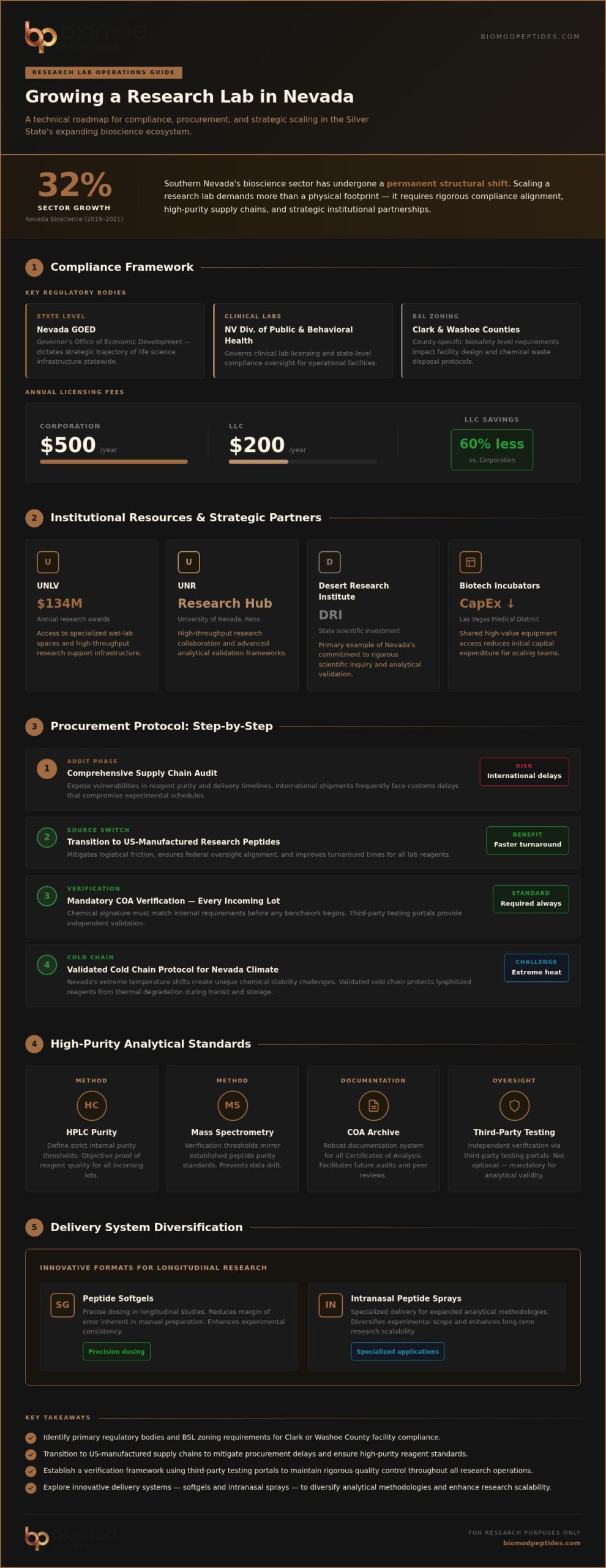
Southern Nevada’s bioscience sector expanded by 32% in a recent two-year window, signaling a permanent shift in the regional economy. For principal investigators and lab managers, growing a research lab in Nevada in 2026 presents a unique set of logistical hurdles. You likely understand that scaling operations requires more than just securing a footprint in the Las Vegas Medical District. It demands a rigorous approach to state-level compliance, including the management of the $500 annual corporate licensing fees and specific personnel certifications. This strategic guide provides a technical roadmap for mapping Nevada’s biotech infrastructure and high-purity procurement. We will examine the current regulatory framework, establish a protocol for sourcing reagents with third-party verified COAs, and outline methods to stabilize your supply chain against specialized material shortages. This ensures your facility maintains long-term operational integrity and analytical precision.
Key Takeaways
- Identify the primary regulatory bodies and BSL zoning requirements necessary for establishing a compliant research facility in Clark or Washoe counties.
- Transition to US-manufactured supply chains to mitigate procurement delays and ensure high-purity standards for all laboratory reagents.
- Establish a verification framework using third-party testing portals to maintain rigorous quality control while growing a research lab in Nevada.
- Explore innovative delivery systems, including research peptide sprays and softgels, to diversify analytical methodologies and enhance long-term research scalability.
Navigating the Nevada Research Ecosystem and Compliance Framework
Establishing a foothold in the Silver State requires precise alignment with the Nevada Governor’s Office of Economic Development (GOED). This agency dictates the strategic trajectory of the state’s life science infrastructure. When growing a research lab in Nevada, you must account for distinct regional zoning mandates. Clark County and Washoe County maintain specific biosafety level (BSL) requirements that impact facility design and chemical waste disposal protocols. Clinical laboratories fall under the jurisdiction of the Nevada Division of Public and Behavioral Health. This necessitates rigorous adherence to state-level licensing. Annual corporate license fees remain fixed at $500, while LLCs operate at a $200 threshold. Standardizing these compliance steps early ensures data reproducibility as your laboratory headcount expands.
Leveraging Local Biotech Incubators and Institutional Resources
Strategic scaling often begins within specialized environments. Joining a life science incubator provides access to shared high-value equipment. This reduces initial capital expenditure while anchoring your physical presence near emerging hubs like the Las Vegas Medical District. Collaboration with institutional giants like UNLV or UNR offers high-throughput research support. The Desert Research Institute serves as a primary example of the state’s investment in rigorous scientific inquiry. These partnerships provide a framework for advanced analytical validation. Leveraging UNLV’s $134 million in annual research awards can facilitate access to specialized wet-lab spaces. Nevada’s bioscience sector grew by 32% between 2019 and 2021. Utilizing these existing resources is critical when growing a research lab in Nevada, allowing managers to focus on protocol refinement rather than infrastructure bottlenecks.
Operational Scaling: Procurement Protocols and Reagent Integrity
Operational efficiency determines the ceiling for any facility growing a research lab in Nevada. Scaling requires a shift from sporadic ordering to a rigorous procurement framework. Audit the chain. Identify delays. Step one involves a comprehensive audit of existing supply chains to expose vulnerabilities in reagent purity and delivery timelines. International shipments often face customs delays that compromise experimental schedules. Transitioning to US-manufactured research peptides mitigates these logistical frictions. It ensures alignment with federal oversight and improves turnaround times.
Every incoming lot must undergo a mandatory COA verification protocol. This ensures that the chemical signature matches internal requirements before any benchwork begins. To improve experimental consistency, researchers should consider scaling delivery formats. Incorporating peptide softgels for research allows for precise dosing in longitudinal studies. This reduces the margin of error inherent in manual preparation. For labs seeking regional stability, choosing a US-based research supplier remains the primary safeguard against supply chain volatility.
Implementing High-Purity Standards for Analytical Consistency
Analytical integrity rests on internal benchmarks. Labs must define strict HPLC purity and mass spectrometry verification thresholds, mirroring established peptide purity standards. These metrics provide objective proof of reagent quality. Nevada’s extreme temperature shifts present a unique challenge to chemical stability. Establishing a validated cold chain protocol is essential. It protects lyophilized reagents from thermal degradation during transit and storage. Maintaining these rigorous controls prevents data drift. High-purity procurement remains the foundation of your laboratory’s growth.
Strategic Resource Management for Long-Term Laboratory Growth
Accountability serves as the cornerstone of sustainable expansion. When growing a research lab in Nevada, principal investigators must prioritize independent third-party testing for every reagent lot. This protocol isn’t optional. It’s a fundamental requirement for analytical validity. A robust documentation system for all certificates of analysis (COA) facilitates future audits and peer reviews. It builds a mandatory historical record of purity. Fostering a culture of precision aligns your facility with the highest standards of laboratory peptide supply. This meticulous approach ensures that experimental data remains defensible under institutional scrutiny.
Diversification of delivery systems enhances experimental scope. Explore intranasal peptide research sprays for specialized analytical grade applications. These delivery mechanisms offer unique pharmacokinetic profiles for specific research models. Integrating varied formats like sprays or softgels allows for more nuanced data collection. It positions the lab as a modern, versatile facility capable of complex methodology. Growing a research lab in Nevada requires this forward-thinking momentum to remain competitive in a rapidly evolving biotech ecosystem.
Establishing Reliable Supply Chains with US-Based Manufacturers
Vendor selection requires technical scrutiny. Prioritize manufacturers providing transparent verification portals for instant access to third-party lab results. Verify that all manufacturing and finishing processes occur within the United States. This geographic anchor guarantees adherence to strict professional industry registers. US-based sourcing reduces logistical lead times and ensures structural integrity during laboratory scaling. Regional stability depends on these verified supply lines. They provide the empirical proof necessary for high-tier research output.
Advancing Laboratory Infrastructure and Analytical Standards
Successful expansion within the Silver State requires a synthesis of regulatory compliance and procurement precision. Scaling beyond the initial incubator stage demands a rigorous commitment to US-manufactured supply chains and standardized documentation. You’ve established the groundwork by aligning with GOED mandates and securing specialized wet-lab space. Now, the focus must shift toward maintaining the structural integrity of your experimental data through uncompromising quality control. Growing a research lab in Nevada is a complex undertaking that rewards those who prioritize analytical verification over convenience. By integrating professional-grade verification portals and independent third-party HPLC and Mass Spec testing, you ensure your facility remains at the forefront of the regional biotech ecosystem. Secure your laboratory supply chain with Biomod Peptides’ US-manufactured research reagents. This disciplined approach provides the stability needed for long-term scientific advancement.
Frequently Asked Questions
What are the primary challenges of growing a research lab in Nevada?
The primary challenges include navigating specific personnel licensing fees for clinical laboratory technologists and managing strict cold chain logistics during summer temperature spikes. Personnel must complete 10 hours of annual continuing education. Additionally, the $100 late fee for business license renewals can disrupt administrative budgets. Growing a research lab in Nevada requires meticulous oversight of these regional regulatory and environmental hurdles.
How do I verify the purity of peptides for my Nevada-based research?
Verification requires accessing independent third-party HPLC and Mass Spectrometry data for every reagent lot. You should utilize a professional-grade COA verification portal to cross-reference batch numbers with analytical results. This process confirms the chemical signature and purity levels before experimental initiation. You shouldn’t rely on internal documentation alone; external validation ensures the structural integrity of your research materials.
Are there specific tax incentives for biotech labs in Nevada for 2026?
Nevada doesn’t offer a state-level Research and Development tax credit as of 2026. However, businesses can claim the federal R&D tax credit for qualifying expenses. Local capital is available through initiatives like Desert Forge Ventures, which offers funding between $100,000 and $1 million for deep-tech startups. The $10 million BioHealth Innovation Challenge also supports regional biotech ecosystem development.
Can I source US-manufactured research peptides locally in Las Vegas?
Yes, Biomod Peptides serves as a reliable regional supplier for labs in the Las Vegas valley. All products are manufactured and finished within the United States to ensure compliance with professional industry registers. This localized supply chain reduces transit times and eliminates the risks associated with international customs. Growing a research lab in Nevada is more efficient when utilizing domestic reagents with verified analytical standards.
Disclaimer
BIOMOD products are sold strictly for laboratory, analytical, and scientific research use only. They are not intended for human or animal consumption, administration, application, ingestion, injection, or any therapeutic, diagnostic, or cosmetic use.
The statements made on this website have not been evaluated by the United States Food and Drug Administration. BIOMOD products are not intended to diagnose, treat, cure, mitigate, or prevent any disease or medical condition.
BIOMOD is a research chemical supplier. BIOMOD is not a compounding pharmacy or chemical compounding facility as defined under Section 503A of the Federal Food, Drug, and Cosmetic Act. BIOMOD is not an outsourcing facility as defined under Section 503B of the Federal Food, Drug, and Cosmetic Act.
By accessing this site, you confirm you are at least 21 years of age and that you have read and accepted the BIOMOD Terms of Sale, Privacy Policy, and Research Use Only Policy. BIOMOD does not provide dosing, medical, therapeutic, diagnostic, veterinary, or use guidance under any channel.