
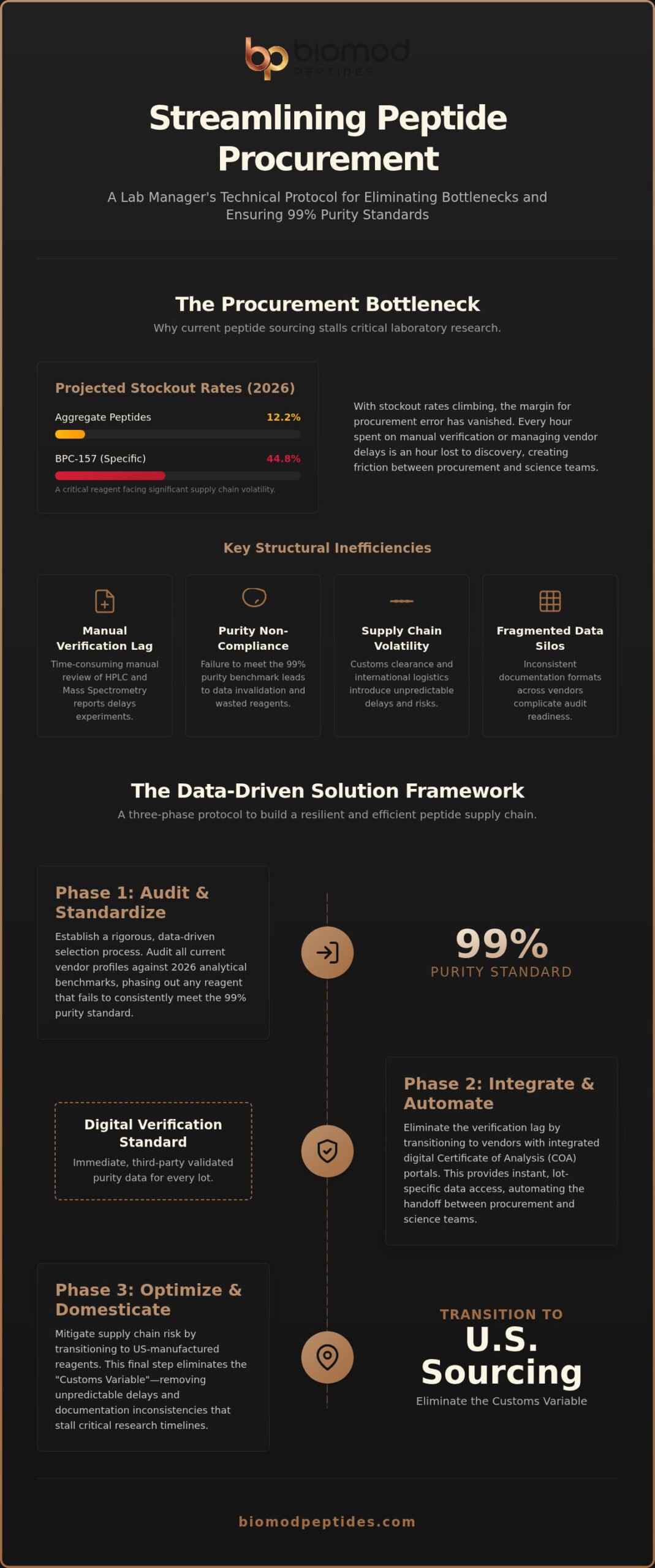
With an aggregate peptide stockout rate reaching 12.2% in 2026, and BPC-157 specifically hitting 44.8%, the margin for procurement error has vanished. You understand that every hour spent on manual HPLC verification or managing international vendor delays is an hour lost to actual discovery. The administrative burden of navigating supply chain volatility often creates unnecessary friction between procurement and science teams. This technical protocol provides a rigorous framework for streamlining peptide procurement for lab managers.
It focuses on reducing overhead while maintaining uncompromising 99% purity standards for all reagents. We’ll detail a standardized workflow that integrates domestic manufacturing advantages and automated COA verification. This guide serves as a blueprint for stabilizing your laboratory’s supply chain and ensuring your research remains on schedule. By consolidating vendors and utilizing real-time documentation portals, you can eliminate the logistical bottlenecks that compromise experimental timelines.
Key Takeaways
- Establish a standardized protocol for streamlining peptide procurement for lab managers to eliminate the verification lag associated with manual HPLC report reviews.
- Audit current vendor profiles against 2026 analytical benchmarks to ensure reagents consistently meet 99% purity standards for laboratory research.
- Integrate digital verification portals into your workflow for instant Certificate of Analysis (COA) access, reducing the administrative handoff between procurement and science teams.
- Mitigate supply chain volatility by transitioning to US-manufactured reagents, removing the customs variables that frequently delay experimental timelines.
The Procurement Bottleneck: Why Peptide Sourcing Stalls Laboratory Research
The verification lag remains the primary obstacle in modern laboratory operations. Manual review of complex HPLC and Mass Spectrometry reports consumed significant administrative hours throughout 2025. This recursive process delays the transition from procurement to active experimentation by days. In 2026, the industry has solidified 99% purity as the non-negotiable benchmark for analytical research. Non-compliance introduces severe institutional risks. It leads to data invalidation and the depletion of high-value reagents without actionable results. Addressing these systemic delays is the first step in streamlining peptide procurement for lab managers.
A deep understanding of peptide synthesis methods is required to evaluate vendor output effectively. Without this technical foundation, identifying subtle impurities becomes impossible. Fragmented procurement across multiple international vendors exacerbates these structural failures. It creates isolated data silos where purity documentation varies in format and rigor. This lack of uniformity is a leading cause of the current reproducibility crisis in peptide-based studies. Effective streamlining peptide procurement for lab managers requires a shift from manual oversight to integrated verification.
Identifying Structural Inefficiencies in Traditional Vendor Workflows
Administrative overhead extends far beyond technical documentation. Customs clearance and international cold-chain monitoring introduce volatile variables that standard laboratory protocols can’t mitigate. These logistical hurdles frequently result in critical documentation gaps. Missing lot-specific data compromises audit readiness and forces research teams to halt projects. Relying on fragmented international supply chains creates a persistent state of reactive management. It prevents the proactive scheduling required for high-throughput laboratory environments.
Implementing a Data-Driven Selection Framework for Peptide Reagents
Modernizing the lab procurement process requires moving beyond anecdotal vendor reliability. A data-driven selection framework is essential for streamlining peptide procurement for lab managers to maintain experimental integrity. This protocol begins with an exhaustive audit of current vendor purity profiles. Any reagent failing to meet the 2026 analytical benchmark of 99% purity must be phased out immediately. High-purity reagents are the only acceptable baseline for reproducible research in high-throughput environments.
Transitioning to vendors who offer integrated digital verification portals is the second critical phase. This move eliminates the verification lag discussed previously by providing instant, lot-specific COA access. Finally, consolidate orders into bulk lots whenever possible. This strategy significantly minimizes lot-to-lot variability. It also reduces the frequency of redundant re-testing, saving both technical hours and research budget. Consistent lot sizes ensure that longitudinal studies aren’t compromised by subtle shifts in reagent composition.
Standardizing Technical Verification Through Integrated COA Portals
Efficiency depends on documentation speed and data accessibility. Utilizing a COA Verification Portal allows lab managers to automate the validation of every batch received. The ‘Digital Verification Standard’ is the benchmark for 2026 procurement, requiring immediate, digital access to third-party validated purity data for every reagent lot. This standard ensures that experimental metadata remains linked to verifiable purity data throughout the research lifecycle.
Linking procurement data directly to experimental metadata improves institutional transparency. It provides a clear audit trail for every reagent used in a study. By streamlining peptide procurement for lab managers through these digital tools, laboratories can shift focus to scientific output rather than administrative troubleshooting. For those seeking to stabilize their supply chain with high-purity reagents, exploring Biomod Peptides’ research offerings provides a viable path forward.
Optimizing the Supply Chain: Transitioning to Domestic Laboratory Partnerships
Domestic sourcing represents the final phase in streamlining peptide procurement for lab managers. Transitioning to US-based manufacturing eliminates the “Customs Variable.” This variable introduces unpredictable delays and documentation inconsistencies that stall critical research. US-manufactured and finished research reagents offer a distinct administrative advantage. They ensure that supply chains remain transparent and verifiable under domestic regulatory frameworks. Specialized delivery formats like peptide softgels and sprays further reduce laboratory overhead. These formats simplify the handling of lyophilized materials and minimize the labor required for reconstitution and preparation.
Reducing Long-Term Administrative Overhead with Reliable Regional Logistics
Regional supply chains in Las Vegas protect research continuity. Localized distribution networks decrease cold-chain failure rates by minimizing transit time and handling stages. Integrating Biomod Peptides’ analytical standards into existing SOPs ensures that every batch meets rigorous 2026 benchmarks. This localized approach allows for rapid response to stockout risks, which reached 12.2% across the industry in 2026. To finalize the transition to a high-efficiency model, lab managers should follow this zero-friction procurement checklist:
- Audit vendor manufacturing locations to prioritize domestic facilities.
- Verify regional logistics capabilities for Las Vegas laboratory use.
- Update SOPs to include automated COA verification for every lot.
- Consolidate specialized formats to minimize reconstitution labor.
Adopting this checklist ensures that procurement remains a technical asset rather than an administrative burden. By focusing on domestic partnerships and regional logistics, laboratories can maintain 99% purity standards while protecting their experimental timelines from global supply chain volatility.
Establishing a High-Efficiency Procurement Standard for 2026
Transitioning from reactive sourcing to a systematic protocol is essential for maintaining experimental momentum. The 2026 analytical landscape demands 99% purity and instant documentation accessibility. By integrating digital verification portals and prioritizing domestic manufacturing, you eliminate the administrative friction that stalls progress. Effective streamlining peptide procurement for lab managers depends on removing the customs variable and ensuring lot-to-lot consistency through regional supply chains. This structural shift moves procurement from a logistical hurdle to a technical asset.
Precision research requires a partner committed to these rigorous benchmarks. Biomod Peptides provides third-party HPLC and Mass Spectrometry verification for every lot. Our US-based manufacturing and Las Vegas regional supply priority protect your continuity from global volatility. Streamline your lab’s procurement with Biomod Peptides’ high-purity reagents and ensure you don’t lose time to documentation gaps.
Frequently Asked Questions
How do 2026 regulatory changes affect peptide procurement for US labs?
Regulatory shifts in 2026 require lab managers to monitor FDA reclassifications closely. As of April 23, 2026, the FDA removed twelve peptides from the Category 2 restricted compounding list. While this doesn’t equate to drug approval, it clarifies the compliance landscape for research use. Procurement protocols must now prioritize vendors who strictly enforce research-only terms of sale to align with these federal guidelines.
What is the difference between HPLC purity and net peptide content in procurement specs?
HPLC purity measures the proportion of the target peptide relative to other peptide impurities. It doesn’t account for non-peptide components like counterions or residual water. Net peptide content represents the actual weight of the peptide in the lyophilized powder. Distinguishing these specs is vital for streamlining peptide procurement for lab managers, as it ensures accurate molar calculations for experimental reproducibility and dosing precision.
How can a COA verification portal reduce my lab’s administrative burden?
A COA verification portal automates the validation process by providing instant access to third-party HPLC and Mass Spectrometry data. This eliminates the need for manual document requests and cross-referencing with vendor sales teams. By integrating this portal into standard workflows, lab managers reduce administrative handoffs. It ensures that every reagent lot in the facility has verifiable 99% purity documentation before research begins.
Why is US-based manufacturing critical for peptide research stability?
US-based manufacturing removes the customs variable, which is the leading cause of cold-chain interruptions and delivery volatility. For lyophilized peptides, maintaining a stable temperature environment is critical for structural integrity. Utilizing regional supply chains in Las Vegas further decreases transit times. This domestic focus protects research continuity by ensuring that reagents arrive without the degradation risks associated with international logistics and prolonged handling.
Disclaimer
BIOMOD products are sold strictly for laboratory, analytical, and scientific research use only. They are not intended for human or animal consumption, administration, application, ingestion, injection, or any therapeutic, diagnostic, or cosmetic use.
The statements made on this website have not been evaluated by the United States Food and Drug Administration. BIOMOD products are not intended to diagnose, treat, cure, mitigate, or prevent any disease or medical condition.
BIOMOD is a research chemical supplier. BIOMOD is not a compounding pharmacy or chemical compounding facility as defined under Section 503A of the Federal Food, Drug, and Cosmetic Act. BIOMOD is not an outsourcing facility as defined under Section 503B of the Federal Food, Drug, and Cosmetic Act.
By accessing this site, you confirm you are at least 21 years of age and that you have read and accepted the BIOMOD Terms of Sale, Privacy Policy, and Research Use Only Policy. BIOMOD does not provide dosing, medical, therapeutic, diagnostic, veterinary, or use guidance under any channel.