
A “Research Use Only” label isn’t a universal legal shield for laboratory operations. With the FDA issuing over 50 warning letters to peptide vendors for compliance failures, the margin for administrative error has vanished. You likely recognize that navigating the intersection of IRB oversight and the Drug Supply Chain Security Act is increasingly complex. Ambiguity regarding RUO boundaries often leads to protocol rejections or data degradation. This article provides a rigorous peptide research compliance checklist for labs to ensure your study meets exacting standards and secures necessary approvals.
We’ll outline the precise framework needed to manage DSCSA tracing and impurity characterization thresholds. You’ll learn how to leverage analytical verification portals to standardize reagent intake and maintain a verifiable chain of custody. This guide transforms regulatory requirements into a repeatable, science-forward methodology for your institution.
Key Takeaways
- Secure institutional approval by integrating batch-specific Certificates of Analysis and analytical verification into your research protocols.
- Mitigate the risk of protocol rejection by implementing this peptide research compliance checklist for labs to address RUO legal boundaries and 21 CFR § 801 standards.
- Establish precise SOPs for cold chain storage and reconstitution to maintain peptide stability and ensure the integrity of your analytical data.
- Differentiate between in-vitro and in-vivo research requirements to provide the rigorous technical justification necessary for successful IRB oversight.
Phase 1: Verification of Procurement Standards and Documentation
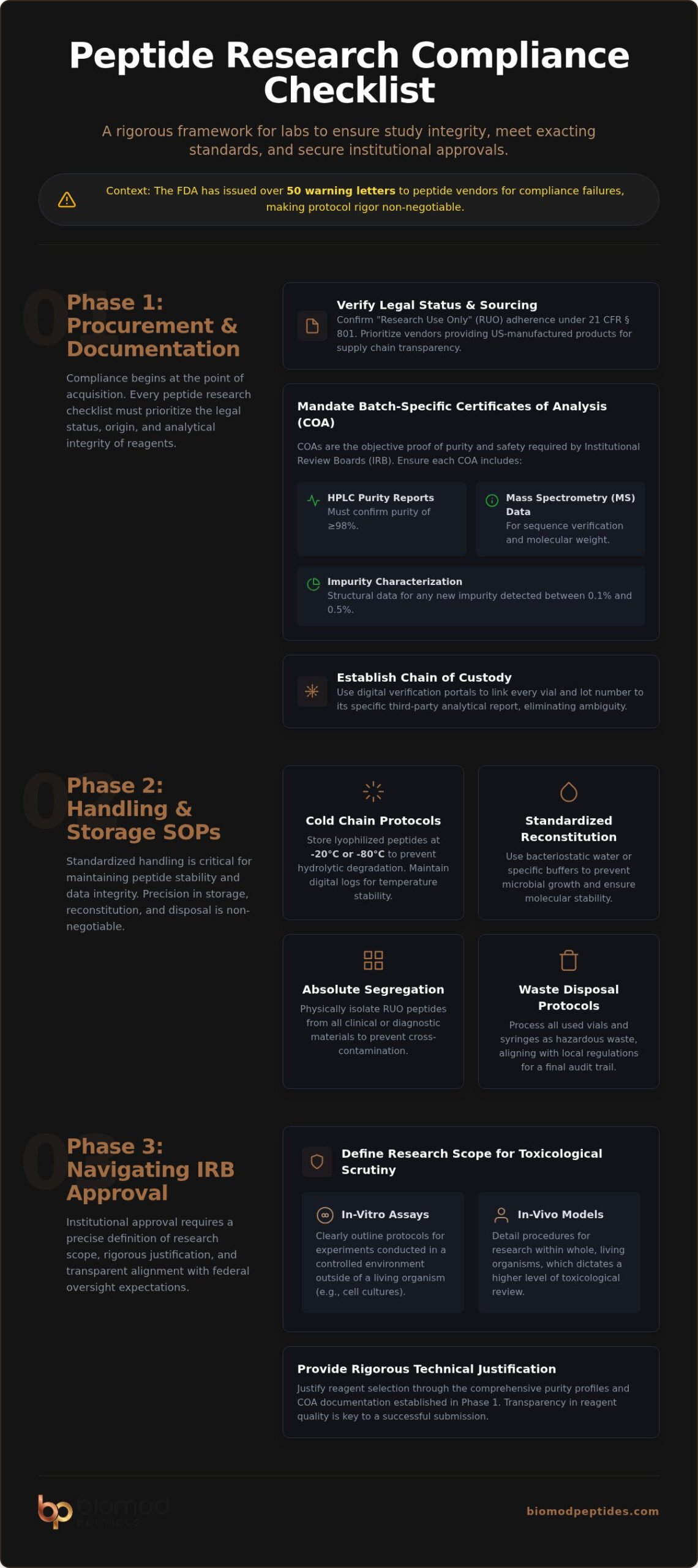
Compliance begins at the point of acquisition. Every peptide research compliance checklist for labs must prioritize the legal status of reagents. Under 21 CFR § 801, material labeled “Research Use Only” (RUO) must strictly adhere to laboratory-grade standards. This designation is not merely a label; it’s a structural boundary that dictates the scope of permissible scientific inquiry. Confirming the FDA classification of peptides, 40 or fewer amino acids, remains a critical first step for procurement. Labs must verify that vendors provide US-manufactured products to ensure supply chain transparency. US-based finishing processes minimize the risks associated with international logistics and inconsistent batch quality.
Analytical integrity requires more than a standard datasheet. Procurement protocols must mandate the collection of batch-specific Certificates of Analysis (COA). These documents provide the objective proof required by an Institutional Review Board (IRB) to validate the safety and purity of the research materials. Every COA should include:
- High-Performance Liquid Chromatography (HPLC) reports confirming purity ≥98%.
- Mass Spectrometry (MS) data for sequence verification and molecular weight.
- Structural characterization for any new impurity detected between 0.1% and 0.5%.
Establishing a Chain of Custody for Analytical Reagents
Data integrity depends on a verifiable chain of custody. Implementing a digital verification protocol using portals like the Biomod verification system ensures that every vial is linked to its specific analytical report. A standardized peptide research compliance checklist for labs facilitates this by linking lot numbers directly to third-party testing results. It eliminates documentation ambiguity and prevents data degradation. Verifying sequence accuracy against analytical grade standards is essential for maintaining the rigor of the investigation. Without this link, the connection between raw material and experimental output remains unverified.
Phase 2: Standard Operating Procedures for Peptide Handling and Storage
Standardized handling is the next critical element in the peptide research compliance checklist for labs. Lyophilized research peptides require strict cold chain protocols, typically storage at -20°C or -80°C, to prevent hydrolytic degradation. Reconstitution procedures must be standardized to maintain molecular stability and sequence integrity. Researchers should refer to FDA guidance on peptide drug products for insights into the chemical factors affecting stability. Using bacteriostatic water or specific buffers prevents microbial growth. It ensures the integrity of the analytical material throughout the study duration. Precision is non-negotiable.
Inventory management requires absolute segregation. Labs must isolate RUO peptides from any clinical or diagnostic materials to prevent cross-contamination. This physical separation is a core requirement for a verifiable chain of custody. Disposal protocols for bioanalytical waste must align with local regulations and institutional safety standards. A robust peptide research compliance checklist for labs mandates that all used vials and syringes require processing as hazardous waste. Proper documentation of disposal acts as a final audit trail for the reagent’s lifecycle. Segregation is mandatory.
Environmental Controls and Contamination Mitigation
Precise environmental monitoring prevents data degradation. Labs should maintain digital logbooks for freezer temperature stability and access control. High-purity reagents require protection from thermal fluctuations and light exposure. For studies requiring precise dosing and reduced handling risks, utilizing specialized formats like peptide softgels can streamline protocol execution. These formats minimize the atmospheric exposure common during traditional reconstitution. Implementing these structural controls ensures your laboratory operates with the transparency required by the Biomod analytical standards. This meticulous approach to storage and handling is essential for maintaining the high-tier reliability of your research data.
Phase 3: Navigating IRB Approval for Peptide-Based Research Protocols
Institutional approval requires a precise definition of the research scope. Protocols must differentiate between in-vitro assays and in-vivo models. This distinction dictates the level of toxicological scrutiny required by reviewers. A comprehensive peptide research compliance checklist for labs ensures that reagent selection is justified through rigorous purity profiles. Researchers should consult the FDA guidance on IRB procedures to align their submissions with federal oversight expectations. Transparency regarding analytical verification is the primary mechanism for mitigating institutional risk. Verification provides the weight of evidence needed for approval.
Drafting the “Materials and Methods” section requires an emphasis on third-party validation. Documenting the use of analytical-grade reagents with independent HPLC and Mass Spectrometry reports provides the necessary objective proof. For novel sequences, Safety Data Sheets (SDS) and toxicological profiles must be included to address potential bioactivity risks. This level of detail transforms a standard protocol into a rigorous scientific proposal. It demonstrates a commitment to methodological integrity. Precision is the standard for modern laboratory investigations.
Documenting Method Development and Validation
Protocol rigor depends on adherence to established peptide purity verification standards. Referencing these benchmarks supports the validity of the experimental design. Coordinating with Las Vegas-based laboratory networks provides a layer of localized procurement and oversight that simplifies the audit trail. This integration into the peptide research compliance checklist for labs ensures that every stage of the study remains verifiable. Meticulous documentation is the final step in securing professional confidence and institutional compliance.
Advancing Scientific Integrity through Procedural Rigor
Establishing a standardized peptide research compliance checklist for labs is the primary mechanism for mitigating institutional risk. Success in modern biochemistry requires more than just high-quality reagents. It demands a verifiable chain of custody and rigorous adherence to 21 CFR § 801 standards. By integrating independent analytical verification into your internal SOPs, you ensure that every protocol meets the exacting requirements of institutional review. This methodology protects your data integrity and accelerates the path to meaningful scientific discovery. Professional confidence is built on the foundation of objective evidence.
Procure High-Purity Peptides for Your Next Research Protocol to leverage US-manufactured analytical grade reagents and independent lab-verified COAs. Our specialized research delivery formats further enhance the precision of your study execution. Your commitment to meticulous documentation ensures the long-term viability of your investigative efforts.
Frequently Asked Questions
What are the primary FDA labeling requirements for research-only peptides?
Labels must explicitly state “For Research Use Only. Not for Human Consumption.” under 21 CFR § 801. They must include a research-use disclaimer, manufacturer identification, and a notice that the FDA hasn’t evaluated the product. This labeling ensures the material is categorized as an analytical reagent rather than a drug. It serves as a foundational legal boundary for laboratory procurement.
How does a Certificate of Analysis (COA) impact IRB approval for peptide studies?
A COA provides the empirical proof of reagent identity and purity that an IRB requires for protocol approval. It documents the peptide sequence and molecular weight via mass spectrometry. Including batch-specific COAs in your peptide research compliance checklist for labs demonstrates technical accountability. It ensures that the materials used in the study meet the rigorous standards of the scientific institution.
Why is third-party HPLC testing essential for laboratory compliance?
Independent HPLC testing verifies that a reagent meets the ≥ 98% purity standard essential for reproducible data. It provides an objective audit of the manufacturer’s internal quality control. Third-party validation identifies impurities that require characterization under current 2026 FDA guidance. This verification is a critical component of a peptide research compliance checklist for labs to ensure analytical integrity and institutional compliance.
Can RUO peptides be used in clinical trials without an IND?
No, RUO peptides are strictly for in-vitro or laboratory research and cannot be used in clinical trials without an approved Investigational New Drug (IND) application. Human subject research requires cGMP-grade materials rather than analytical-grade reagents. Using RUO materials for human consumption violates federal law and institutional ethics. These products are intended solely for scientific investigations within a controlled laboratory environment.
Disclaimer
BIOMOD products are sold strictly for laboratory, analytical, and scientific research use only. They are not intended for human or animal consumption, administration, application, ingestion, injection, or any therapeutic, diagnostic, or cosmetic use.
The statements made on this website have not been evaluated by the United States Food and Drug Administration. BIOMOD products are not intended to diagnose, treat, cure, mitigate, or prevent any disease or medical condition.
BIOMOD is a research chemical supplier. BIOMOD is not a compounding pharmacy or chemical compounding facility as defined under Section 503A of the Federal Food, Drug, and Cosmetic Act. BIOMOD is not an outsourcing facility as defined under Section 503B of the Federal Food, Drug, and Cosmetic Act.
By accessing this site, you confirm you are at least 21 years of age and that you have read and accepted the BIOMOD Terms of Sale, Privacy Policy, and Research Use Only Policy. BIOMOD does not provide dosing, medical, therapeutic, diagnostic, veterinary, or use guidance under any channel.