
Precision in accelerated aging studies for peptides is a function of starting purity. Without high-tier, US-manufactured reagents, your stability data is statistically invalid. Most researchers face significant uncertainty regarding degradation pathways and inaccurate shelf-life predictions. These errors don’t just waste time. They compromise the entire research data set.
You likely recognize that correlating accelerated data with real-time stability is the most difficult hurdle in peptide research. It’s a complex process. It requires absolute adherence to standardized protocols. This guide provides a rigorous technical roadmap for executing accelerated stability studies to predict shelf-life and ensure reagent integrity.
We’ll analyze the current ICH Q1A(R2) standards and the implications of the June 2025 consolidated draft guidance. You’ll learn how to implement a repeatable protocol that relies on COA verification as a necessary baseline. This approach establishes a validated shelf-life prediction and ensures the chemical integrity of your laboratory reagents.
Key Takeaways
- Identify the primary chemical degradation pathways, such as deamidation and hydrolysis, driven by the Arrhenius equation during thermal stress.
- Establish precise T0 metrics using a COA Verification Portal as the mandatory baseline for all accelerated aging studies for peptides.
- Compare the structural stability and degradation resistance of various reagent formats, including lyophilized powders and specialized peptide softgels.
- Analyze the “Purity Paradox” to understand how residual TFA and manufacturing origin influence the rate of catalytic degradation.
- Implement a validated stability protocol to correlate accelerated data with real-time shelf-life, ensuring the long-term integrity of your research data.
The Mechanics of Accelerated Aging for Peptide Stability
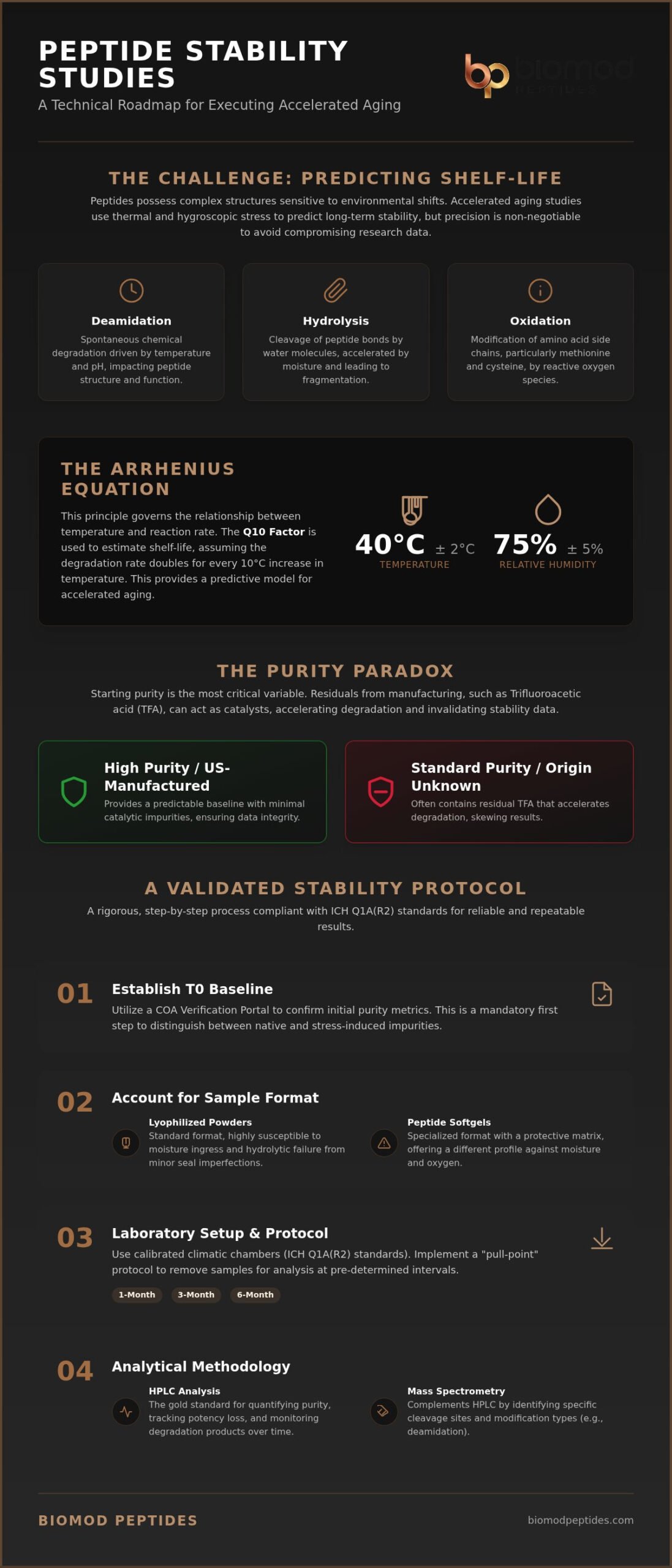
Accelerated aging studies for peptides rely on the deliberate application of thermal and hygroscopic stress to simulate long-term storage conditions. This methodology uses elevated temperature and humidity to speed up chemical degradation, providing a predictive model for shelf-life. Unlike small molecules, peptides possess complex secondary and tertiary structures. This makes them highly sensitive to environmental shifts. Precision is non-negotiable. Standard protocols often follow The Mechanics of Accelerated Aging to ensure that the chemical transformations observed during testing accurately reflect real-world stability.
The primary degradation pathways in peptide reagents include deamidation, oxidation, and hydrolysis. These processes are kinetic. They follow predictable patterns based on the Arrhenius equation. Researchers utilize the Q10 factor to estimate the shelf-life acceleration factor. This factor assumes that the reaction rate doubles for every 10°C increase in temperature. However, for research peptides, this rule of thumb often requires refinement through empirical validation. It’s necessary to account for specific amino acid sequences that may be more labile than standard models suggest.
The Arrhenius Equation in Peptide Kinetics
The relationship between temperature and reaction rate is defined by activation energy (Ea). In peptide kinetics, Ea represents the energy barrier that must be overcome for a degradation reaction to occur. A higher Ea indicates greater temperature sensitivity. To calculate the acceleration factor, researchers compare the rate constant at 40°C against the baseline at 25°C. This allows for a compressed testing timeline without sacrificing data integrity. It’s a calculated risk. It requires high-purity starting materials to ensure the results aren’t skewed by manufacturing impurities or residual solvents.
Critical Environmental Variables
Temperature is the primary driver of kinetic energy. It directly influences bond cleavage and molecular collisions. High temperatures increase the probability of side-chain interactions that lead to structural failure. Relative Humidity (RH) is equally critical. In lyophilized powders, moisture acts as a plasticizer. It lowers the glass transition temperature and facilitates hydrolytic degradation. Maintaining a strict 75% RH ± 5% RH is essential for consistency. For researchers using specialized formats like peptide softgels, these variables must be adjusted to account for the protective barrier of the encapsulated matrix.
Designing a Standardized Protocol for Peptide Stability Studies
Designing a Standardized Protocol for Peptide Stability requires more than just environmental controls. It begins with establishing a rigorous T0 baseline. Researchers must utilize a COA Verification Portal to confirm initial purity metrics before any thermal stress is applied. Without this step, identifying whether impurities are native or stress-induced is impossible. High-purity, US-manufactured reagents provide the most predictable starting point for these assessments.
Sample format significantly influences degradation rates. While lyophilized vials are standard, specialized formats like peptide softgels offer different protection profiles against moisture and oxygen. Accelerated aging studies for peptides must account for these container-closure differences to ensure accurate shelf-life predictions. The choice between formats often dictates the complexity of the extraction protocol required for subsequent analysis.
Step-by-Step Laboratory Setup
Climatic chambers must be calibrated to maintain ICH Q1A(R2) standards. This typically involves 40°C ± 2°C and 75% RH ± 5% for accelerated aging studies for peptides. Container closure integrity (CCI) is a critical variable. Minor seal failures lead to rapid moisture ingress and hydrolytic failure in lyophilized powders. The study design relies on a “pull-point” protocol, which refers to the pre-determined removal of samples from the chamber at specific intervals for immediate analysis. Standard intervals for research-grade peptides include 1-month, 3-month, and 6-month timepoints.
Analytical Methodology for Stability
Analytical monitoring must be continuous and precise. HPLC is the gold standard for quantifying the main peak percentage against emerging degradation products. It provides the necessary resolution to track potency loss over time. Mass Spectrometry complements this by identifying specific cleavage sites or modification types, such as deamidation or oxidation. This dual-method approach ensures that any loss in purity is categorized and documented with institution-grade accuracy. Establishing this level of detail is essential for maintaining the integrity of long-term research data.
Ensuring Data Integrity: The Impact of Peptide Purity on Aging
Data integrity in accelerated aging studies for peptides is inextricably linked to the chemical profile of the starting material. The “Purity Paradox” describes a critical phenomenon where two reagents, both labeled at 98% purity, exhibit vastly different degradation kinetics. This discrepancy usually stems from residual solvents and counter-ions like Trifluoroacetic acid (TFA). These manufacturing byproducts act as catalysts. They lower the activation energy required for deamidation and hydrolysis, causing unverified peptides to fail stability tests prematurely.
Stability profiles also shift based on the delivery matrix. While lyophilized powders are chemically inert, intranasal peptide research sprays introduce aqueous variables. Liquid formulations require precise pH buffering to prevent peptide aggregation and maintains preservative efficacy over the study duration. Researchers must account for these interactions when correlating accelerated data with real-time shelf-life to avoid compromised results.
Manufacturing Standards and Stability
US-based manufacturing and finishing provide a level of environmental control that imported alternatives rarely match. Reducing atmospheric contaminants during the final lyophilization stage is essential for long-term stability. Every lot must undergo independent third-party testing to validate the absence of pro-degradant impurities. This verification ensures that the degradation observed during thermal stress is a result of the peptide’s intrinsic properties rather than external chemical interference.
Predicting Shelf-Life for Specialized Formats
Specialized formats like peptide softgels require unique stability considerations. Lipid oxidation within the capsule matrix can influence the peptide’s structural integrity. Researchers must evaluate shell permeability and its resistance to oxygen ingress during the aging process. For liquid spray formulations, the focus shifts to molecular shearing and the potential for peptide chains to unfold at the air-liquid interface. These variables demand a higher tier of analytical oversight than standard powder vials.
Establishing a valid stability baseline is only possible with laboratory-grade reagents. Biomod Peptides provides the high-purity foundation required for valid stability studies in Las Vegas labs and beyond. By prioritizing US-manufactured purity and rigorous documentation, researchers can ensure their shelf-life predictions are both accurate and repeatable.
Advancing Precision in Stability Modeling
Executing accelerated aging studies for peptides requires an uncompromising commitment to analytical rigor. Reliability starts with the T0 baseline. Identifying degradation pathways like deamidation or oxidation is only possible when starting with verified high-purity materials. Standardizing your environmental stress protocols according to ICH guidelines ensures that your shelf-life predictions are statistically sound and repeatable. These benchmarks protect the validity of your entire longitudinal data set.
Success in long-term research depends on the structural integrity of your reagents. US-manufactured and finished products provide the most predictable kinetics. Every lot must undergo independent third-party testing to eliminate manufacturing variables that catalyze premature failure. Utilizing a verification portal for all COAs is the final step in securing your data against the Purity Paradox. This level of documentation is the difference between a failed study and a breakthrough.
Secure the foundation of your next stability protocol. Procure High-Purity Research Peptides for Your Stability Studies and ensure your research data remains beyond reproach. Precision is the only path to scientific progress.
Frequently Asked Questions
What is the standard temperature for accelerated aging studies for peptides?
The standard temperature for accelerated aging studies for peptides is 40°C ± 2°C, coupled with a relative humidity of 75% ± 5% RH. These parameters follow the ICH Q1A(R2) regulatory framework for stress testing. This specific environment accelerates chemical transformations that would normally take years at room temperature. It allows for a comprehensive stability assessment within a compressed six month timeframe. Adhering to these documented standards ensures that your laboratory data is accurate and comparable to industry benchmarks.
How does the Arrhenius equation apply to peptide shelf-life prediction?
The Arrhenius equation applies to peptide shelf-life prediction by establishing a mathematical link between temperature and the rate of chemical degradation. It assumes that the rate constant increases exponentially as temperature rises. By calculating the activation energy for a specific sequence, researchers determine the Q10 factor. This factor estimates how much a 10°C temperature increase accelerates shelf-life depletion. It remains a critical tool for converting accelerated data into real time storage expectations for high purity reagents.
Can accelerated aging studies replace real-time stability testing for research peptides?
Accelerated aging studies cannot fully replace real-time stability testing; they serve as a predictive screening tool rather than a final confirmation. While these studies provide immediate data on potential degradation pathways, real-time testing accounts for long-term variables that thermal stress might not capture. These include container closure interactions and subtle atmospheric fluctuations over years. Combining both methods is the only way to establish a fully validated shelf-life for sensitive laboratory reagents.
What are the most common degradation products found in aged peptides?
The most common degradation products in aged peptides result from deamidation, oxidation, and hydrolysis reactions. Deamidation frequently occurs at asparagine residues, leading to the formation of isoaspartate analogs. Oxidation often targets methionine or cysteine, altering the peptide’s mass and secondary structure. Hydrolysis involves the cleavage of peptide bonds, resulting in shorter, inactive fragments. Identifying these specific impurities via HPLC and Mass Spectrometry is necessary to verify the reagent’s ongoing chemical integrity during research.
Disclaimer
BIOMOD products are sold strictly for laboratory, analytical, and scientific research use only. They are not intended for human or animal consumption, administration, application, ingestion, injection, or any therapeutic, diagnostic, or cosmetic use.
The statements made on this website have not been evaluated by the United States Food and Drug Administration. BIOMOD products are not intended to diagnose, treat, cure, mitigate, or prevent any disease or medical condition.
BIOMOD is a research chemical supplier. BIOMOD is not a compounding pharmacy or chemical compounding facility as defined under Section 503A of the Federal Food, Drug, and Cosmetic Act. BIOMOD is not an outsourcing facility as defined under Section 503B of the Federal Food, Drug, and Cosmetic Act.
By accessing this site, you confirm you are at least 21 years of age and that you have read and accepted the BIOMOD Terms of Sale, Privacy Policy, and Research Use Only Policy. BIOMOD does not provide dosing, medical, therapeutic, diagnostic, veterinary, or use guidance under any channel.

I like forgathering utile information , this post has got me even more info! .
Assisted me a lot, just what I was looking for : D.
Thanks for sharing the information with us.