
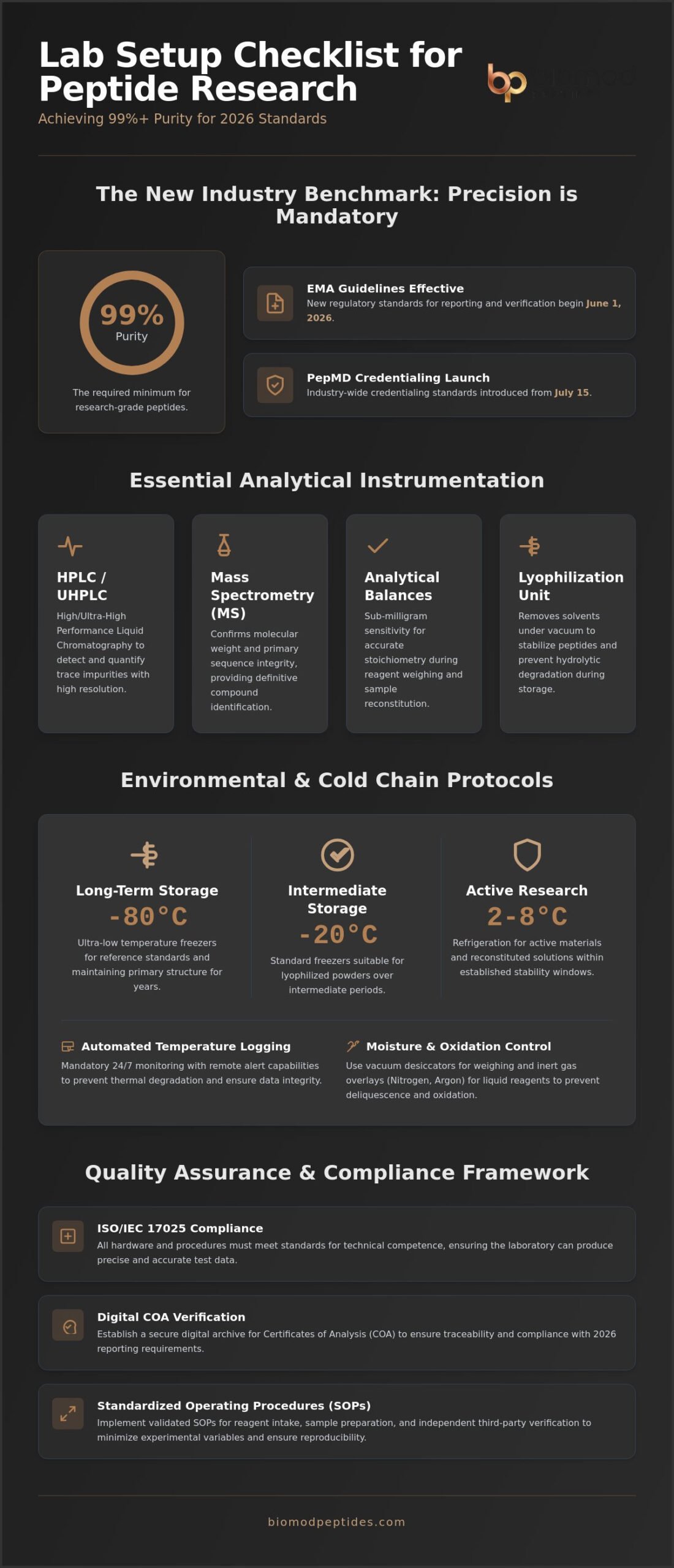
The benchmark for research-grade peptide purity is now 99% or higher. This shift reflects the June 1, 2026, EMA guidelines and the July 15 launch of PepMD credentialing standards. Precision is mandatory. Establishing a high-precision laboratory environment requires more than just high-end hardware. It demands a rigorous lab setup checklist for peptide research that accounts for everything from ISO/IEC 17025 compliance to localized US-manufacturing standards. Material degradation and inconsistent analytical results often stem from minor environmental variables. These variables compromise sensitive sequences before testing begins.
You likely recognize that even slight fluctuations in storage temperature or HPLC calibration can derail months of data collection. Precision is not accidental; it is a structural requirement. This guide provides a clinical, step-by-step checklist for establishing a laboratory environment optimized for synthesis, storage, and analytical verification. The following sections detail specific hardware requirements for 2026. They address the necessity of third-party COA validation through secure portals. They outline the procedural protocols required to minimize variable interference. This framework ensures workflows remain reproducible and compliant with the latest industry benchmarks.
Key Takeaways
- Identify the specific analytical instrumentation required to verify 99% purity and molecular weight in modern research environments.
- Standardize dual-tier environmental controls to prevent sequence degradation during long-term storage and active experimentation.
- Utilize a rigorous lab setup checklist for peptide research to align hardware calibration with high-precision procurement standards.
- Establish a digital archive for COA verification to ensure compliance with 2026 EMA reporting and ISO/IEC 17025 requirements.
- Minimize experimental variables by implementing validated SOPs for reagent intake and independent third-party verification.
Essential Hardware and Analytical Instrumentation for Peptide Analysis
High-purity research requires specialized infrastructure. A standard lab setup checklist for peptide research must prioritize analytical resolution over general utility. General chemistry tools are insufficient for verifying 99% purity levels. You need High-Performance Liquid Chromatography (HPLC) to detect trace impurities. These impurities often arise during complex Peptide Synthesis Methods. Accuracy starts with the hardware. Reliable data depends on the sensitivity of your detection systems.
Mass Spectrometry (MS) provides the secondary layer of verification. It confirms molecular weight and sequence integrity. Without MS, you can’t guarantee the identity of the synthesized chain. Precision analytical balances with sub-milligram sensitivity are also critical. They ensure accurate stoichiometry during reconstitution. Lyophilization units stabilize materials by removing solvents under vacuum. This process prevents hydrolytic degradation during long-term storage. Every piece of hardware must meet ISO/IEC 17025 standards for technical competence.
Primary Analytical Verification Tools
Baseline stability is the foundation of reproducible data. Establish a routine HPLC maintenance schedule to prevent peak drifting. Modern UHPLC systems offer the resolution required for 2026 analytical standards. Integrate MS to provide definitive identification. This dual-track verification is the only way to meet the rigorous reporting requirements of the June 2026 EMA guidelines. It’s the benchmark for any professional laboratory setting.
Sample Preparation and Processing
Preparation impacts final purity. High-speed refrigerated centrifuges are necessary for separation and pelleting after reconstitution. Maintaining a low temperature during centrifugation prevents thermal degradation of sensitive sequences. Ultrasonic cleaners are mandatory for glassware. They eliminate cross-contaminants that might mimic peptide impurities on an HPLC chromatogram. Cleanliness is a functional requirement for analytical integrity.
Environmental Stabilization and Cold Chain Storage Protocols
Thermal fluctuations compromise structural integrity. Peptides are thermodynamically unstable. They require strict adherence to cold chain protocols to prevent deamidation or oxidation. A comprehensive lab setup checklist for peptide research must include multi-tiered storage solutions. Ultra-low temperature freezers (-80°C) are mandatory for long-term reference standard storage. These units maintain the primary structure of sensitive sequences for years. Standard laboratory refrigeration (2-8°C) is suitable for active research materials, provided you utilize them within established stability windows.
Automated temperature logging is no longer optional. Modern analytical standards require 24/7 monitoring with remote alert capabilities. This ensures any deviation from the set point is addressed before material degradation occurs. For researchers sourcing high-purity compounds, maintaining these conditions is the only way to validate experimental results against the original Certificate of Analysis.
Managing Peptide Stability Across Formats
Different formats demand specific environmental controls. Lyophilized powders are stable at -20°C for intermediate periods. Reconstituted liquid solutions degrade rapidly; prepare them fresh for each assay. Specialized research formats like peptide softgels require stable humidity levels to maintain the integrity of the outer casing. Similarly, peptide spray products often contain light-sensitive stabilizers. Store these in amber glass or opaque containers to prevent UV-induced peptide cleavage.
Moisture Control and Desiccation
Atmospheric moisture is a primary catalyst for deliquescence. Use vacuum desiccators to protect lyophilized peptides during the weighing process. Exposure to ambient air leads to weight inaccuracies due to moisture absorption. For liquid reagents, implementing an inert gas overlay, such as Nitrogen or Argon, creates a protective barrier against oxidation. These steps are essential for maintaining the high-purity benchmarks established in the previous section’s analytical instrumentation guidelines.
Quality Assurance Frameworks and Reagent Procurement Standards
Infrastructure and storage protocols mean nothing without high-integrity reagents. A robust lab setup checklist for peptide research must account for the variability in vendor-supplied materials. Precision is a procedural habit. Standard Operating Procedures (SOPs) for reagent intake are mandatory. Every incoming lot requires immediate verification against its documentation to ensure the chemical identity matches the experimental design.
Establish a digital archive for every Certificate of Analysis (COA). This documentation serves as the primary audit trail for your research. Don’t rely solely on vendor claims. Conduct regular internal audits using the analytical instrumentation described in earlier sections. Comparing internal HPLC results against vendor-provided data identifies discrepancies before they contaminate a larger data set. Internal audits are the final step in a lab setup checklist for peptide research, confirming that the physical environment and the chemical inputs remain in sync.
The Verification-First Procurement Model
Prioritize vendors that provide independent, third-party laboratory verification for every lot. Tools like the Biomod Peptides verification portal allow for real-time validation of batch-specific data. This transparency is critical for Las Vegas laboratories and other US-based facilities that require high-tier accountability. Verification-first models eliminate the ambiguity of batch-to-batch variation. All materials must meet analytical grade peptide standards to ensure experimental reproducibility and structural integrity.
Compliance and Safety Documentation
Regulatory compliance in 2026 is stricter than ever. Maintain clear “Research Use Only” (RUO) documentation for all lab personnel. This prevents regulatory uncertainty regarding the intended application of the materials. Implement Safety Data Sheet (SDS) accessibility for all peptide reagents. SDS documentation provides critical handling instructions for specialized formats. This is especially important for non-traditional delivery systems that may require specific disposal or containment protocols.
Standardizing Precision for Future Peptide Discovery
Precision in the laboratory is a continuous process of verification and stewardship. This lab setup checklist for peptide research provides the structural framework necessary to maintain 99% purity standards in a shifting regulatory landscape. By aligning high-resolution analytical hardware with strict environmental controls, researchers eliminate the variables that lead to inconsistent data. Success depends on the synergy between technical infrastructure and rigorous procurement protocols. Every calibration and storage log entry builds the foundation for reproducible science.
Reliability begins with the source material. Every experiment requires reagents that meet or exceed 2026 analytical benchmarks. Explore Analytical Grade Research Peptides from Biomod to secure materials that are third-party tested for purity and sequence accuracy. Our offerings are manufactured and finished in the United States. We provide a comprehensive COA verification portal to ensure complete logistical transparency for every lot. Secure your research inputs from a provider that prioritizes empirical proof over market hype.
Establish your laboratory with the discipline required for modern peptide science. When every variable is controlled and every reagent is validated, your research moves forward with absolute confidence.
Frequently Asked Questions
What is the minimum equipment required for a startup peptide research lab?
A foundational lab setup checklist for peptide research must prioritize analytical verification over high-throughput synthesis. Minimum requirements include a High-Performance Liquid Chromatography (HPLC) system for purity assessment and a Mass Spectrometer (MS) for sequence verification. Essential support hardware includes a precision analytical balance with sub-milligram sensitivity and a high-speed refrigerated centrifuge. These tools ensure that materials are both accurately measured and protected from thermal degradation during processing.
How do I verify the purity of research peptides purchased from a new vendor?
Verification requires a dual-track approach of documentation review and independent analytical testing. Researchers should first validate batch-specific data through a proprietary COA verification portal to ensure the provided documentation is authentic. Subsequently, perform internal HPLC-MS analysis to confirm that the peptide meets the 99% purity benchmark. This rigorous process identifies any discrepancies between vendor claims and the physical reality of the reagent before experimental use.
Why is US-based manufacturing important for peptide research integrity?
US-based manufacturing ensures adherence to stringent domestic quality control standards and logistical transparency. Domestic finishing reduces the risk of material degradation associated with extended international transit and unmonitored customs delays. This proximity allows for tighter oversight of the manufacturing environment. It also facilitates easier auditing of the facility’s compliance with ISO 9001:2015 and ISO/IEC 17025 protocols, which are critical for maintaining the integrity of a lab setup checklist for peptide research.
How long can lyophilized research peptides be stored before degradation occurs?
Lyophilized peptides generally remain stable for several years when stored in an ultra-low temperature freezer at -80°C. At standard freezer temperatures of -20°C, most sequences maintain structural integrity for 12 to 24 months. These timelines assume the materials are kept in a desiccated environment to prevent moisture-induced degradation. Once reconstituted, the stability window narrows significantly. This often requires use within days or weeks depending on the specific sequence and buffer characteristics.
Disclaimer
BIOMOD products are sold strictly for laboratory, analytical, and scientific research use only. They are not intended for human or animal consumption, administration, application, ingestion, injection, or any therapeutic, diagnostic, or cosmetic use.
The statements made on this website have not been evaluated by the United States Food and Drug Administration. BIOMOD products are not intended to diagnose, treat, cure, mitigate, or prevent any disease or medical condition.
BIOMOD is a research chemical supplier. BIOMOD is not a compounding pharmacy or chemical compounding facility as defined under Section 503A of the Federal Food, Drug, and Cosmetic Act. BIOMOD is not an outsourcing facility as defined under Section 503B of the Federal Food, Drug, and Cosmetic Act.
By accessing this site, you confirm you are at least 21 years of age and that you have read and accepted the BIOMOD Terms of Sale, Privacy Policy, and Research Use Only Policy. BIOMOD does not provide dosing, medical, therapeutic, diagnostic, veterinary, or use guidance under any channel.