
Can a peptide softgel maintain its molecular integrity during a high-temperature transit to a Las Vegas research facility? Many investigators handle lyophilized vials with confidence but view oral formats with clinical skepticism. You’re right to be cautious. The lack of standardized peptide softgel stability testing data for oral research reagents often makes shelf-life feel like a guessing game. Precision is non-negotiable. Accountability is mandatory.
This article provides a rigorous framework for verifying the integrity of your research materials to eliminate that uncertainty. You’ll master the analytical protocols required to verify shelf-life, interpret complex COAs, and implement storage standards that protect your US-manufactured reagents. We’ll examine ICH temperature benchmarks and the specific lipid-matrix interactions that dictate peptide longevity. By the end, you’ll have the technical tools to ensure your laboratory reagents meet the highest standards of structural integrity from receipt to application. Trust is built through data. We provide the methodology to secure it.
Key Takeaways
- Identify how the lipid matrix functions as a critical barrier against moisture and oxidative stress to preserve peptide molecular structure.
- Execute rigorous peptide softgel stability testing using ICH Q1A(R2) benchmarks to establish reliable shelf-life data for laboratory reagents.
- Master the interpretation of third-party COAs through dedicated verification portals to ensure the highest standards of analytical transparency.
- Optimize laboratory dosing protocols by applying forced degradation data to determine precise open-vial expiration windows for softgel formats.
The Science of Peptide Softgel Stability: Understanding the Lipid Matrix
Stability in oral research formats is a dual-variable equation. It requires maintaining both the chemical integrity of the peptide and the physical durability of the outer shell. In laboratory settings, peptide softgel stability testing is defined as the quantitative measurement of degradation rates when the reagent is exposed to controlled environmental stressors. Unlike lyophilized vials, which remain inert in a powdered state, softgels involve active liquid suspensions. This complexity requires analytical markers that account for the interaction between the peptide and its lipid carrier. Precision is the baseline. Accountability is the result.
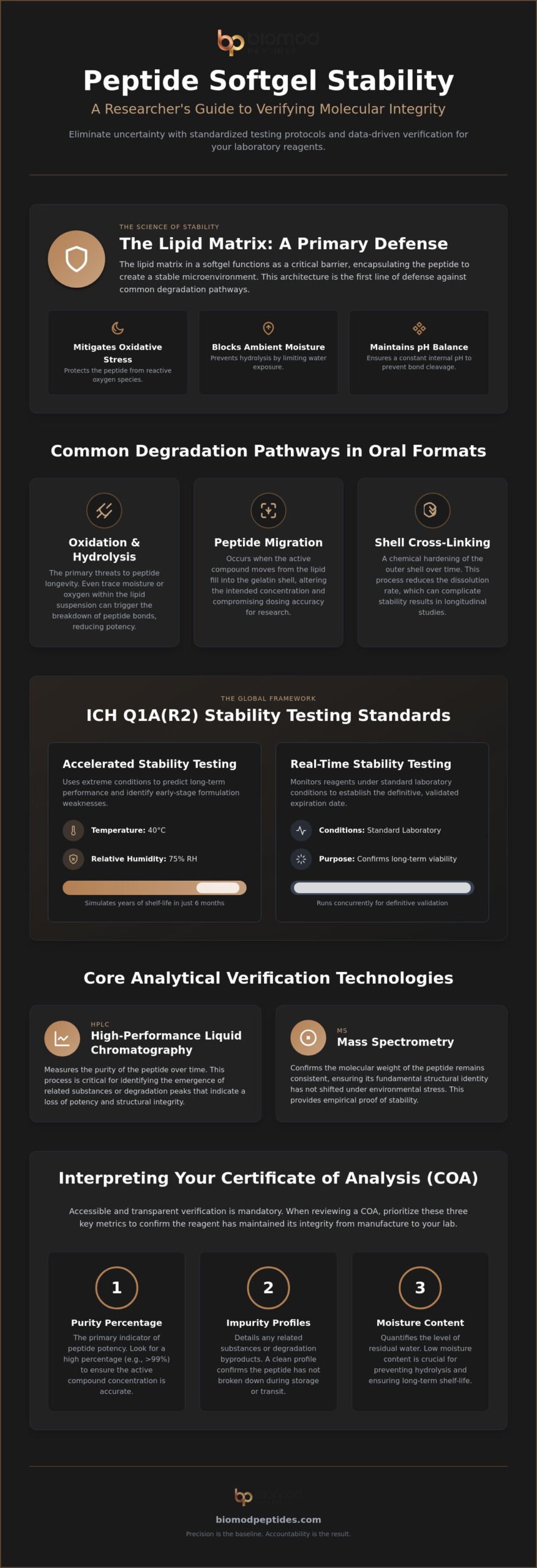
The lipid matrix serves as the primary defense mechanism. It encapsulates the peptide to mitigate exposure to oxidative stress and ambient moisture. High-tier research reagents utilize specialized oils and surfactants to create a stable microenvironment. This architecture prevents the rapid degradation often seen in aqueous solutions. It ensures the peptide remains viable throughout its intended shelf-life.
Encapsulation Integrity and Migration
Researchers must account for peptide migration. This occurs when the active compound moves from the lipid fill into the gelatin or polymer shell. This process can alter the intended concentration and compromise dosing accuracy. Additionally, cross-linking within the shell can occur over time. This chemical hardening reduces the dissolution rate; it complicates stability results during longitudinal studies. Monitoring these physical changes is as critical as tracking chemical purity.
Common Degradation Pathways in Oral Formats
Oxidation and hydrolysis remain the primary threats to peptide longevity. Even within a lipid suspension, trace moisture can trigger breakdown. Peptide stability and degradation are influenced heavily by the internal pH of the formulation. Proper stability protocols verify that the pH-balanced environment within peptide softgels remains constant. This prevents premature cleavage of the peptide bonds. Verification of these pathways is essential for maintaining US-manufactured quality standards in research applications.
Analytical Protocols for Stability Verification: ICH Standards
Rigorous verification requires standardized benchmarks. The International Council for Harmonisation (ICH) Q1A(R2) guidelines serve as the global definitive framework for assessing research reagents. In peptide softgel stability testing, these standards dictate the specific environmental parameters needed to validate shelf-life claims with clinical precision. Every lot must undergo forced degradation studies. This process intentionally exposes softgels to intense light and thermal stress. It identifies potential breakdown products before they can compromise laboratory results. Precision is the baseline. Accountability is the result.
Analytical accuracy relies on High-Performance Liquid Chromatography (HPLC) and Mass Spectrometry (MS). HPLC measures the purity of the peptide over time. It identifies the emergence of related substances or degradation peaks that indicate a loss of potency. Meanwhile, MS verification confirms the molecular weight remains consistent. It ensures the structural identity hasn’t shifted despite environmental pressure. This dual-layered verification provides the empirical proof researchers require for high-stakes applications. It eliminates the guesswork inherent in unverified reagents.
Accelerated vs. Real-Time Stability Studies
Accelerated testing utilizes extreme conditions to predict long-term performance. Standard protocols involve storage at 40°C with 75% relative humidity (RH). This environment simulates years of ambient storage in just six months. It’s a critical tool for identifying early-stage formulation weaknesses. Real-time studies run concurrently. They monitor reagents under standard laboratory conditions to establish the definitive expiration date. Both methods are necessary to account for the unique vulnerabilities of the lipid matrix during transit and storage.
Interpreting the COA Verification Portal Data
Verification must be accessible and transparent. Researchers can utilize the Biomod verification portal to access lot-specific stability data instantly. When reviewing a Certificate of Analysis (COA), prioritize three key metrics: purity percentage, impurity profiles, and moisture content. These data points confirm the reagent has maintained its integrity since the point of manufacture. You can review our internal benchmarks to understand how these protocols protect your research investments. Documentation is the ultimate proof of quality.
Research Applications: Leveraging Stability Data for Lab Protocols
Stability data serves as a functional blueprint for laboratory precision. It dictates the “open-vial” timeframe for softgel reagents. This is the window during which the reagent maintains its verified potency after the primary seal is breached. Relying on peptide softgel stability testing allows investigators to move beyond generalized assumptions. It provides a data-driven timeline for reagent replacement. Precision is the baseline. Accountability is the result.
Longitudinal studies require absolute consistency. If a researcher understands the specific degradation kinetics of their peptide softgels, they can design experiments around known rates of change. This enables precise dosing calculations over months of observation. High-throughput screening also benefits from this transparency. It ensures every assay uses reagents with identical purity profiles. Sourcing stability-validated materials is the first step toward empirical success.
Cold Chain Logistics and Las Vegas Storage
Thermal stress is a significant variable during transit. This is particularly true for deliveries to Las Vegas laboratory facilities where ambient temperatures can exceed 40°C. Mitigating this risk requires established cold chain protocols. Once received, investigators must prioritize long-term storage in climate-controlled environments. Maintain a constant 2°C to 8°C range. Protect reagents from high humidity and direct UV light. This prevents shell cross-linking and preserves the lipid matrix.
Experimental Design and Reagent Longevity
Validated stability data reduces the number of uncontrolled variables in bioanalytical research. It allows labs to incorporate stability margins into their procurement cycles. By aligning purchase orders with known degradation windows, researchers can optimize their budgets. They ensure no reagent is used beyond its analytical peak. This disciplined approach to procurement reflects a commitment to structural integrity. It facilitates experimental reproducibility.
Advancing Research Precision with Stability-Validated Reagents
Securing the reliability of oral reagents requires more than just careful handling. It demands a sophisticated understanding of how environmental stressors interact with complex lipid carriers. Standardized peptide softgel stability testing provides the empirical foundation needed to eliminate variables in longitudinal studies and high-throughput screening. By moving beyond unverified shelf-life claims, investigators gain absolute control over their experimental timelines. It’s about replacing uncertainty with laboratory-grade evidence.
Biomod Peptides facilitates this level of precision through a commitment to structural integrity and logistical transparency. Every lot is US-manufactured in precision laboratories and undergoes rigorous third-party HPLC/MS verification. Researchers can access these critical metrics instantly through our dedicated COA verification portal; this ensures that every reagent meets the highest analytical standards before it reaches the bench. Documentation is the ultimate proof of quality.
Take the next step in securing your laboratory’s output. Explore Stability-Tested Research Softgels and ensure your results remain as robust as your methodology. Your research deserves the certainty of verified science.
Frequently Asked Questions
What is the typical shelf-life of a research-grade peptide softgel?
Most research-grade peptide softgels maintain a shelf-life of 18 to 24 months when stored in a controlled refrigerated environment between 2°C and 8°C. This duration is established through longitudinal studies that monitor both chemical purity and physical shell integrity over time. Researchers should always verify the specific expiration date via the lot-specific COA; this ensures the reagent hasn’t reached its analytical decline before the study begins.
How does temperature fluctuation during shipping impact peptide integrity?
High-temperature excursions during transit can accelerate degradation pathways like hydrolysis or oxidation. Standard peptide softgel stability testing protocols, specifically accelerated studies at 40°C, help manufacturers predict how these reagents perform during shipping to extreme climates. While short-term exposure is often mitigated by the protective lipid matrix, prolonged heat can cause irreversible cross-linking in the gelatin shell, which alters dissolution rates in laboratory applications.
Why is third-party testing more critical for softgels than for powders?
Softgels are dynamic systems where the peptide is suspended in a complex lipid matrix; this creates more potential for chemical interactions than a static lyophilized powder. Third-party testing verifies that the peptide hasn’t migrated into the shell or reacted with internal excipients over time. Utilizing independent HPLC and MS verification ensures the purity level remains consistent with the original manufacturing benchmarks, providing a necessary layer of accountability for complex oral formats.
Can I use softgel stability data to predict the longevity of peptide sprays?
Stability data is format-specific and cannot be transferred between different delivery systems. While softgels utilize a protective lipid environment, peptide sprays are typically aqueous or saline-based solutions. These different matrices face unique challenges, such as microbial growth or rapid pH shifts, that aren’t present in encapsulated formats. Each reagent requires its own dedicated analytical verification to ensure research accuracy and reagent longevity.
Disclaimer
BIOMOD products are sold strictly for laboratory, analytical, and scientific research use only. They are not intended for human or animal consumption, administration, application, ingestion, injection, or any therapeutic, diagnostic, or cosmetic use.
The statements made on this website have not been evaluated by the United States Food and Drug Administration. BIOMOD products are not intended to diagnose, treat, cure, mitigate, or prevent any disease or medical condition.
BIOMOD is a research chemical supplier. BIOMOD is not a compounding pharmacy or chemical compounding facility as defined under Section 503A of the Federal Food, Drug, and Cosmetic Act. BIOMOD is not an outsourcing facility as defined under Section 503B of the Federal Food, Drug, and Cosmetic Act.
By accessing this site, you confirm you are at least 21 years of age and that you have read and accepted the BIOMOD Terms of Sale, Privacy Policy, and Research Use Only Policy. BIOMOD does not provide dosing, medical, therapeutic, diagnostic, veterinary, or use guidance under any channel.