
The integrity of a laboratory model depends entirely on the molecular purity of its reagents. The Wolverine Stack Peptide is frequently discussed with more marketing hype than scientific rigor. You likely recognize that inconsistent purity in the research chemical market isn’t just a logistical hurdle; it’s a threat to the validity of your data. As of July 2026, the regulatory status of BPC-157 and TB-500 remains complex. This makes independent third-party verification critical for Las Vegas laboratories seeking technical precision.
This guide provides a technical examination of the biochemical synergy between BPC-157 and TB-500. We’ll analyze how BPC-157 facilitates localized repair while TB-500 drives systemic cellular migration in controlled environments. You’ll learn to identify high-purity procurement sources and verify analytical standards through rigorous documentation. We’ll preview the essential verification protocols and COA standards necessary to maintain institutional benchmarks in your 2026 research projects.
Key Takeaways
- Analyze the synergistic mechanisms where TB-500 promotes systemic cellular migration while BPC-157 facilitates localized angiogenic responses in laboratory models.
- Define the analytical framework of the Wolverine Stack Peptide, focusing on the precise combination of Pentadecapeptide BPC-157 and Thymosin Beta-4.
- Establish rigorous procurement standards by utilizing HPLC and Mass Spectrometry to verify peptide sequences and identify potential impurity profiles.
- Ensure institutional accountability in Las Vegas research environments through the use of third-party COA verification portals and high-purity reagent standards.
The Analytical Framework of the Wolverine Stack Peptide
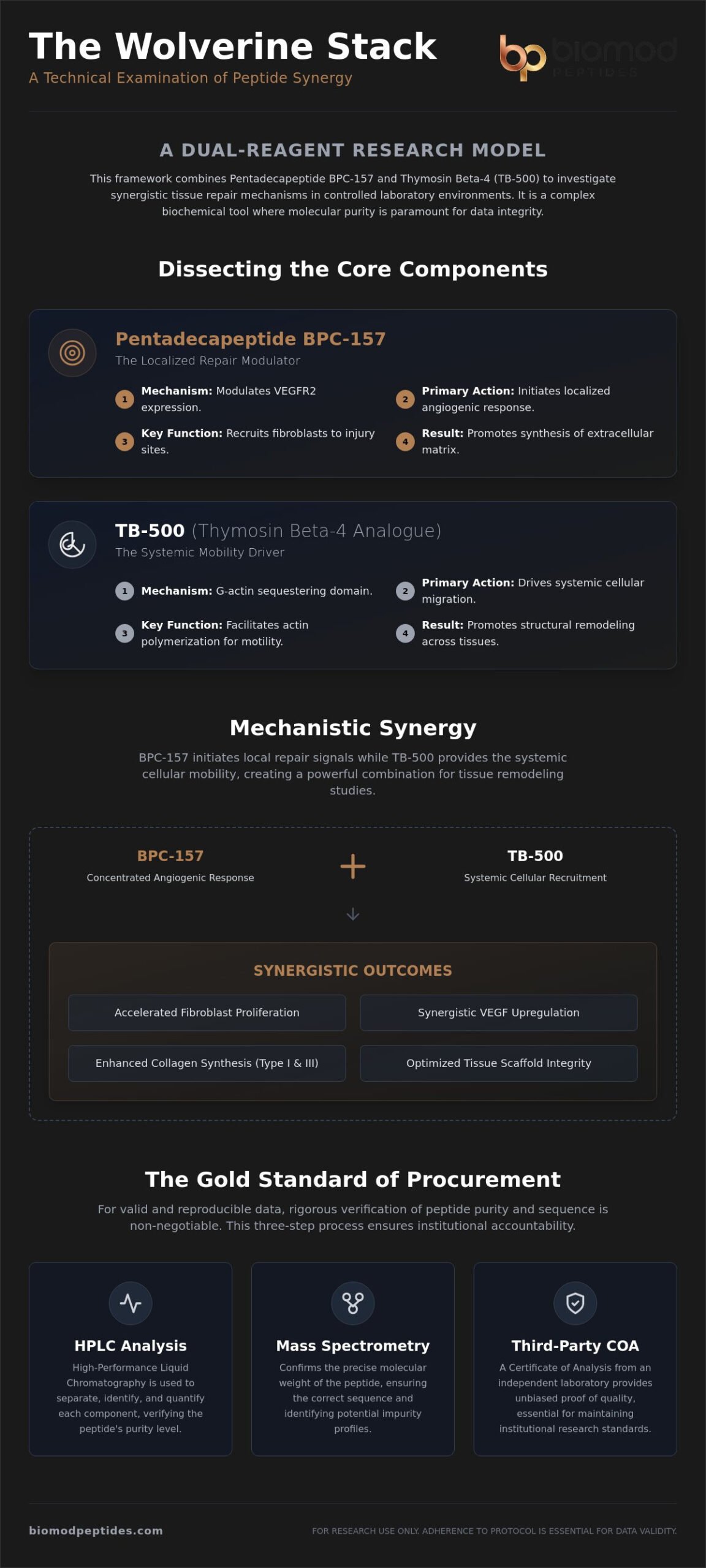
The Wolverine Stack Peptide represents a specialized dual-reagent research model designed for the investigation of synergistic tissue repair mechanisms. This framework is not a consumer “healing therapy” but a complex biochemical combination requiring strict laboratory-grade nomenclature. The model consists of two primary components: Pentadecapeptide BPC-157 and the synthetic analogue of Thymosin Beta-4, commonly identified as TB-500. Researchers utilize this stack to observe how separate signaling pathways intersect during cellular regeneration and structural remodeling.
Data integrity in these studies relies on the precise identification of molecular structures. Biomod Peptides provides these reagents as high-purity analytical standards for Las Vegas laboratories. Researchers often utilize specialized delivery formats, such as peptide spray products, to evaluate absorption kinetics in specific mucosal or localized research models. Verification of these compounds is non-negotiable; empirical proof must precede any experimental application.
Biochemical Profile of BPC-157
Structural analysis identifies BPC-157 as a sequence of 15 amino acids derived from a protective protein found in human gastric juice. In controlled laboratory environments, the primary research focus centers on its ability to modulate Vascular Endothelial Growth Factor Receptor 2 (VEGFR2) expression. This signaling pathway is foundational for understanding angiogenic responses. Current studies also investigate the activation of early growth response 1 (EGR1). This protein acts as a critical switch for transcription factors involved in the synthesis of the extracellular matrix and the recruitment of fibroblasts to localized sites of injury.
Biochemical Profile of TB-500
TB-500 functions as a low-molecular-weight analogue of a naturally occurring protein. Its primary utility in cellular studies is derived from its G-actin binding domain. By sequestering actin, the peptide facilitates cellular migration and structural remodeling across various tissue types. Understanding the Thymosin beta-4 function is essential for investigators analyzing how these proteins influence the rate of angiogenesis in vitro. Unlike the localized signaling seen with BPC-157, TB-500 is often studied for its systemic mobility and its role in promoting the migration of endothelial cells to areas of experimental damage.
Mechanistic Synergy: BPC-157 and TB-500 in Laboratory Models
The Wolverine Stack Peptide functions through molecular crosstalk that optimizes the regenerative environment in laboratory assays. This synergy is most evident in the accelerated proliferation of fibroblasts and the subsequent synthesis of Type I and Type III collagen. While BPC-157 initiates a concentrated angiogenic response at the site of experimental injury, TB-500 provides the systemic mobility required for cellular recruitment. This dual-action approach allows researchers to observe complex tissue remodeling that single-peptide models cannot replicate.
Musculoskeletal injury models frequently utilize this stack to evaluate the modulation of Transforming Growth Factor-beta (TGF-beta) signaling pathways. By influencing these pathways, the combination may alter the rate of myofibroblast differentiation and minimize fibrotic scar tissue formation in vitro. Investigators must remain cognizant of the regulatory status of BPC-157 and its classification as an unapproved substance. Maintaining strict adherence to research-only protocols is essential for data validity.
Angiogenesis and Vascular Endothelial Growth Factor
New blood vessel formation is a primary endpoint in wound healing assays involving this peptide combination. BPC-157 acts as a catalyst for VEGFR2 expression; the presence of TB-500 appears to sustain the longevity of the newly formed vascular network. Dual-peptide models demonstrate a synergistic upregulation of VEGF that exceeds the angiogenic response observed in single-reagent controls. This interaction is critical for studying nutrient delivery to ischemic tissue scaffolds.
Cellular Migration and Actin Polymerization
TB-500 is indispensable for laboratory studies focusing on cardiomyocyte and endothelial cell movement. Its role in G-actin sequestration directly influences the rate of actin polymerization, a prerequisite for cellular motility. When combined with BPC-157, the resulting structural integrity of the tissue scaffold is significantly enhanced. This allows for more robust observations in long-term cellular migration studies. For laboratories requiring verified reagents for these assays, Biomod Peptides offers analytical grade research peptides manufactured under strict US standards.
Procurement Standards for High-Purity Research Stacks
Procuring a Wolverine Stack Peptide for laboratory use requires an uncompromising approach to analytical verification. The “research chemical” market is frequently saturated with inconsistent reagents that can compromise data integrity. High-Performance Liquid Chromatography (HPLC) is the primary method for sequence verification. It confirms the identity of the peptide chain with absolute precision. Mass Spectrometry is equally critical; it identifies impurity profiles and ensures that synthesis byproducts do not interfere with experimental outcomes.
US-based manufacturing and finishing offer a layer of accountability that international sources often lack. This provides logistical transparency for Las Vegas laboratories. Analytical precision is maintained through controlled environments and standardized testing protocols that exceed basic industry norms. This meticulous approach to quality control is the only way to ensure that the reagents used in your study match the theoretical molecular models described in previous sections.
The 2026 regulatory landscape is complex. With BPC-157 and TB-500 scheduled for review at FDA advisory committee meetings in July 2026, strict adherence to “Research Only” compliance is mandatory. This ensures that laboratory supplies remain legally and operationally separate from human consumption channels. Researchers must prioritize providers that value empirical proof over marketing aesthetics.
Verification Protocols and COA Transparency
Documentation is the baseline for professional trust. Every reagent must be accompanied by a third-party Certificate of Analysis (COA). Verification portals allow researchers to confirm that testing results are current, accurate, and tied to the specific batch in their possession. Learn more about our analytical standards to understand how we maintain these benchmarks through independent validation.
Stability and Formulation in Research
Stability is a critical variable in peptide research. Lyophilized powders are typically preferred for long-term storage, yet specialized delivery formats like peptide softgels offer unique opportunities for specific research models. In the high-temperature environment of Las Vegas, maintaining a cold chain and proper storage protocols is essential. This prevents peptide degradation and ensures the reproducibility of your data across multiple experimental cycles.
Advancing Analytical Standards in Peptide Research
The success of complex tissue modeling depends on the precision of the underlying biochemical reagents. This examination has established that the Wolverine Stack Peptide is a sophisticated research model where BPC-157 and TB-500 work through distinct but intersecting pathways. These peptides influence fibroblast activity and angiogenic responses in ways that require meticulous observation. Maintaining the integrity of these laboratory results requires a transition from generic supplies to verified, analytical-grade compounds.
Data reliability in 2026 hinges on rigorous procurement standards and transparent documentation. Every reagent must undergo independent third-party testing to confirm sequence identity and purity levels. Biomod Peptides provides US manufactured and finished reagents specifically for institutional research environments. Our COA verification portal ensures your laboratory has immediate access to the documentation required for total analytical transparency. Precision starts with the quality of your materials.
Access the Biomod Peptides Catalog for High-Purity Research Reagents
Frequently Asked Questions
What is the primary difference between BPC-157 and TB-500 in research?
BPC-157 primarily functions through localized signaling pathways, specifically modulating VEGFR2 expression at the site of experimental interest. In contrast, TB-500 acts as a systemic agent by sequestering G-actin to facilitate cellular migration across broader tissue scaffolds. While BPC-157 focuses on the recruitment of fibroblasts, TB-500 drives the movement of endothelial cells and cardiomyocytes in vitro. This distinction is fundamental for researchers designing multi-phase tissue repair assays.
How should the Wolverine Stack be reconstituted for analytical studies?
Reconstitution of the Wolverine Stack Peptide requires the addition of a sterile diluent, typically bacteriostatic water or 0.9% sodium chloride, depending on the specific analytical model. Researchers must introduce the diluent slowly along the side of the vial to avoid mechanical stress on the lyophilized cake. Avoid aggressive agitation; a gentle swirling motion ensures complete dissolution without causing molecular shear or degradation of the peptide chains. Precision during this step preserves the structural integrity of the reagents.
Are these peptides verified by third-party laboratories?
Every batch is subject to independent third-party testing to ensure sequence identity and purity benchmarks. We utilize High-Performance Liquid Chromatography (HPLC) and Mass Spectrometry to verify that reagents meet institutional standards. Laboratories can access these results directly through our COA verification portal, providing objective empirical proof of the reagent’s analytical grade before experimental use. This level of verification is a non-negotiable standard for maintaining professional accountability in scientific studies.
What is the stability of BPC-157 and TB-500 when stored in a laboratory setting?
Lyophilized peptides remain stable for approximately 24 months when stored at -20°C in a moisture-controlled environment. Once reconstituted, BPC-157 and TB-500 are highly sensitive to thermal degradation and should be stored at 2°C to 8°C for no longer than 14 to 21 days. In high-ambient temperature regions like Las Vegas, maintaining a consistent cold chain is vital to prevent peptide denaturation and ensure data reproducibility. Protect vials from direct light exposure to further mitigate degradation risks.
Disclaimer
BIOMOD products are sold strictly for laboratory, analytical, and scientific research use only. They are not intended for human or animal consumption, administration, application, ingestion, injection, or any therapeutic, diagnostic, or cosmetic use.
The statements made on this website have not been evaluated by the United States Food and Drug Administration. BIOMOD products are not intended to diagnose, treat, cure, mitigate, or prevent any disease or medical condition.
BIOMOD is a research chemical supplier. BIOMOD is not a compounding pharmacy or chemical compounding facility as defined under Section 503A of the Federal Food, Drug, and Cosmetic Act. BIOMOD is not an outsourcing facility as defined under Section 503B of the Federal Food, Drug, and Cosmetic Act.
By accessing this site, you confirm you are at least 21 years of age and that you have read and accepted the BIOMOD Terms of Sale, Privacy Policy, and Research Use Only Policy. BIOMOD does not provide dosing, medical, therapeutic, diagnostic, veterinary, or use guidance under any channel.