
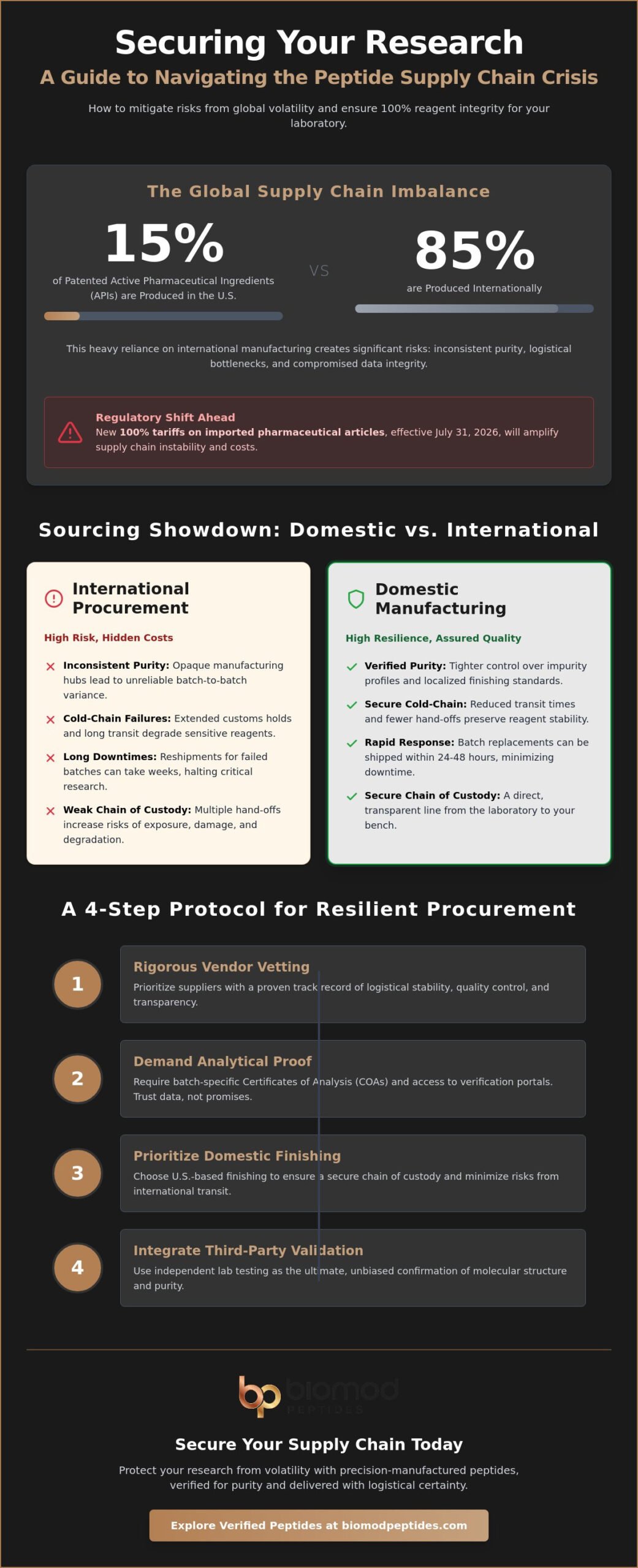
Only 15% of patented active pharmaceutical ingredients are produced within the United States. This manufacturing concentration creates a precarious environment for laboratories facing research peptide supply chain issues. You’ve likely experienced the frustration of inconsistent purity from overseas batches or the sudden failure of a critical cold-chain shipment. These logistical bottlenecks don’t just delay timelines. They compromise the integrity of your data.
We agree that current volatility in global logistics demands a more rigorous approach to procurement. This analysis establishes a framework for securing a resilient, high-purity supply chain despite the 100% tariffs on imported pharmaceutical articles effective July 31, 2026. We’ll examine how to manage upcoming regulatory shifts and implement a 100% analytical verification protocol to eliminate reagent uncertainty. You’ll gain the technical insights needed to minimize research downtime and ensure absolute structural integrity for every compound in your facility.
Key Takeaways
- Evaluate the 2026 geopolitical landscape to anticipate and bypass fluctuations in peptide precursor availability.
- Navigate complex research peptide supply chain issues by establishing a procurement protocol focused on logistical stability.
- Prioritize domestic finishing and manufacturing to ensure a secure chain of custody and minimize reagent degradation.
- Adopt a rigorous vendor vetting process that utilizes COA verification portals for batch-specific analytical transparency.
- Secure your laboratory workflow by integrating real-time documentation and external validation as core procurement requirements.
Global Volatility and the Research Peptide Supply Chain
The 2026 landscape for laboratory reagents is defined by systemic friction. Geopolitical shifts have restructured trade routes, directly impacting the availability of essential precursors. These research peptide supply chain issues are compounded by new 100% tariffs on imported pharmaceutical articles effective July 31, 2026. This regulatory shift forces a critical reevaluation of traditional procurement models. Laboratories relying on international sources now face a widening “purity gap” as oversight remains inconsistent across global manufacturing hubs. Relying on foreign production, where 53% of patented pharmaceuticals are currently manufactured, introduces a layer of risk that domestic sourcing eliminates.
Logistical bottlenecks do more than delay arrival. They threaten the physical stability of the product. While the custom peptide synthesis process creates a stable lyophilized powder, that stability depends on rigorous environmental controls. Extended customs holds and cold-chain failures during transit can degrade sensitive reagents before they reach the bench. Supply chain resilience is the capacity to maintain uninterrupted access to reagents that meet 100% of their stated analytical benchmarks regardless of external logistical pressure.
The Hidden Cost of International Procurement
Customs volatility often compromises cold-chain maintenance. Sensitive reagents sitting in unregulated warehouses for days lose their structural integrity. Verifying batch-to-batch consistency becomes nearly impossible when dealing with distant, opaque manufacturing hubs. While international peptides may appear cost-effective initially, the high rate of batch failure and subsequent research downtime results in significantly higher long-term laboratory costs. True efficiency requires a transparent chain of custody that international high-volume shipping cannot consistently guarantee. At Biomod Peptides, we prioritize logistical transparency to mitigate these exact vulnerabilities.
Strategic Sourcing: Domestic Manufacturing vs. International Procurement
Domestic manufacturing offers a level of structural oversight that international imports cannot replicate. While over 50% of patented pharmaceutical products are distributed from foreign hubs, only 15% of active pharmaceutical ingredients are produced within the United States. This disparity creates significant gaps in pharmaceutical production and quality control. For laboratories, the decision to source domestically is no longer just about convenience. It’s a strategy to mitigate research peptide supply chain issues that compromise batch purity. US-based facilities maintain tighter control over the impurity profile by adhering to localized finishing standards, ensuring that reagents don’t degrade during month-long transit cycles.
Chain of custody is the primary variable in reagent stability. International procurement involves multiple hand-offs, increasing the risk of temperature excursions and atmospheric exposure. Domestic finishing reduces these variables, providing a direct line from the laboratory to the bench. Third-party testing serves as the final layer of defense, neutralizing supply chain uncertainties through empirical validation. By utilizing independent analytical laboratories, providers can confirm that the molecular structure remains intact. Laboratories seeking verified reagents can explore precision-manufactured research peptides to stabilize their internal supply chains and ensure data reproducibility.
Regional Advantages for Las Vegas Research Facilities
Nevada-based laboratories benefit from localized supply chains that bypass major international ports of entry. Reducing transit time is essential to preserve the structural integrity of sensitive formulations, such as peptide spray products, which are susceptible to thermal degradation. Regional hubs also facilitate faster batch replacement. If a quality deviation is identified, a domestic provider can ship a replacement within 24 to 48 hours. This agility prevents the weeks of downtime common with international reshipments. Localized logistics ensure that 100% of the reagents entering your facility meet the highest analytical grade standards without the volatility of global shipping lanes.
Optimizing Laboratory Procurement in a Volatile Market
Procurement optimization requires a shift from reactive purchasing to a structured vetting protocol. Analytical transparency is the only metric that yields reproducible results. To effectively mitigate research peptide supply chain issues, laboratories must demand more than just a promise of quality. They require empirical proof. A rigorous vetting process evaluates a supplier’s internal benchmarks, their chain of custody, and their commitment to objective verification. This ensures that the reagents entering your facility are stable and structurally sound.
Documentation must be real-time and batch-specific. Static, outdated PDF files are insufficient for modern laboratory standards. Utilizing a Biomod Peptides COA verification portal ensures that the specific reagent in your possession has been validated against established purity benchmarks. This level of granular oversight addresses the core of research peptide supply chain issues by eliminating the “last mile” uncertainty where product degradation often occurs during unregulated transit. Precision is the result of disciplined, accessible documentation.
Specialized delivery formats also contribute to research efficiency. Integrating peptide softgels into your protocol can streamline laboratory handling and improve the consistency of reagent application. A mature procurement strategy prioritizes these stabilized, quality-controlled formats over the lower initial price points of unverified international imports. Investing in high-purity reagents reduces the hidden costs of batch failure and data contamination. Quality is a long-term investment in data integrity.
The Biomod Peptides Standard: US Finishing and Independent Testing
Biomod Peptides maintains supply chain integrity through a localized infrastructure. All finishing processes and storage occur within US-based, temperature-controlled facilities. Independent third-party testing is our non-negotiable procurement standard. We facilitate the integration of verified peptide certificates of analysis directly into laboratory records. This protocol ensures that every reagent is analytically sound and fully documented before it enters your workflow, providing a level of accountability that exceeds traditional industry norms.
Securing Analytical Integrity in a Volatile Market
Managing research peptide supply chain issues requires a transition from passive procurement to active verification. It’s no longer sufficient to rely on the opaque standards of international logistics. Geopolitical friction and new tariff structures demand a more resilient framework. Domestic finishing and US-based storage serve as the primary safeguards against the degradation and delay common in global shipping lanes. These protocols ensure that the structural integrity of your reagents remains intact from the point of manufacture to the laboratory bench.
By prioritizing independent third-party testing and utilizing a digital COA verification portal, laboratories can eliminate the variables that compromise data reproducibility. BioMod Peptides provides this level of accountability through a science-forward infrastructure designed for precision. Explore Biomod Peptides’ US-Manufactured Research Catalogue to secure your facility’s logistical resilience. Maintain the momentum of your refinement and discovery with reagents that meet 100% of your analytical standards without compromise.
Frequently Asked Questions
How do current supply chain issues specifically affect peptide purity?
Supply chain issues introduce environmental variables that degrade molecular integrity. Extended transit times and customs holds often lead to thermal excursions. These temperature fluctuations break down peptide bonds, resulting in a higher percentage of impurities and truncated sequences. When research peptide supply chain issues occur, the secondary and tertiary structures of sensitive reagents are compromised before laboratory arrival, leading to inconsistent batch quality.
Why is US manufacturing critical for research peptide stability in 2026?
US manufacturing ensures a shortened chain of custody that minimizes exposure to unregulated environments. Domestic production allows for immediate transfer from synthesis to climate-controlled storage. This proximity is vital because 2026 logistical volatility increases the risk of product degradation during international shipping. Localized finishing ensures that the lyophilized product maintains its structural integrity without the thermal stress of transoceanic transit or prolonged warehouse stays.
What should a researcher look for in a domestic peptide supplier?
Researchers must prioritize analytical transparency and verifiable documentation. A reliable provider offers batch-specific COAs and access to a digital verification portal for real-time data access. Look for suppliers that maintain domestic storage and utilize independent third-party testing for every lot. These standards mitigate research peptide supply chain issues by providing empirical proof of purity. Accountability is defined by the availability of raw HPLC and MS data.
Can supply chain delays impact the results of analytical research?
Yes, logistical delays directly influence data reproducibility and experimental outcomes. Reagents that spend weeks in transit are susceptible to chemical degradation that’s often invisible to the eye. Using compromised peptides introduces unknown variables into your assay, leading to skewed results or false negatives. Stable research requires reagents that have been handled with continuous cold-chain integrity from the point of domestic finishing to the final delivery at the bench.
Disclaimer
BIOMOD products are sold strictly for laboratory, analytical, and scientific research use only. They are not intended for human or animal consumption, administration, application, ingestion, injection, or any therapeutic, diagnostic, or cosmetic use.
The statements made on this website have not been evaluated by the United States Food and Drug Administration. BIOMOD products are not intended to diagnose, treat, cure, mitigate, or prevent any disease or medical condition.
BIOMOD is a research chemical supplier. BIOMOD is not a compounding pharmacy or chemical compounding facility as defined under Section 503A of the Federal Food, Drug, and Cosmetic Act. BIOMOD is not an outsourcing facility as defined under Section 503B of the Federal Food, Drug, and Cosmetic Act.
By accessing this site, you confirm you are at least 21 years of age and that you have read and accepted the BIOMOD Terms of Sale, Privacy Policy, and Research Use Only Policy. BIOMOD does not provide dosing, medical, therapeutic, diagnostic, veterinary, or use guidance under any channel.